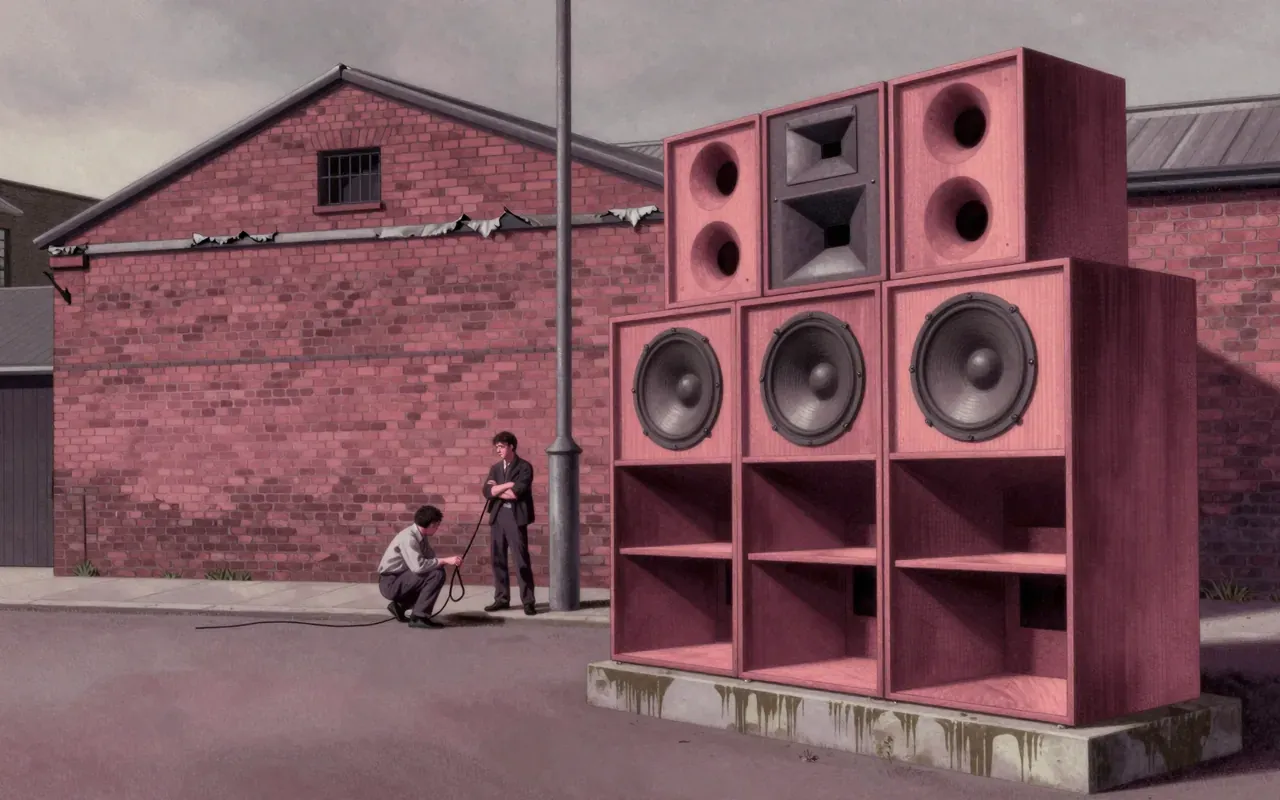
What the record is and where it came from
Minutemen’s third studio album. Released July 1984 on SST Records. A double LP with 45 songs. Inspired by Hüsker Dü’s Zen Arcade, recorded a month earlier. Made in Los Angeles.
How it sounds, and how it was made
Recorded in two sessions at Radio Tokyo Studios in November 1983 and April 1984 with producer Ethan James. Mixed overnight on an eight-track for $1,100. Blends punk rock, funk, country, spoken word, and jazz. Features live and studio-recorded tracks, including a live cover of ‘Don’t Look Now’ and ‘Love Dance’, written at Ian MacKaye’s Dischord House.
What lands
The 45-song double LP lands as a deliberate refusal of hierarchy: no singles, no filler, no side-long suites. Its brevity—no track exceeds 2:56—forces compression, not expansion. Its eclecticism is structural, not decorative.
What does not
It does not sustain a single mood, tempo, or instrumental palette across more than two consecutive tracks. It does not privilege melody over rhythm, or vice versa. It does not separate studio from live performance cleanly—‘Don’t Look Now’ is live, ‘Love Dance’ is studio, both appear without distinction.
The ideas inside it
Themes include the Vietnam War, racism, working-class life, and linguistics. The band adopted a car-themed concept after initially lacking one. Each member chose songs for a side; the fourth side was titled ‘Chaff’. Friends including Henry Rollins, Jack Brewer, and Joe Carducci contributed lyrics.
Who should hear it, and who should not
People who hear rhythm before harmony. People who value concision over continuity. People who want to hear bass, guitar, and drums treated as equal, non-hierarchical voices. People who distrust the idea of ‘a sound’.
Is it worth your time
Yes—if you want music that refuses to settle into a groove, a genre, or a length. It rewards attention but does not flatter it. It is not background music. It is not comfort food.