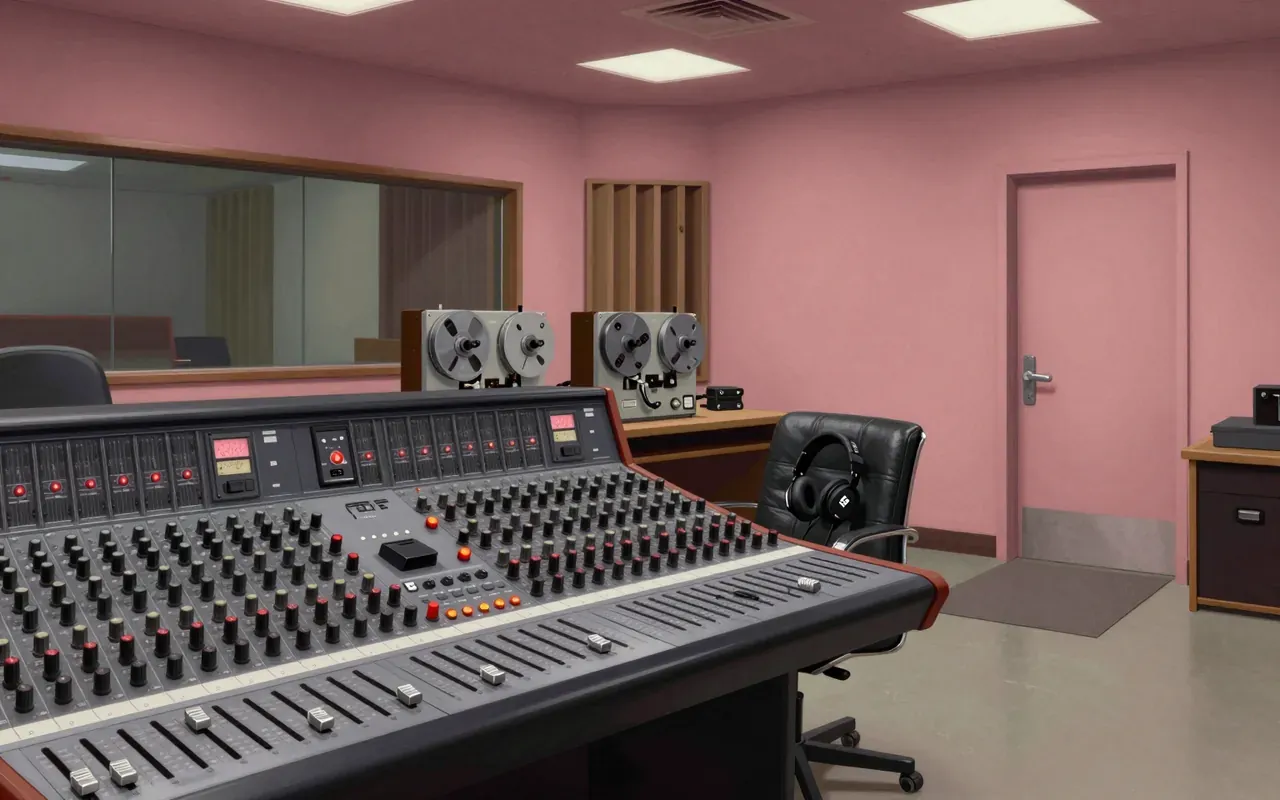
What the record is and where it came from
It is David Bowie’s 1980 album, made after the Berlin Trilogy. It is a deliberate pivot: less process, more punch. It is not a continuation of the trilogy’s methods — it is their distillation into direct, high-contrast statements.
How it sounds, and how it was made
It sounds like a tightened Berlin Trilogy: colder, sharper, more percussive. The room is dry and close. Guitars dominate — Fripp’s jagged textures, Townshend’s stabs, Hammer’s guitar-synthesiser on ‘Ashes to Ashes’. No reverb washes the vocals; Bowie’s voice is clipped, urgent, often doubled or reversed. Drums are tight and mechanical, bass lines angular and insistent. Synths are used for texture, not atmosphere.
What lands
‘Ashes to Ashes’ lands with its synth-bass hook, vocal stutters, and Hammer’s glassy guitar-synthesiser. ‘Fashion’ lands with its stop-start riff and sneering delivery. ‘Scary Monsters (and Super Creeps)’ lands with its descending chromatic bassline and Fripp’s shrieking solo. ‘Teenage Wildlife’ lands with its six-and-a-half-minute arc and sudden, brutal fade-out.
What does not
It does not linger in abstraction. It does not soften its edges with warmth or ambiguity. It does not revisit the ambient drift of ‘Heroes’ or the rhythmic sprawl of ‘Lodger’. It does not offer resolution.
The ideas inside it
It explores fractured identity, media saturation, and emotional exhaustion. Major Tom returns as a symbol of failed escape. ‘Fashion’ treats style as weaponised conformity. ‘Teenage Wildlife’ dissects artistic obsolescence. ‘Scream Like a Baby’ uses panic as structure.
Who should hear it, and who should not
People who want rock music with surgical precision. People who hear guitars as argument, not decoration. People who distrust nostalgia but recognise its machinery. Not people who need comfort, cohesion, or catharsis.
Is it worth your time
Yes. It rewards focused listening. Every track has a clear sonic signature and purpose. It does not ask for patience — it demands attention.