Saved
Folk & singer-songwriter · Pop

Titanic Rising

A soft rock record about the world ending — and why holding someone’s hand still matters.

Worth your time?4.5/5Yes.Hear the whole thing.What works, what does not, who it is for ↓
9:26in productionCh. 1 · FM Radio as Syntax/ 9:26 · ceiling 15 min
4 chapters · 9:26Ceiling 15:00

The brief is written and checked. The video joins this page when it is cut.4 chapters · 2 min read · 9:26 planned

Read the brief

A soft rock record about the world ending — and why holding someone’s hand still matters.

Chapters & takeaways4
  1. 1:26
    FM Radio as Syntax

    It sounds like 1970s FM radio — not as pastiche, but as functional language.

  2. 2:48
    The Drum That Anchors the Flood

    The LinnDrum on 'Andromeda' is placed not for groove, but for contrast — a mechanical pulse inside a submerged world.

  3. 4:08
    A Set Built to Drown

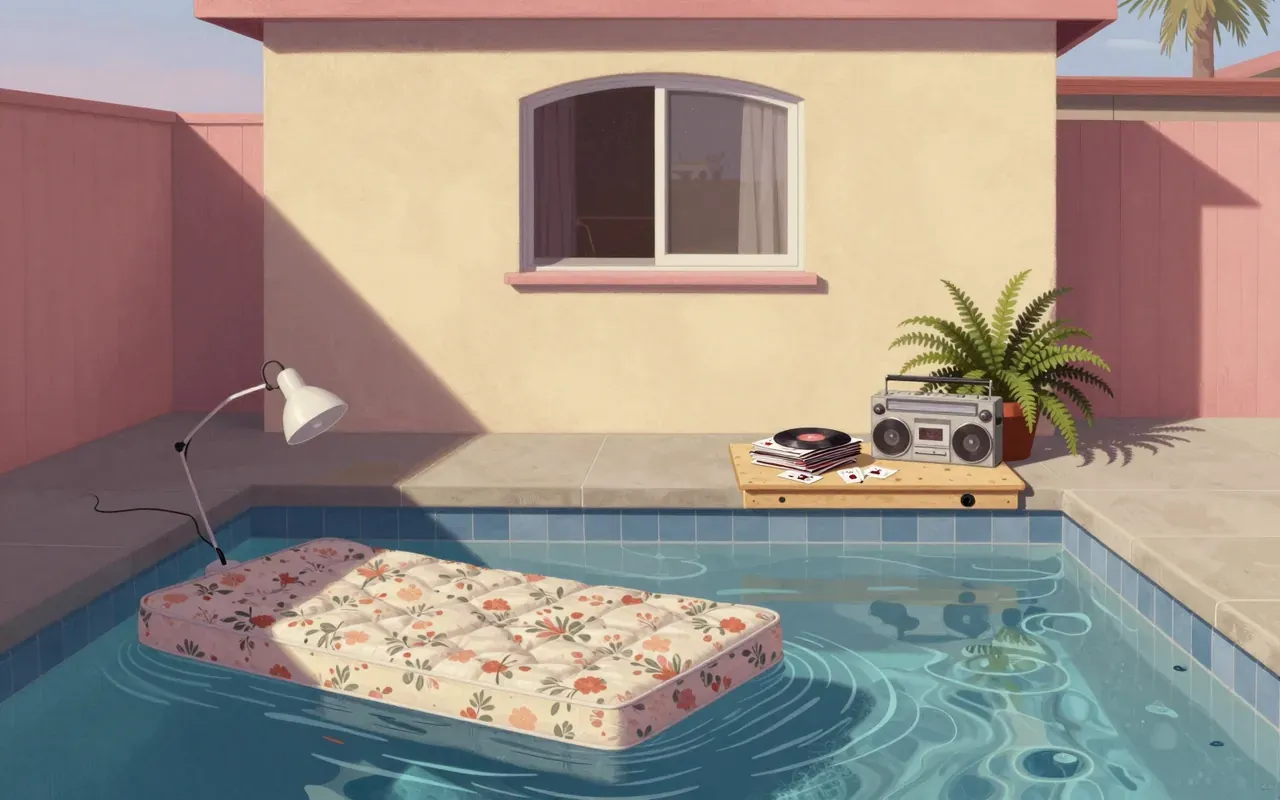
    The underwater bedroom isn’t surrealism — it’s documentary: a constructed sacred space built for a two-hour shoot before water destroyed it.

  4. 5:18
    Two Kinds of Sinking

    It names climate change and romantic disappointment in the same breath — because both are forms of systemic failure.

1 more chapterFewer chapters
Running order10
  1. 01
    A Lot’s Gonna Change4:22
  2. 02
    Andromeda4:40

    Heard in Percy Jackson: Sea of Monsters (2013)

  3. 03
    Everyday5:07

    Heard in Pulp Fiction (1994)

  4. 04
    Something to Believe4:46

    Heard in Pastpresent (1989)

  5. 05
    Titanic Rising1:36
  6. 06
    Movies5:54
  7. 07
    Mirror Forever5:06
  8. 08
    Wild Time6:09
  9. 09
    Picture Me Better3:42
  10. 10
    Nearer to Thee1:06

Film placements are the ones described in each film's own entry, so the list is partial rather than complete.

Worth your time?

Yes. Hear the whole thing.

4.5/ 5
What works
  • the underwater album cover lands as a precise visual correlative
  • the LinnDrum on 'Andromeda' lands as a deliberate anachronism
  • the sequencing lands as narrative architecture
  • the voice lands as unwavering anchor
What does not
  • offer solutions
  • use modern pop’s chord changes or lyrical shorthand
  • avoid fragility
  • treat nostalgia as escape
Hear it if
  • people who listen for texture, not just tune
  • people who want love songs that name climate change
  • people who trust FM radio warmth as a vessel for dread and tenderness
Skip it if
  • people who need immediate hooks
  • people who need literal storytelling
Who should hear it, and who should skipHide who it is for
The written brief2 min read

What the record is and where it came from

Titanic Rising is Weyes Blood’s fifth studio album, produced with Jonathan Rado and released by Sub Pop on April 5, 2019. It was made under conditions of heightened creative control after Front Row Seat to Earth, and is the first chapter in a trilogy.

How it sounds, and how it was made

It sounds like 1970s FM radio: warm, wide, and softly layered. Recorded over three months in 2018 at Sonora Studios in Los Angeles, it uses expansive arrangements drawn from soft rock, chamber pop, and baroque pop. The LinnDrum on ‘Andromeda’ anchors its rhythm. No synthesiser models, microphone types, or tempos are stated — only the LinnDrum placement and the studio’s location are verified.

What lands

The underwater album cover — a teenage bedroom submerged in a Long Beach pool — lands as a precise visual correlative to the record’s themes. The LinnDrum on ‘Andromeda’ lands as a deliberate anachronism. The sequencing — with the instrumental title track as pivot — lands as narrative architecture. The voice lands as unwavering anchor.

What does not

It does not offer solutions. It does not use modern pop’s chord changes or lyrical shorthand. It does not avoid fragility — it centres it. It does not treat nostalgia as escape; it treats it as material.

The ideas inside it

Romantic disappointment. Damaged reality. Finding hope. Climate change. Resource depletion. Interpersonal disconnection. The bedroom as a subconscious altar. Media as modern myth-making. The Titanic as metaphor for ecological collapse.

Who should hear it, and who should not

People who listen for texture, not just tune. People who want love songs that name climate change. People who trust FM radio warmth as a vessel for dread and tenderness. Not people who need immediate hooks or literal storytelling.

Is it worth your time

Yes. It rewards attention with sonic cohesion and lyrical precision. Its ambition is fully realised: every production choice, from studio to drum machine, serves its emotional and philosophical inquiry. It is not background music. It asks to be heard whole.

Same genre · Folk & singer-songwriter4 of 174
8:49
Late for the SkyJackson Browne · 1974Late for the Sky is a tightly focused, sparsely produced singer-songwriter album built around piano, acoustic guitar, lap steel, fiddle, strings, and jug. Written at Browne’s childhood home and recorded quickly with his touring band, it trades polish for presence. Its eight songs form a deliberate arc — from disorientation to cataclysm — held together by recurring motifs and restrained arrangements. It does not resolve. It does not soothe. It lands where it means to: in the space between a breath and a sigh.
9:02
YsJoanna Newsom · 2006Ys is Joanna Newsom’s second studio album, released November 14, 2006, by Drag City. It features full orchestral arrangements by Van Dyke Parks on four of its five tracks. Harp and vocals were recorded by Steve Albini in December 2005 at Village Recording Studio; orchestration was recorded by Tim Boyle in May–June 2006 at Entourage Studios. The album was mixed by Jim O'Rourke to tape and mastered at Abbey Road Studios. Its five long-form songs explore grief, illness, and relationship turmoil, referencing the mythical Breton city of Ys. There is no title track.
9:53
Tragic Songs of LifeThe Louvin Brothers · 1956Tragic Songs of Life is the Louvin Brothers’ 1956 Capitol debut—a concept album of tragic heartbreak, misfortune, and murder ballads, performed by Charlie (vocals, guitar) and Ira (vocals, mandolin), with Paul Yandell on guitar and Ken Nelson producing. It is rooted in country music, with no verified use of bluegrass or gospel instrumentation beyond the stated roles.
2:30
Basket of LightThe Pentangle · 1969Pentangle's 1969 album brought an unusually flexible acoustic group to a broad audience. “Light Flight” served as the theme for the television drama Take Three Girls, and the album reached number five in Britain. Its appeal rests on the resources of the ensemble: several distinct players contributing to a shared musical space.
Up next in Music

Tommy

The Who · 1969 · 8:22

A studio-bound rock opera that sacrifices narrative clarity for sonic density—and wins on sound alone.

8:22