Saved
Punk & post-punk

Fresh Fruit for Rotting Vegetables

Punk as a scalpel, not a sledgehammer — and it cuts deeper because it refuses to flinch.

Worth your time?4.5/5Yes.Hear the whole thing.What works, what does not, who it is for ↓
9:26in productionCh. 1 · One Drummer, One Guitarist/ 9:26 · ceiling 15 min
4 chapters · 9:26Ceiling 15:00

The brief is written and checked. The video joins this page when it is cut.4 chapters · 2 min read · 9:26 planned

Read the brief

Fresh Fruit for Rotting Vegetables is a tightly wound, ideologically charged debut that uses minimal means — one drummer, one extra guitarist, sparse keyboards, stacked backing vocals on a single track — to deliver maximum friction. Its sound is stripped, urgent, and unrelenting. Its ideas are specific, prosecutorial, and unapologetic. It does not invite reflection — it demands reaction.

Chapters & takeaways4
  1. 1:07
    One Drummer, One Guitarist

    Bruce Slesinger is the only drummer on this album, and Carlo Cadona appears on just one track — making this the band’s most rhythmically singular release.

  2. 2:56
    Fire on the Cover, Fire in the Grooves

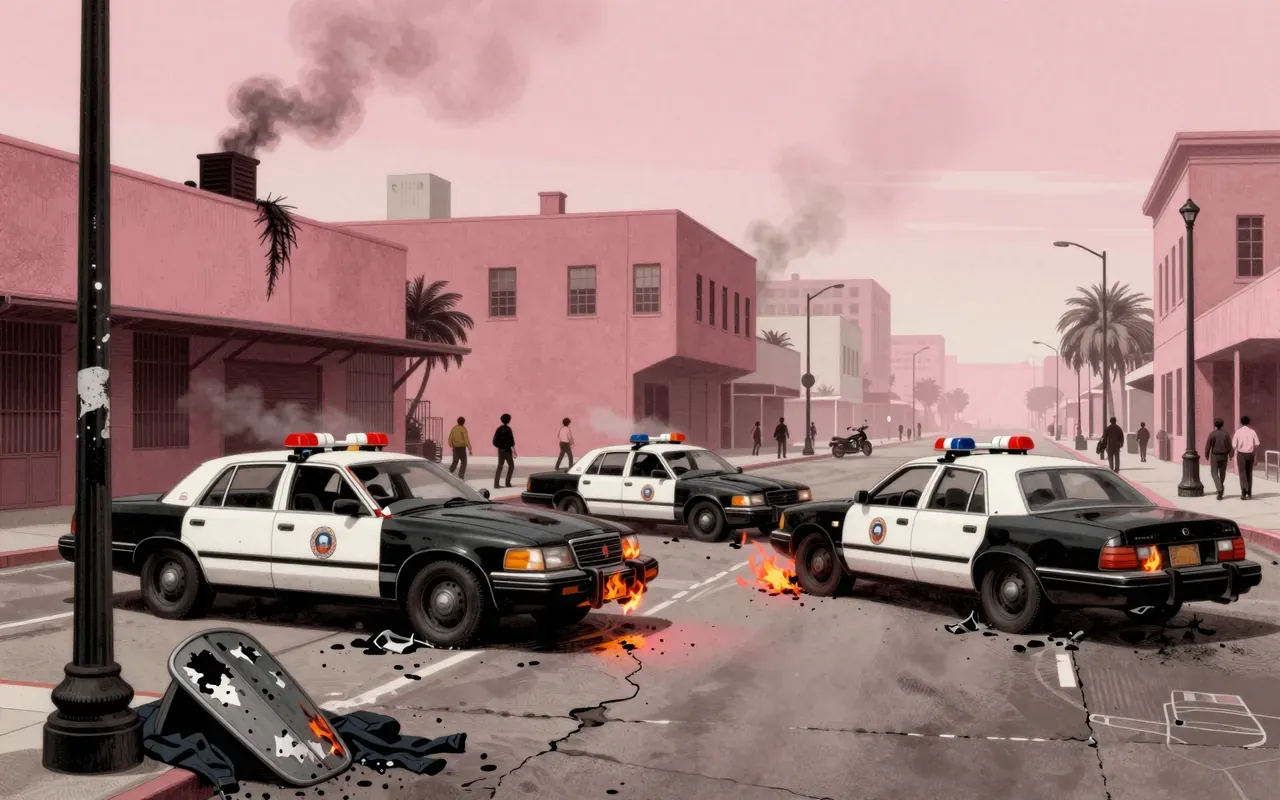
    The cover photograph captures burning police cars during the White Night riots — a direct visual echo of the album’s confrontational stance.

  3. 4:23
    Crowd Versus Clarity

    Eleven people contribute backing vocals to 'Chemical Warfare', while keyboards appear on only two tracks — showing where the band chose density and where they chose austerity.

  4. 5:49
    Policy as Lyric

    Jello Biafra’s mayoral campaign included a statue of Dan White for public pelting — and the band rewrote 'I Fought the Law' to name that same incident.

1 more chapterFewer chapters
Running order14
  1. 01
    Kill the Poor3:05

    Heard in Kill the Poor (2003)SLC Punk!

  2. 02
    Forward to Death1:24
  3. 03
    When Ya Get Drafted1:24
  4. 04
    Let’s Lynch the Landlord2:13
  5. 05
    Drug Me1:57
  6. 06
    Your Emotions1:21
  7. 07
    Chemical Warfare2:56

    Heard in Wonder Woman (2017)

  8. 08
    California über alles3:02
  9. 09
    I Kill Children2:04

    Heard in American Honey (2016)

  10. 10
    Stealing People’s Mail1:35
  11. 11
    Funland at the Beach1:50
  12. 12
    Ill in the Head2:46
  13. 13
    Holiday in Cambodia4:35

    Heard in Neighbors (1981)

  14. 14

Film placements are the ones described in each film's own entry, so the list is partial rather than complete.

Worth your time?

Yes. Hear the whole thing.

4.5/ 5
What works
  • rhythm section locks into fast, blunt tempos
  • guitar is treble-heavy and staccato
  • bass is dry and present
  • vocals are shouted, clipped, and close-mic’d
What does not
  • build atmosphere
  • develop motifs across tracks
  • use reverb, delay, or stereo width to create space
  • feature solos, bridges, or harmonic variation
Hear it if
  • people who want to hear punk as a functional tool, not a mood
  • people who value lyrical precision over melodic comfort
  • people who listen to records for argument, not ambience
Skip it if
  • people who expect dynamic range, tonal warmth, or instrumental nuance
Who should hear it, and who should skipHide who it is for
The written brief2 min read

What the record is and where it came from

Dead Kennedys’ debut studio album. Recorded in June 1980. Released September 1980 on UK label Cherry Red. Preceded by the single ‘Holiday in Cambodia’. Features Bruce Slesinger on drums — the only Dead Kennedys album to do so.

How it sounds, and how it was made

The album was recorded in June 1980 with Ted on drums, East Bay Ray on guitar, Klaus Flouride on bass, and Jello Biafra on vocals. Carlo Cadona plays guitar on one track. Paul Roessler and Ninotchka add keyboards to two songs. ‘Chemical Warfare’ features a crowd of backing vocalists. Norm and East Bay Ray co-produced. Oliver DiCicco and John Cuniberti engineered and mixed. No details about studio space, mic placement, tape speed, compression, or room treatment are given.

What lands

The rhythm section locks into fast, blunt tempos. The guitar is treble-heavy and staccato. The bass is dry and present. The vocals are shouted, clipped, and close-mic’d. The production is flat, immediate, and unadorned — no bleed, no ambience, no polish.

What does not

It does not build atmosphere. It does not develop motifs across tracks. It does not use reverb, delay, or stereo width to create space. It does not feature solos, bridges, or harmonic variation. It does not soften its delivery for accessibility.

The ideas inside it

It treats American politics as farce and violence as policy. It mocks civic complacency, militarism, consumerism, and carceral logic with literal, unsparing language. It locates satire not in irony but in escalation: ‘I Kill Children’, ‘Kill the Poor’, ‘Let’s Lynch the Landlord’.

Who should hear it, and who should not

People who want to hear punk as a functional tool, not a mood. People who value lyrical precision over melodic comfort. People who listen to records for argument, not ambience. People who distrust consensus aesthetics.

Is it worth your time

Yes — if you want a raw, unvarnished document of early US hardcore punk’s sonic and political posture. No — if you expect dynamic range, tonal warmth, or instrumental nuance.
Same genre · Punk & post-punk4 of 91
11:33
Sandinista!The Clash · 1980A 36-song triple LP released in December 1980. The Clash’s fourth studio album. Recorded over most of 1980 across London, Manchester, Jamaica, and New York. Produced by the band — primarily Mick Jones and Joe Strummer — with Mikey Dread’s participation. The only Clash album where all four members perform lead vocals.
9:23
The RaincoatsThe Raincoats · 1979The Raincoats’ 1979 debut is a document of intuition over instruction. Four women — Ana da Silva, Gina Birch, Palmolive, and Vicky Aspinall — recorded it with Mayo Thompson and Geoff Travis, using minimal gear and maximal trust in their own ears. Its sound is ragged, homespun folk-punk: elastic rhythms, reedy vocals, rickety structures. Lora Logic’s saxophone appears once. Ross Crighton’s lyrics for 'Life on the Line' name Ladbroke Grove tube station. Palmolive left before release; Ingrid Weiss replaced her. No myth. Just music made in real time, with what they had.
9:20
DamagedBlack Flag · 1981Damaged is not a document of rebellion — it is the sound of a room, a wrist, a decision to record twice and choose the first take of 'Damaged I'. Its power lies in what it leaves unplayed, unsoftened, unexplained.
11:48
Fear of MusicTalking Heads · 1979Fear of Music was recorded live in two days in Chris Frantz and Tina Weymouth’s Long Island City loft. Brian Eno co-produced and applied electronic treatments after the fact. David Byrne’s lyrics fixate on urban isolation and unnamed dread. The sound merges post-punk rock and funk. The recording environment — raw, wired, untreated — defines the album more than any instrument or melody.
Up next in Music

From Elvis in Memphis

Elvis Presley · 1969 · 9:39

Elvis didn’t come back—he walked straight into the Memphis Boys’ room and sang like he meant it.

9:39