musicbriefs
2:32in production/ 2:32 · ceiling 15 min
Folk & singer-songwriter

At Folsom Prison

Johnny Cash makes the people hearing his songs part of what those songs mean.

At Folsom Prison was recorded at California's Folsom State Prison on January 13, 1968, and released that year. Producer Bob Johnston supported Cash's plan to record a prison concert. The resulting album draws on two performances rather than presenting one show from beginning to end.

Worth your time?

Yes. Hear the whole thing.

What works
    What does not
      Hear it if
      • Listeners interested in live performance, country storytelling and audience relationships
      Skip it if
      • Listeners wanting polished studio sound or an uncomplicated feel-good set
      The written brief2 min read

      What the record is and where it came from

      At Folsom Prison was recorded at California’s Folsom State Prison on January 13, 1968, and released that year. Producer Bob Johnston supported Cash’s plan to record a prison concert. The resulting album draws on two performances rather than presenting one show from beginning to end.

      How it sounds, and how it was made

      Cash is joined by musicians including Luther Perkins, Marshall Grant and W. S. Holland, with June Carter among the performers. The programme moves between prison songs, ballads, duets and jokes. That range allows the concert to address its audience as people with different appetites and feelings.

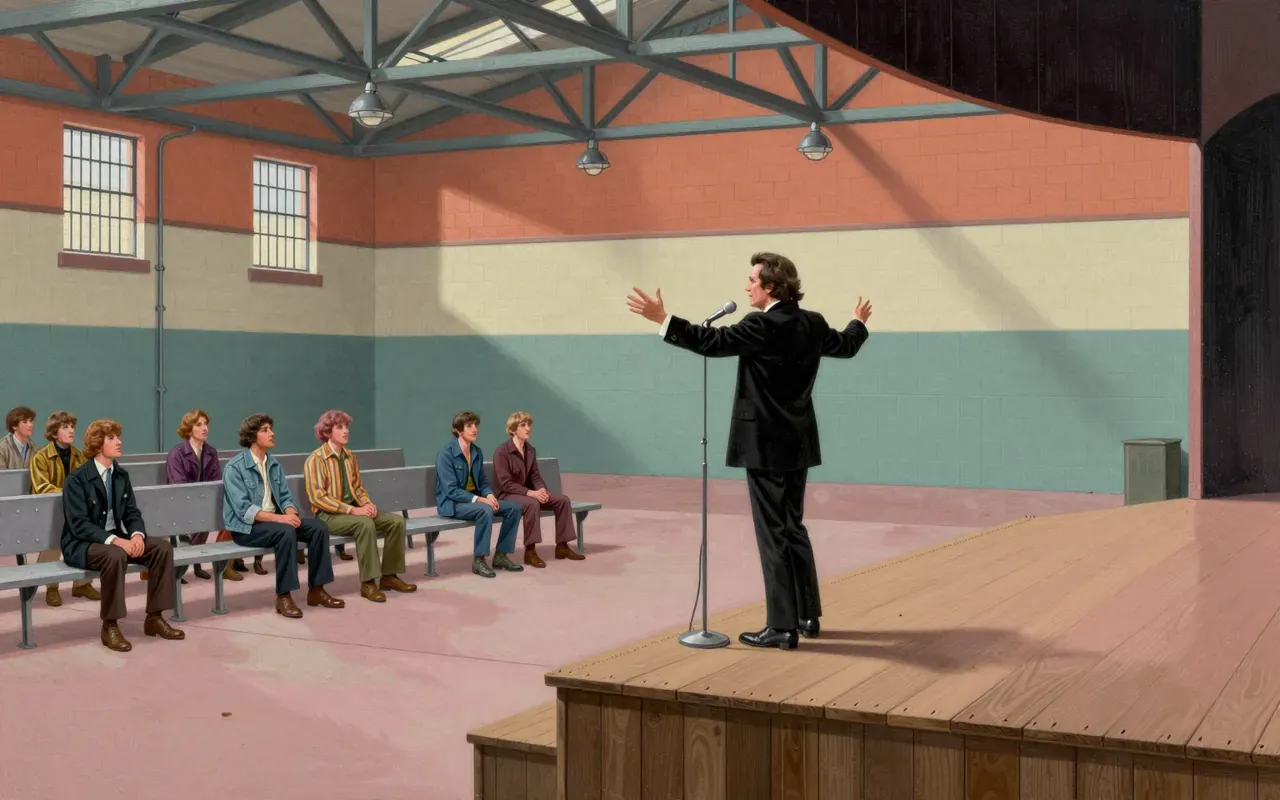
      The location changes the frame around familiar material. A song about confinement has particular stakes when the listeners cannot simply leave after the performance.

      What lands

      “Folsom Prison Blues” establishes that relationship at once. The inclusion of “Greystone Chapel,” written by inmate Glen Sherley, gives it another dimension: somebody inside the institution supplies a song for the visiting star.

      The humorous numbers matter alongside the more sombre material. They keep the audience from becoming only a symbol of suffering. A concert can acknowledge difficult circumstances while making room for shared entertainment.

      What does not

      The legend surrounding the event can overwhelm the record. This is a selected commercial album, not an unmediated account of prison life, and Cash cannot speak for everybody in the room. The novelty songs may also interrupt the mood for listeners mainly drawn to the darker ballads.

      The ideas inside it

      Recognition need not depend on idealising the people being recognised. The act of bringing a substantial show into the prison gives the audience attention without requiring every song to make a political argument. Sherley’s contribution makes that recognition more specific than a general gesture of sympathy.

      Who should hear it, and who should not

      Hear it if you want a live album whose setting is integral to the performance. It rewards attention to the programme’s changes of mood as well as to the famous opening song.

      Is it worth your time

      Yes. Hear the original album before an edition containing both complete concerts. The shorter sequence makes clear how songs, jokes and an audience relationship become one enduring record.
      Same genre · Folk & singer-songwriter4 of 174
      10:51
      Johnny Cash at San QuentinJohnny Cash · 1969Johnny Cash at San Quentin (1969) is a live album recorded at San Quentin State Prison on February 24, 1969. It is Cash’s first album without Luther Perkins, who had recently died. Two songs — 'San Quentin' and 'A Boy Named Sue' — debuted live there. Producer Bob Johnston chose to include both performances of 'San Quentin'. 'A Boy Named Sue' was performed spontaneously, with Cash using a lyric sheet while the band improvised. 'Starkville City Jail' and 'Blistered' were unintentionally slowed by half a step. 'Jackson' and 'Orange Blossom Special' were performed but omitted from the original LP. The album reached number one on both Billboard country and pop album charts. 'A Boy Named Sue' reached number one on country charts and number two on US pop charts. It won the Grammy for Best Male Country Vocal Performance and was certified triple platinum.
      10:17
      At Folsom PrisonJohnny Cash · 1968Johnny Cash at Folsom Prison is a 1968 live album recorded during two performances on January 13, 1968, at Folsom State Prison in California. It features Cash, the Tennessee Three, Carl Perkins, the Statler Brothers, and June Carter. The first show — at 9:40 a.m. — forms the core of the album; only two tracks ('Give My Love to Rose' and 'I Got Stripes') were taken from the 12:40 p.m. second show. Rehearsals spanned two days and included learning 'Greystone Chapel', written by inmate Glen Sherley. The album reached number one on the Billboard country album chart.
      9:18
      American RecordingsJohnny Cash · 1994American Recordings is Johnny Cash’s 1994 solo album for Rick Rubin’s American Recordings label. It was recorded mostly in Cash’s Tennessee cabin or Rubin’s Los Angeles home, with Cash accompanied only by his Martin Dreadnought acoustic guitar. Two tracks—'Tennessee Stud' and 'The Man Who Couldn’t Cry'—were recorded live at the Viper Room in Los Angeles. The album features newly commissioned songs by Tom Waits and Glenn Danzig, a cover written by Nick Lowe, and two re-recordings of Cash’s earlier material. Rubin granted Cash full creative control, resulting in a stark, intimate record that launched a late-career resurgence. It won the 1995 Grammy for Best Contemporary Folk Album.
      10:05
      MacallaClannad · 1985Macalla is Clannad’s 1985 eighth studio album, recorded across Switzerland, England, and Ireland. It features bilingual Irish-English material, including two fully Irish-language tracks and a notable duet with Bono. Producer Steve Nye oversaw key tracks such as 'Closer to Your Heart' and 'Almost Seems (Too Late to Turn)', both of which became hit singles. The album also includes the hit duet 'In a Lifetime' with Bono, opening with Máire teaching him Irish phrases.
      Up next in Music

      Joy as an Act of Resistance

      Idles · 2018 · 2:07

      Idles put the force of an abrasive band behind grief, solidarity and an argument against emotional repression.

      2:07