musicbriefs
2:23in production/ 2:23 · ceiling 15 min
Jazz

At Mister Kelly's

A small Chicago club puts Sarah Vaughan and her rhythm section within conversational distance.

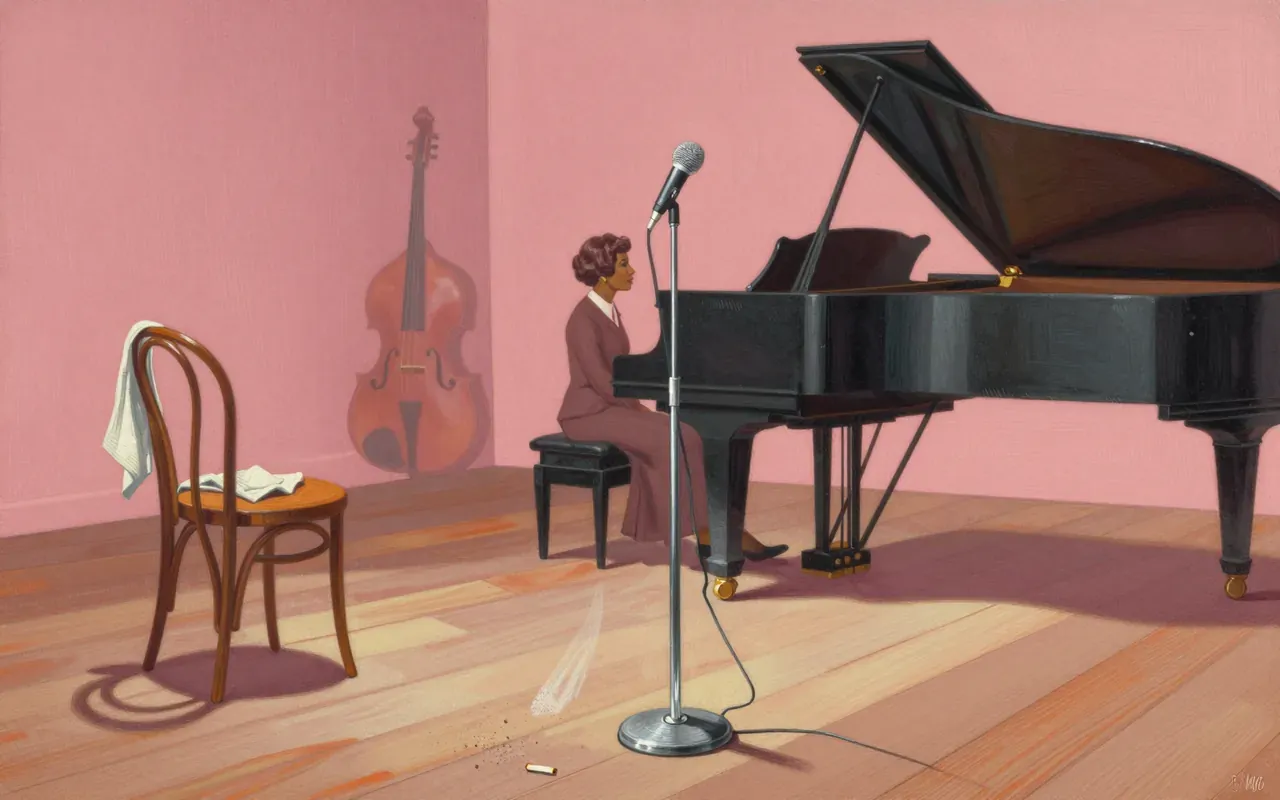
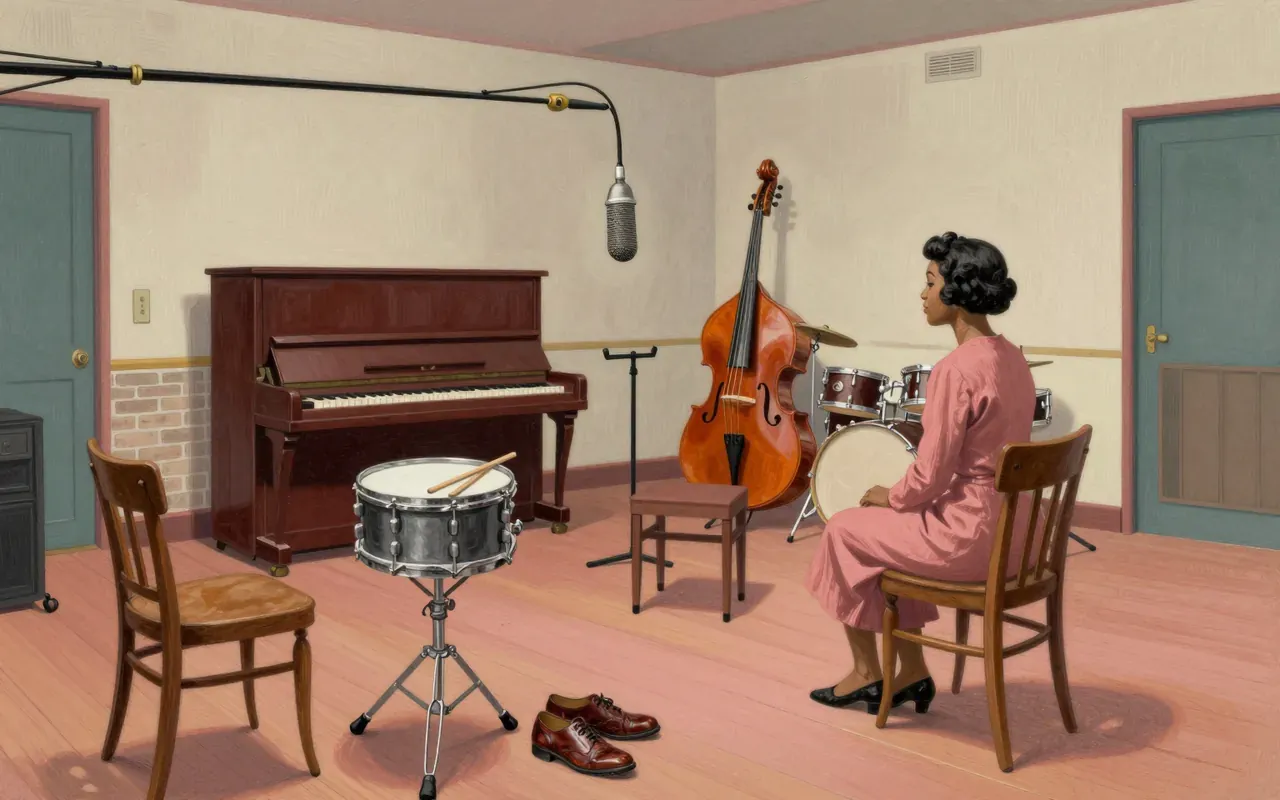
At Mister Kelly's records Sarah Vaughan in a Chicago jazz club in 1957, accompanied by pianist Jimmy Jones, bassist Richard Davis and drummer Roy Haynes. The setting is a useful alternative to hearing a major singer surrounded by a large arrangement: four musicians carry the performance.

Worth your time?

Yes. Hear the whole thing.

What works
    What does not
      Hear it if
      • Listeners who enjoy jazz singing with a small rhythm section
      Skip it if
      • Listeners seeking orchestral vocal arrangements
      The written brief2 min read

      What the record is and where it came from

      At Mister Kelly’s records Sarah Vaughan in a Chicago jazz club in 1957, accompanied by pianist Jimmy Jones, bassist Richard Davis and drummer Roy Haynes. The setting is a useful alternative to hearing a major singer surrounded by a large arrangement: four musicians carry the performance.

      How it sounds, and how it was made

      Piano, double bass and drums leave the relationship between singer and rhythm section exposed. Listen for how the vocal phrase sits within the playing, and for the ways accompaniment can answer a singer without becoming a competing lead.

      The small group also gives the listener a manageable number of voices to follow. The performance can be understood as an exchange rather than simply a display of vocal capability.

      What lands

      “Thou Swell,” “Honeysuckle Rose” and “Willow Weep for Me” give the programme contrasting emotional demands. The useful question is how the same singer and trio can make room for wit and melancholy without requiring a new orchestration for each.

      Vaughan’s technical resources are part of the attraction, but technique has a purpose here: shaping a song in the company of other musicians.

      What does not

      The intimacy will not replace the sweep of an orchestra for a listener who loves that setting. Nor does a club performance promise the isolation and finish of a studio vocal. Its interest includes the sense of musicians sharing a particular occasion.

      The ideas inside it

      Scale changes what virtuosity means. With fewer instruments surrounding a singer, timing, response and restraint become easier to notice. The trio makes vocal interpretation a social activity.

      Who should hear it, and who should not

      Hear it if you are interested in how a singer works with piano, bass and drums. It is a strong prospect for listeners who want to pay as much attention to the accompanists as to the featured name.

      Is it worth your time

      Yes. Follow one member of the trio through a song, then return to Vaughan. The comparison turns a celebrated voice into a more complete picture of ensemble performance.
      Same genre · Jazz4 of 167
      9:16
      Swingin' EasySarah Vaughan and Her Trio · 1957Swingin' Easy is a 1957 studio album by Sarah Vaughan featuring recordings made in April 1954 and February 1957 in New York City; eight tracks from the April 1954 session—featuring John Malachi on piano and Joe Benjamin on bass—originally appeared on the 10-inch LP Images; the album showcases Vaughan’s vocal virtuosity, including octave-spanning bop phrasing on 'All of Me' and a reimagined, slower-tempo melody on 'Pennies from Heaven'; critical reception emphasized her professionalism, relaxed delivery, and freedom when backed solely by a rhythm section, highlighting specific tracks such as 'Words Can't Describe', 'Shulie a Bop', 'Lover Man', and 'Linger Awhile'; personnel include Jimmy Jones and John Malachi alternating on piano, Richard Davis and Joe Benjamin alternating on double bass, and Roy Haynes on drums; the album contains twelve standard jazz songs plus one bonus track, 'Linger Awhile', not on the original LP; the Billboard review praised its ease and cogency, while The Penguin Guide underscored its freewheeling, good-humoured character within a stripped-down instrumental setting.
      10:22
      Interstellar SpaceJohn Coltrane · 1974Interstellar Space is a 1967 duo album by John Coltrane and Rashied Ali, recorded at Van Gelder Studio on February 22, 1967, and released in September 1974. It consists of four tracks — 'Mars', 'Venus', 'Jupiter', and 'Saturn' — each bearing alternate titles in the session sheets. Two further tracks from the same session, 'Leo' and 'Jupiter Variation', appeared on the 1978 compilation Jupiter Variation. The session was minimally planned, cut in one take, and built around Coltrane’s desire for 'more time, more rhythm all around me'.
      10:18
      Ella Fitzgerald Sings the Rodgers and Hart Song BookElla Fitzgerald · 1956A strategic pivot, not a sentimental one.
      11:02
      Diamond LifeSade · 1984Diamond Life is Sade’s debut studio album, recorded in six weeks at Power Plant Studios in London in 1983. Fifteen songs were written collectively by the band—except 'Smooth Operator', co-written solely by Sade Adu and Ray St. John—and produced by Robin Millar. The band developed the album’s musical direction collaboratively, rehearsing each song in detail before recording. The album blends soul, jazz, and sophisti-pop, with lyrics focused on love; its instrumentation includes prominent basslines, smooth drums, subtle guitar, brass, and keyboards. Specific recording details include using a real piano and Fender Rhodes painstakingly synced, manual mixing for 'Cherry Pie' with six people at the desk simultaneously, and Adu composing 'When Am I Going to Make a Living' on a cleaning ticket during financial hardship. The album opens with 'Smooth Operator' and closes with a cover of Timmy Thomas’s 'Why Can't We Live Together'.
      Up next in Music

      Scott 4

      Scott Walker · 1969 · 2:02

      Scott Walker’s first all-original programme gives his dramatic voice a more rhythm-conscious setting.

      2:02