musicbriefs
2:01in production/ 2:01 · ceiling 15 min
Rock

The Elvis Presley Sun Collection

A later compilation places Presley’s early Sun recordings back inside their small-band world.

The Elvis Presley Sun Collection was issued in the UK in 1975; the related American release followed as The Sun Sessions in 1976. The recordings come from 1954–55 at Sun in Memphis under Sam Phillips. The album date therefore describes the act of collecting the performances.

Worth your time?

Yes. Hear the whole thing.

What works
    What does not
      Hear it if
      • Listeners interested in early rockabilly and compact ensemble interaction
      Skip it if
      • Listeners expecting a complete archive or later orchestral Presley
      The written brief1 min read

      What the record is and where it came from

      The Elvis Presley Sun Collection was issued in the UK in 1975; the related American release followed as The Sun Sessions in 1976. The recordings come from 1954–55 at Sun in Memphis under Sam Phillips. The album date therefore describes the act of collecting the performances.

      How it sounds, and how it was made

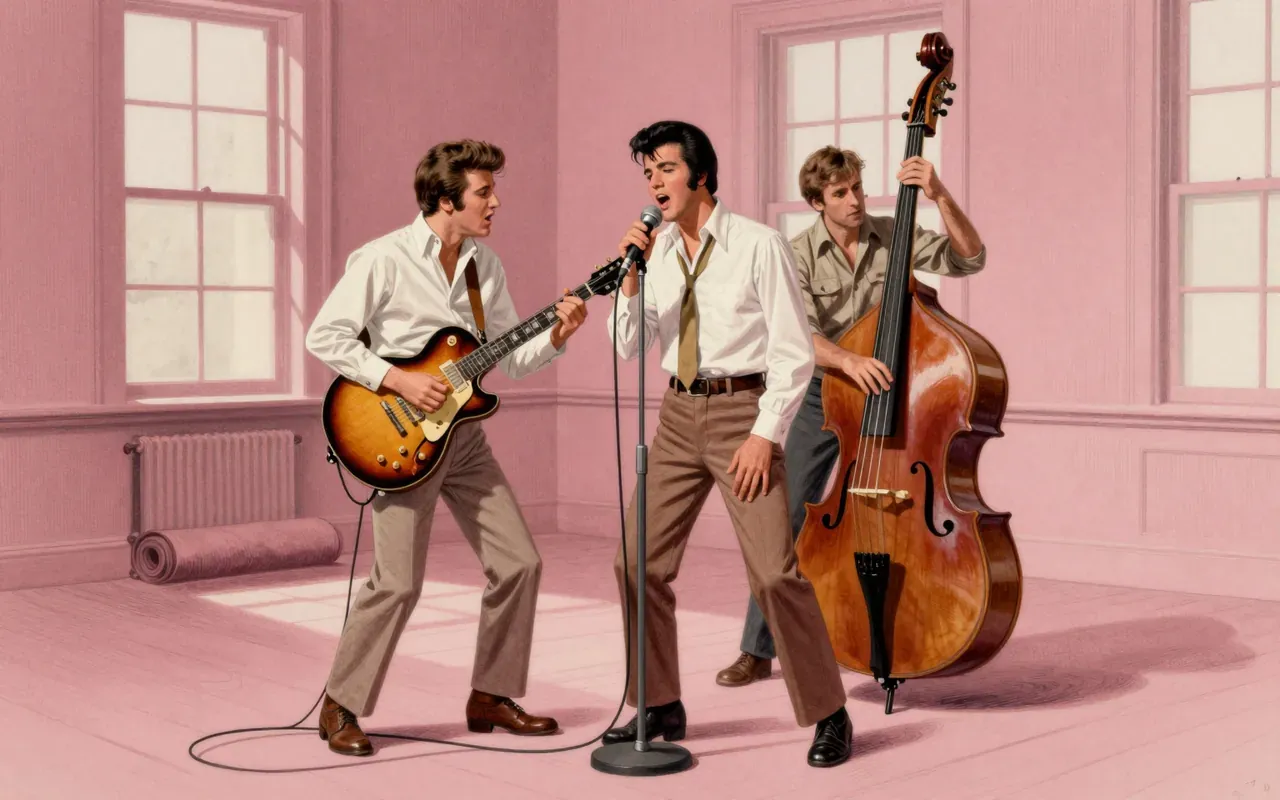
      Presley’s voice works with the small-band setting associated with guitarist Scotty Moore and bassist Bill Black. Blues and country material meet in the performances. The limited ensemble leaves the singer’s phrasing and the supporting players’ responses carrying much of the musical identity.

      What lands

      “That’s All Right” and “Mystery Train” provide direct access to the collection’s appeal. The interest is the particular way familiar source material becomes a recognisable group sound. Hearing the recordings together gives that relationship more weight than approaching them only as isolated historical milestones.

      What does not

      The collection is not a complete Sun archive, and later releases add omitted material and alternate takes. The short, early recordings may also feel slight beside the scale of Presley’s later studio work. Historical reputation cannot guarantee a personal connection to the voice.

      The ideas inside it

      A compilation can restore the setting around an overfamiliar public figure. Here it redirects attention toward a singer working with a few musicians, making the practical construction of a sound available beneath the accumulated mythology.

      Who should hear it, and who should not

      Hear it if the early ensemble interests you more than the later spectacle. It is less suitable when completeness or orchestral arrangements are essential.

      Is it worth your time

      Yes. Use the collection to hear the working relationship, then explore larger archives only if the session detail becomes your main interest.
      Same genre · Rock4 of 319
      10:22
      ElvisElvis Presley · 1956Elvis Presley’s 1956 debut album is a pivot point made audible: five Sun recordings and seven RCA tracks, with guitar replacing piano on R&B covers, vocals prioritised over polish, and zero studio artifice. It topped Billboard for ten weeks — not as novelty, but as necessity.
      12:18
      Elvis PresleyElvis Presley · 1956Elvis Presley’s 1956 debut is not a collection of songs. It is a recalibration. Guitar replaces piano in the R&B covers. Five Sun tracks sit alongside seven RCA recordings—not as past and future, but as equal parts of a single argument. It was the first rock and roll album to top Billboard—and held that spot for ten weeks. No hedging. No filler. Just sound, structure, and consequence.
      10:25
      OdelayBeck · 1996Odelay is a 1995 album recorded primarily in the Dust Brothers’ home studio in Silver Lake, Los Angeles, after Beck abandoned an earlier acoustic album of somber, orchestrated folk tunes made with Tom Rothrock and Rob Schnapf in 1994. Only 'Ramshackle' survived that session. The Dust Brothers’ hip-hop–influenced, layered production — informed by their work with Beastie Boys, Tone Lōc and Young MC — shaped the album’s sound. Their record-filled studio supplied many of the album’s samples. Musicians worked 16-hour days, starting from scratch each day. The album blends country, blues, rap, jazz and rock using cut-and-paste, sample-heavy techniques.
      9:38
      Face to FaceThe Kinks · 1966Face to Face is The Kinks’ fourth studio album, released on 28 October 1966. It marks a stylistic departure from beat music toward baroque pop and music hall. It is their first album of entirely original material and has been regarded as one of rock’s earliest concept albums — unified by Ray Davies’ observational and satirical songwriting about English culture, class, and the music industry. Recording occurred after Davies’ nervous breakdown and amid personnel instability. Nicky Hopkins contributed piano and harpsichord. The album reached
      Up next in Music

      Entertainment!

      Gang of Four · 1979 · 2:03

      Gang of Four make pleasure, work and romance sound like parts of the same political system.

      2:03