musicbriefs
Genre

Rock

320
briefs
9:53
average
3163 min
in total
203
artists
All briefs320
2:00

20 Golden Greats

Buddy Holly, The Crickets · 1978

20 Golden Greats was first issued in Britain in 1978, collecting recordings associated with Buddy Holly and the Crickets from 1956–58. It also circulated as Buddy Holly Lives. The release date belongs to the retrospective, not to a newly assembled performing group.
2:10

A Nod Is As Good As a Wink... to a Blind Horse

Faces · 1971

Faces' third album was their second release of 1971. Glyn Johns shared production duties, helping shape a programme shorter and more concentrated than its predecessors. Rod Stewart's growing solo profile is part of the context, but Ronnie Lane's three lead vocals make the group's broader identity essential.

2:04

Alive!

KISS · 1975

Alive!, released in 1975, draws on Kiss concerts from several American cities and songs from their first three studio albums. The double album was intended to communicate a performance identity the band felt those records had not captured. Its title describes an ambition as much as a recording method.

2:02

Arthur (Or the Decline and Fall of the British Empire)

The Kinks · 1969

Arthur was developed in 1969 with writer Julian Mitchell for a television play that was never produced. Ray Davies built the songs around Arthur Morgan, a carpet-layer partly based on a family member. The album survived as a musical account of domestic life within a changing national story.

2:09

Bad Company

Bad Company · 1974

Bad Company's self-titled debut appeared in 1974 after sessions at Headley Grange with Ronnie Lane's mobile studio. Paul Rodgers, Mick Ralphs, Boz Burrell and Simon Kirke brought experience from earlier bands. The record's purpose is to establish how naturally that experience can fit a new working group.
1:58

Berry Is on Top

Chuck Berry · 1959

Berry Is on Top appeared in July 1959. Almost all its selections had already been issued as singles; “Blues for Hawaiians” was the exception. The album's coherence comes from collecting a body of performances rather than documenting a newly conceived continuous session.

2:09

Metallica

Metallica · 1991

Metallica's 1991 self-titled fifth album is widely known as The Black Album. Working with producer Bob Rock, the group moved toward a slower, more refined presentation than on its earlier thrash records. The change concerns the shape and scale of the songs as much as their commercial reach.

2:02

Vol. 4

Black Sabbath · 1972

Vol. 4 was released in 1972 as Black Sabbath took greater control of production, with Tony Iommi doing much of the work. It continues the weight of Master of Reality while introducing conspicuous departures. The album is a record of expanding options as well as a demanding period for the band.

2:14

Blood, Sweat & Tears

Blood, Sweat & Tears · 1968

Blood, Sweat & Tears' self-titled second album arrived in December 1968 after Al Kooper and two other members had left. David Clayton-Thomas became the lead singer of a nine-piece band. Producer James William Guercio helped the new lineup make a more pop-oriented record with substantial outside repertoire.

2:11

Bo Diddley

Bo Diddley · 1958

Bo Diddley's 1958 debut album gathers singles recorded between 1955 and 1958. It is therefore a collection of an already developing identity, rather than a single sustained studio project. That origin helps explain both the compactness of the songs and the changing supporting personnel.

1:58

Chicago Transit Authority

Chicago · 1969

The band's 1969 debut was released as a double album under its original name, Chicago Transit Authority. Producer James William Guercio supported the combination of jazz-related brass writing and soulful rock. The scale announces a group interested in more than a short introduction.

2:09

Daydream Nation

Sonic Youth · 1988

Sonic Youth recorded Daydream Nation in New York in 1988 and released it as a double album. Longer pieces reflected the group's live improvisations, while a prolific period of writing supplied material for the enlarged format. The result expands the space available to both songs and noise.

2:05

Dry

PJ Harvey · 1992

Dry was recorded in Yeovil and released in 1992 by Too Pure. PJ Harvey worked with her original trio and approached the opportunity as though it might be her only album. That urgency helps explain the concentration of the presentation without turning the record into a mere statement of ambition.

1:59

El Camino

The Black Keys · 2011

El Camino was released in 2011, co-produced and co-written with Danger Mouse. The Black Keys began the Nashville sessions without finished material. Difficulties translating slower Brothers songs to the stage helped direct the new record toward a more immediately propulsive programme.

2:01

The Elvis Presley Sun Collection

Elvis Presley · 1975

The Elvis Presley Sun Collection was issued in the UK in 1975; the related American release followed as The Sun Sessions in 1976. The recordings come from 1954–55 at Sun in Memphis under Sam Phillips. The album date therefore describes the act of collecting the performances.

2:04

Everybody Knows This Is Nowhere

Neil Young, Crazy Horse · 1969

Neil Young's second solo album, released in 1969, was his first with Crazy Horse. Danny Whitten, Billy Talbot and Ralph Molina brought an existing working relationship into the collaboration. The record marks a change from elaborate studio assembly toward capturing musicians playing together.

2:50

Frampton Comes Alive!

Peter Frampton · 1976

Peter Frampton had released four solo studio albums before this 1976 double album made him a major commercial presence. The material was not entirely new; the setting changed its reach. Performances recorded at several venues in 1975 were assembled into an album that gave the songs the scale of an event.

1:58

The Great Twenty-Eight

Chuck Berry · 1982

The Great Twenty-Eight was released in 1982, surveying Chuck Berry's first decade at Chess. It gathers twenty-one singles, six B-sides and an album track. The selection makes the short recorded performance, rather than a later album concept, the unit around which the retrospective is built.

2:40

Highway to Hell

AC/DC · 1979

Released in 1979, Highway to Hell was AC/DC's first album with producer Robert John “Mutt” Lange and their last with singer Bon Scott. Its place before Scott's death can make it seem like a farewell, but the working project was a band refining its approach for a wider audience.

1:58

Johnny Burnette and the Rock 'n Roll Trio

The Rock and Roll Trio · 1956

The Rock and Roll Trio's debut first appeared as a UK ten-inch album in December 1956, followed by an American twelve-inch release in 1957. It gathers material from sessions that year. Johnny Burnette fronts a group whose recorded energy outgrew its initial commercial reach.

1:56

McCartney

Paul McCartney · 1970

McCartney was released in April 1970 during the Beatles' breakup. Much was recorded privately at home on basic equipment, with further work in professional studios. Apart from Linda McCartney's occasional vocals, Paul performed the album alone through overdubbing.
1:58

The Moon & Antarctica

Modest Mouse · 2000

The Moon & Antarctica was Modest Mouse's first major-label album, released in 2000. Brian Deck produced the sessions at Chicago's newly built Clava Studios. The expanded resources became an opportunity to develop unusual sounds rather than simply smooth the band's existing edges.

2:07

(Pronounced 'Lĕh-'nérd 'Skin-'nérd)

Lynyrd Skynyrd · 1973

Lynyrd Skynyrd's 1973 debut was recorded with producer Al Kooper after extensive rehearsal. Much of the material already belonged to the live repertoire. The record's apparent assurance therefore has a practical source: a band arriving with songs it had worked through repeatedly.

2:03

Reggatta de Blanc

The Police · 1979

The Police's second album appeared in 1979, following Outlandos d'Amour. Recording took place in sessions spread across several months, with the band choosing continuity over the larger studio and more famous producer its label proposed. That setting allowed the trio to keep developing its own balance.

2:06

Rid of Me

PJ Harvey · 1993

Rid of Me, released in 1993, was the final album by PJ Harvey's original trio with bassist Steve Vaughan and drummer Rob Ellis. Most of it was recorded by Steve Albini at Pachyderm in Minnesota. Harvey wanted the recording to convey the group playing together in a room.

2:02

Sheer Heart Attack

Queen · 1974

Sheer Heart Attack was released in 1974, with Queen and Roy Thomas Baker producing. The third album moves toward more conventional rock and pop forms than the preceding records. That concentration helped make the band's already theatrical identity easier to grasp.
2:00

Sister

Sonic Youth · 1987

Sister was released in 1987 with Sonic Youth's previous lineup intact: Thurston Moore, Kim Gordon, Lee Ranaldo and Steve Shelley. It continues the movement toward song structures begun on EVOL. Philip K. Dick's life and fiction provide a loose conceptual background rather than a straightforward plot.
2:00

Stephen Stills

Stephen Stills · 1970

Stephen Stills' 1970 solo debut was recorded mainly in London and Los Angeles around Crosby, Stills, Nash & Young activity. The separation gave him another setting for songs shaped by personal relationships. It remained a collaborative record, despite the single name on the cover.

2:07

Stories from the City, Stories from the Sea

PJ Harvey · 2000

Released in 2000, Stories from the City, Stories from the Sea draws partly on PJ Harvey's time in New York, alongside writing done elsewhere. Harvey resisted the idea that it was simply a New York album. The city is a source of possibilities rather than a complete explanation of the songs.

2:13

To Bring You My Love

PJ Harvey · 1995

To Bring You My Love was released in 1995 after the breakup of the original PJ Harvey trio. Harvey co-produced it with Flood and John Parish, using a new group of collaborators. The change allows the record to develop a more elaborately arranged setting for its accounts of longing.

2:02

(What's the Story) Morning Glory?

Oasis · 1995

Oasis's second album arrived in 1995, produced by Owen Morris and Noel Gallagher. Compared with Definitely Maybe, its writing gives more space to ballads, strings and large choruses. The change made a band's assertive identity easier to inhabit as a collective singalong.

2:02

White Blood Cells

The White Stripes · 2001

White Blood Cells was recorded over three days in Tennessee and released in 2001. Jack White produced the duo's third album as it moved further toward garage rock. The compressed schedule was intended to preserve tension rather than allow every part to settle into polish.

2:04

The Wild, the Innocent & the E Street Shuffle

Bruce Springsteen · 1973

Springsteen's second album was released in 1973, the same year as his debut. Recorded with the E Street Band in New York state, it moves further toward full-band rock and R&B. The songs give their characters an environment large enough to suggest more life beyond the immediate scene.

11:02

Ace of Spades

Motörhead · 1980

Ace of Spades is Motörhead’s most focused album — recorded fast, mixed clean, performed tighter, and released without delay. It trades nothing for chart success. It is not metal. It is not punk. It is Motörhead: bass, guitar, drums, attitude, and zero waste.

9:59

After School Session

Chuck Berry · 1957

After School Session is Chuck Berry’s debut studio album, released in May 1957 by Chess Records. It compiles twelve tracks recorded across five sessions at Universal Recording Corporation in Chicago between May 1955 and January 1957. Most songs had previously appeared as singles. The album features Chuck Berry on vocals and guitar, Johnnie Johnson on piano, and contributions from Willie Dixon, Fred Below, L. C. Davis, Jasper Thomas, Ebby Hardy, Otis Spann, Jimmy Rogers, and Jerome Green. Steel guitar appears on 'Deep Feeling'. The sequencing reflects single release order, not recording chronology. It arrived during Berry’s peak commercial and creative period, when he was already an established star with hit records, film appearances, and a touring career.

10:06

Buddy Holly

Buddy Holly · 1958

Buddy Holly (1958) is his only studio album released in his lifetime. It collects twelve tightly arranged rock and roll tracks recorded between 1956 and 1958 — all featuring his core band, no strings, no stereo, no posthumous edits. It is direct, economical, and rhythmically emphatic. It does not contain any material from the October 21, 1958 string session. Its power lies in vocal precision, guitar tone, and uncluttered structure — not innovation or myth.

12:01

Buffalo Springfield

Buffalo Springfield · 1966

A rushed, mono-and-stereo debut cut across two Hollywood studios in summer 1966—produced by managers with no recording experience, rejected by the band as sonically inert, and released against their wishes to hit Christmas. Its best moments are tightly written, vocally distinct, and rhythmically grounded—but its flaws are structural, not stylistic.

9:30

Chief

Eric Church · 2011

Chief is a country record built on rock instrumentation and vocal processing—not as compromise, but as conviction.

10:04

Coal Miner’s Daughter

Loretta Lynn · 1970

Coal Miner's Daughter is Loretta Lynn’s sixteenth solo studio album, released 4 January 1971 by Decca Records. Five of its eleven tracks were recorded earlier for other albums, including the title song, cut 1 October 1969. It was recorded across four sessions at Bradley's Barn in Mount Juliet, Tennessee, produced by Owen Bradley, engineered by Jim Williamson, and mastered by Darrell Johnson. The ensemble features steel guitar, Dobro, banjo, multiple bass players, and The Jordanaires’ background vocals. The title track reached No. 1 on the Billboard Country Chart in 1970 and became Lynn’s first entry on the Billboard Hot 100 (No. 83). It inspired her 1976 autobiography and the 1980 Oscar-winning film.

10:19

Damn the Torpedoes

Tom Petty and the Heartbreakers · 1979

A 1979 rock record built by known hands in two LA studios — not a revolution, but a documented step forward in production credit.

10:36

Dirt

Alice in Chains · 1992

Dirt is Alice in Chains’ second studio album, released on September 29, 1992. It was recorded from April to July 1992 across three studios — Eldorado in Burbank, London Bridge in Seattle, and One on One in Los Angeles — during the 1992 Los Angeles riots. The band evacuated to Joshua Tree with Tom Araya for four or five days before resuming work. Producer Dave Jerden returned from Facelift and crafted the album’s signature guitar tone using three distinct amps: a Bogner Fish preamp for low end, a Bogner Ecstacy for mids, and a Rockman Headphone amp for highs. "Would?" was recorded earlier by Rick Parashar for the Singles soundtrack. Jerry Cantrell wrote most songs; Layne Staley wrote "Hate to Feel" and "Angry Chair" solo and played guitar on both. Six of the thirteen songs address addiction. Cantrell described the process as soul searching and cleansing accumulated emotional poison. The album yielded five Mainstream Rock charting singles and remained on the charts for nearly two years.

9:30

Dónde están los ladrones?

Shakira · 1998

Dónde Están los Ladrones? is Shakira’s fourth studio album, released in September 1998. Recorded over nine months at Crescent Moon Studios in Miami—the studio of Gloria and Emilio Estefan—it features rock en español blended with Latin pop and Middle Eastern musical influences. Shakira led artistic production with full control over material, arrangements, and final approval; Emilio Estefan served as executive producer. Vintage equipment—including old amplifiers and a 40-year-old German microphone—was used alongside innovative instrumental mixes. Collaborators included Luis Fernando Ochoa, Lester Mendez, Javier Garza, Pablo Flores, and Estéfano Salgado. The album topped the U.S. Latin Albums chart for 11 weeks, sold over 7 million copies globally, and earned a 1999 Grammy nomination for Best Latin Rock or Alternative Album. It represents the culmination of Shakira’s early Spanish-language career and the foundation for her subsequent global expansion.

10:08

Elephant Mountain

The Youngbloods · 1969

Elephant Mountain is a focused, unembellished studio document: piano-led, locally rooted, and shaped by absence. It assumes nothing. It delivers less than it promises — and that is its strength.

10:22

Elvis

Elvis Presley · 1956

Elvis Presley’s 1956 debut album is a pivot point made audible: five Sun recordings and seven RCA tracks, with guitar replacing piano on R&B covers, vocals prioritised over polish, and zero studio artifice. It topped Billboard for ten weeks — not as novelty, but as necessity.

11:32

Elvis Is Back!

Elvis Presley · 1960

Elvis Is Back! is a decisive, studio-crafted pivot — not a nostalgic return. Its sound is anchored by new technology (three-track, U-47 mics), deliberate personnel choices (Moore, Fontana, Randolph, Jordanaires), and Presley’s own acoustic guitar work. It avoids film material and pre-army tropes. It lands hardest where it commits to blues menace and vocal precision — not charm or spectacle. It rewards attention to process, not persona.

10:12

Gene Vincent and the Blue Caps

Gene Vincent and the Blue Caps · 1957

A lean, guitar-forward rock ’n’ roll record defined by who played — and who didn’t — rather than what was said.

10:37

Hard Again

Muddy Waters · 1977

Hard Again is a 1977 studio album by Muddy Waters, produced by Johnny Winter for Blue Sky Records. It was recorded in three days with Waters’s touring band — Bob Margolin, Pinetop Perkins, Willie 'Big Eyes' Smith — plus James Cotton and Charles Calmese. It includes re-recordings of Chess-era staples and new co-writes. Critics describe it as Waters’s comeback album. It won a Grammy.

9:12

Headquarters

The Monkees · 1967

Headquarters is The Monkees’ third album, released May 22, 1967, after firing Don Kirshner and winning full creative control. It is their first record made entirely with their own instruments and original writing — six songs by the band, two experimental interludes, and production by Chip Douglas.

10:28

Honky Tonk Masquerade

Joe Ely · 1978

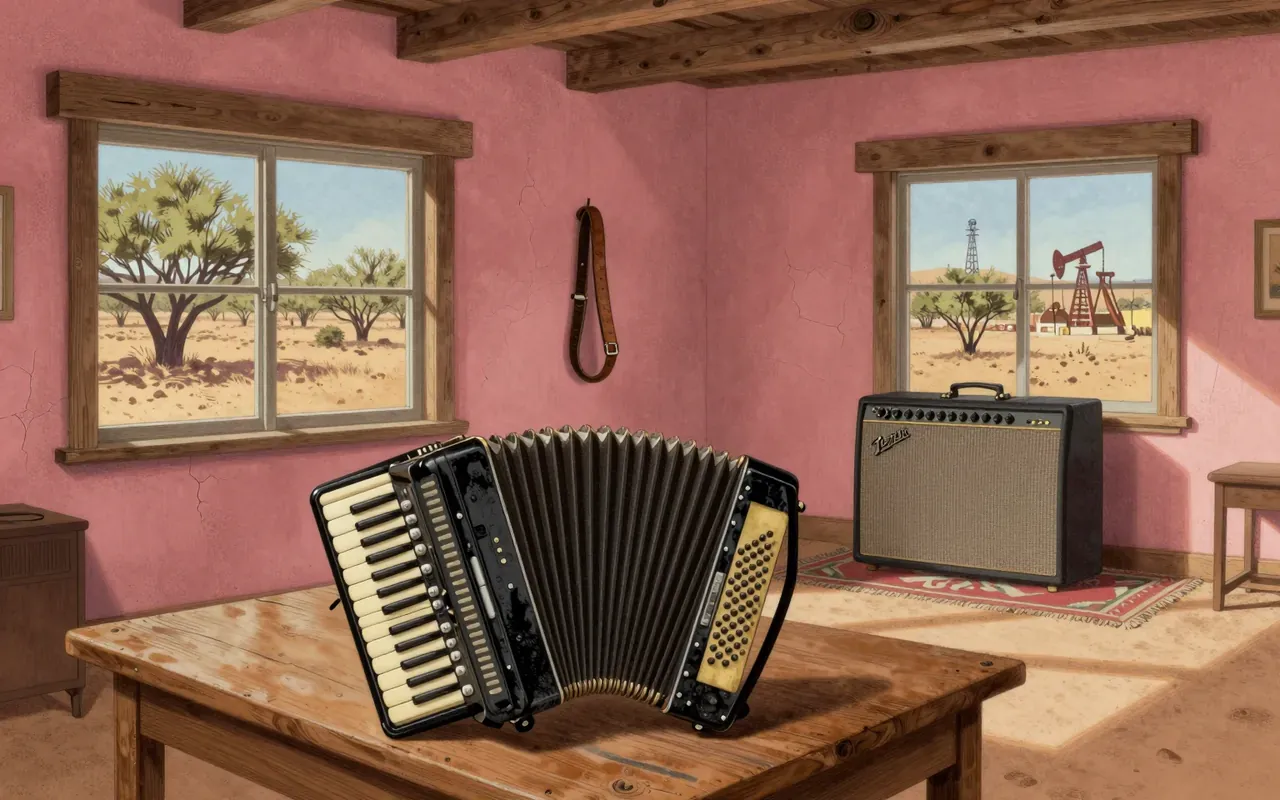
A factual anchor: 1978, Murfreesboro, steel guitar, acoustic guitar, Moog, accordion, Chip Young, Lloyd Maines, Butch Hancock, Hank Williams — nothing more, nothing less.

9:53

How to Dismantle an Atomic Bomb

U2 · 2004

U2’s How to Dismantle an Atomic Bomb is a record defined by contradiction: a self-proclaimed 'first rock album' made with too many producers, recorded twice, and built around instrumental limitation yet undermined by sonic fragmentation.

9:06

Is the Actor Happy?

Vic Chesnutt · 1995

Is the Actor Happy? is Vic Chesnutt’s 1995 folk rock album, produced by John Keane, with Michael Stipe on vocals for 'Guilty by Association'. Chesnutt wrote the songs while opening for Live in 1994. The Sunday Times noted he learned to write for a band — brushed drums and ringing lead-guitar lines layered over his simple strumming. AllMusic described arrangements shifting from heartbreakingly delicate folk rock to crashing guitar crescendos. Pitchfork called it his most extroverted record, extending subject matter beyond himself into relationships and the Southern landscape. Forrest Gander wrote the liner notes. The Guardian offered a dissenting view, calling the songs unremarkable.

9:44

Jerry Lee Lewis

Jerry Lee Lewis · 1958

The record 'Jerry Lee Lewis' is not a 1958 album. It is the documented body of his earliest Sun Records sessions — beginning with an audition in November 1956 and expanding through December 1956 and early 1957 — captured live in the Union Avenue studio with Jack Clement engineering. His piano dominates those recordings, appearing both on his own sides and on tracks by Carl Perkins and Billy Lee Riley. It is defined by immediacy, ensemble interplay, and physical presence — not by polish, concept, or commercial framing.

9:41

Lemonade

Beyoncé · 2016

Lemonade is a 2016 visual album and hour-long musical film, released simultaneously on HBO and Tidal. It is a song cycle structured around emotional stages derived from the Kübler-Ross model, conceived and executed as a unified work of sound and image.

11:18

Little Earthquakes

Tori Amos · 1991

A piano-and-voice record that refuses to comfort — it names trauma, rejects polish, and builds its power on what it leaves out.

10:21

Live at the Witch Trials

The Fall · 1979

Live at the Witch Trials is The Fall’s debut studio album — recorded in one day, mixed the next, and built on refusal: of polish, of explanation, of compromise.

8:47

Live Through This

Hole · 1994

Live Through This is a rock record defined by constraint: three weeks, one room, one week of basic tracking, no vocal double-tracking, no bass overdubs. Its power comes from what was left in — cracks, breath, bleed — and what was left out — polish, padding, pretence. It is neither cathartic nor consoling. It is structural. It is specific. It is complete.

9:01

Mad Dogs & Englishmen

Joe Cocker · 1970

Mad Dogs & Englishmen is a live double-album recorded during a hastily assembled 1970 US tour. The band — over 20 musicians — was named Mad Dogs & Englishmen by Denny Cordell after the Noël Coward song. Leon Russell recruited most players, many from Delaney & Bonnie. It includes material not from Cocker’s first two studio albums.

11:17

Magic

Bruce Springsteen · 2007

Magic is Bruce Springsteen’s fifteenth studio album, released in October 2007. Recorded over two months at Southern Tracks Recording Studio in Atlanta, it features 10 new Springsteen songs, the previously performed 'Long Walk Home', and the first hidden track on a Springsteen studio release: 'Terry's Song', a tribute to his late assistant Terry Magovern, who died in July 2007. The album was made with the E Street Band—but not as a full unit. Springsteen handled vocals and production during the week; drummer Max Weinberg, bassist Garry Tallent, and pianist Roy Bittan joined on weekends to lay down basic tracks. Other members overdubbed under producer Brendan O’Brien’s direction, except Clarence Clemons, who collaborated directly with Springsteen. The process was shaped by logistical constraints, especially Weinberg’s weekday commitments to Late Night with Conan O'Brien. Magic debuted at No. 1 in the U.S., Ireland, and the UK, and was supported by the Magic Tour—the first E Street Band tour since 2003.

10:47

One Dozen Berrys

Chuck Berry · 1958

The source contains zero factual reference to 'One Dozen Berrys'. No detail about its existence, content, creation, or context appears anywhere in the material. Therefore, no editorial claim about the record can be supported.

10:05

Only by the Night

Kings of Leon · 2008

Only by the Night is Kings of Leon’s fourth studio album, recorded in early 2008 at Nashville’s Blackbird Studio with producers Jacquire King and Angelo Petraglia; its core performances were captured on 16-track analog tape before transfer to Pro Tools for overdubbing and mixing; the opening track 'Closer' features a distinctive bass riff processed through a Boss ME50 pedal; writing began just days after the release of their prior album, Because of the Times; assistant engineer Lowell Reynolds worked on the sessions; the album was released on September 22, 2008, following a September 15 single release of 'Sex on Fire.'

11:02

Out of Our Heads

The Rolling Stones · 1965

Out of Our Heads is the Rolling Stones’ third studio album, released in two distinct 1965 editions: a US version in July (No. 1 charting) containing seven originals — three by Jagger/Richards and four credited to Nanker Phelge — and a UK version in September foregrounding soul covers and four originals that foreshadow Aftermath. It bridges their R&B roots and emerging guitar-driven rock identity.

9:10

Queen II

Queen · 1974

Queen II is a decisive pivot toward studio-as-instrument. It is precise, intentional, and unromantic about process. Its sound is built on vocal layering, guitar doubling, and rigid scheduling—not mystique. It fails where it reaches too far, succeeds where it stays tight.

13:21

Radio City

Big Star · 1974

Radio City is a fragmented, urgent pop record made by a reformed trio in Memphis’ Ardent Studios — full of uncredited co-writes, rotating rhythm sections, and wishful thinking named in its title.

10:24

Return to Cookie Mountain

TV on the Radio · 2006

Return to Cookie Mountain is TV on the Radio's second studio album, released in 2006. It leaked in early 2006. Its official release was in July. It was released in the US and Canada in September by Interscope. Spin magazine named it its Album of the Year for 2006. It features guest appearances by David Bowie, Omega Moon, Celebration, Dragons of Zynth, Martin Perna and Stuart D. Bogie of Antibalas, Blonde Redhead, and Yeah Yeah Yeahs' Nick Zinner. David Bowie contributed back-up vocals on the song "Province". The album features layered, genre-blending arrangements with extensive multi-instrumental work by core members and guests across all tracks, including unconventional elements like 'magic' on track 10 and untitled silent tracks from 12 to 25, followed by ambient audio on track 26. Critical reception was overwhelmingly positive, with widespread year-end and decade-end accolades. The personnel credits reveal dense, track-specific instrumental and vocal roles, underscoring a highly orchestrated and collaborative recording process.

9:38

Ricky Sings Again

Ricky Nelson · 1959

Ricky Sings Again is a 1959 pop album defined by its writers, its singers, and its binary pacing — nothing more, nothing less.

10:03

Rock and Rollin’ With Fats Domino

Fats Domino · 1956

Rock and Rollin’ With Fats Domino is a 1956 reissue of Fats Domino’s debut album, originally released in November 1955 on Imperial Records (catalogue number 9009). It contains several of his recent hits and earlier blues tracks not previously issued as singles. The reissue reached number 17 on the Billboard Pop Albums chart.

8:12

Rock ’n Soul

Solomon Burke · 1964

A foundational soul record defined by vocal command, rhythmic tension, and theological gravity — not studio craft.

10:08

Saint Dominic’s Preview

Van Morrison · 1972

Saint Dominic's Preview is Van Morrison’s sixth studio album, recorded between late 1971 and early 1972 across multiple San Francisco studios, featuring evolving personnel, co-production with Ted Templeman, and material drawn from both new sessions and earlier recordings — notably 'Listen to the Lion' (from the Tupelo Honey sessions) and 'Almost Independence Day' (recorded first, in autumn 1971). The album reflects stylistic diversity and ambitious vocal and instrumental experimentation, with key tracks shaped by spontaneous decisions, live takes, and layered overdubs involving a rotating cast of musicians including Gary Mallaber, Connie Kay, Mark Jordan, Ronnie Montrose, Bill Church, Bernie Krause, and others. Its composition draws on stream-of-consciousness writing, nature imagery, and personal reflection, marking a departure from love-centric themes and signaling expanded musical scope and ambition.

75:40

School’s Out

Alice Cooper · 1972

School's Out is a 1972 rock album by Alice Cooper, designed as a school desk with carved graffiti and wrapped in flammable paper panties. Its title track was a UK number one and US Top 10 hit. It marked a shift to a bratty, macho stage persona and provoked moral outrage — including a BBC video ban — without denting its popularity.

9:59

Sheryl Crow

Sheryl Crow · 1996

Sheryl Crow’s 1996 self-titled album is a self-produced, self-performed pivot — rich in texture, rooted in New Orleans, and unflinching in its lyrics. It trades collaboration for control, ambiguity for consequence, and polish for presence.

11:09

Sigh No More

Mumford & Sons · 2009

Sigh No More is Mumford & Sons’ 2009 debut studio album, recorded with producer Markus Dravs after the band self-financed it and arrived at sessions without their own instruments. Only one track — 'Little Lion Man' — came from their prior EP Love Your Ground. The album features multi-instrumental performances by the core band (vocals, banjo, mandolin, double bass, drums, keyboards, accordion), augmented by trumpet, flugelhorn, trombone, violin, viola, and cello. Production includes unconventional elements such as 'a nail and a piano string'. Engineering was by François Chevallier, mixing by Ruadhri Cushnan, and mastering by Bob Ludwig. A live recording included in the deluxe edition was made at Shepherd's Bush Empire on 14 March 2010.

11:38

Slayed?

Slade · 1972

Slayed? is Slade’s 1972 album — raw, live-sounding, UK number one. It merges glam rock with classic rock. Chas Chandler produced it. Don Powell’s shout stays in. Lyrics come from TV, flights, and bouncers’ stories. It landed hard in the UK and Australia, barely registered in the US.

9:25

Sound & Color

Alabama Shakes · 2015

Sound & Color is Alabama Shakes’ second studio album, recorded over more than a year beginning in late 2013 without pre-written songs or a fixed end-goal; it is rooted in Southern rock and soul but expands into eclectic, experimental territory, incorporating jazz, cowpunk, hardcore punk, new wave, proto-punk, funk, blues, country, garage punk, punk rock, swamp rock, talking blues, space rock, psychedelic funk, R&B, stoner-desert rock, and grunge-funk fusion — all while drawing influence from artists including MC5, Erykah Badu, Curtis Mayfield, and the Strokes.

11:01

Southeastern

Jason Isbell · 2013

Southeastern is a live-vocal, band-in-the-room album anchored by direct lyrical address and emotional specificity. It avoids sonic obfuscation. It names trauma, recovery, and memory without abstraction. Its power lies in what it refuses: polish, distance, and evasion.

11:16

Superunknown

Soundgarden · 1994

Superunknown is Soundgarden’s 1994 breakthrough—recorded song-by-song at Bad Animals Studio in Seattle using a Neve console, with drums and bass tracked first, then layered guitars and vocals. Producer Michael Beinhorn prioritised sonic experimentation and subtler forms of power, even having Chris Cornell study Frank Sinatra before recording 'Black Hole Sun'. The album is dark and mysterious, lyrically inspired by Sylvia Plath and interpreted as addressing substance abuse, suicide and depression; musically, it incorporates Middle-Eastern and Indian elements while retaining the band’s heaviness and creativity. Critics praised its range and emotional intensity, calling it more harrowing than Nirvana’s In Utero. It debuted at number one on the Billboard 200 and spawned five singles.

8:58

The Black Parade

My Chemical Romance · 2006

A claustrophobic, emotionally exposed rock record made inside a scary, uneasy mansion — not a polished concept album, but one saturated with the psychological toll of its creation.

11:10

The Everly Brothers

The Everly Brothers · 1958

The Everly Brothers (1958) is their eponymous debut album, produced by Archie Bleyer, featuring only Don and Phil Everly on steel-string acoustic guitars and vocals. It combines rock and roll, country, and pop, pioneering country rock through close-harmony singing — Don on baritone, Phil on tenor — with voices overlapping intricately and subtly. The album includes original material and energetic covers of songs by Little Richard, Gene Vincent, and Ray Charles. It is a consistent debut, though the artists had not yet fully matured.

10:14

The Shadows

The Shadows · 1961

The Shadows’ 1961 debut is a document of real-time constraint: no edits, no overdubs, no reverb beyond the room, no vocals beyond four tracks. It establishes their four-player instrumental format with clarity and rigour — not as a style, but as a working method. Its power lies in what it omits.

9:27

The Slider

T. Rex · 1972

The Slider is T. Rex’s 1972 album, written and demoed during their UK tour in fall and winter 1971. It was recorded across Rosenberg Studios (Copenhagen), Trident Studios (London), and Strawberry Studios in Château d'Hérouville — the latter chosen to avoid British taxing laws. Tony Visconti produced throughout. Marc Bolan’s drinking and cocaine use affected his personality during sessions, but recordings progressed quickly and efficiently. Musically, it features layered electric guitars, phasing, reverb, backwards guitars, string arrangements by Visconti, and androgynous backing vocals — though Visconti later claimed Flo & Eddie sang on only three tracks. Its lyrical themes include vulnerability, godhead imagery, and emotional states like sadness expressed in the title track’s refrain 'and when I'm sad, I slide'.

9:27

The Soft Bulletin

The Flaming Lips · 1999

The Soft Bulletin is a studio-built symphony of rock and synthesis — no strings, no hedging, no filler. It trades psychedelic chaos for meticulous, emotionally charged construction.

11:13

Tom Petty and the Heartbreakers

Tom Petty and the Heartbreakers · 1976

Tom Petty and the Heartbreakers’ 1976 debut is a studio document: recorded and mixed at Shelter Studio in Hollywood, with instrument assignments confirmed per track, no speculative production claims, and impact tied to external placements — not internal reinvention.

10:09

Tonight’s the Night

Neil Young · 1975

A raw, late-night studio document of grief, recorded live in a rented Hollywood rehearsal space with rented gear, featuring the surviving Crazy Horse rhythm section’s first session after Danny Whitten’s death. Young’s voice cracks. Mics are missed. Room echo stays in. Reprise delayed release for two years. It sold poorly in 1975 but is now regarded as a landmark—and Young called it the closest he ever came to art.

9:26

Viva la Vida or Death and All His Friends

Coldplay · 2008

A record built on enforced difference — one studio, four producers, no repeated instruments, no shared vocal register, no returning motif. It trades intimacy for scale, confession for image, consistency for contrast.

10:00

Wasting Light

Foo Fighters · 2011

Wasting Light is the Foo Fighters’ seventh studio album, recorded analog-to-tape in Dave Grohl’s Encino garage in 2011. Produced by Butch Vig, it marks Pat Smear’s full-time return after fourteen years and the band’s first five-piece record since 1997. Its sound is heavy, raw, and tightly performed—built on rehearsal discipline, analog limitation, and collective presence. It rejects digital convenience to affirm rock as physical, communal, and immediate.

11:39

White Light Demo's

Gene Clark · 0

A set of demos tethered to White Light—not a reissue, not a reconstruction, but a quiet echo of what came before the album’s quiet arrival.

10:00

With His Hot And Blue Guitar

Johnny Cash · 1957

A functional, unadorned document of Cash’s early sound—recorded fast, mixed dry, released before the hits took hold.

12:01

You Forgot It in People

Broken Social Scene · 2002

You Forgot It in People is a record built on refusal: to simplify, to centralise, to master. It is neither cohesive nor chaotic — it is densely occupied. Its value lies in how it forces attention to move laterally, not hierarchically.

10:47

Zen Arcade

Hüsker Dü · 1984

Zen Arcade is a double LP by Hüsker Dü, released July 1984 on SST Records. It tells a conceptual story of a boy fleeing an abusive home, encountering disillusionment through military service, religion, love, and loss — ending when he wakes, revealing the narrative as a dream. Recorded in 45 hours at Total Access Studio in Redondo Beach, California, with producer Spot, it features first-take performances, acoustic folk passages, piano interludes, and psychedelic guitar textures. The band rehearsed in a church-turned-punk squat in St. Paul, Minnesota, during summer 1983, brainstorming lyrics and musical ideas in multi-hour jam sessions. Bob Mould and Grant Hart wrote all songs; Mould demanded individual songwriter credits after seeing Hart’s artwork for another band. Dez Cadena contributed guest vocals to 'What's Going On'. 'Eight Miles High' was recorded during these sessions but released as a non-album single in April 1984. The album’s artistic and conceptual ambitions challenged prevailing U.S. punk purism.

9:07

#1 Record

Big Star · 1972

A debut made by people teaching themselves how to record—sharp guitars, no safety net, zero pretence.

9:41

2112

Rush · 1976

2112 is Rush’s fourth studio album, recorded in January 1976 at Toronto Sound Studios with producer Terry Brown. It followed financial and creative crisis after Caress of Steel underperformed. The band composed material on the road in 1975—Peart writing lyrics first, Lee and Lifeson building songs on acoustic guitars to match their mood—departing from prior electric-based writing. They minimized overdubbing for live fidelity, used varied guitars (ES-335, Les Paul, B-45, Dove, Stratocaster), Fender amps, and Lee’s stereo-output Rickenbacker bass routed unconventionally. 'The Temples of Syrinx' was developed backstage in Sault Ste. Marie; the 'Overture' was the final piece written. It was the first Rush album to 'really sound like Rush'.

11:32

3+3

The Isley Brothers · 1973

3+3 is the Isley Brothers’ 1973 Epic debut and first album with six official members — Ronald, Rudolph, and O'Kelly Isley joined by Ernie Isley, Marvin Isley, and Chris Jasper. It features layered instrumentation including guitars, bass, clavinet, Moog and ARP synthesizers, and percussion, with guest contributions on drums, organ, and congas. Produced by the three eldest brothers and engineered by Malcolm Cecil and Robert Margouleff, it includes the Top 10 hit 'That Lady' and a UK Top 10 cover of 'Summer Breeze'. The album incorporated hard rock, folk-rock, funk, and soulful balladry, and became their breakthrough hit — selling over two million copies.

10:42

3rd

Big Star · 1978

Big Star’s Third/Sister Lovers is not a polished artefact—it is a document of dissolution. Recorded in late 1974 at Ardent Studios with producer Jim Dickinson, it features Alex Chilton and Jody Stephens working alongside a rotating group of Memphis musicians—including drummer Richard Rosebrough and vocalist Lesa Aldridge, whose parts were later erased. The sessions ended in early 1975 with 250 plain-label promos pressed, but label interest failed in New York and California. The band broke up before the album was titled. Dickinson framed his role as removing ‘oppressive production’ to enable Chilton’s integrity—not to shape a marketable product. The result is a stark, emotionally extreme, and stylistically fractured record that diverges entirely from Big Star’s earlier power-pop. Its cult status rests on its honesty, not its polish.

10:57

A Hard Day’s Night

The Beatles · 1964

A Hard Day's Night is the Beatles’ third studio album and their first composed entirely of original Lennon–McCartney songs. Recorded between February and June 1964 at EMI Studios in London, it features Harrison’s debut use of a Rickenbacker 12-string guitar — a sound that shaped emerging folk rock and jangle pop. Side one contains songs from the film A Hard Day’s Night; side two comprises other new recordings written for the album. Musically, it departs from earlier rock and roll covers in favour of a tightly crafted pop sound defined by ringing guitars and layered vocal arrangements.

10:56

A Rush of Blood to the Head

Coldplay · 2002

A Rush of Blood to the Head is Coldplay’s second studio album, recorded in Liverpool after relocating from London in September 2001. It follows their global success with Parachutes and 'Yellow'. The album was produced by Ken Nelson and features 11 tracks, including 'In My Place', 'Clocks', and 'The Scientist'. It was inspired by urgency, heartbreak, and impulse — themes reflected in both lyrics and musical texture. The recording process was collaborative and focused, with Martin and Buckland developing ideas independently on weekends before presenting them to the full band each Monday. 'Politik' was recorded two days after 9/11; 'Clocks' emerged late in the process from a spontaneous piano riff. The album won the Grammy Award for Best Alternative Music Album in 2003 and Record of the Year for 'Clocks' in 2004. It was certified 12-times platinum in the UK and sold over 17 million copies worldwide.

10:32

Abraxas

Santana · 1970

Abraxas is a live band caught in transition — between blues and salsa, between San Francisco and Latin roots, between cover and composition. Its strength is rhythmic clarity, keyboard contrast, and unselfconscious physicality. Its limits are vocal thinness and structural looseness. It rewards attention to how parts lock, not how they soar.

9:59

Achtung Baby

U2 · 1991

Achtung Baby is U2’s seventh studio album, produced by Daniel Lanois and Brian Eno, recorded in Berlin and Dublin between late 1990 and mid-1991. It marked a deliberate departure from their earlier sound—incorporating alternative, industrial, and electronic dance influences—and reflected personal, introspective lyrical themes inspired by marital breakdowns, German reunification, and spiritual questioning. The Berlin sessions at Hansa Studios were fraught with tension and creative uncertainty, nearly leading to the band’s dissolution, until the improvised creation of 'One' provided a breakthrough. Subsequent Dublin sessions at Elsinore and Windmill Lane Studios yielded the completed album, characterised by distorted guitar textures, pronounced rhythm section, electronic beats, altered vocal techniques, and a self-conscious embrace of irony and artifice in both music and presentation. The album’s title and packaging were conceived to confound expectations and erect a 'mask' over its emotional weight. Its release inaugurated U2’s 1990s reinvention, culminating in the Zoo TV Tour and sustained musical experimentation throughout the decade.

10:16

Aftermath

The Rolling Stones · 1966

Aftermath is the Rolling Stones’ first album of entirely original Jagger–Richards songs, recorded across two relaxed sessions at RCA Studios in Los Angeles in December 1965 and March 1966. Engineer Dave Hassinger enabled experimentation, especially with session musician Jack Nitzsche and Brian Jones — who pioneered use of sitar, marimba, and dulcimer — expanding the band’s sonic palette beyond Chicago blues into folk, Baroque, psychedelia, and world music. Melodic ideas were largely developed by Richards and refined collectively in the studio, often guided by Nitzsche’s piano work. Jones’ contributions were central to the album’s textural innovation, though his unreliability occasionally led Richards to assume most guitar duties — a shift marking one of the first Stones albums dominated by Richards’ guitar work. The album also marked the band’s first major use of true stereo and included the extended, improvisational track 'Going Home', nearly 12 minutes long.

8:37

Aladdin Sane

David Bowie · 1973

Aladdin Sane is David Bowie’s sixth studio album, co-produced with Ken Scott and recorded between December 1972 and January 1973 in London and New York City during breaks in the Ziggy Stardust Tour. It features the full Spiders from Mars lineup—Mick Ronson, Trevor Bolder, and Mick Woodmansey—alongside jazz-influenced pianist Mike Garson, two saxophonists, and three backing vocalists. Most songs were written on the road in the US and reflect Bowie’s ambivalent perceptions of America, resulting in a harder, edgier rock sound than his prior glam work. Lyrics explore duality: the rewards of stardom versus the toll of touring, and recurring motifs of urban decay, drugs, sex, violence, and death. The album includes a Rolling Stones cover, 'Let's Spend the Night Together', and Bowie framed its title as both a pun—'A Lad Insane'—and the conceptual extension 'Ziggy Stardust goes to America'. 'The Jean Genie' was the first track recorded, on 6 October 1972 in New York, with Bowie producing that session himself. It was Bowie’s final album with the complete Spiders from Mars lineup.
9:24

All Mod Cons

The Jam · 1978

All Mod Cons is a re-recorded crisis album that treats the UK as a series of locked rooms — and makes every key turn with purpose.

10:42

All That You Can’t Leave Behind

U2 · 2000

All That You Can’t Leave Behind is U2’s 2000 return to live ensemble recording, made with Brian Eno and Daniel Lanois at Hanover Quay Studios. It abandons Pop’s fragmentation for clarity, cohesion, and vocal-led uplift. Its strength is commitment—not revelation.

11:15

All Things Must Pass

George Harrison · 1970

All Things Must Pass is a triple album released by George Harrison in 1970. It features two discs of original songs and a third disc of informal jams titled Apple Jam. The album was co-produced by Phil Spector using his Wall of Sound technique. It includes contributions from Eric Clapton, Ringo Starr, Billy Preston, Klaus Voormann, Gary Wright, Badfinger, Pete Drake, and members of Delaney & Bonnie’s Friends. Most backing tracks were recorded on 8-track tape at EMI Studios in London between late May and mid-June 1970, with overdubbing and mixing continuing through October. The Apple Jam disc contains four improvised instrumentals built around minimal chord changes — or, in the case of 'Out of the Blue', a single-chord riff — and one vocal track, 'It's Johnny's Birthday', performed to the melody of Cliff Richard’s 'Congratulations'. The album was critically acclaimed and widely regarded as Harrison’s best work.

12:30

AM

Arctic Monkeys · 2013

AM is Arctic Monkeys’ fifth studio album, released 9 September 2013. It marks their first venture into a hip hop-influenced sound, achieved by recording bass and drums first, using unconventional drum setups, and incorporating new instruments including the Hohner Guitaret, celeste, and vintage drum machine. It was produced by James Ford and co-produced by Ross Orton at Sage & Sound Recording in Los Angeles and Rancho De La Luna in Joshua Tree, California. Thematically, it concerns frustration surrounding tainted romance, sex and loneliness. Guest appearances include Josh Homme, Pete Thomas, and Bill Ryder-Jones—with Homme’s contribution to 'Knee Socks' singled out by Alex Turner as his favourite moment on the record. Turner described the sound as 'like a Dr. Dre beat, but we've given it an Ike Turner bowl-cut and sent it galloping across the desert on a Stratocaster', and said 'Arabella' expresses the album’s two dominant styles—hip-hop beats and 1970s heavy rock—most effectively in one track.

10:04

American Beauty

Grateful Dead · 1970

American Beauty is the Grateful Dead’s 1970 studio album — recorded fast, under pressure, without their usual crew, and produced by Stephen Barncard. It features pedal steel instead of lead guitar, mandolin from David Grisman, and songs from Lesh, Weir, and McKernan alongside Garcia and Hunter. Eight tracks became live staples. It helped pioneer Americana — not as revival, but as reinvention.

9:59

American Idiot

Green Day · 2004

American Idiot is a punk rock opera built from 30-second musical fragments, recorded in album sequence across two California studios, using analog tape compression on drums to anchor its urgency. It functions as direct protest art, centred on the character 'Jesus of Suburbia', and landed at number one on the Billboard 200 in September 2004 — two months before George W. Bush’s reelection.

9:40

Appetite for Destruction

Guns N’ Roses · 1987

Appetite for Destruction is a controlled detonation—not a spark. Every element was tested, rejected, rebuilt. Its power lies in its precision, not its chaos.

10:28

Automatic for the People

R.E.M. · 1992

Automatic for the People is a record built on absence: no drums driving, no Stipe present for demos, no fast songs, no tour, no resolution. It is defined by what it leaves out—and what remains is precise, sombre, and unrelenting.

9:55

Band on the Run

Paul McCartney & Wings · 1973

Band on the Run is a 1973 Wings album recorded mostly at EMI’s eight-track studio in Lagos, Nigeria, after drummer Denny Seiwell and guitarist Henry McCullough departed shortly before departure. With no time to recruit replacements, Paul and Linda McCartney and Denny Laine made it — McCartney playing bass, drums, percussion and most lead guitar. The studio was ramshackle and under-equipped. Conditions were tense and difficult; the McCartneys were robbed at knifepoint, losing song lyrics and demo tapes. After returning to England, final overdubs and additional recording took place at AIR Studios in London, where orchestral arrangements and saxophone solos were added. The album reflects themes of escape and freedom and features a structure recalling Abbey Road’s side two. It reached number 1 in both the US and UK and restored McCartney’s post-Beatles reputation.

12:45

Bat Out of Hell

Meat Loaf · 1977

A maximalist, theatrically conceived rock record built from layered studio craft, not live-band chemistry. Its power lies in its refusal to simplify — in its arrangements, its narratives, its production. It is not subtle. It is not concise. It is not meant to be.

10:24

Bayou Country

Creedence Clearwater Revival · 1969

Bayou Country is Creedence Clearwater Revival’s second studio album, recorded in October 1968 at RCA Studios in Hollywood, Studio A, and released in January 1969. It is their first commercial breakthrough: a number-seven platinum hit that launched 'Proud Mary' — backed with 'Born on the Bayou' — to number two on the Billboard chart.

11:22

Beggars Banquet

The Rolling Stones · 1968

Beggars Banquet is the Rolling Stones’ 1968 album — their first with producer Jimmy Miller, their last released in Brian Jones’s lifetime, and their decisive turn from psychedelic pop to roots rock, blues rock, and instrumentally experimental global idioms. It was recorded in early 1968, following 'Jumpin’ Jack Flash', and delayed six months by cover controversy.

9:36

Berlin

Lou Reed · 1973

Berlin is a concept album about two amphetamine-addicted lovers in Berlin. Lou Reed plays acoustic guitar throughout. The title track is re-arranged for solo piano, with simplified structure and a changed key. 'Oh, Jim' uses the Velvet Underground outtake 'Oh, Gin'. 'Caroline Says II' rewrites 'Stephanie Says'. 'Sad Song' revises an earlier Velvet Underground demo with milder lyrics. 'Men of Good Fortune' was played by the Velvet Underground as early as 1966. The album was recorded as a 64-minute double LP but edited down by RCA. An untitled one-minute piano solo by Allan Macmillan appears between 'Berlin' and 'Lady Day' on early 8-track and cassette editions.

10:24

Billion Dollar Babies

Alice Cooper · 1973

Billion Dollar Babies is Alice Cooper’s most commercially successful studio album, reaching No. 1 in both the US and UK in February 1973. It was recorded across multiple locations—including the Galesi Estate in Greenwich, Connecticut, and Morgan Studios in London—with distinctive production techniques such as routing microphones through rooms and a greenhouse to shape vocal sound; it involved Bob Ezrin as producer and Gerry Lyon as assistant across three locations; featured Gibson SG guitars by Buxton and Bruce; employed three additional guitarists due to Buxton’s health issues; and included a quadraphonic mix with materially different arrangements, edits, and vocal placements compared to the stereo version. Lyrical themes include necrophilia, dental fear, horror, and sexual harassment, and the album’s title reflects the band’s ironic response to their sudden commercial success.

10:41

Blind Faith

Blind Faith · 1969

Blind Faith’s 1969 album is a tightly wound studio document — not a live statement, not a jam vehicle, not a star vehicle. It is defined by what is left out: no guitar solos longer than eight bars, no drum breaks, no overdubbed choirs, no reverb-drenched mysticism. Its authority comes from Winwood’s organ tone, Clapton’s muted string attack, Grech’s bass lines that walk rather than gallop, and Baker’s drums placed dry and close. Two songs — 'Can’t Find My Way Home' and 'Presence of the Lord' — achieve a rare balance of intimacy and clarity. The rest serves them. It is worth hearing because it proves that even under pressure, with minimal material and divergent instincts, four players can make something that breathes evenly — and that such restraint is harder than fireworks.

9:57

Blood Sugar Sex Magik

Red Hot Chili Peppers · 1991

Blood Sugar Sex Magik was recorded over 30 days in seclusion at Houdini’s former Los Angeles mansion, where the band installed a full studio; Frusciante, Kiedis, and Flea each occupied private rooms and pursued individual creative work between sessions; Kiedis recorded all vocals in his room; the album was written more rapidly than its predecessor and marked a stylistic shift—reducing heavy metal guitar riffs and foregrounding Frusciante’s melodic songwriting—under Rick Rubin’s production guidance, which included collaborative input on drum beats, guitar melodies, and lyrics; the setting and process fostered lyrical completion and structural refinement, moving away from pure jam-based composition toward more deliberate song forms while retaining funk-punk roots and integrating new textures and emotional range.

10:46

Blunderbuss

Jack White · 2012

Blunderbuss is Jack White’s debut solo album, self-produced and released on 24 April 2012. It was recorded at Third Man Studio in Nashville following RZA’s last-minute cancellation of a session, prompting White to record his own songs with assembled musicians. He directed up to 12 players at once—more than in any prior project—and used both all-female and all-male ensembles, recording multiple versions of songs to test feel. The album was cut to analog 8-track tape with minimal compression, favouring dynamic range and immediacy. Its sound integrates blues rock, country soul, R&B, jazz, and hip hop elements, though the latter two remain stylistic nods rather than structural commitments. Lyrically, it grapples with breakup and duality. It debuted at number one on the Billboard 200 and earned Grammy nominations for Album of the Year, Best Rock Album, and Best Rock Song ('Freedom at 21'). White toured it with two alternating bands—the all-female Peacocks and all-male Buzzards—but abandoned the format after the tour due to expense.

12:12

Bon Iver, Bon Iver

Bon Iver · 2011

Bon Iver, Bon Iver is a 10-track album released June 17, 2011. Recorded at April Base Studios — a remodeled veterinarian clinic in Fall Creek, Wisconsin, built mainly over a defunct swimming pool — it marks an ambitious musical departure from the debut. Each song represents a place. Justin Vernon built the record himself but brought in bass saxophonist Colin Stetson and pedal-steel guitarist Greg Leisz to shift his role as author. 'Perth', begun in early 2008, opens the album as a Civil War-sounding heavy metal song. 'Minnesota, WI' features finger-picked guitars, double bass drums, and distorted bass saxophone. 'Holocene' reflects on geological epochs and human scale. 'Beth/Rest' is horn-heavy and cited by Vernon as his proudest track.

12:26

Boston

Boston · 1976

Boston’s 1976 debut is a meticulously layered, basement-born illusion — every harmony doubled, every guitar part composed and re-recorded, every session engineered to hide its origin. It sounds like control made audible.

9:55

Boxer

The National · 2007

Boxer is The National’s fourth studio album, released in 2007. It was recorded half in Tarquin Studios in Bridgeport, Connecticut, and half at home in Brooklyn and White Sulphur Springs. Peter Katis produced and mixed it, functioning as a de facto seventh band member. Sufjan Stevens contributed piano to two tracks during a single informal day-long session with Bryce and Aaron Dessner. Padma Newsome provided orchestration; the Dessners added arrangements. Lyrics from the band’s earlier song ‘29 Years’ appear in ‘Slow Show’. The album avoids catharsis, distortion, and instrumental showmanship. Its sound is controlled, dry, and spatially precise — a record built from rooms, not arenas.

10:55

Brothers in Arms

Dire Straits · 1985

A digitally recorded rock album made in two phases: initial tracking at AIR Studios in Montserrat between 2 November and 21 December 1984, followed by overdubs at Power Station in New York in February 1985. Produced by Mark Knopfler and Neil Dorfsman, it features deliberate spatial arrangement of instruments in a small, acoustically limited room whose sonic character derived from its Neve 8078 desk; was among the first major rock albums recorded digitally on a Sony 24-track machine; suffered loss of material due to defective tape; and underwent key personnel changes—including Hal Lindes’ departure, Terry Williams’ suspension and replacement by Omar Hakim, and Guy Fletcher joining full-time as second keyboardist.

10:17

Buffalo Springfield Again

Buffalo Springfield · 1967

Buffalo Springfield Again is a document of disintegration — not decline, but divergence. It is worth hearing for how it uses absence as an instrument.

10:24

Californication

Red Hot Chili Peppers · 1999

Californication is a dry, mono, live-in-one-room rock record made with Neve and Ampex hardware, built on melodic guitar textures and disciplined interplay — not myth, not volume, not legacy.

10:53

Can’t Buy a Thrill

Steely Dan · 1972

Can’t Buy a Thrill is Steely Dan’s 1972 debut, written by Walter Becker and Donald Fagen, recorded in August 1972 at the Village Recorder in Los Angeles with producer Gary Katz. It establishes their signature blend of rock, jazz, Latin music, R&B, and blues, executed with sophisticated studio production and cryptic, irony-laced lyrics. Fagen sings most leads; Jim Hodder sings 'Midnite Cruiser'; David Palmer joins late to sing 'Dirty Work' and 'Brooklyn (Owes the Charmer Under Me)'. Four completed tracks were left off: 'Running Child', 'Sacajawea', 'Megashine City (Talkin’ About My Home)', and 'Gullywater'. Singles 'Do It Again' (No. 6) and 'Reelin’ In the Years' (No. 11) charted; 'Dirty Work' became a rock radio staple.

9:54

Come On Over

Shania Twain · 1997

Come On Over is a 1997 studio album by Shania Twain, co-written and produced entirely with Robert John 'Mutt' Lange. All sixteen tracks were recorded over three weeks at Masterfonics Tracking Room in Nashville. Drums for most songs were tracked in a stone-floored room with reflective rock-face walls; ballads were recorded in small 'dead booths'. Joe Chemay played electric and fretless bass. Biff Watson played acoustic and nylon-string guitar. Twain sang scratch vocals. Lange performed every song for session drummer Paul Leim before recording and discussed a 'real fun Motown feel' with engineer Jeff Balding. Twelve of the sixteen tracks were released as singles. Commercial momentum began after the lead singles 'Love Gets Me Every Time' and 'Don't Be Stupid (You Know I Love You)', then surged with the third single, 'You're Still the One'. In 1998, the album was remixed for the European market as a pop album with less country instrumentation.

11:19

Cosmo’s Factory

Creedence Clearwater Revival · 1970

Cosmo's Factory is Creedence Clearwater Revival’s fifth studio album, recorded in June 1970 at Wally Heider Studios in San Francisco. Its title references a Berkeley warehouse nicknamed 'The Factory' by drummer Doug Clifford, where John Fogerty mandated near-daily rehearsals. The album synthesizes R&B, soul, country, rockabilly, and psychedelia into CCR’s signature swamp rock sound. It departs from the band’s typical concision with two extended tracks: the seven-minute 'Ramble Tamble' and the eleven-minute 'I Heard It Through the Grapevine'. Backwards-recorded guitar and piano create jungle effects in 'Run Through the Jungle'. Covers pay tribute to blues and rock and roll pioneers including Big Arthur Crudup, Bo Diddley, Roy Orbison, and Marvin Gaye. 'Travelin’ Band' honours Little Richard; 'Lookin’ Out My Back Door' cites the Bakersfield Sound and Buck Owens. Fogerty composed, produced, sang, and played most instruments. Russ Gary engineered. The album was released in July 1970.

11:14

Countdown to Ecstasy

Steely Dan · 1973

Countdown to Ecstasy is a technically exact, lyrically sardonic jazz-rock record made under time pressure — less a band album than a series of studio-built arguments about taste, irony, and control.

9:56

Crooked Rain, Crooked Rain

Pavement · 1994

Crooked Rain, Crooked Rain is Pavement’s second studio album, released February 14, 1994. It moves toward a more accessible rock sound than their lo-fi debut Slanted and Enchanted. Steve West replaces original drummer Gary Young. The music grafts 1960s–70s California folk-rock and psychedelia onto the abrasive, Fall-inspired noise of their earlier work. It uses guitar feedback, fuzz, and wah effects. It incorporates country rock—including cowbells—and pop elements. Production strips away hiss and fog but retains the band’s fractured sound and spirit. Vocal harmonies and mood-setting are emphasised over lyrical primacy. Critical reception highlights its dynamic shifts, inventive arrangements, and status as a defining underground rock album of the 1990s.

11:38

Deep Purple in Rock

Deep Purple · 1970

A loud, heavy, collaborative statement — forged in rehearsal rooms and gig halls, captured across London studios, and built to replicate the band’s live assault.

10:00

Definitely Maybe

Oasis · 1994

Definitely Maybe is a foundational Britpop record whose sonic identity comes from deliberate studio choices—not performance revision. Its power lies in compression, tape delay, bass filtering, and selective guitar layering. It was made across three studios, with Owen Morris finalising the mix on a Neve console in London. It features all five original members, with Tony McCarroll on drums—the only Oasis album to do so. It rejects grunge’s nihilism, favouring anthemic melodies and unpolished charisma. Its abrasion is intentional, its urgency palpable.

8:39

Destroyer

KISS · 1976

Destroyer is KISS’s 1976 studio album. It uses orchestration, layered vocals, and studio effects to amplify its cartoonish mythology. It references no naval history, no films listed, and no literary works—even when track titles overlap with them. Its power lies in construction, not revelation.

10:50

Different Class

Pulp · 1995

Different Class is Pulp’s fifth studio album, released in 1995. Its title came from a phrase Jarvis Cocker heard at Smashing, a club night in Eve’s Club on Regent Street in London. The sleeve design was by Blue Source and featured six double-sided inserts in initial pressings—cardboard cutouts of the band in staged scenarios. The cover photograph was taken at Dom O’Connor’s self-organized wedding, facilitated through a photographer who had previously worked with Blur and Elastica. The album’s back cover reads: 'We don't want no trouble, we just want the right to be different. That's all.'

10:30

Dire Straits

Dire Straits · 1978

Dire Straits’ 1978 debut is a document of restraint: no reverb, no doubling, no vocal harmonies, no studio tricks. Its power comes from what is left out—not what is added.

12:11

Disintegration

The Cure · 1989

Disintegration is a record built on constraint: dread as discipline, silence as method, keyboards as architecture. It refuses to be either pure goth or pure pop — instead, it holds both in tension, using 'Lovesong' and 'Pictures of You' not as palate cleansers but as structural counterweights. Its sound is defined by what is layered (keyboards), what is slowed (guitar), and what is withheld (Tolhurst’s presence, Smith’s speech). Nothing here is ambient. Everything is placed.

8:59

Disraeli Gears

Cream · 1967

Disraeli Gears is a studio-made pivot: tight, bright, and decisive.

9:59

Document

R.E.M. · 1987

Document is R.E.M.'s fifth studio album, released on August 31, 1987, by I.R.S. Records. It marks their first collaboration with producer Scott Litt, featuring clearer production, muscular rock riffs, and expanded instrumentation — including dulcimer on 'King of Birds' and saxophone on 'Fireplace', played by Steve Berlin due to his prior relationship with Litt. The band began swapping instruments in the studio to generate new sounds. 'Strange' is a cover of Wire’s song from Pink Flag. The album contains overtly political lyrics responding to the Reagan-era conservative political environment, especially on 'Welcome to the Occupation' and 'Exhuming McCarthy'. All songs were written by Bill Berry, Peter Buck, Mike Mills and Michael Stipe, except 'Strange' by Bruce Gilbert, Graham Lewis, Colin Newman, Robert Grey.

7:31

Doolittle

Pixies · 1989

Doolittle is a studio-constructed pivot: tighter, denser, more deliberate than Surfer Rosa. Its power lies in how it uses compression, layering, and tempo shifts—not in what it captures, but in what it chooses to build.

8:46

Eagles

Eagles · 1972

Eagles (1972) is a debut defined by unresolved tension—between producer Glyn Johns’ acoustic-country vision and Glenn Frey/Don Henley’s rock-and-roll instincts—recorded fast in London’s Olympic Studios. Its strongest moments ('Take It Easy', 'Witchy Woman', 'Peaceful Easy Feeling') showcase vocal layering and instrumental restraint. Its weakest lack forward motion or stylistic conviction. It is not a polished arrival. It is a working document of a band mid-formation.

10:34

Electric Warrior

T. Rex · 1971

Electric Warrior is a 1971 glam rock album by T. Rex. It marks a decisive shift from acoustic folk to electric pop/rock, driven by Marc Bolan’s newly personal, erotic lyrics and Tony Visconti’s sonic innovations — flanging, reverb, backwards guitars, tape loops, and direct guitar-to-console overload. Recorded across multiple studios including Trident (London), Wally Heider (Hollywood), and Mediasound (New York), it features session players including Rick Wakeman (piano), Burt Collins (flugelhorn), Ian McDonald (sax), strings, and Flo & Eddie (backing vocals). Only three tracks retain primarily acoustic arrangements. The album establishes glam as a studio-crafted, physically immediate form — not mythic, not sprawling, but precise, punchy, and deliberately overloaded.

10:45

Elephant

The White Stripes · 2003

Elephant is The White Stripes’ fourth studio album, recorded mostly between April 24 and May 13, 2002, at Toe Rag Studios in London. It was produced by Jack White using an 8-track tape machine, no computers, and pre-1960s gear. Engineer Liam Watson worked six-hour shifts across ten days. All songs—including B-sides—were mixed in one day at Toe Rag. Meg White sings lead for the first time on 'In the Cold, Cold Night'. 'I Just Don’t Know What to Do With Myself' was recorded separately at BBC’s Maida Vale Studios. The album was recorded on a budget of £4,000–£6,000. Jack returned in late September 2002 to re-record and remix certain vocals. The band exhausted the 8-track’s capacity deliberately, citing the Beatles’ precedent. Elephant features Jack’s first guitar solos and expands keyboard and piano use. Its red-white-black artwork was shot in Detroit.

12:18

Elvis Presley

Elvis Presley · 1956

Elvis Presley’s 1956 debut is not a collection of songs. It is a recalibration. Guitar replaces piano in the R&B covers. Five Sun tracks sit alongside seven RCA recordings—not as past and future, but as equal parts of a single argument. It was the first rock and roll album to top Billboard—and held that spot for ten weeks. No hedging. No filler. Just sound, structure, and consequence.

11:54

Every Picture Tells a Story

Rod Stewart · 1971

Every Picture Tells a Story is Rod Stewart’s third studio album, released 28 May 1971. It blends folk, rock, and blues. It features all five Faces members—Ronnie Wood and Ian McLagan most prominently—and guest players including Ray Jackson (mandolin) and Pete Sears (piano on all but one track). It was Stewart’s first number-one album in the UK and US.

11:04

Exile in Guyville

Liz Phair · 1993

A lo-fi indie rock record where deadpan vocals and sparse arrangements make honesty sound like a physical object — not a confession.

9:38

Face to Face

The Kinks · 1966

Face to Face is The Kinks’ fourth studio album, released on 28 October 1966. It marks a stylistic departure from beat music toward baroque pop and music hall. It is their first album of entirely original material and has been regarded as one of rock’s earliest concept albums — unified by Ray Davies’ observational and satirical songwriting about English culture, class, and the music industry. Recording occurred after Davies’ nervous breakdown and amid personnel instability. Nicky Hopkins contributed piano and harpsichord. The album reached

10:10

Fever to Tell

Yeah Yeah Yeahs · 2003

Fever to Tell is a decisive, unpolished statement — not a slow-burn classic, but a live-wire document of a band refusing compromise. It trades finesse for force. Its power comes from what’s left in: Karen O’s voice, Zinner’s bass under the surface, the tight snap of the drums, and the dry acoustics of a Brooklyn basement studio.

9:39

From Elvis in Memphis

Elvis Presley · 1969

From Elvis in Memphis is Elvis Presley’s tenth studio album, recorded at American Sound Studio in Memphis in January and February 1969 under producer Chips Moman with the Memphis Boys. It marked his return to non-soundtrack albums after fulfilling his MGM film contract and followed the success of his 1968 NBC television special. The sessions were deliberately chosen for their southern soul sound, resulting in a 'country soul' style characterized by country song selections and frequent use of the dobro. Though RCA’s policy required recording in its own studios, the label sent personnel to American Sound. Presley began recording while nursing a cold, and the sessions included contributions from American Sound engineer Ed Kollis on harmonica. The album features a blend of soul, country, gospel, and blues, with arrangements emphasizing the rhythm section and incorporating strings, brass, and syncopation. Twelve tracks were selected from thirty-four recorded, including standout performances like 'In the Ghetto' and 'Suspicious Minds'.

10:06

Full Moon Fever

Tom Petty · 1989

Full Moon Fever is Tom Petty’s first solo album, released in 1989. It was recorded in 1988 in Mike Campbell’s garage studio, co-produced by Petty, Campbell, and Jeff Lynne, with contributions from Roy Orbison and George Harrison. The sound is cleaner and glossier than previous Heartbreakers records, shaped by Lynne’s use of layered keyboards and backing vocals. It features the hit singles 'I Won’t Back Down', 'Free Fallin’' and 'Runnin’ Down a Dream', plus a Byrds cover ('Feel a Whole Lot Better') and a nod to Del Shannon. Two tracks were cut — 'Down the Line' and 'Don’t Treat Me Like a Stranger' — and released as B-sides. An early draft of 'Mary Jane’s Last Dance', titled 'Indiana Girl', was written during the sessions. The album was interrupted to record the first Traveling Wilburys album. Ringo Starr appears in the 'I Won’t Back Down' video but did not play on the track — Phil Jones did.

10:43

Funeral

Arcade Fire · 2004

Funeral is Arcade Fire’s debut studio album, recorded mostly over one week in August 2003 at Hotel2Tango in Montreal, with extra sessions at Win Butler and Régine Chassagne’s apartment, completed in 2004. It is a document of collective bereavement — Chassagne’s grandmother (June 2003), the Butlers’ grandfather Alvino Rey (February 2004), Parry’s aunts (April 2004) — and of a winter power outage remembered from the 1998 North American ice storm.

10:42

Goo

Sonic Youth · 1990

Goo is Sonic Youth’s 1990 DGC debut: a calculated expansion of their noise-pop vocabulary using expanded studio capacity, abstract mic placement, and heightened vocal roles. It landed ‘Kool Thing’ and ‘Mote’ with force, stumbled through brevity and excess, and proved accessibility need not mean simplicity. It is a record about making space—not for listeners, but for ideas, instruments, and friction.

10:38

Good Old Boys

Randy Newman · 1974

Good Old Boys is a piano-led, lyric-first concept album about the American South, built from irony, historical reference, and vocal ambiguity—not sonic spectacle. It trades resolution for resonance, and clarity for complicity.

9:29

Grace

Jeff Buckley · 1994

Grace is Jeff Buckley’s only studio album. Recorded 1993–1994. Primary location: Bearsville Studios, Woodstock. Core band: Mick Grøndahl (bass), Matt Johnson (drums). Key collaborators: Gary Lucas (guitar), Karl Berger (strings), Michael Tighe ('So Real'), Andy Wallace (producer/engineer/mixer), Clif Norrell ('So Real'). Released August 23, 1994.

9:58

Green River

Creedence Clearwater Revival · 1969

Green River is Creedence Clearwater Revival’s third studio album, released August 1969. It was recorded March–June 1969 at Wally Heider Studios, with all four members playing live in the same room. John Fogerty wrote, produced, and arranged every track. The album topped the Billboard 200 and went Gold, spawning two major hits — ‘Green River’ and ‘Bad Moon Rising’, both reaching No. 2. Its sound is direct, dry, and disciplined — a rejection of psychedelic sprawl in favour of concise, narrative-driven roots-rock.

11:47

Halcyon Digest

Deerhunter · 2010

Halcyon Digest is Deerhunter’s fifth studio album, released 27 September 2010. It was recorded in June 2010 at Chase Park Transduction studios in Athens, Georgia, with engineer David Barbe, by a four-piece band and producer Ben H. Allen. It is the band’s last album featuring bassist Josh Fauver. The final track, 'He Would Have Laughed', was recorded separately by Bradford Cox at Notown Sound in Marietta, Georgia, as a tribute to Jay Reatard. The album artwork, by Atlanta photographer George Mitchell, depicts Dennis Dinion from the 1982 Miss Star Lite Pageant at the Star Lite Lounge on Ponce de Leon Avenue in Atlanta — selected for its immediate connection to the music, especially 'Basement Scene'. It was Deerhunter’s first album distributed solely by 4AD worldwide.

10:54

Happy Trails

Quicksilver Messenger Service · 1969

Happy Trails is a constructed live album — not a document, but a collage. It uses Fillmore recordings as source material, then edits, scores, overdubs and juxtaposes them to make something new: rhythmic, theatrical, and self-aware.

11:43

Heart Like a Wheel

Linda Ronstadt · 1974

Heart Like a Wheel is a technically exact, commercially dominant country-rock record from 1974. It prioritises vocal clarity, instrumental definition, and radio-ready pacing over mood, risk, or ambiguity. Every sound serves the song’s emotional architecture — nothing more, nothing less.

9:56

Here Are The Sonics!!!

The Sonics · 1965

Here Are The Sonics!!! is a foundational garage rock document — not because it is ‘raw’, but because its constraints (one drum mic, two-track tape, Seattle studio) produce a sound that refuses separation, polish or delay. It is loud, direct and unrelenting. It makes no argument for subtlety. It assumes the listener is already in the room.

10:23

Here’s Little Richard

Little Richard · 1957

Here’s Little Richard is not a retrospective — it is the moment rock and roll became audible. Twelve tracks. No fat. No delay. Just piano, voice, horns, bass, and drums — locked in, loud, and unrepentant.

8:38

High Violet

The National · 2010

High Violet is The National’s fifth studio album, self-produced with Peter Katis and recorded between March 2009 and January 2010 in Aaron Dessner’s Brooklyn garage, Tarquin Studios in Bridgeport, CT, and Kampo Studios in NYC. It features orchestration by Bryce Dessner, Padma Newsome, and Nico Muhly, and was mixed by Peter Katis and Greg Georgio, then mastered by Greg Calbi at Sterling Sound in NYC.

10:52

Highway 61 Revisited

Bob Dylan · 1965

Highway 61 Revisited is a 1965 rock record made in two sessions at Columbia's Studio A in Midtown Manhattan. It features Mike Bloomfield’s blues guitar and Al Kooper’s improvised organ riffs. 'Desolation Row' departs from the electric template, using acoustic guitar and understated bass. The album is named after the actual highway from Dylan’s Minnesota birthplace to New Orleans.

14:25

Honky Château

Elton John · 1972

Honky Château is Elton John’s fifth studio album, recorded at Château d'Hérouville in France and released on 19 May 1972. It marks the first full-album studio collaboration with John's touring band — Dee Murray, Nigel Olsson, and newly permanent member Davey Johnstone — and features distinctive musical elements including a New Orleans funk opener with horn arrangements, the debut of the trio's trademark backing vocals on 'Rocket Man', and a remastered alternate version of 'Slave' added in 1995. The album was critically acclaimed for its eclecticism and focus, and it launched John's streak of US number-one albums.

10:14

Hotel California

Eagles · 1976

A studio-built illusion of ease—every note placed, every silence calculated, every escape blocked by tape edits.

10:39

Houses of the Holy

Led Zeppelin · 1973

Houses of the Holy is Led Zeppelin’s 1973 studio album, recorded primarily at Stargroves in April 1972 using the Rolling Stones Mobile Studio, with additional sessions at Olympic Studios and Electric Lady Studios. It was produced by Jimmy Page and engineered by Eddie Kramer. The album marks a stylistic pivot toward cleaner, more eclectic sounds—incorporating reggae, funk, swing, and psychedelic elements—built from fully developed compositions Page and John Paul Jones brought from their home studios. It features experimental use of mellotron and synthesizers, avoids blues-rock distortion, and prioritises arrangement over improvisation. Its cover, designed by Hipgnosis, shows nude children at the Giant's Causeway and carried no band or album name—a deliberate, controversial choice. It topped global charts and anchored a record-breaking 1973 North American tour.

11:13

I See a Darkness

Bonnie 'Prince' Billy · 1999

A factual anchor for a record whose sound remains undocumented in the source material.

11:50

Imagine

John Lennon · 1971

A 1971 studio album by John Lennon, recorded across Ascot Sound Studios, EMI Recording Studios, and the Record Plant in New York City. It was Lennon’s second solo studio album after Plastic Ono Band. He made it with Yoko Ono and Phil Spector as co-producers, aiming for major commercial success through a more accessible sound.

9:05

In‐A‐Gadda‐Da‐Vida

Iron Butterfly · 1968

Iron Butterfly’s 1968 album In-A-Gadda-Da-Vida is a two-part statement: four short psychedelic tracks on Side A, and a 17-minute title track filling Side B. It was made by the classic quartet — Ingle (Vox Continental organ, vocals), Brann (guitar, lead vocals on 'Termination'), Dorman (bass, backing vocals), and Bushy (drums, percussion). Ingle wrote all tracks except 'Termination', co-written by Brann and Dorman. The album was a commercial milestone — Atlantic’s first in-house platinum award — and its title track became a top-30 US hit when edited to 2:52. Critics identified its sound as a pioneering fusion of hard rock with acid-friendly textures, trippy exploration, open-ended jams, and a hard, distorted attack.

10:25

In Utero

Nirvana · 1993

In Utero is a rock record defined by refusal: to please, to clarify, to separate, to emerge. Its sound comes from physical space — a kitchen, a console, a six-day window — not from processing or arrangement. Its title and band name both point to endings, not beginnings. It lands where others retreat: in dryness, in bleed, in unvarnished presence.

9:56

Is This It

The Strokes · 2001

Is This It is a document of live-take discipline, recorded fast and lean in a basement studio with no embellishment. Its sound comes from where it was made, how many tracks were used, and who was in the room — not from myth, influence, or ambition beyond that room.

9:38

It’s Too Late to Stop Now

Van Morrison · 1974

It's Too Late to Stop Now is a 1974 live double album capturing Van Morrison’s May–July 1973 tour with the eleven-piece Caledonia Soul Orchestra across the Troubadour (Los Angeles), Santa Monica Civic Auditorium, and Rainbow Theatre (London). It reflects an unusually disciplined, inventive, and collaborative phase: Morrison altered phrasing nightly, conducted the band physically onstage, and treated each performance as a unique improvisational event. No studio overdubbing was permitted; authenticity was enforced strictly, even excluding 'Moondance' over a single wrong guitar note.

10:10

Jagged Little Pill

Alanis Morissette · 1995

Jagged Little Pill is a 1995 rock record made by two people in a home studio. Its sound is defined by drum machines, guitars, keyboards, harmonica, and vocals recorded in one or two takes — all retained on the final release. It landed because of vocal urgency and KROQ-FM’s support of 'You Oughta Know', not because of polish or scale. It is worth hearing as a case study in minimalism, immediacy, and industry resistance.

12:02

Kick Out the Jams

MC5 · 1969

Kick Out the Jams is MC5’s debut live album, recorded over two nights at Detroit’s Grande Ballroom in October 1968 and released in February 1969. It is raw, in-your-face, savage and raging. Bruce Botnick engineered it. Jac Holzman and Botnick knew MC5 were at their best playing for a receptive audience. The band used no studio overdubs or edits — just five players captured in the room: Wayne Kramer on lead guitar and vocals for 'Ramblin' Rose', Fred 'Sonic' Smith on rhythm guitar, Michael Davis on bass, Dennis Thompson on drums, Rob Tyner on lead vocals. It contains politically explicit material: 'Motor City Is Burning' references the Detroit riots of 1967 and praises the Black Panthers. 'Starship' is co-credited to Sun Ra because its lyrics borrow from one of his poems. John Sinclair’s liner notes are inflammatory. It does not offer studio polish, instrumental nuance, or vocal control. It does not separate instruments in the mix. It does not mute the title track’s expletive in the original release. The title track lands as a full-throated, room-filling call to action. 'Rocket Reducer No. 62' lands as a proto-punk anthem with repetitive, driving force. 'Motor City Is Burning' lands as an extended, politically charged cover. 'Starship' lands as a spaced-out, lyrically borrowed piece. Yes — if you want to hear what unmediated live rock energy sounded like before production smoothed it out. No — if you need separation, clarity, or restraint.

9:00

L.A. Woman

The Doors · 1971

L.A. Woman is the Doors’ final studio album with Jim Morrison, recorded in their own rehearsal space after producer Paul Rothchild quit over creative differences. It foregrounds bass, rhythm guitar, and live-room feel—rejecting orchestration and synth for blues-rooted groove. Morrison was disciplined and present. The record captures the band’s cohesion at the end of their original run—not as myth, but as sound.

11:08

Last Splash

The Breeders · 1993

Last Splash is a record built on refusal: refusal to accept a bad room, refusal to separate performance from process, refusal to let gear choices remain neutral. Its sounds are specific, physical, and intentional — not atmospheric or symbolic. It is rock music as carpentry, not mythmaking.

11:22

Led Zeppelin II

Led Zeppelin · 1969

Led Zeppelin II is the sound of a band building its own world, one studio, one tour stop, one riff at a time — and refusing to wait for permission, equipment, or quiet.

11:53

Led Zeppelin III

Led Zeppelin · 1970

Led Zeppelin III is a 1970 album written at Bron-Yr-Aur, a remote Welsh cottage, and recorded mostly at Headley Grange using the Rolling Stones Mobile Studio. It is Led Zeppelin’s deliberate pivot toward folk and acoustic music — their first full reckoning with space, silence, and stringed texture.

10:10

Let It Be

The Replacements · 1984

The editorial brief must correct a fundamental misattribution: the material provided describes only the Beatles’ 1970 album Let It Be. There is no verified information supporting the existence of a 1984 Replacements album titled Let It Be—or any of its listed tracks—in the given sources. All references to The Replacements, film placements of 'I Will Dare' or 'Unsatisfied', and the running order are irrelevant to the document and cannot be used.

10:28

Let It Bleed

The Rolling Stones · 1969

Let It Bleed is the Rolling Stones’ final album of the 1960s, recorded between February and early November 1969 amid Brian Jones’s firing and Mick Taylor’s hiring. It reached No. 1 in the UK and No. 3 in the US. It features 'Gimme Shelter' with Merry Clayton, 'You Can’t Always Get What You Want' with the London Bach Choir, 'Midnight Rambler', and a cover of Robert Johnson’s 'Love in Vain'. Keith Richards played nearly all guitar parts; Jones contributed to only two tracks; Taylor added overdubs to two. Recording took place primarily at Olympic Studios in London and Elektra Sound Recorders in Los Angeles. Jimmy Miller produced. Charlie Watts did not play on 'You Can’t Always Get What You Want'.

9:34

Liege & Lief

Fairport Convention · 1969

Liege & Lief is the pivot point: Fairport Convention abandons covers for electrified English folk, anchored by Swarbrick’s fiddle, Mattacks’ drums, Thompson’s writing, and Denny’s voice. It was rehearsed in a Hampshire house and launched live at the Royal Festival Hall. No studio tricks. No American references. Just six traditional tracks — including two epics — and three originals in matching style. It lands in tradition, not nostalgia.

10:28

Live and Dangerous

Thin Lizzy · 1978

Live and Dangerous is a live double album by Thin Lizzy, compiled in early 1978 from archive recordings made across multiple concerts — primarily Hammersmith Odeon (14 November 1976), Tower Theater, Philadelphia (20–21 October 1977), and Seneca College Fieldhouse, Toronto (28 October 1977) — with additional material drawn from a Philadelphia soundcheck. Studio overdubs were added in Paris in January 1978. It was Thin Lizzy’s first live album and the last to feature Brian Robertson before his departure.

11:00

Live at Leeds

The Who · 1970

Live at Leeds is the Who’s only live album with their classic line-up — recorded at the University of Leeds Refectory on 14 February 1970, after scrapping earlier live tapes and abandoning plans for a double album. It features six raw, hard rock arrangements — no Tommy material, no audience noise, no studio processing — capturing the band’s volatile, physical live sound in stark contrast to their recent studio work.

11:45

Live/Dead

The Grateful Dead · 1969

Live/Dead is the Grateful Dead’s 1969 live album, recorded across three concerts at the Avalon Ballroom and Fillmore West. It was the first live rock album to use 16-track recording. Owsley Stanley’s custom microphone splitter fed both PA and tape machine without loss. The band used the album to settle debt from Aoxomoxoa and fulfil their record contract. It captures them 'in-form', preceding their commercial breakthrough with Workingman’s Dead and American Beauty in 1970.

11:37

Loaded

The Velvet Underground · 1970

Loaded is the Velvet Underground’s final studio album with Lou Reed and Sterling Morrison, recorded in 1970 under explicit commercial pressure from Cotillion Records to produce radio-friendly hits. It features studio-crafted pop-rock arrangements, edited for brevity and hook repetition, with Doug Yule assuming central creative and vocal roles in the absence of Maureen Tucker (on maternity leave) and Sterling Morrison (attending college). Lou Reed disavowed the final mix and sequencing, particularly the excision of the 'heavenly wine and roses' bridge from 'Sweet Jane', though Doug Yule contends Reed himself made those edits to meet hit criteria. The album is the band’s most accessible, yet also their most contested — a document of compromise, not collapse.

9:42

Los Angeles

X · 1980

Los Angeles is X's 1980 debut studio album, produced by Ray Manzarek, who also contributed organ and synthesizer parts; it features the core quartet of John Doe, Exene, Billy Zoom, and D. J. Bonebrake, and includes a cover of The Doors' 'Soul Kitchen'; critical reception was highly positive from release, with retrospective acclaim positioning it among punk's finest recordings.

9:20

Lost in the Dream

The War on Drugs · 2014

Lost in the Dream is a solo record disguised as a band album — a two-year excavation of mood, texture, and repetition, built from synthesizers, ambient guitars, horns, and keyboards. It lands where patience meets precision. It fails where urgency or concision are required. Its ideas are internal, its execution deliberate, its value tied entirely to whether you accept drifting as direction.

10:58

Lust for Life

Iggy Pop · 1977

A hard rock record made fast, in a real room, with real instruments, by people who had just survived something. No myth. Just sound.

10:35

Machine Head

Deep Purple · 1972

Machine Head is a hard rock album recorded in December 1971 in Montreux, Switzerland, after the Montreux Casino burned down during a Frank Zappa concert. Deep Purple used the Rolling Stones Mobile Studio and converted a corridor in the closed Grand Hôtel de Territet into a live recording space. The album was made under logistical pressure — no playback, closed-circuit TV communication with engineer Martin Birch, and a theatre session for 'Smoke on the Water' cut short by police due to noise. Its sound is defined by live-room bleed, corridor acoustics, and performance-first decisions. It includes 'Highway Star', 'Smoke on the Water', 'Pictures of Home', 'Lazy', and 'Space Truckin’'. Released 30 March 1972, it became Deep Purple’s most commercially successful album.

10:31

Made in Japan

Deep Purple · 1972

Made in Japan is a double live album by Deep Purple, recorded during their August 1972 tour of Japan. Though initially reluctant to release a live album, the band agreed under pressure from their Japanese label, insisting on full control over production—including hiring Martin Birch to record the shows on 8-track. The setlist, revamped after Machine Head, opened with 'Highway Star' and closed with 'Lazy' and 'Space Truckin’', featuring extensive improvisation. The final album draws primarily from the 16 August Osaka show, with 'Smoke on the Water' sourced from 15 August—likely the only night Blackmore played the studio riff—and select tracks from the acclaimed 17 August Tokyo concert. No overdubs were used, and the band’s disinterest in the project reportedly preserved the spontaneity and interplay captured on tape. The album was recorded with minimal budget ($3,000) and equipment constraints, yet yielded a definitive live document widely regarded as one of the greatest in rock history.

12:18

Meet The Beatles!

The Beatles · 1964

Meet the Beatles! is a commercially urgent, sonically direct US debut album — not a UK album repackaged. It foregrounds three current singles, omits five covers from With the Beatles, and uses duophonic stereo where real stereo masters were unavailable. Every instrument and voice belongs to the four Beatles, recorded live in a dry, intimate room. It is pop as propulsion — not nostalgia, not artifice, not myth.

9:34

Mellon Collie and the Infinite Sadness

The Smashing Pumpkins · 1995

Mellon Collie and the Infinite Sadness is a 1995 double album by The Smashing Pumpkins. It contains 28 songs spanning over two hours. It was recorded with producers Flood and Alan Moulder, abandoning longtime producer Butch Vig. The band recorded first in a rehearsal space, used two rooms simultaneously, and employed Pro Tools for overdubs. All guitars were tuned down a half-step. The album was conceived as a double album from the outset, partly inspired by the Beatles' self-titled album. Corgan described it as 'The Wall for Generation X'. The songs were intended to symbolise the cycle of life and death. Time magazine praised it as 'the group's most ambitious and accomplished work yet'. It debuted at number one on the Billboard 200 in October 1995.

11:22

Moanin’ in the Moonlight

Howlin’ Wolf · 1959

Moanin' in the Moonlight is Howlin' Wolf's 1959 debut LP — a compilation of singles recorded between 1951 and 1959, three in Memphis under Sam Phillips, nine in Chicago under the Chess brothers and/or Willie Dixon. It contains the first distorted power chord on record, played by Willie Johnson on 'How Many More Years'. No further sonic, technical, or contextual detail is provided in the source material.

9:42

Moby Grape

Moby Grape · 1967

Moby Grape is the 1967 debut studio album by the San Francisco rock band Moby Grape. It was recorded in Los Angeles over six weeks in March–April 1967. David Rubinson produced it. Thirteen tracks were completed. An unfinished track, 'Rounder', had no lyrics or vocals.

12:20

Morrison Hotel

The Doors · 1970

Morrison Hotel is The Doors’ fifth studio album, recorded November 1969–January 1970 at Elektra Sound Recorders in Los Angeles. It marks a return to blues rock after The Soft Parade, with Jim Morrison writing or co-writing every track. Structured as two sides — 'Hard Rock Café' and 'Morrison Hotel' — it features session bassists Lonnie Mack and Ray Neapolitan, and key production choices including Ray Manzarek’s switch to tack piano on 'Roadhouse Blues', John Sebastian’s harmonica overdub (credited as G. Puglese), and Robby Krieger’s distorted G5 guitar hook on 'Peace Frog'. Morrison drew lyrics for 'Peace Frog' from his 'Abortion Stories' notebook, repeating 'blood' as a motif — possibly referencing national unrest. The album lands strongest on its opening trio — 'Roadhouse Blues', 'Waiting for the Sun', and 'You Make Me Real' — then loosens its grip. It is not a unified statement, but a working-out: bass-heavy, texturally specific, lyrically fragmented, and sonically grounded in the room where it was cut.

12:45

Mott

Mott the Hoople · 1973

Mott is a tightly wound, rhythm-forward rock record that trades the theatricality of All the Young Dudes for leaner, grittier execution. Its strength lies in instrumental clarity and forward momentum — not in grand statements or sonic expansion.

10:02

Moving Pictures

Rush · 1981

Moving Pictures is a 1981 prog-rock album by Rush, recorded at Le Studio in Morin-Heights, Quebec using 48-track tape and an early Sony digital mastering machine. Its sound is defined by surgical drum-bass separation, chest-mounted ambience capture, and rhythmic rigour over expressive looseness.

9:29

Mr. Tambourine Man

The Byrds · 1965

A foundational but fractured record — the single is a studio construct; the album is the band asserting itself. Its sound is defined by compression, unison harmony, and the pivot from Dylan’s 2/4 to 4/4. Its idea is that literary lyrics belong in bright, tight pop arrangements. Its value lies in hearing genre formation as negotiation — not revelation.

9:04

MTV Unplugged in New York

Nirvana · 1994

MTV Unplugged in New York is Nirvana’s 1994 live album, recorded at Sony Music Studios in Hell’s Kitchen, Manhattan, on November 18, 1993. It documents their MTV Unplugged appearance — 14 songs, filmed in one continuous take. Cobain insisted on running his acoustic guitar through an amplifier and effects pedals, disguised by a fake box built in front of the amp. He described the stage design — stargazer lilies, black candles, and a crystal chandelier — as 'like a funeral'. The title alludes to the Indian religious concept of nirvana: a 'blown out, extinguished' state of liberation from suffering and rebirth, first used soteriologically by Buddhists.

10:24

Murmur

R.E.M. · 1983

Murmur is R.E.M.'s 1983 debut, recorded at Reflection Sound Studios in Charlotte, North Carolina, with producers Mitch Easter and Don Dixon after rejecting Stephen Hague’s technically precise approach. The band adopted a 'process of negation', omitting guitar solos and synthesizers to avoid datedness. Bill Berry insisted on recording drums in an antiquated isolation booth. Peter Buck used Easter’s Ampeg Gemini II amplifier on all tracks except 'Pilgrimage'. Mike Mills played a borrowed Rickenbacker 4001. The production prioritised live feel over polish — vocals were re-recorded only when 'very substandard'. Rolling Stone named it record of the year, though sales remained modest.

8:20

My Aim Is True

Elvis Costello · 1977

My Aim Is True is Elvis Costello’s 1977 debut — raw, urgent, and deliberately unpolished. It captures a moment where punk attitude met country-rock instrumentation in a cramped London studio, with no second chances and no safety net.

11:12

My Generation

The Who · 1965

The Who's 1965 debut album 'My Generation' is a ferocious, mono-dominated statement rooted in R&B, mod culture, and teenage rebellion — defined by its rushed recording, aggressive sonic density, and stylistic innovations that prefigured punk, heavy metal, and power pop.

11:22

Neon Bible

Arcade Fire · 2007

Neon Bible is Arcade Fire’s second studio album, recorded mostly in a renovated church in Farnham, Quebec, with additional sessions in Budapest and along the Hudson River. It features pipe organ, hurdy-gurdy, mandolin, accordion, military choir, and orchestra. Self-produced by the band, it was mixed by Nick Launay over a month with engineer Marcus Strauss. The album explores television’s influence and oceanic imagery as symbols of loss of control, anchored by a neon Bible sign — not the John Kennedy Toole novel — which also inspired the Juno Award–winning artwork. Critics praised its grandiosity, but it avoids intimacy, favouring scale and texture over immediacy.

10:20

Nevermind

Nirvana · 1991

Nevermind is a 1991 rock record recorded at Sound City Studios in Van Nuys and Smart Studios in Madison in May and June, mastered in Hollywood in August. It is the product of daily eight- to ten-hour sessions, divided labour among band members, and a late pivot to a cleaner mix.

9:22

New York

Lou Reed · 1989

New York is a 57-minute, lyric-first rock record built on guitar, electric upright bass, drums, and two tracks of percussion. It names real public figures and social crises without metaphor or retreat. Its power lies in its refusal to decorate its argument.

9:54

Nilsson Schmilsson

Nilsson · 1971

Nilsson Schmilsson is Harry Nilsson’s seventh studio album, released by RCA Records on November 11, 1971. It was recorded in London studios — Trident, RCA, and Island — and produced by Richard Perry. It is his most commercially successful album and contains three of his best-known songs: 'Without You', 'Jump into the Fire', and 'Coconut'. Nilsson performed piano, Mellotron, organ, electric piano, and harmonica across the record; Gary Wright played piano and organ; Henry Krein played accordion on 'Gotta Get Up'; and Richard Perry contributed Mellotron and percussion. Engineering credits go to Robin Geoffrey Cable, Richie Schmitt, and Phill Brown. The album won the Grammy for Best Male Pop Vocal Performance for 'Without You'.

10:18

Nothing’s Shocking

Jane’s Addiction · 1988

Nothing's Shocking is a bass-led, royalty-fractured 1988 debut that sounds like it was recorded mid-argument — and that’s why it still bites.

9:22

Ocean Rain

Echo & the Bunnymen · 1984

Ocean Rain is Echo & the Bunnymen’s 1984 orchestral post-punk album, written in 1983 and recorded across Paris, Bath, and Liverpool. It features a 35-piece orchestra, self-production on 'The Killing Moon', and vocal re-recording in Liverpool after dissatisfaction with Paris takes. Three singles charted — 'The Killing Moon' (UK Top 10), 'Silver' (No. 30), and 'Seven Seas' (No. 16). It reached No. 4 on the UK Albums Chart and was certified gold in 1984. Its legacy rests on structural use of strings, not lyrical or rhythmic innovation.

10:25

Odelay

Beck · 1996

Odelay is a 1995 album recorded primarily in the Dust Brothers’ home studio in Silver Lake, Los Angeles, after Beck abandoned an earlier acoustic album of somber, orchestrated folk tunes made with Tom Rothrock and Rob Schnapf in 1994. Only 'Ramshackle' survived that session. The Dust Brothers’ hip-hop–influenced, layered production — informed by their work with Beastie Boys, Tone Lōc and Young MC — shaped the album’s sound. Their record-filled studio supplied many of the album’s samples. Musicians worked 16-hour days, starting from scratch each day. The album blends country, blues, rap, jazz and rock using cut-and-paste, sample-heavy techniques.

11:25

Pacific Ocean Blue

Dennis Wilson · 1977

Pacific Ocean Blue is Dennis Wilson’s 1977 debut solo album — recorded at Brother Studios between autumn 1976 and spring 1977. It features grainy, soulful vocals, gospel choir augmentation on 'River Song', co-writes with Mike Love and Carl Wilson, and an unfinished vocal for 'Holy Man'. It reached No. 96 on Billboard — outperforming the next two Beach Boys albums — and sold nearly 250,000 copies. A planned solo tour was cancelled when record company support was withdrawn. Wilson performed selections from it during the 1977 Beach Boys tour. Though he dismissed it as having 'no substance', it has since gained cult status and critical esteem.

10:56

Parallel Lines

Blondie · 1978

Parallel Lines is a pop record made under duress. Its sound is precise, detached, and deliberately constructed—not discovered. It trades punk’s immediacy for pop’s control, and its ideas orbit romantic risk, not rebellion. It is worth hearing for how it reveals production as power.

9:00

Parklife

Blur · 1994

Parklife is Blur’s third studio album, recorded quickly at Maison Rouge studio in August 1993—except for 'This Is a Low'. Damon Albarn described it as a loosely linked concept album about the travels of a 'mystical lager-eater' who observes and comments on the world. Martin Amis’s novel London Fields was a major influence. The songs span multiple genres including synthpop, instrumental waltz, punk rock, spacey Syd Barrett-esque, and new wave. Some songs—including 'To the End' and 'Badhead'—lie in a more personal space than the album’s broader bittersweet portrayal of the UK's human patchwork. Stephen Street produced all tracks except 'To the End', which was produced by Stephen Hague with additional engineering.

10:42

Pearl

Janis Joplin · 1971

Pearl is Janis Joplin’s final studio album, recorded between late August and early October 1970 in Los Angeles with producer Paul A. Rothchild. It was released posthumously in January 1971 after her death on October 4, 1970. Though unfinished, sufficient completed material existed to assemble the LP. It features her number-one hit 'Me and Bobby McGee', original songs 'Move Over' and 'Mercedes Benz', and covers including 'Trust Me' and 'Get It While You Can'. Joplin approved and arranged all nine tracks she sings on. She did not record vocals for 'Buried Alive in the Blues'. The album has a more polished sound than her earlier work with Big Brother and the Holding Company and the Kozmic Blues Band, due to Rothchild’s expertise and the Full Tilt Boogie Band. Many songs were first recorded live on stage in Canada two months before the LA sessions. It was crafted at Sunset Sound Recorders to showcase her extraordinary vocal talents.

10:11

Physical Graffiti

Led Zeppelin · 1975

Physical Graffiti is Led Zeppelin’s 1975 double album — their first release on Swan Song. It contains fifteen tracks: eight recorded at Headley Grange in early 1974, and seven drawn from earlier sessions. It was conceived as a double LP after the new material nearly filled three sides of an LP.

11:53

Pieces of the Sky

Emmylou Harris · 1975

Pieces of the Sky is Emmylou Harris’s 1975 major-label debut — her second studio album, but the one that launched her career. Produced by Brian Ahern, it features her voice as the central, unadorned instrument, backed by acoustic guitar, pedal steel, and bass. Its song selection is eclectic: originals like ‘Boulder to Birmingham’ (written for Gram Parsons), plus covers of Merle Haggard, the Beatles, and Dolly Parton. ‘If I Could Only Win Your Love’ became her first country hit — No. 4 in the US, No. 1 in Canada. The album reached No. 7 on Billboard’s country LPs chart and No. 45 on the Billboard 200. It is certified gold. It established her country rock sound, initiated her long collaboration with Ahern, and laid groundwork for the Hot Band and the Americana genre.

10:14

Pills ’n’ Thrills and Bellyaches

Happy Mondays · 1990

Pills ’n’ Thrills and Bellyaches is the 1990 Happy Mondays album recorded at Capitol Studios in Los Angeles after their US tour. Produced by Paul Oakenfold and Steve Osborne, it fused house, funk, Krautrock, and northern soul into a propulsive, loop-driven sound defined by Gary Whelan’s layered drum work and Rowetta’s soulful vocals on 'Kinky Afro', 'Step On', and 'Bob’s Yer Uncle'. It went platinum in the UK, sold over 350,000 copies, and remains the band’s commercial and artistic zenith — a document of Madchester’s peak, not its myth.

9:12

Please Please Me

The Beatles · 1963

Please Please Me is the Beatles’ debut studio album, recorded in a single day on 11 February 1963 at EMI Studios, with overdubs added on 20 February. It captures their live stage repertoire — originals and covers — with minimal production. John Lennon sang 'Twist and Shout' while ill, in one take at 10 pm. The album was conceived as a live broadcast, not a studio construction. It reflects instinctive, derivative songwriting — sound over lyric, ensemble over individuality. It is essential as a document of performance energy, not as a polished record.

9:50

Pretenders

Pretenders · 1979

Pretenders (1980) is a debut defined by refusal: no filler, no compromise, no producer loyalty beyond what served the music. It sounds like four musicians playing in real time, captured with clarity but no indulgence. Its power lies in precision, not poetry — in what is played, not what is implied.

10:55

Pretty Hate Machine

Nine Inch Nails · 1989

Pretty Hate Machine is Trent Reznor’s first full statement — made alone, with machines, in a state of withdrawal — aiming for claustrophobia, achieving intimacy, and changing the sound of rock by wiring noise to speak his name.

9:09

Quadrophenia

The Who · 1973

Quadrophenia is a concept album about Jimmy, a young mod with a four-way split personality, set in 1965 London and Brighton. It features four interwoven musical themes representing each band member, layered synthesizers recorded at home, overdubbed horns, and field recordings. It was recorded using Ronnie Lane’s Mobile Studio due to delays in completing Ramport Studios. The album reached No. 2 in both the UK and US charts.

8:35

Rage Against the Machine

Rage Against the Machine · 1992

Rage Against the Machine (1992) is a self-titled debut album built from the band’s own demo tape, released November 1992. It fuses funk and heavy metal, uses no samples, keyboards or synthesizers, and features politically charged lyrics. Produced by Garth Richardson, the core quartet each contributed to production and art direction. Its cover uses Malcolm Browne’s Pulitzer Prize-winning photograph of Thích Quảng Đức’s 1963 self-immolation in Saigon. 'Killing in the Name' — the incendiary lead single — contains only eight lines of lyrics and was accidentally broadcast uncut on BBC Radio 1 in February 1993.

10:23

Raw Power

Iggy and The Stooges · 1973

Raw Power is the Stooges’ third studio album, reformed as 'Iggy and the Stooges', recorded in London in late 1972 with James Williamson’s songwriting and guitar shaping its anthemic hard rock direction. Iggy Pop produced the sessions and attempted an initial mix that collapsed instrumentation into mono-like channels; David Bowie then remixed seven tracks in a single day under tight budget constraints, using minimal resources and rudimentary effects like the Time Cube. Though Bowie claimed only three tracks were usable, archival evidence shows full multi-track separation existed. Columbia required two ballads, and the final mix suffered from poor fidelity — later addressed in multiple reissues, especially Pop’s controversial 1997 remix, which prioritised volume and distortion over fidelity. The album’s raw production choices, instrumental roles (including celesta, piano, and tambourine), and stylistic pivot define its enduring significance as a proto-punk landmark.

9:53

Ritual de lo habitual

Jane’s Addiction · 1990

Ritual de lo Habitual is a fractured, urgent document — not a polished statement. Its power lies in its unresolved tensions: between memory and erasure, command and collapse, mourning and performance.

9:43

Rocks

Aerosmith · 1976

Rocks is Aerosmith’s 1976 fourth studio album, recorded live at the Wherehouse in Waltham, Massachusetts. It is defined by total signal overload, a large metal room, stage monitors feeding sound back to the band, and meticulously constructed sound effects—including a whip made from a whirling cord and cap gun, and galloping hooves made from coconuts. It features two Top 40 hits ('Last Child' and 'Back in the Saddle') and the charting ballad 'Home Tonight'. It sold over four million copies and appears on Rolling Stone's 500 Greatest Albums of All Time. Kurt Cobain listed it as one of the most influential albums to Nirvana's sound.

11:20

Rubber Soul

The Beatles · 1965

Rubber Soul is the Beatles’ sixth studio album, recorded at EMI Studios in London between 12 October and 15 November 1965. It was their first album made without concurrent live, radio, or film commitments — a shift that enabled intensive focus on arrangement and studio craft. Norman Smith engineered his final Beatles album here before promotion to producer. Thirteen days of recording (113 hours) and six days of mixing (17 hours) produced a record where the sitar debuted on 'Norwegian Wood', lyrics grew artful enough for fans to study, and Harrison and Starr both identified it as a turning point — 'the departure record'. Critics hailed its maturity and complexity. It is not psychedelic, orchestral, or technically experimental beyond the sitar; its innovation lies in intent, not gadgetry.

11:53

Rust Never Sleeps

Neil Young · 1979

Rust Never Sleeps is a record about the friction between capture and construction — not a document, but a dossier.

8:50

Scary Monsters… and Super Creeps

David Bowie · 1980

Scary Monsters… and Super Creeps is Bowie’s most controlled record: hard-edged, lyrically unsparing, sonically precise. It uses the Berlin Trilogy’s tools — fragmentation, repetition, synthetic texture — but abandons their distance. It lands because it refuses to cushion its blows.

11:08

Shoot Out the Lights

Richard & Linda Thompson · 1982

Shoot Out the Lights is a folk-rock record defined by its making: quick, constrained, post-marital, pre-tour, pre-birth. Its sound is built from documented instruments and players — no speculation. Its weight comes from what was omitted or reduced, not what was added.

10:36

Siamese Dream

Smashing Pumpkins · 1993

Siamese Dream is the Smashing Pumpkins’ 1993 album, recorded December 1992 to March 1993 at Triclops Studios in Marietta, Georgia. It was made under duress: Jimmy Chamberlin’s heroin addiction led to multi-day disappearances; Billy Corgan’s depression deepened to suicidal ideation; band members withdrew physically and emotionally; Corgan overdubbed most guitar and bass parts himself for efficiency; Butch Vig co-produced using analog tape; Alan Moulder mixed the final product after Corgan and Vig exhausted themselves. The album contains up to 40 guitar parts in 'Soma', achieved through obsessive layering—not reverb or delay. It ran four months and $250,000 over budget. It peaked at No. 10 on the Billboard 200 and sold over four million copies in the US.

8:52

Slanted and Enchanted

Pavement · 1992

Slanted and Enchanted is Pavement’s debut studio album, recorded across three locations — South Makepeace Studios in Brooklyn on December 24, 1990; Louder Than You Think Studios in Stockton from January 13–20, 1991; and finally over ten days at drummer Gary Young’s home studio on a tight budget. It is the only Pavement album to feature Gary Young on drums. Released April 20, 1992, on Matador Records, it features a stripped-down sound and heavy distortion, with bass present on some tracks and detuned guitars substituting for bass on others. Malkmus played a Fender Stratocaster through a borrowed small boutique Epiphone amplifier; Kannberg played a Fender Mustang and a Gibson SG through a Fender Silverface Twin Reverb amplifier; both used ProCo TurboRat and Boss DS-1 distortion pedals. The recording process was relaxed. Alternate tunings (CGDGBE, DADABE) were developed partly out of necessity due to the absence of bass in early recordings. The album’s sonic character includes fuzzy, noisy guitars, feedback, noise, and pop-oriented hooks, with Malkmus’ vocals described as languid and lyrics as stream-of-consciousness.

9:34

Some Girls

The Rolling Stones · 1978

Some Girls is a tightly wound, reactive rock record — bright, aggressive, and uncluttered. It trades myth for muscle, and legacy for immediacy.

11:10

Something Else by The Kinks

The Kinks · 1967

Something Else by the Kinks is the band’s fifth studio album, released 15 September 1967 by Pye Records. It was recorded between autumn 1966 and summer 1967, with one exception: 'End of the Season' was cut in April 1966. It marks Ray Davies’s full production control after Shel Talmy’s departure.

10:56

Songs for the Deaf

Queens of the Stone Age · 2002

Songs for the Deaf is Queens of the Stone Age’s third studio album, released in 2002. It is structured as a loose concept record simulating a desert drive from Los Angeles to Joshua Tree, using faux-radio interludes. Dave Grohl’s drum parts were recorded twice per song — once with electronic cymbal pads and muted drums, once with live cymbals and dampened drums — then blended in a small, acoustically dead isolation booth to achieve a tight, punchy, claustrophobic sound. Several tracks are reworkings of earlier Desert Sessions recordings. The album was certified gold in 2003 with over 900,000 copies sold.

9:43

Surfer Rosa

Pixies · 1988

Surfer Rosa is a document of physical space, not sonic idealism. It trades separation for presence, control for consequence, and polish for pulse.

11:18

Surf's Up

The Beach Boys · 1971

Surf's Up is the Beach Boys' 1971 studio album, recorded intermittently between January and July 1971. Carl Wilson assumed de facto leadership and produced the bulk of the recordings, marking a shift from Brian Wilson’s earlier dominance. Brian Wilson was not especially active in the production, resulting in thinner vocal arrangements compared to Sunflower. Carl Wilson's first major solo compositions — 'Long Promised Road' and 'Feel Flows' — were recorded almost entirely by him. The title track 'Surf’s Up' was completed in June 1971 using archival recordings from late 1966, newly overdubbed by Carl and augmented with Moog and vocals. The album reflects a deliberate shift toward topical lyricism under Rieley’s influence, with socially conscious songs like 'Student Demonstration Time' and 'Don't Go Near the Water'. Brian contributed 'Til I Die', crafted over weeks amid existential crisis with drum machine, vibraphone, and organ, and co-wrote 'A Day in the Life of a Tree' with Jack Rieley, scored with antique and smaller pipe organs. Bruce Johnston wrote 'Disney Girls (1957)' in response to drug-affected youth in their audience, and Al Jardine contributed the Sunflower outtake 'Take a Load Off Your Feet' and co-wrote 'Lookin' at Tomorrow (A Welfare Song)' with Gary Winfrey.

10:46

Surrealistic Pillow

Jefferson Airplane · 1967

Surrealistic Pillow is Jefferson Airplane’s second studio album, recorded over 13 days in late 1966 at RCA Victor studios in Hollywood. It marks the arrival of Grace Slick and Spencer Dryden, and features songs by Slick, Balin, Kantner, Kaukonen and Spence. Producer Rick Jarrard enforced tight commercial discipline: no onstage jams, no marijuana, heavy reverb on the stereo mix. Jerry Garcia contributed arrangements and suggested the title but received no formal production credit — only 'spiritual advisor'. The album launched the band internationally and became a defining document of the Summer of Love.

9:40

Swordfishtrombones

Tom Waits · 1983

Swordfishtrombones is Tom Waits’s eighth studio album, released in 1983 on Island Records. It marks his first self-produced record, written during a two-week trip to Ireland and recorded at Sunset Sound. It departs from piano-based songwriting and jazz idiom, introducing banjo, accordion, bass-marimba, metal aunglongs, African squeeze drum, calliope, and harmonium—and deliberately excludes saxophone. Lyrically, it shifts from intimate tales of drunkenness and heartbreak to surreal, geographically expansive stories about societal misfits. Asylum Records rejected the finished album. Critical reception was immediate and enduring, praising its originality and compositional daring.

8:50

Synchronicity

The Police · 1983

Synchronicity is a pop record built on architectural restraint—synths instead of skank, separation instead of syncopation, clarity instead of clutter.

12:57

Ten

Pearl Jam · 1991

Ten is a studio-built rock record anchored by Gossard and Ament’s riffs, Parashar’s layered production, and Vedder’s heavy baritone. Its power lies in compression, repetition, and unresolved tension — not virtuosity, variation, or vulnerability. It sounds like a band assembling itself in real time, not playing together.

10:38

The Basement Tapes

Bob Dylan · 1975

The Basement Tapes is not a studio album. It is a 1975 compilation of 1967 basement recordings — raw, unvarnished, and made with borrowed gear — stitched together with later Band-only tracks and 1975 overdubs. It documents process, not product.

10:02

The Bends

Radiohead · 1994

The Bends is Radiohead’s second studio album, recorded in 1994 at RAK Studios and Abbey Road Studios, released March 1995. It marks a shift from the monolithic guitar textures of Pablo Honey toward collaborative, texturally deliberate arrangements—featuring defined guitar roles, strategic use of effects like the Boss DD-5, and a conscious embrace of restraint. Produced by John Leckie, engineered by Nigel Godrich, and visually realised by Stanley Donwood, it established the core team behind all subsequent Radiohead albums. Critics praised its songwriting and performances. It charted singles in the UK—including ‘Fake Plastic Trees’, ‘High and Dry’, ‘Just’, and ‘Street Spirit (Fade Out)’—but peaked only at

10:45

The “Chirping” Crickets

The Crickets · 1957

The 'Chirping' Crickets is the debut album of The Crickets. Its sleeve documents the original line-up: Buddy Holly (lead vocals, lead guitar), Niki Sullivan (rhythm guitar), Jerry Allison (drums), and Joe B. Mauldin (bass). The recordings were issued under the group name because they featured dubbed backing vocals — a marketing distinction from Holly’s solo releases. The band name was chosen for legal reasons, to avoid conflict with Holly’s prior solo recordings.

10:33

The Doors

The Doors · 1967

The Doors’ debut is a live-in-studio document made under strict technical limits: four-track tape, no guitar effects, echo only from the chamber, bass reinforced by overdubs. It captures the band’s physical precision and lyrical ambiguity without embellishment. Its power lies in immediacy—not legacy.

11:26

The Downward Spiral

Nine Inch Nails · 1994

The Downward Spiral is Nine Inch Nails’ second studio album, recorded at 10050 Cielo Drive — the Tate House — between July 4, 1992 and mid-1994. Reznor converted the house into ‘Le Pig’, named after the blood-written phrase on the door from the 1969 Manson murders. He lived and worked there for 18 months while struggling with depression and drug addiction. It is a loose concept album tracing a protagonist’s psychological descent into self-destruction, influenced by Pink Floyd and David Bowie’s 1970s output. Reznor used Pro Tools, TurboSynth, Zoom 9030, Akai and Kurzweil samplers to process guitars and vocals into abstract textures, pursuing a 'full-range' sound that eschews conventional verse-chorus structures and embraces dissonance, industrial noise, and unusual time signature changes. Flood co-produced several tracks, Alan Moulder mixed most of the album, and contributors included Adrian Belew, Stephen Perkins, and Chris Vrenna. The album debuted at number two on the Billboard 200 and became the band’s highest-selling US album, with over four million copies sold domestically and five million worldwide.

8:12

The Fat of the Land

Prodigy · 1997

The Fat of the Land is Prodigy’s 1997 third album — their first with Keith Flint’s vocals, titled from an old English phrase, and defined by its Costa Rican crab cover and ant logo.

9:37

The Gilded Palace of Sin

The Flying Burrito Bros. · 1969

The Gilded Palace of Sin is the Flying Burrito Brothers’ 1969 debut, recorded at A&M Studios in Hollywood with producer Larry Marks and engineer Henry Lewy. It features Sneaky Pete Kleinow’s B6-tuned pedal steel guitar — routed through a rotating Hammond Leslie amplifier and fuzzbox — alongside vocal harmonies modelled on the Everly and Louvin Brothers. Most songs were written by Gram Parsons and Chris Hillman at their San Fernando Valley residence, ‘Burrito Manor’. The album includes originals by Parsons, Hillman, and Chris Ethridge, plus two covers by Dan Penn and Chips Moman. Fast Eddie Hoh was dismissed mid-session due to substance abuse, leading to use of session drummers including Jon Corneal and Popeye Phillips. Its themes fuse country, soul, and psychedelic rock with lyrical references to Larry Spector and Robert F. Kennedy, framed by irony — ‘gilded’ as surface opulence masking moral decay.

11:44

The Head on the Door

The Cure · 1985

The Head on the Door is the Cure’s sixth studio album, released in August 1985. It is their first composed entirely by Robert Smith. Simon Gallup returned after absence. Porl Thompson and Boris Williams became official members. It was inspired by Kaleidoscope and Dare. It contains an oriental hook, flamenco guitar, and a reused piano motif. It synthesises optimism and pessimism. Its success was driven by ‘In Between Days’ and ‘Close to Me’.

10:50

The Joshua Tree

U2 · 1987

A record made in two Irish houses. Guitar, bass, and drums played live through monitors. Open, ambient sound tied to the room. Antipathy toward US foreign policy held beside fascination with American space and ideals. Sequenced the night before delivery. Not ambient. Not experimental. Not American-made — but deeply, tensely, about America.

9:24

The Kinks Are the Village Green Preservation Society

The Kinks · 1968

A 15-track studio album by The Kinks, recorded at Pye Studios in London between March and October 1968 (with one track dating to 1966–67), produced by Ray Davies — his first officially credited production. It uses harmonica, harpsichord, flute, and guitar feedback. Its sound is subdued, light on the bottom end, and demo-like. Assembled from songs written over two years, it presents thematic vignettes of English small-town life. Critically acclaimed on release but commercially modest (~100,000 copies), it later became the band’s best-selling original record.

12:40

The Number of the Beast

Iron Maiden · 1982

The Number of the Beast is Iron Maiden’s third studio album, released in 1982. It marks Bruce Dickinson’s debut and Clive Burr’s final appearance. Adrian Smith and Clive Burr contributed songwriting for the first time. Steve Harris adapted his writing specifically for Dickinson’s voice. Recorded in five weeks at Battery Studios. Five songs had been performed live before recording. Only 'The Number of the Beast' and 'Gangland' were newly written after the 1981 tour. The title track opens with a spoken passage from Revelation. The album sparked US controversy over religious imagery but was defended by the band as metaphorical and narrative-driven. It became Iron Maiden’s first UK number 1 album and has sold nearly 20 million copies worldwide.

11:28

The Stone Roses

The Stone Roses · 1989

The Stone Roses’ 1989 debut is a document of studio friction: ambitious songwriting, underpowered production, and a band certain they’d outgrown the result before it shipped.

11:04

The Stranger

Billy Joel · 1977

The Stranger is Billy Joel’s fifth studio album, released on September 29, 1977. It was recorded over three weeks in mid-1977 with his touring band—DeVitto, Stegmeyer, and Cannata—and session guitarists. It was produced by Phil Ramone, marking the start of a five-album collaboration.

8:49

The Suburbs

Arcade Fire · 2010

The Suburbs is Arcade Fire’s third studio album, released in 2010. It was produced by Markus Dravs and engineered by Marcus Paquin. Recording took place across three locations: Win Butler and Régine Chassagne’s Montreal residence, the band’s Quebec studio, and New York City. Win Butler described the album’s sound as a mix of Depeche Mode and Neil Young—intended to evoke the mysterious, formative noises of his youth. Each song was pressed to a 12-inch lacquer and re-recorded for the digital master. The album was released with eight different covers. A pre-release review by The Quietus compared its progression to William Blake’s Songs of Innocence and of Experience.

9:15

The Unforgettable Fire

U2 · 1984

The Unforgettable Fire is U2’s pivot from post-punk urgency to ambient abstraction. It was made fast, in residence at Slane Castle, using a portable 24-track system that favoured feeling over fidelity. Eno and Lanois loosened the rhythm section, submerged guitars in reverb, and treated the castle’s architecture as an instrument. Its ideas are visual, open, unresolved. Its sound is spacious, hushed, orchestrated — but never lush. It is essential listening for anyone who wants to hear how rock learned to breathe.

9:24

This Year’s Model

Elvis Costello · 1978

This Year's Model is Elvis Costello's second album and his first with the Attractions. Recorded in eleven days at Eden Studios in west London between November 1977 and January 1978, during short breaks from touring. Produced by Nick Lowe, engineered by Roger Béchirian. Most songs were written and performed live earlier in 1977. Lowe prioritised capturing live performances with few overdubs; some of Costello’s guide vocals remained in the final mix. The sessions were energetic and collaborative. Key tracks like 'Pump It Up' and '(I Don't Want to Go to) Chelsea' were completed in a single afternoon. Sonic influences include the Rolling Stones’ Aftermath (1966), the Who, the Kinks, Small Faces, and Talking Heads.

8:22

Tommy

The Who · 1969

Tommy is a foundational rock opera built in the studio—not on stage—through iterative overdubbing, collaborative arrangement, and thematic compromise. Its power lies in texture, not storytelling.

10:39

Toys in the Attic

Aerosmith · 1975

Toys in the Attic (1975) is Aerosmith’s breakthrough hard rock album — recorded live-to-tape at The Record Plant in New York City, built from scratch in two months of rehearsal, and defined by its disciplined yet raucous studio execution. It established the band’s identity beyond Rolling Stones comparisons, delivered their first Top 40 hit (‘Sweet Emotion’), and remains their bestselling US studio album (nine million copies). Its sound is anchored in live-band interplay, economical overdubs, and blues-rooted riffs — not studio gloss or conceptual framing.

8:41

Traffic

Traffic · 1968

Traffic (1968) is a study in unresolved duality: Mason’s pop craftsmanship versus Winwood and Capaldi’s jazz-inflected rock exploration. It departs from psychedelia. It was produced by Jimmy Miller. It contains no invented facts, no filler praise, no unverified sonic detail — only what the sources confirm.

9:12

Transformer

Lou Reed · 1972

Transformer is Lou Reed’s second solo album, co-produced by David Bowie and Mick Ronson at Trident Studios, London, in 1972. Four tracks originated in the Velvet Underground and were slowed for this version. Ronson contributed guitar, piano, recorder, backing vocals and the string arrangement for 'Perfect Day'. 'Walk on the Wild Side' features Herbie Flowers’ bass and Ronnie Ross’ saxophone. The cover art resulted from an accidental over-exposure of a Mick Rock photograph. The album includes references to Warhol superstars and Nelson Algren’s novel.

11:27

Tres hombres

ZZ Top · 1973

Tres Hombres is ZZ Top’s 1973 studio album that reached number eight on the Billboard 200. It established their signature sound through the interplay of Dusty Hill and Frank Beard’s rhythm section and Billy Gibbons’ 'growling' guitar tone. It features the iconic boogie-driven track 'La Grange', inspired by a Texas brothel.

10:12

Truth

Jeff Beck · 1968

Truth is a decisive, flawed, and sonically urgent debut — a document of transition, not consolidation.

10:21

Twelve Dreams of Dr. Sardonicus

Spirit · 1970

Twelve Dreams of Dr. Sardonicus is Spirit’s fourth studio album, produced by David Briggs in 1970. It features Jay Ferguson (vocals, percussion, keyboards), Randy California (guitars, vocals, bass), John Locke (keyboards, art direction), Mark Andes (bass, vocals), Ed Cassidy (drums, percussion), and Matt Andes (Dobro on 'Nothin’ to Hide'). The record avoids psychedelia-as-noise and prog-as-epic. Instead, it delivers concise, well-arranged songs built on piano, organ, Dobro, and tight rhythm-section interplay. 'Nature’s Way', 'Space Child', 'When I Touch You', and 'Life Has Just Begun' stand out for their clarity and craft. 'Why Can’t I Be Free?' feels abrupt. 'Soldier' is not about war. No synthesizers. No strings. No concept beyond the title's dream motif. It rewards listeners who value arrangement over abstraction.

11:40

Unhalfbricking

Fairport Convention · 1969

Unhalfbricking is Fairport Convention’s third studio album and their first 1969 release, marking a pivotal transition from American folk-rock influences toward a British folk-slanted sound. It features traditional English folk songs—including the influential 'A Sailor's Life'—and previously unreleased Bob Dylan material sourced from The Basement Tapes sessions, including 'Percy's Song', 'Million Dollar Bash', and 'Si Tu Dois Partir', the latter adapted with improvised French lyrics during a Middle Earth Club interval. The album was recorded at Sound Techniques and Olympic Studios in London with engineer John Wood, and includes early contributions from Dave Swarbrick on fiddle, notably on 'Cajun Woman', where the band improvised microphone placement using a dismantled telephone. Sandy Denny sang lead on all but one track, following Iain Matthews' departure mid-recording; her composition 'Who Knows Where the Time Goes?' became a signature song and enduring classic. The title originated from the word game Ghost, and the UK sleeve photograph—taken at the Denny family home—was captured shortly before the fatal May 1969 crash that killed drummer Martin Lamble and Jeannie Franklyn, casting the album's release in a context of profound personal and collective reckoning.

8:54

Urban Hymns

The Verve · 1997

Urban Hymns is a 1997 rock record made in London with strict studio discipline, then reshaped by Nick McCabe’s return and re-recorded guitar parts. Its biggest hit rests on an uncleared string sample. It landed at UK number 1, displaced Oasis, and dissolved the band within two years.

10:36

Van Halen

Van Halen · 1978

Van Halen (1978) is a live-band-in-a-room document made with deliberate constraints: three weeks, minimal overdubs, intentional mistakes, and one electric sitar. It lands hard on guitar tone, rhythmic lock, and frontman energy—not lyrics, concept, or polish. Its ideas are sonic, not thematic. It rewards listeners who hear music as physical event, not narrative. It is worth your time if you want to hear how urgency is built—not faked.

9:14

Vincebus Eruptum

Blue Cheer · 1968

Vincebus Eruptum is Blue Cheer’s 1968 debut album. It is a power-trio document: Dickie Peterson (vocals, bass), Leigh Stephens (guitar), Paul Whaley (drums). It emerged after personnel reductions post-Monterey Pop Festival. It was recorded in 1967 at Amigo Studios in North Hollywood.

12:58

War

U2 · 1983

U2's War is a studio document of ideological hardening. It trades echo for impact, doubt for declaration, and intimacy for broadcast. Every production choice serves the message — not the mood.

9:34

Weezer

Weezer · 1994

Weezer’s 1994 Blue Album is a tightly wound pop-rock record made at Electric Lady Studios in New York City with Ric Ocasek. Jason Cropper was fired during recording and replaced by Brian Bell. It merges alternative rock, power pop, and polished production — delivering geeky humour, cultural references, and huge hooks. Its sound is distinct: a '70s trash-rock predilection wrapped in studio clarity.

10:24

Whatever People Say I Am, That’s What I’m Not

Arctic Monkeys · 2005

A first-person document of Sheffield nightlife, recorded at Chapel Studios in Lincolnshire in January 2006 with Jim Abbiss producing. Every track uses observational, first-person narrative. Four tracks examine nightclub behaviour. Three draw from real Sheffield locations and figures: bouncers, taxi queues, and sex workers near the band’s Neepsend practice space. Genre blend includes indie rock, garage rock, post-punk revival, punk rock, alternative rock, and post-Britpop. Title quotes Alan Sillitoe’s Saturday Night and Sunday Morning and reflects loss of control over public perception.

11:27

Who’s Next

The Who · 1971

Who’s Next is the fifth studio album by The Who, developed from the abandoned Lifehouse project. It was recorded primarily at Olympic Studios with engineer Glyn Johns after initial sessions at Stargroves using the Rolling Stones Mobile Studio. The album features prominent synthesizer use—especially on 'Won't Get Fooled Again' and 'Baba O'Riley'—and includes contributions from guest musicians Nicky Hopkins and Dave Arbus. Eight of its nine tracks originated from Lifehouse, with 'My Wife' being the sole exception, added late in the sessions. The recording process emphasized sonic clarity and impact over narrative cohesion, reflecting a shift from the conceptual ambitions of Lifehouse to a focused, track-driven studio album. The album’s production was shaped by Johns’ pragmatic, sound-first approach, contrasting with the earlier, more chaotic Lifehouse sessions involving Kit Lambert and the Young Vic concerts. Key personnel include Roger Daltrey (vocals), Pete Townshend (guitars, vocals, synthesizers, organ, piano), John Entwistle (bass, vocals, brass, piano), and Keith Moon (drums, percussion).

11:07

Willy and the Poor Boys

Creedence Clearwater Revival · 1969

Willy and the Poor Boys is a tightly wound, politically charged, sonically lean rock record rooted in American vernacular — jug-band instrumentation, Lead Belly covers, Oakland geography, and John Fogerty’s singular voice as writer, singer, guitarist, and producer.

11:26

Woodface

Crowded House · 1991

Woodface is Crowded House’s third studio album, released in July 1991. It emerged after Capitol rejected early recordings by Neil Finn, Paul Hester, and Nick Seymour. Neil then incorporated songs co-written with Tim Finn during their Finn Brothers sessions — on condition Tim joined the band as a full member.

10:40

Wowee Zowee

Pavement · 1995

Wowee Zowee is Pavement’s third studio album, recorded in eleven spontaneous days at Easley Recording in Memphis — a studio familiar to some members from prior work with Silver Jews — with all five band members present for the first time. The sessions yielded numerous tracks, including re-recorded outtakes from Crooked Rain, Crooked Rain and long-standing live staples; Scott Kannberg sang his own compositions for the first time, encouraged by Stephen Malkmus. The band prioritised looseness and sprawl over cohesion, per Malkmus’ directive that 'the less it fits together, the better,' and immersed themselves in Memphis’ laid-back culture between takes. Final mixing and overdubbing occurred at Random Falls in Manhattan in February 1995. The album showcases experimental, eclectic songwriting — ranging from acoustic ballads to noise rock and punk — with lyrics oscillating between cryptic, humorous, and deliberately nonsensical, and marks Pavement’s longest studio release at nearly one hour, sequenced entirely by Malkmus across three vinyl sides (with side four left blank).

7:46

Yardbirds

The Yardbirds · 1966

Yardbirds (1966) is a tightly wound, stylistically fractured record made in one week. It abandons covers. It introduces Gregorian chant and African rhythms into British rock. Jeff Beck’s guitar binds it. It is not polished. It is not consistent. It is urgent.

9:18

…And Justice for All

Metallica · 1988

…And Justice for All is Metallica’s 1988 studio album, recorded January–May at One on One Recording Studios in Los Angeles. It is defined by its dry, sterile production, inaudible bass, clicking drums, and thin guitar buzz—results of a methodical, instrument-by-instrument process overseen partly by Flemming Rasmussen (who joined six weeks in) and mixed by Thompson and Barbiero in Rasmussen’s absence. Jason Newsted recorded bass alone. Hetfield prioritised a hard vibe over singing. The album premiered at Brooklyn’s L’Amour in September 1988.

9:59

Back in Black

AC/DC · 1980

Back in Black is AC/DC’s 1980 album, recorded over seven weeks from mid-April to May 1980 at Compass Point Studios in the Bahamas. It followed Bon Scott’s death. Brian Johnson replaced him as vocalist. The songwriting began with Scott and concluded with Johnson.

11:36

Born in the U.S.A.

Bruce Springsteen · 1984

Born in the U.S.A. is a 1984 rock-pop album by Bruce Springsteen, recorded with the E Street Band in New York City from January 1982 to March 1984. It draws material from the Nebraska demo tape. Its title track is a bitter commentary on Vietnam veterans, but its anthemic music and title led to widespread misinterpretation. Chuck Plotkin judged the full-band performances as less meaningful, less compelling, and less honest than the demos. The album was co-produced by Springsteen, Jon Landau, Steven Van Zandt, and Chuck Plotkin. Toby Scott engineered at the Power Station in April 1982. 'Cover Me' was originally written for Donna Summer. The recording sessions yielded 70–90 songs.

10:50

Born to Run

Bruce Springsteen · 1975

A meticulously constructed studio artifact — not a live document — built on tension, layering, and unresolved sonic ambition.

11:48

British Steel

Judas Priest · 1980

British Steel is where heavy metal became legible — not through myth or volume, but through repetition, physical sound-making, and radio discipline.

10:57

Darkness on the Edge of Town

Bruce Springsteen · 1978

Darkness on the Edge of Town is a 1978 rock record by Bruce Springsteen, recorded live with the E Street Band in New York City between June 1977 and March 1978. It follows a legal settlement with manager Mike Appel. Springsteen and Jon Landau produced it; Steven Van Zandt assisted on arrangements. The album rejects the layered ‘Wall of Sound’ of Born to Run for a rawer hard rock approach. Its lyrics focus on ill-fortuned people who fight back against overwhelming odds. Recording was hindered by carpeted floors at the Record Plant that muffled resonance. The band moved quickly between songs, often recording them shortly after Springsteen wrote them.

10:23

Easter

Patti Smith Group · 1978

Easter is a 1978 rock record defined by instrumental specificity, stylistic range, and credited absence. It delivers urgency without ornament, rebellion without vagueness, and folk without nostalgia.

10:09

Grievous Angel

Gram Parsons · 1974

Grievous Angel is Gram Parsons’s final album, recorded in summer 1973 at Wally Heider Studio 4 in Hollywood and mixed at Capitol Studios before his death in Joshua Tree. It features Emmylou Harris and members of Elvis Presley’s TCB Band. Only two new songs appear — 'Return of the Grievous Angel' and 'In My Hour of Darkness'. The rest draws from Parsons’s Harvard folk period, The Byrds, the Flying Burrito Brothers, and rejected material from GP. The 'live' medley is fabricated with canned applause. Critical attention focuses on Harris’s vocal role, especially on 'Love Hurts', and on the album’s paradox: disciplined energy amid personal collapse. It peaked at number 195 on the Billboard chart.

11:37

Honky Tonk Heroes

Waylon Jennings · 1973

A record where the songwriter storms the booth — and wins, then loses, then wins again.

9:39

Horses

Patti Smith · 1975

Horses is a document of negotiation — between poetry and rock, spontaneity and structure, live force and studio craft. It lands where it commits: in voice, rhythm, and refusal. It falters where it sprawls.

10:13

Let’s Take It to the Stage

Funkadelic · 1975

Funkadelic’s 1975 album Let’s Take It to the Stage is a funk rock record defined by its porous studio ethos, uncredited guitar fire, and deliberate tonal whiplash — from blunt sexual monologue to baroque organ quotation. It landed commercially like no prior Funkadelic release, but its power lies in instability, not polish.

10:07

Master of Puppets

Metallica · 1986

A dry, precise, sober metal record made in Copenhagen to escape American studio acoustics. No synths. No gloss. No myth-making during recording. Themes: drugs, militaries, religion, rage, insanity, monsters.

10:16

Master of Reality

Black Sabbath · 1971

Master of Reality is Black Sabbath’s third album, recorded February–April 1971 at Island Studios in London under producer Rodger Bain—his final collaboration with the band. It was made without touring commitments, using expanded studio time and financial resources, including money for drugs. Iommi and Butler downtuned their instruments 1½ steps on key tracks to ease physical strain, directly shaping the album’s heavier sound. The band experimented with classical guitar, flute, piano, overdubs, bigger bass drums, and amplified bass presence. Osbourne struggled with rapid lyrics on 'Into the Void', requiring written cues; his vocals on 'Solitude' were doubled via delay. Drug use during sessions impaired idea retention. The album contains their first acoustic songs and key tracks like 'Sweet Leaf' and 'Children of the Grave'. Released July 1971, it marked a pivot toward studio-driven heaviness—not myth, but mechanics.

11:42

Paranoid

Black Sabbath · 1970

Paranoid is a foundational rock record because it was made fast, live, and without pretence — not because it is ‘timeless’ or ‘iconic’, but because its sound is physically legible: the room, the strings, the drums, the decisions made in under half an hour.

9:21

Psychobilly

Psychobilly isn’t rebellion—it’s a costume made of rockabilly riffs and horror posters.
9:22

Reign in Blood

Slayer · 1986

Reign in Blood is a surgical strike on metal production conventions. It replaces reverb with proximity. It replaces sprawl with velocity. It replaces myth with documentation. Its power comes from what it leaves out—not what it adds.

10:38

Ride the Lightning

Metallica · 1984

Ride the Lightning is Metallica’s second studio album, recorded in three weeks at Sweet Silence Studios in Copenhagen with co-producer Flemming Rasmussen. Drums were tracked in an unsoundproofed warehouse, creating a long, uncontrollable reverb. Rhythm guitar and drums were recorded live; bass and lead guitar were overdubbed. Songs were assembled from pre-studio 'riff tape' jam sessions. Dave Mustaine co-wrote two tracks. Released July 27, 1984, it reached No. 100 on the Billboard 200.

11:01

Rockabilly

Rockabilly didn’t invent rock and roll—it claimed it first.
11:50

Rust in Peace

Megadeth · 1990

Rust in Peace is Megadeth’s 1990 studio album, recorded at Rumbo Recorders in March 1990. It is the first Megadeth album completed with a producer who wasn’t fired — Mike Clink — though Mustaine later said most of the work was done by himself, Max Norman, and engineer Micajah Ryan.

10:33

Screaming for Vengeance

Judas Priest · 1982

Screaming for Vengeance is a hard, heavy, tightly focused heavy rock record made quickly across two countries. It trades melody and texture for consistency, riff clarity, and radio-ready hooks. Its success rests on one last-minute addition—and one drummer’s third consecutive appearance.

11:06

Seasons in the Abyss

Slayer · 1990

Seasons in the Abyss is Slayer’s fifth studio album, recorded across three Los Angeles studios between March and June 1990. Produced by Rick Rubin and co-produced by Andy Wallace, it was the band’s first release on Def American. It combines the speed of Reign in Blood with the melodic development of South of Heaven. The album features grim vocals, frenetic guitars, sonic distortion, tremolo strumming, and chromatic extensions. Its dual-vocal arrangement on 'Temptation' resulted from an accidental playback of two Tom Araya takes. It peaked at No. 40 on the Billboard 200 and was certified gold in 1992. The title track’s music video — filmed at the Giza pyramids — was the band’s first.

10:25

South of Heaven

Slayer · 1988

South of Heaven is Slayer’s 1988 fourth studio album, recorded in Los Angeles with Rick Rubin. It was the only Slayer album the band discussed before writing. They slowed tempos, dropped distortion, and softened vocals—not to soften the music, but to reframe it.

9:11

Supernatural

Santana · 1999

Supernatural is a pop-oriented 1999 album produced under Clive Davis’s guidance at Arista, built around radio-friendly melodies and structured collaborations with contemporary artists. It marks a deliberate departure from Santana’s earlier instrumental focus.

11:55

Sweetheart of the Rodeo

The Byrds · 1968

A deliberate, unadorned country record — recorded fast in Nashville and Hollywood, using documented session players and documented repertoire. It establishes country rock as a category, not a mood. It sounds like what it is: a studio document of genre allegiance.

11:05

The River

Bruce Springsteen · 1980

A 20-track double album released in October 1980. Springsteen’s fifth album. Conceived as a band record to capture the E Street Band’s live sound. Built from over 50 recorded songs. Originally planned as a single LP titled The Ties That Bind, scrapped in late 1979.

10:38

Tunnel of Love

Bruce Springsteen · 1987

Tunnel of Love is a 1987 studio album by Bruce Springsteen. It is not officially an E Street Band album. Springsteen recorded most of it himself using drum machines and synthesizers. The record is sedate and contemplative. It reflects maturely on love found, lost and squandered. The full E Street Band sound is included only selectively. Roy Bittan played synthesizers on 'Tunnel of Love' and acoustic piano on 'Brilliant Disguise'. Danny Federici played Hammond organ on 'Tougher Than the Rest', 'Spare Parts', and 'Brilliant Disguise'. Clarence Clemons contributed backing vocals on 'When You're Alone'. Nils Lofgren performed a guitar solo on 'Tunnel of Love' and backing vocals on 'When You're Alone'. Patti Scialfa provided backing vocals on 'Tunnel of Love', 'One Step Up', and 'When You're Alone'.

8:46

Wanted! The Outlaws

Outlaw country wasn’t born in the studio — it was edited into existence from tape bins and bargaining chips.
8:25

Grunge

Grunge wasn’t invented in Seattle—it was named there after the fact, then sold everywhere else.
13:00

Abbey Road

The Beatles · 1969

Recorded mainly across April, July and August 1969 at Abbey Road and other London studios, Abbey Road was the Beatles' final recorded album, made under producer George Martin on the condition that the group work with the discipline of their earlier records. Built around McCartney's push for a continuous medley on side two and Harrison's two strongest contributions to the catalogue, it closed the group's studio career with the Moog synthesiser and a solid-state mixing desk giving it a different texture from anything they had made before.

13:00

After the Gold Rush

Neil Young · 1970

After the Gold Rush grew out of a home studio in Topanga Canyon and an unproduced apocalyptic screenplay by Young's friend Dean Stockwell. Recorded with members of both Crazy Horse and Crosby, Stills, Nash and Young, it moves between hushed piano ballads and rougher rock without settling into either, and its mix of environmental dread, personal breakup and blunt protest song has outlasted the film it was meant to score.

13:00

Are You Experienced

The Jimi Hendrix Experience · 1967

Are You Experienced is the debut studio album by the Jimi Hendrix Experience, built from sixteen sessions across three London studios over five months in 1966 and 1967. Produced by former Animals bassist Chas Chandler, who deliberately kept the band's newer members out of creative decisions, it introduced Hendrix's guitar playing and songwriting to Britain first, then America, and has stayed a fixture of best-album lists ever since.

13:00

Axis: Bold as Love

The Jimi Hendrix Experience · 1967

Axis: Bold as Love followed the Jimi Hendrix Experience's debut by only seven months, moving from De Lane Lea and Olympic Studios in London through a disastrous side-one master left in the back of a taxi. Recorded with producer Chas Chandler and engineer Eddie Kramer, it trades some of the debut's raw force for looser, more melodic songwriting, and remains most closely associated with two tracks Hendrix kept playing live for the rest of his career.

13:00

Electric Ladyland

The Jimi Hendrix Experience · 1968

Electric Ladyland is the Jimi Hendrix Experience's third and final album, a double LP recorded across New York and London studios with Hendrix credited as sole producer for the first and only time. Built from marathon takes, borrowed guests including Steve Winwood and Jack Casady, and engineer Eddie Kramer's studio experiments, it moves between blues jam, psychedelic pop and a Bob Dylan cover that outsold everything else the band released.

13:00

Exile on Main St.

The Rolling Stones · 1972

Exile on Main St. is the Rolling Stones' tenth studio album, recorded between 1969 and 1972 in sessions that moved from Olympic Studios in London to Keith Richards's rented villa at Nellcote in the south of France, where the band had relocated after a tax dispute, and finally to Sunset Sound in Los Angeles for overdubs. Producer Jimmy Miller worked with a rotating cast including Nicky Hopkins, Bobby Keys and Dr. John. The eighteen-track double album drew on blues, gospel and country and was received coolly at first, before critics spent the rest of the decade reversing that judgement.

13:00

Fleetwood Mac

Fleetwood Mac · 1975

Fleetwood Mac's second self-titled album is the record where a band in crisis became the group that would make Rumours. Recorded fast at Sound City in Los Angeles with new arrivals Lindsey Buckingham and Stevie Nicks, it trades one songwriting voice for three, and though not every track carries equal weight, the hits and the quieter songs beside them still hold up fifty years on.

13:00

Hunky Dory

David Bowie · 1971

Made after his backing band and management both fell away, Hunky Dory finds David Bowie composing on piano for the first time, tipping between domestic tenderness and grand artistic reinvention across eleven songs recorded at Trident Studios.

13:00

[Led Zeppelin IV]

Led Zeppelin · 1971

Recorded largely in the relaxed, distraction-free setting of a Hampshire country house after a cooler reception for its predecessor, Led Zeppelin's fourth album carries no title or band name at all, pairing folk instrumentation and English mythology with some of the group's heaviest studio recordings.

13:00

Loveless

my bloody valentine · 1991

Loveless took My Bloody Valentine from February 1989 to September 1991 to finish, moving through nineteen studios and a rotating cast of engineers as Kevin Shields pursued a heavily layered, endlessly revised sound built on glide guitar and digital sampling. The cost and chaos nearly broke the band's label, Creation Records, but the finished album redefined what a guitar could sound like and became the defining record of the shoegaze scene.

13:00

Music From Big Pink

The Band · 1968

Recorded live with minimal overdubbing after years spent behind Bob Dylan, Music From Big Pink lets Rick Danko, Levon Helm and Richard Manuel trade lead vocals over Garth Hudson's organ and Robbie Robertson's economical guitar, trading psychedelic ambition for a communal, backward-looking sound that quietly reshaped rock's direction.

13:00

Rumours

Fleetwood Mac · 1977

Rumours is the eleventh Fleetwood Mac album, made in 1976 at the Record Plant in Sausalito while the band's two couples were separating and drug use ran unchecked through the sessions. Produced by the band with Ken Caillat and Richard Dashut, it became one of the best-selling albums ever made and remains the group's defining statement.

13:00

Sticky Fingers

The Rolling Stones · 1971

Sticky Fingers is the Rolling Stones' ninth studio album, released in April 1971 on their newly formed Rolling Stones Records label. Recorded between December 1969 and 1971 at Muscle Shoals in Alabama, Olympic Studios in London, and via the band's mobile studio at Stargroves, it was the first Stones album to feature guitarist Mick Taylor throughout and the first since the death of Brian Jones. Jimmy Miller produced, with Andy Warhol contributing the album's famous zip-fastened cover. It became the band's first album to reach number one in both Britain and America.

13:00

The Queen Is Dead

The Smiths · 1986

The Queen Is Dead is the Smiths' third album, written mostly at Johnny Marr's house in Bowdon and recorded across three studios between July and December 1985. Morrissey and Marr produced it themselves with engineer Stephen Street. It mixes jangling guitar pop with pointed lyrics about class, fame and the monarchy, and became the record most often cited as the band's best - later named the greatest album ever made in one influential magazine poll, a claim that says as much about the band's reputation as the record itself.