A London session before the storm
Fela’s London Scene is the record Fela Kuti and his band Nigeria 70 made during a stay in England in 1971, cut while on tour rather than at home in Lagos, and released that year on the Nigerian arm of EMI. It sits early in a catalogue that would eventually run past forty albums, made before the compound life and repeated police raids of the Kalakuta years had fully set the terms of Kuti’s later work. The band brings two drummers to the session, pairing Tony Allen, already the rhythmic architect of Kuti’s sound, with Ginger Baker, then newly free of Cream and drawn to Lagos’s music scene enough to record there himself before long. Five tracks, most well past the length of a single, carry the record’s just over forty minutes, a format Kuti’s band would keep refining for the rest of the decade.
Two drummers, one groove
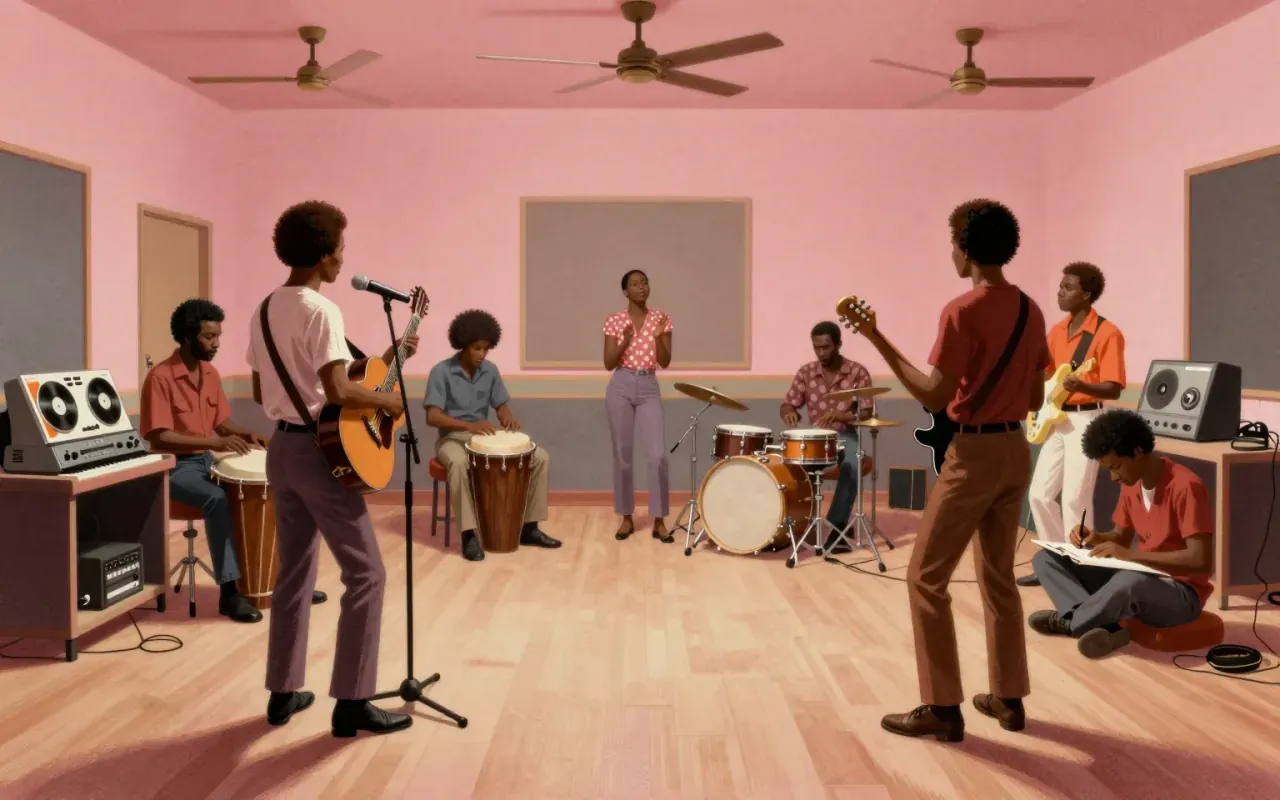
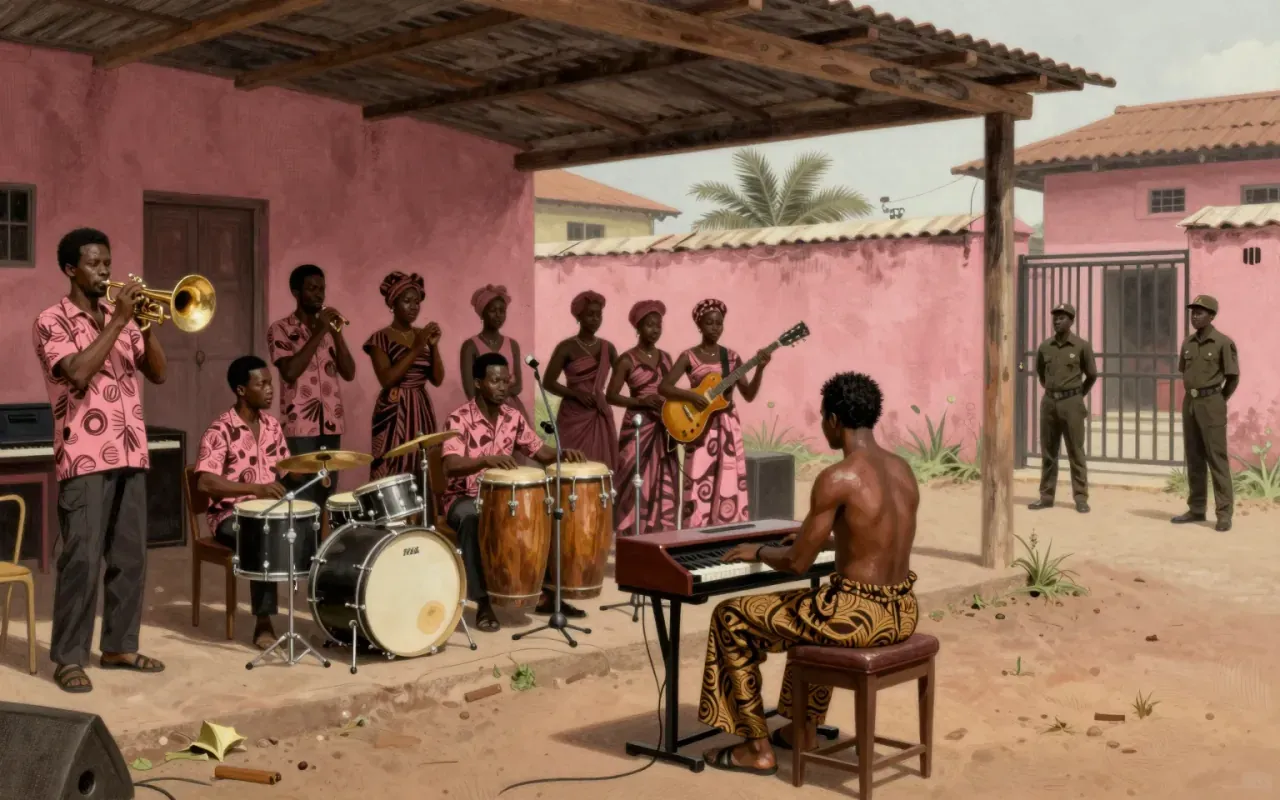
The band’s frontline pairs Igo Chico’s tenor saxophone with Lekan Animashaun’s baritone and two trumpeters, Eddie Faychum and Tunde Williams, while Kuti himself plays electric piano rather than his later signature alto saxophone and sings lead. Peter Animashaun’s guitar and Maurice Ekpo’s bass sit under a thick percussion section: two drummers in Allen and Baker, plus congas from three players and additional hand percussion, giving the rhythm section a weight and density a single kit could not manage alone. Tracks like Egbe Mi O run past thirteen minutes, built from a slow-build structure of horn riff, vocal call and instrumental stretch that would become Kuti’s standard architecture. The record leans harder on instrumental interplay than on song form, with vocals arriving well into most tracks rather than opening them.
Where the density pays off
What distinguishes the record most clearly is the two-drummer arrangement, and hearing Allen and Baker work the same groove from different backgrounds gives the rhythm section a texture neither drummer generates alone elsewhere in either man’s catalogue. Fight to Finish and J’Ehin J’Ehin both let that rhythmic density carry long instrumental passages before the horns or vocal enter, and the patience of the arrangements, rather than any individual solo, is where the record earns its reputation as an early high point. Retrospective critics have pointed to this period as the beginning of Kuti’s strongest run of recordings, and heard alongside the albums that followed, the record’s confidence in its own pacing looks less like an accident and more like a band finding the exact tempo and structure it would keep returning to for years.
Thinner on argument than later records
Because documentation of this session is thin next to Kuti’s better-known later records, a listener has less context for what exactly Baker’s presence changed versus what Allen was already doing on his own, and the album itself does not make that distinction easy to hear track by track. The record’s five long pieces demand the same patience later, more famous Kuti albums would ask for, but without the sharper political framing that made records like Expensive Shit land as clearly as narrative statements; Buy Africa aside, the lyrical content here sits further in the background than the arrangements. Listeners expecting the more pointed satire of Kuti’s mid-seventies work may find this earlier record’s concerns comparatively diffuse, its interest carried more by rhythm and band chemistry than by a single, memorable lyrical hook.
A political voice still finding its subject
Buy Africa states its argument plainly enough to stand out from the rest of the record: a call for economic self-reliance across the continent, made years before Kuti’s confrontations with the Nigerian state would sharpen into the pointed narratives of his mid-seventies albums. Heard against that later work, the record catches Kuti’s political voice still finding its subject, more interested here in a general Pan-African argument than in the specific confrontations with police and military government that would define his most famous records. The two-drummer lineup carries its own quieter idea: that Lagos rhythm and a British rock drummer’s vocabulary could sit inside the same groove without either overwhelming the other, a small piece of cross-continental exchange that predates the more celebrated collaborations Baker would go on to record in Nigeria not long afterward.
A missing piece, not an entry point
Listeners already committed to Kuti’s catalogue, and curious about the years before Kalakuta and the sharper political records that made his name, should treat this as a genuine missing piece rather than a footnote, since it shows the band’s core rhythmic identity taking shape before the lyrics caught up to match it. Anyone interested in Ginger Baker’s career beyond Cream gets a rare, substantial document of his time playing inside a Nigerian band rather than fronting his own, worth hearing on those grounds alone. Listeners who come to Kuti expecting the fully formed satire and narrative bite of his later Africa 70 records may find this one comparatively unfocused lyrically, carried more by groove and horn arrangement than by a single memorable political statement, and should adjust expectations before starting rather than measuring it against records made years afterward.
A genuine link worth the patience
Just over forty minutes spent here buys a genuine missing link rather than a minor detour: a record made at the exact point where Kuti’s band sound was locking into the extended, horn-and-percussion architecture that would define the next decade, with an unusual drummer pairing that never quite repeated itself in his catalogue afterward. It asks for the same patience as any long-form Afrobeat record and offers less political sharpness in return than the albums that followed, so listeners hoping for an entry point into Kuti’s most famous work should probably start elsewhere and come back to this once the shape of his later argument is familiar. For anyone already invested in the story, though, hearing Allen and Baker share a groove this early is reason enough on its own, and the record holds up as more than a curiosity once that context is in place.