musicbriefs
2:37in production/ 2:37 · ceiling 15 min
World

Talking Timbuktu

Ali Farka Touré and Ry Cooder meet through guitar without making their backgrounds interchangeable.

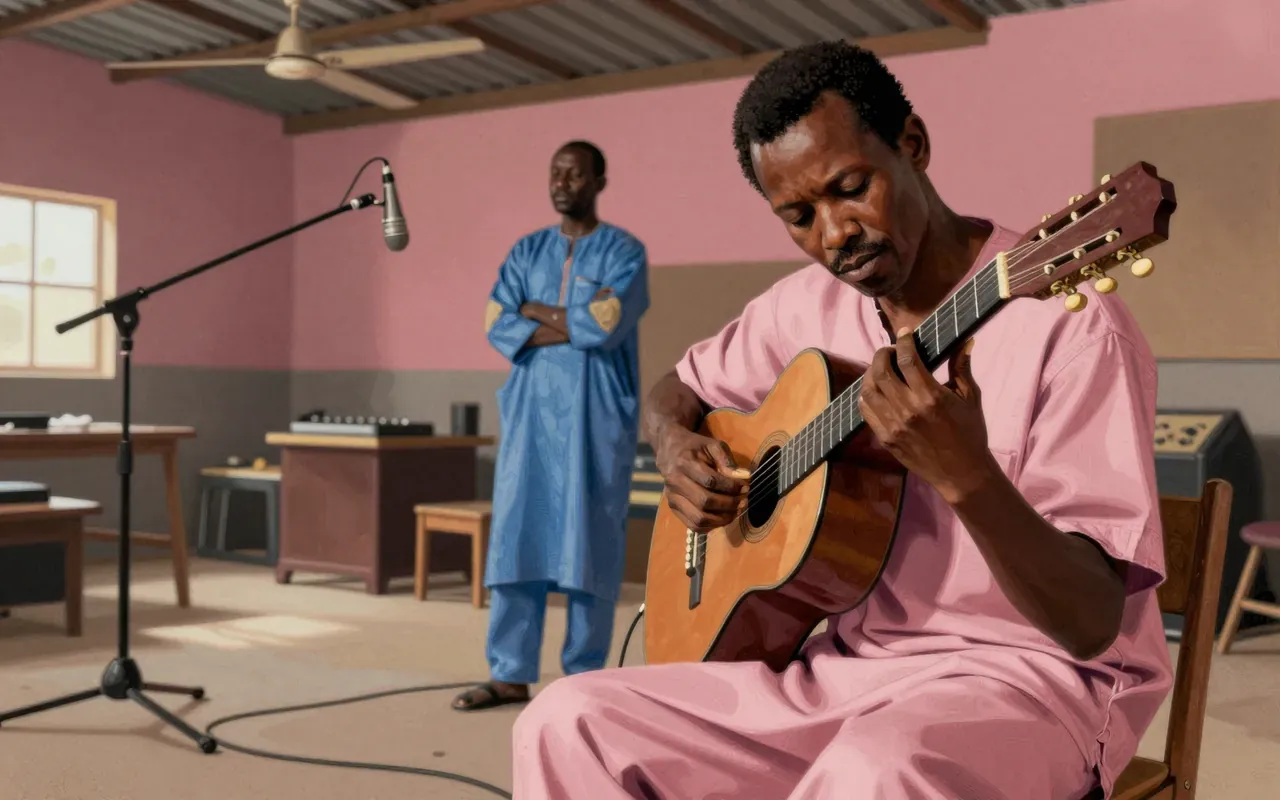
Talking Timbuktu is the 1994 collaboration between Malian guitarist Ali Farka Touré and American guitarist and producer Ry Cooder. Its ten tracks provide a meeting place for two musicians whose histories should remain visible even when their instruments suggest a connection. The album's identity begins with both names.

Worth your time?

Yes. Hear the whole thing.

What works
    What does not
      Hear it if
      • Listeners interested in guitar-led collaboration and Malian music
      Skip it if
      • Listeners looking for a concise sequence of pop singles
      The written brief2 min read

      What the record is and where it came from

      Talking Timbuktu is the 1994 collaboration between Malian guitarist Ali Farka Touré and American guitarist and producer Ry Cooder. Its ten tracks provide a meeting place for two musicians whose histories should remain visible even when their instruments suggest a connection. The album’s identity begins with both names.

      How it sounds, and how it was made

      The programme moves among songs identified in the liner notes with Peul, Bambara, Songhai and Tamasheck. That variety is a reminder that even the Malian side of the collaboration cannot be reduced to one undifferentiated tradition.

      The lengths vary substantially: “Banga” lasts under three minutes, while “Amandrai” extends beyond nine. The sequence therefore makes room for both compact statements and performances that ask the listener to stay with a piece.

      What lands

      “Diaraby” is a useful entrance. Its guitar figure became familiar to listeners of the radio programme The World, but its position at the end of this album restores a larger context around that recognisable fragment.

      The collaboration is most interesting when familiarity becomes a starting point for curiosity. A listener arriving through Cooder can follow the song titles and language credits toward Touré’s work, instead of treating his contribution solely as an explanation of American music.

      What does not

      The broad “world music” category under which the album circulated tells a listener little about those distinctions. It can make a specific collaboration appear representative of an enormous region. The longer tracks also ask more patience than a listener seeking quick changes may want to give.

      The ideas inside it

      Resemblance does not settle a question of origin or ownership. Two guitarists can find common ground without one becoming a footnote to the other’s tradition. The multilingual programme is a practical reason to keep asking what each song brings to the meeting.

      Who should hear it, and who should not

      Hear it if a collaboration makes you want to explore the musicians individually. It works particularly well as a doorway from familiar guitar music into a more specific interest in Touré.

      Is it worth your time

      Yes. Start with “Diaraby,” then return to the beginning and hear the whole programme. Let the collaboration expand the names and traditions you follow, rather than collapse them into a single label.
      Same genre · World4 of 17
      10:02
      A Meeting by the RiverRy Cooder · 1993A Meeting by the River is a 1993 Grammy-winning world music crossover album recorded in September 1992 by Ry Cooder on slide guitar and Vishwa Mohan Bhatt on the Mohan veena—an instrument Bhatt created—with Joachim Cooder on dumbek and Sukhvinder Singh Namdhari on tabla. The session was unplanned and unrehearsed: Cooder and Bhatt met less than an hour before recording began. Produced and engineered by Kavichandran Alexander, it features voice-like phrasing, alternating and unison melodic lines, and improvisation rooted in Hindustani classical tradition and blues sensibility. Its four tracks—'A Meeting by the River', 'Longing', 'Ganges Delta Blues', and 'Isa Lei'—are noted for clarity, distinctness, and three-dimensional sound quality.
      8:47
      ClandestinoManu Chao · 1998Clandestino is a document of accidental minimalism — made mobile, made human, made urgent.
      13:00
      PlayMoby · 1999Made at Moby's own Manhattan studio after a career-threatening previous album, Play folds vocal hooks lifted from Alan Lomax's field recordings into electronic production, letting decades-old voices carry new songs. Slow to catch on, it eventually sold over twelve million copies largely through film and advertising licensing.
      10:35
      CalypsoHarry Belafonte · 1956Calypso is Harry Belafonte's third studio album, released in 1956 on RCA Victor. It features vocal performances backed by guitarists Millard J. Thomas and Frantz Casseus, Tony Scott and His Orchestra, and The Norman Luboff Choir on select tracks. It includes 'Day-O (The Banana Boat Song)', sung from the perspective of banana dock workers awaiting daylight, alongside 'Star-O' as a lyrical variant reprise, and 'Jamaica Farewell', a mento folk song published here for the first time. Production involved multiple producers, a conductor, a chorus leader, and contributors to visual and textual elements of the release.
      Up next in Music

      Technique

      New Order · 1989 · 2:02

      New Order let club music and band identity negotiate the same record.

      2:02