musicbriefs
1:59in production/ 1:59 · ceiling 15 min
Psychedelia

The United States of America

Electronic treatment makes this psychedelic band’s political unease part of the sound itself.

The United States of America's only studio album appeared in 1968, produced by David Rubinson. Joseph Byrd and Dorothy Moskowitz brought backgrounds in experimental music into a politically engaged rock project. The band sought more than unusual decoration around conventional songs.

Worth your time?

Yes. Hear the whole thing.

What works
    What does not
      Hear it if
      • Listeners interested in early electronic rock and experimental song forms
      Skip it if
      • Listeners seeking a naturalistic band sound or uniformly clear vocals
      The written brief1 min read

      What the record is and where it came from

      The United States of America’s only studio album appeared in 1968, produced by David Rubinson. Joseph Byrd and Dorothy Moskowitz brought backgrounds in experimental music into a politically engaged rock project. The band sought more than unusual decoration around conventional songs.

      How it sounds, and how it was made

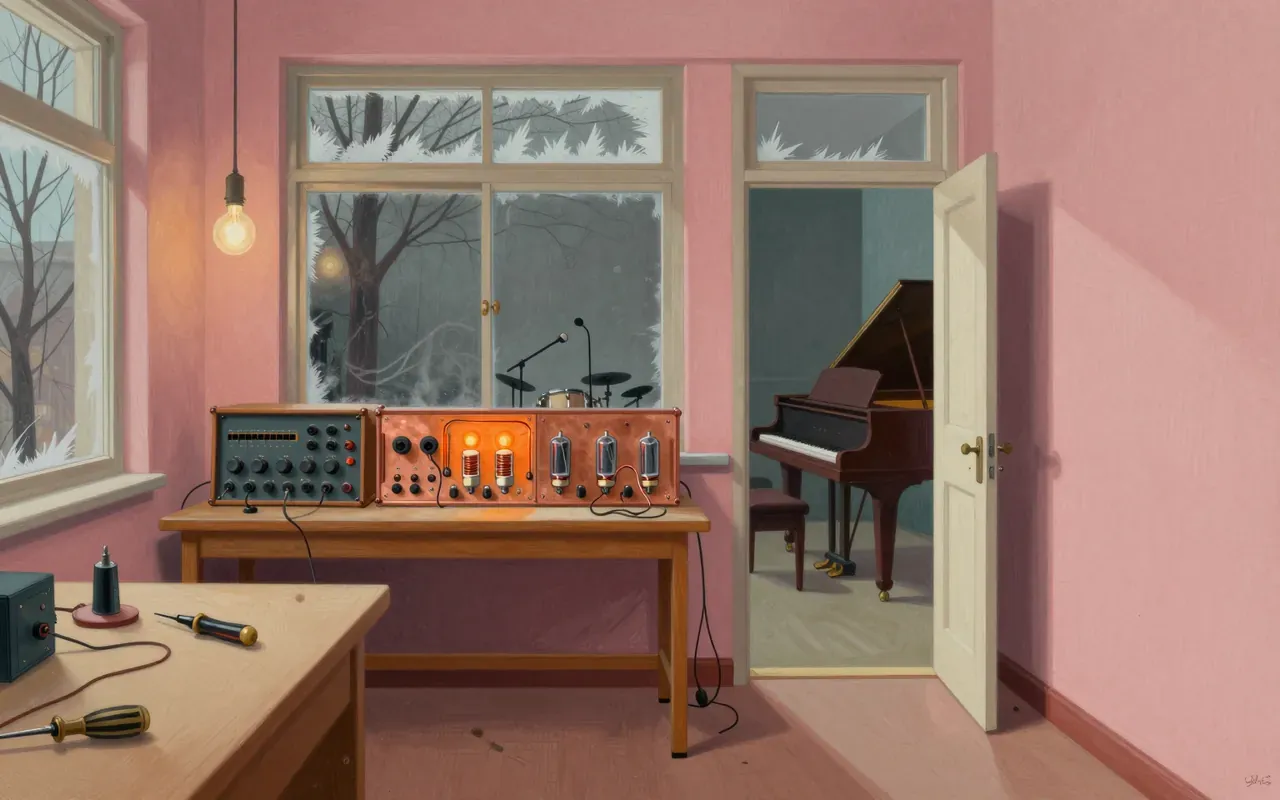
      Custom oscillators and electronic processing alter instruments and Moskowitz’s voice. On “The American Metaphysical Circus,” the vocal becomes increasingly difficult to understand. The equipment’s limitations required inventive construction, making the electronic identity part of the work’s method as well as its surface.

      What lands

      The processing can make a familiar voice become unfamiliar within the same song. That change gives the record a way to unsettle the listener without relying solely on lyrics. Experimental technique and political discomfort reinforce one another when the sound itself resists a stable presentation.

      What does not

      Some effects can feel more historically interesting than emotionally persuasive. The dense or distorted passages also make the words harder to follow. A listener should not have to regard technical novelty as sufficient compensation when the song stops engaging.

      The ideas inside it

      A recording can question familiar appearances by altering how they are perceived. Here, electronic manipulation becomes a means of making an apparently recognisable musical object less secure. The political stance has a formal counterpart.

      Who should hear it, and who should not

      Hear it if early electronic methods interest you as compositional tools. It is a poor choice when warmth, transparency and easy vocal comprehension are essential.

      Is it worth your time

      Yes. Its best moments turn the technology into an expressive decision, giving the album a value beyond its place in the history of equipment.
      Same genre · Psychedelia4 of 66
      8:58
      Fleet FoxesFleet Foxes · 2008Fleet Foxes’ self-titled 2008 debut was recorded mostly in domestic spaces — Pecknold’s parents’ basement and Wescott’s home — due to tight funds; it aimed for simplicity through harmonies and unconventional structures, underwent full re-recording and exhaustive revision, and was produced by Phil Ek with vocals added the night before final mixing. Its pastoral acoustic sound foregrounds vocal arrangements modelled on classical string textures, informed by folk, gospel, psychedelic pop and Sacred Harp styles, with lyrics rooted in Pecknold’s rural surroundings, philosophical reflection and personal abandonment — not love songs.
      10:17
      Buffalo Springfield AgainBuffalo Springfield · 1967Buffalo Springfield Again is a document of disintegration — not decline, but divergence. It is worth hearing for how it uses absence as an instrument.
      10:35
      “Awaken, My Love!”Childish Gambino · 2016‘Awaken, My Love!’ is a committed, cohesive plunge into psychedelic soul—no hedging, no genre tourism, no rap. It works because it trusts the weight of groove, the heat of analogue texture, and the authority of Glover’s voice as instrument first, storyteller second.
      10:16
      AftermathThe Rolling Stones · 1966Aftermath is the Rolling Stones’ first album of entirely original Jagger–Richards songs, recorded across two relaxed sessions at RCA Studios in Los Angeles in December 1965 and March 1966. Engineer Dave Hassinger enabled experimentation, especially with session musician Jack Nitzsche and Brian Jones — who pioneered use of sitar, marimba, and dulcimer — expanding the band’s sonic palette beyond Chicago blues into folk, Baroque, psychedelia, and world music. Melodic ideas were largely developed by Richards and refined collectively in the studio, often guided by Nitzsche’s piano work. Jones’ contributions were central to the album’s textural innovation, though his unreliability occasionally led Richards to assume most guitar duties — a shift marking one of the first Stones albums dominated by Richards’ guitar work. The album also marked the band’s first major use of true stereo and included the extended, improvisational track 'Going Home', nearly 12 minutes long.
      Up next in Music

      Unknown Soldier

      Fela Kuti · 1979 · 2:02

      An extended ensemble supports Fela’s refusal to let violence disappear into an official explanation.

      2:02