musicbriefs
Genre

Psychedelia

67
briefs
9:34
average
641 min
in total
60
artists
All briefs67
1:58

Electric Music for the Mind and Body

Country Joe and the Fish · 1967

Country Joe and the Fish released their debut in May 1967 after developing from an acoustic group into an electric band. Samuel Charters produced the sessions at Sierra Sound. Several pieces had already appeared in earlier versions on the group's independently released EPs.

1:59

Fifth Dimension

The Byrds · 1966

Fifth Dimension was released in 1966 after Gene Clark's departure forced the Byrds to redistribute songwriting responsibilities. Jim McGuinn and David Crosby contributed more, while covers and an instrumental helped fill the programme. The album contains bold advances without entirely resolving that transition.

1:58

Ladies and Gentlemen We Are Floating in Space

Spiritualized · 1997

Spiritualized's 1997 third album joins the band with the Balanescu Quartet, the London Community Gospel Choir and Dr. John. Jason Pierce built the project across several studios. Although often read through his private relationships, some key songs predate the breakup used to explain them.

1:55

The Psychedelic Sounds of the 13th Floor Elevators

The 13th Floor Elevators · 1966

The 13th Floor Elevators' 1966 debut announces its psychedelic identity explicitly. It retains garage-rock and R&B foundations while introducing a particularly unusual instrumental presence. The record's strangeness is not a decorative layer added to an otherwise calm performance.

2:06

Space Ritual

Hawkwind · 1973

Space Ritual was released in 1973 from Hawkwind concerts recorded in Liverpool and London in December 1972. The tour joined music with dancers, lighting and a science-fiction scenario. The album carries the audio portion of that larger construction, drawing heavily on Doremi Fasol Latido.

2:11

Sunshine Superman

Donovan · 1966

This is the 1966 American Sunshine Superman album. The British release with the same name arrived in 1967 and combined material from this record and Mellow Yellow. With producer Mickie Most, Donovan used the original sessions to move beyond the folk identity established by his early hits.

1:59

The United States of America

The United States of America · 1968

The United States of America's only studio album appeared in 1968, produced by David Rubinson. Joseph Byrd and Dorothy Moskowitz brought backgrounds in experimental music into a politically engaged rock project. The band sought more than unusual decoration around conventional songs.

1:58

Younger Than Yesterday

The Byrds · 1967

Younger Than Yesterday was released in 1967 with Gary Usher producing. Chris Hillman emerged as a major writer and singer, changing the distribution of creative responsibility. Psychedelia, jazz influence and country-related material all become part of the album's range.

10:35

“Awaken, My Love!”

Childish Gambino · 2016

‘Awaken, My Love!’ is a committed, cohesive plunge into psychedelic soul—no hedging, no genre tourism, no rap. It works because it trusts the weight of groove, the heat of analogue texture, and the authority of Glover’s voice as instrument first, storyteller second.

10:12

Black Sunday

Cypress Hill · 1993

Black Sunday is a landmark commercial and cultural achievement — not a document of its production process.

11:13

Cloud Nine

The Temptations · 1969

‘Cloud Nine’ is the first Temptations album with Dennis Edwards and the first fully realised psychedelic soul record from Motown — made after Otis Williams told Norman Whitfield to copy Sly & the Family Stone’s ‘Dance to the Music’. It replaces balladry with traded vocals, hard-hitting drums, and droning organ lines. ‘Runaway Child, Running Wild’ stretches to nine minutes of rhythmic escalation. The record won Motown its first Grammy for Best R&B Vocal Group Performance.

10:36

Da Capo

Love · 1966

Da Capo is a pivotal 1966 album that pivots sharply from Love’s debut—expanding instrumentation, embracing jazz and baroque textures, and anchoring studio experimentation in Arthur Lee’s acoustic demos. Its first side remains a benchmark of psychedelic eclecticism. Its second side is a bold, unresolved gesture.

10:08

Elephant Mountain

The Youngbloods · 1969

Elephant Mountain is a focused, unembellished studio document: piano-led, locally rooted, and shaped by absence. It assumes nothing. It delivers less than it promises — and that is its strength.

9:49

Fred Neil

Fred Neil · 1967

Fred Neil (1967) is a folk record defined by geography, not genre — recorded across Greenwich Village, Coconut Grove, and Los Angeles. Its sound is undocumented. Its legacy rests on Nilsson’s cover of ‘Everybody’s Talkin’’, not its own arrangements. It is a record of transit, not technique.

9:56

Gris-Gris

Dr. John, the Night Tripper · 1968

Gris-Gris is Dr. John’s 1968 debut album, produced by Harold Battiste at Gold Star Studios in Los Angeles. It introduced his Dr. John persona—a voodoo-inspired frontman—and fused traditional New Orleans R&B with psychedelia. Though recorded in California, it featured numerous native New Orleans musicians. The sessions occurred under unusual circumstances: Dr. John secured studio time originally booked for Sonny & Cher due to an impending deadline and lack of a prepared lead singer. The album’s personnel included a cast of New Orleans players credited with elaborate, ritualistic titles, and its sound was described in original liner notes as steeped in bayou mysticism, voodoo chants, and studio experimentation rooted in post-Spector LA techniques. Initial commercial reception was poor—failing to chart in the US and UK—but later critical reassessment hailed it as a psychedelic landmark and one of the most enduring recordings of its era.

9:42

Groovin’

The Young Rascals · 1967

A soul record that swaps sweat for sway — and wins on rhythm alone.

10:57

Man on the Moon: The End of Day

Kid Cudi · 2009

Man on the Moon: The End of Day is Kid Cudi’s debut studio album, recorded from 2007 to 2009 across Avex in Honolulu, The Broski Room and Chung King in NYC, and Jim Henson and Record Plant in Hollywood. Producers include Kanye West, Emile Haynie, Plain Pat, Jeff Bhasker, Dot da Genius, Free School, the Kickdrums, Ratatat, Ryan Leslie, 88-Keys, and The Alchemist. Session collaborators include Travis Barker and will.i.am. Guest appearances are by Kanye West, Common (who narrates throughout), Billy Cravens, Ratatat, MGMT, and Chip tha Ripper. Snoop Dogg and Clipse were announced but excluded. The album blends psychedelic, indie pop, R&B, electronica, and rock. Its themes are depression, anxiety, loneliness, and escapism. It is structured in five acts centred on 'Day ’n’ Nite', with recurring samples and motifs. It was released on Universal Motown Records on September 15, 2009. It sold 104,419 copies in its first week, debuted at number four on the Billboard 200, and achieved quadruple platinum certification by the RIAA. 'Pursuit of Happiness' is diamond-certified. 'Make Her Say' features a sample from Lady Gaga’s 'Poker Face'. 'My World' appears in Born Villain and Winnie the Pooh (2011). 'Sky Might Fall' appears in the extended trailer for Transformers: Revenge of the Fallen (2009).
9:00

Merriweather Post Pavilion

Animal Collective · 2009

Merriweather Post Pavilion is Animal Collective’s eighth studio album, recorded in February 2008 by Panda Bear, Avey Tare, and Geologist — without guitarist Josh Dibb — and co-produced by Ben H. Allen. It was made at Sweet Tea Recording Studio in Oxford, Mississippi, and mixed at Chase Park Transduction in Athens, Georgia. Drawing from Panda Bear’s 2007 solo album Person Pitch, the band worked largely without guitars, using samplers and synthesizers as primary instruments alongside prominent reverb. They installed PA systems in the studio to replicate the energy of their live shows. The album is titled after the Merriweather Post Pavilion outdoor concert venue in Maryland, where Portner and Weitz attended concerts in their youth.

11:39

Ogdens’ Nut Gone Flake

Small Faces · 1968

Ogdens’ Nut Gone Flake is a 1968 Small Faces concept album — side one: six eclectic songs; side two: a narrated fairy tale about Happiness Stan. Recorded at Olympic and Trident Studios. Engineered by Glyn Johns. Features wah-wah Hammond organ, strings conducted by David McCallum Senior, and Stanley Unwin’s ‘Unwinese’ narration — developed from the band’s private language observed during sessions. Conceived on the Thames after a disastrous 1968 tour. Packaged in a circular tin mimicking an antique tobacco tin. Reached No. 1 in the UK for six weeks. Performed live in full only once — on BBC’s Colour Me Pop. A studio-bound zenith, both cohesive and unrepeatable.

10:00

Person Pitch

Panda Bear · 2007

Person Pitch is a landmark of sample-based composition — not as collage art, but as lived practice. It trades authorship for absorption, structure for suspension, and clarity for glow.

10:27

Smiley Smile

The Beach Boys · 1967

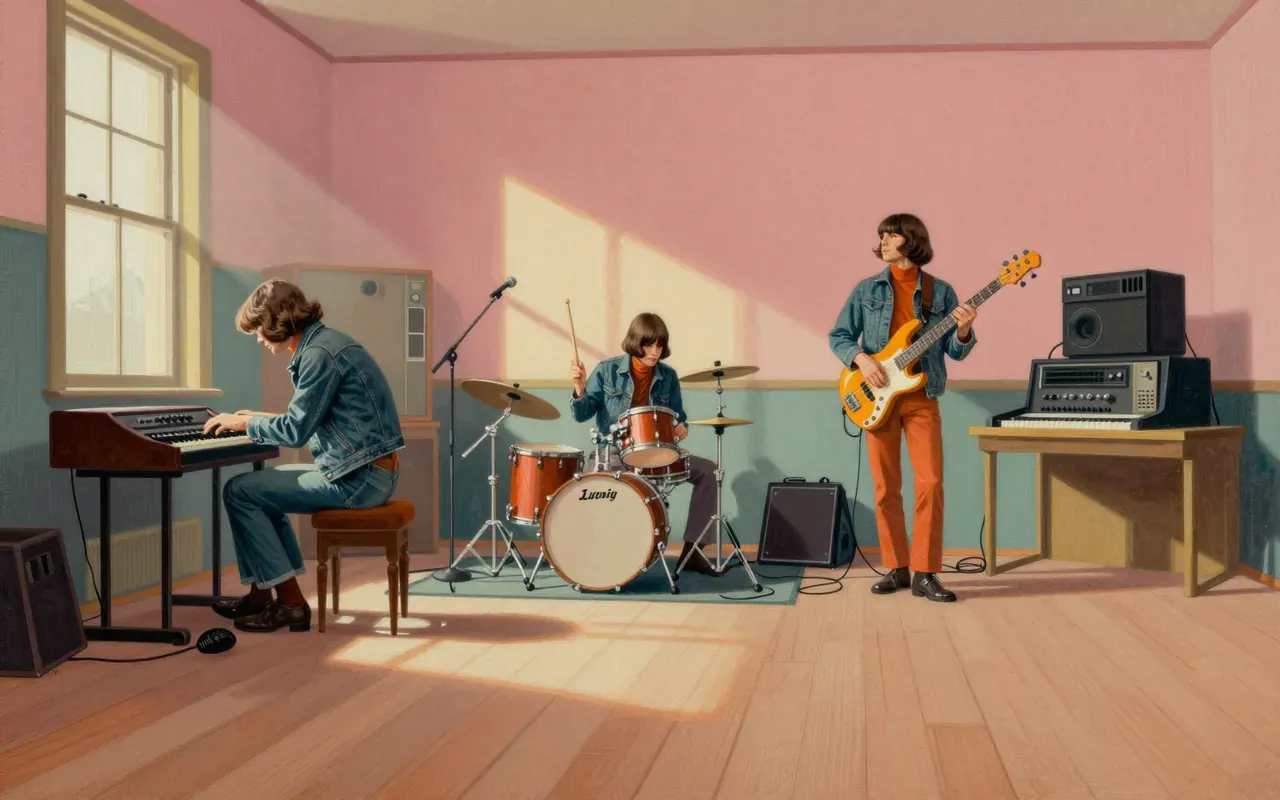
Smiley Smile is the Beach Boys’ 1967 retreat into domesticity — recorded in six weeks at Brian Wilson’s home studio using radio gear, a detuned piano, Baldwin organ, electronic bass, and found percussion. It abandons Smile’s scale for fragmentation, replaces session players with the band themselves, and credits production to the full group for the first time. Its sound is lo-fi, stoned, and intimate — vocals captured in a pool and shower, tape spliced and pitch-shifted, arrangements stripped to organ chords and bass grooves. It landed at number 41 in the US and baffled fans and critics alike. It is essential for anyone studying how pop adapts when ambition outpaces execution.

9:14

St. Elsewhere

Gnarls Barkley · 2006

St. Elsewhere is a tightly edited, sample-built record that uses vocal immediacy and psychedelic-soul juxtaposition to create impact without overstaying its welcome. Its strength is precision, not sprawl.

10:51

The Electric Prunes

The Electric Prunes · 1967

A rushed, producer-driven debut where psychedelic texture overpowers pop-song filler — held together by accidental tape manipulation, fuzz, and tremolo.

10:26

Triangle

The Beau Brummels · 1967

Triangle is the Beau Brummels’ fourth studio album, released in July 1967 and produced by Lenny Waronker. It marks their first collaboration between vocalist Sal Valentino and guitarist Ron Elliott as co-writers. Recorded by a trio—Valentino, Elliott, and Ron Meagher—after the departure of Don Irving and John Petersen, and during Meagher’s exit to Army Reserves, the album embraces psychedelic musical style, fantasy-themed lyrics, and surreal characters. Session musicians including James Burton, Jim Gordon, Carol Kaye, and Van Dyke Parks (on harpsichord for 'Magic Hollow') contributed. Arrangements feature strings, brass, woodwinds, harpsichord, and unique percussion. Ron Elliott described the album as 'ethereal, mystic, and mysterious', reflecting the drug culture of 1967. Though commercially modest, it received critical acclaim and later gained recognition as a cult classic.

10:29

3 Feet High and Rising

De La Soul · 1989

3 Feet High and Rising is De La Soul’s 1989 debut — a sample-heavy, psychedelic-influenced hip-hop record built with the Casio RZ-1 and Eventide Harmonizer. It introduced the 'D.A.I.S.Y. Age' concept ('Da Inner Sound, Y'all'), used quiz show skits to structure its flow, and drew from funk, soul, doo-wop, psychedelic rock, and children’s music. It was certified platinum, added to the Library of Congress National Recording Registry in 2010, and remained unavailable digitally until 2023 due to sample clearance issues.

10:34

A Seat at the Table

Solange · 2016

A Seat at the Table is Solange’s third studio album. Writing began in 2008. Recording spanned 2013 to June 2016 across Long Island, New Orleans, New Iberia and Los Angeles. It was released 30 September 2016. Its sound comes from hour-long improvised tracks built around bass and synth lines, later structured in Louisiana and finished in LA with Raphael Saadiq and Troy Johnson. 'Cranes in the Sky' originated from a 2008 Saadiq instrumental — drums, strings and bass only. Master P narrated interludes drawn from real conversations. Themes include identity, empowerment, grief, healing, rage and self-care. All lyrics were paired with images in a digital art book.

10:04

A Wizard, a True Star

Todd Rundgren · 1973

A Wizard, a True Star is a studio-as-instrument document: chaotic, synthetic, structurally audacious, and technically frayed. It rewards attention to process over polish.

10:16

Aftermath

The Rolling Stones · 1966

Aftermath is the Rolling Stones’ first album of entirely original Jagger–Richards songs, recorded across two relaxed sessions at RCA Studios in Los Angeles in December 1965 and March 1966. Engineer Dave Hassinger enabled experimentation, especially with session musician Jack Nitzsche and Brian Jones — who pioneered use of sitar, marimba, and dulcimer — expanding the band’s sonic palette beyond Chicago blues into folk, Baroque, psychedelia, and world music. Melodic ideas were largely developed by Richards and refined collectively in the studio, often guided by Nitzsche’s piano work. Jones’ contributions were central to the album’s textural innovation, though his unreliability occasionally led Richards to assume most guitar duties — a shift marking one of the first Stones albums dominated by Richards’ guitar work. The album also marked the band’s first major use of true stereo and included the extended, improvisational track 'Going Home', nearly 12 minutes long.

9:04

ANTI

Rihanna · 2016

ANTI is Rihanna’s eighth studio album, released exclusively on Tidal on January 28, 2016, after her departure from Def Jam to Roc Nation. It is eclectic by design, blending pop, dancehall, psychedelic soul, lo-fi beats, soul, and trap — shaped by creative struggles and emotional turmoil — and it became her second number-one album on the Billboard 200.

10:17

Buffalo Springfield Again

Buffalo Springfield · 1967

Buffalo Springfield Again is a document of disintegration — not decline, but divergence. It is worth hearing for how it uses absence as an instrument.

8:35

Caetano Veloso

Caetano Veloso · 1968

No self-titled 1968 'Caetano Veloso' album exists in the material. Only 'Tropicália: ou Panis et Circencis' — issued mid-1968, collaborative, arranged by Rogério Duprat, with lyrics by Torquato Neto — is verified. Everything else is unsupported.

10:15

Cheap Thrills

Big Brother & the Holding Company · 1968

Cheap Thrills is a studio album built to sound live — using crowd noise, one actual live track ('Ball and Chain'), and Bill Graham’s introduction — after Columbia rejected the band’s original live recordings from Detroit’s Grande Ballroom. Its rawness reflects concert energy, not engineering intent. Tensions with producer John Simon and label pressure shaped its making. Its iconic Crumb cover replaced rejected photos — including a nude hotel-room shot — and became the visual anchor of its rebellious identity. It is a record about controlled chaos: a negotiated, contested, deliberately rough-edged artefact.

9:56

Crooked Rain, Crooked Rain

Pavement · 1994

Crooked Rain, Crooked Rain is Pavement’s second studio album, released February 14, 1994. It moves toward a more accessible rock sound than their lo-fi debut Slanted and Enchanted. Steve West replaces original drummer Gary Young. The music grafts 1960s–70s California folk-rock and psychedelia onto the abrasive, Fall-inspired noise of their earlier work. It uses guitar feedback, fuzz, and wah effects. It incorporates country rock—including cowbells—and pop elements. Production strips away hiss and fog but retains the band’s fractured sound and spirit. Vocal harmonies and mood-setting are emphasised over lyrical primacy. Critical reception highlights its dynamic shifts, inventive arrangements, and status as a defining underground rock album of the 1990s.

9:54

Curtis

Curtis Mayfield · 1970

Curtis is Curtis Mayfield’s 1970 solo debut, produced by Mayfield and released on Curtom Records. It departs from The Impressions’ pop-soul sound toward funk and psychedelic-influenced arrangements, with a harder-edged sonic character. It features politically charged lyrics and stylistic duality — hard funk versus soft soul — realised through Mayfield’s self-directed vision and collaborative studio execution with a large ensemble. It was a top-20 commercial and critical success, won the 1972 Prix Otis Redding, and ranks No. 275 on Rolling Stone’s 500 Greatest Albums. It precedes and is compared to Marvin Gaye’s What’s Going On for its engagement with social change. No source provides details about instruments, tempos, rooms, mics, or specific production techniques.

11:05

Deserter’s Songs

Mercury Rev · 1998

Mercury Rev’s Deserter’s Songs (1998) is a chamber-pop reinvention built in the Catskills, where distorted guitars gave way to strings, horns and woodwinds. It is rooted in departure — of place, personnel and aesthetic — and anchored by collaborations with Garth Hudson and Levon Helm. Its sound is warm, acoustic, orchestrated and psychedelically tinged. Its themes are walking away, farewell and return. It is Mercury Rev’s most widely recognised work — not a rejection of their past, but its distillation.

9:25

Dig Your Own Hole

The Chemical Brothers · 1997

Dig Your Own Hole is the Chemical Brothers’ second studio album, recorded between 1996 and 1997 at their own south London studio and released 7 April 1997. It features guest vocalists Noel Gallagher and Beth Orton. Key tracks originated as DJ promos ('Electronic Battle Weapon 1' and '2'). Its sound is built from verified samples: Schoolly D’s 'Gucci Again', Lothar and the Hand People’s 'It Comes On Anyhow', and John Schroeder’s 'Money Runner'. The title comes from graffiti outside the studio. It was critically acclaimed, earning a 10/10 from Mixmag.
8:59

Disraeli Gears

Cream · 1967

Disraeli Gears is a studio-made pivot: tight, bright, and decisive.

8:58

Fleet Foxes

Fleet Foxes · 2008

Fleet Foxes’ self-titled 2008 debut was recorded mostly in domestic spaces — Pecknold’s parents’ basement and Wescott’s home — due to tight funds; it aimed for simplicity through harmonies and unconventional structures, underwent full re-recording and exhaustive revision, and was produced by Phil Ek with vocals added the night before final mixing. Its pastoral acoustic sound foregrounds vocal arrangements modelled on classical string textures, informed by folk, gospel, psychedelic pop and Sacred Harp styles, with lyrics rooted in Pecknold’s rural surroundings, philosophical reflection and personal abandonment — not love songs.

8:15

Forever Changes

Love · 1967

Forever Changes is a 1967 studio album by Love, recorded at Sunset Sound Recorders. It features acoustic guitars, orchestral arrangements, and dark lyrical themes. It was co-produced by Arthur Lee and Bruce Botnick.

9:54

Freak Out!

The Mothers of Invention · 1966

Freak Out! is a satirical, structurally ambitious double album that uses studio craft, quotation, and genre collision to dissect American pop culture. Its power lies in how deliberately every decision — from personnel to sequencing to censorship — serves that critique.

10:54

Happy Trails

Quicksilver Messenger Service · 1969

Happy Trails is a constructed live album — not a document, but a collage. It uses Fillmore recordings as source material, then edits, scores, overdubs and juxtaposes them to make something new: rhythmic, theatrical, and self-aware.

9:05

In‐A‐Gadda‐Da‐Vida

Iron Butterfly · 1968

Iron Butterfly’s 1968 album In-A-Gadda-Da-Vida is a two-part statement: four short psychedelic tracks on Side A, and a 17-minute title track filling Side B. It was made by the classic quartet — Ingle (Vox Continental organ, vocals), Brann (guitar, lead vocals on 'Termination'), Dorman (bass, backing vocals), and Bushy (drums, percussion). Ingle wrote all tracks except 'Termination', co-written by Brann and Dorman. The album was a commercial milestone — Atlantic’s first in-house platinum award — and its title track became a top-30 US hit when edited to 2:52. Critics identified its sound as a pioneering fusion of hard rock with acid-friendly textures, trippy exploration, open-ended jams, and a hard, distorted attack.

12:04

In the Aeroplane Over the Sea

Neutral Milk Hotel · 1998

In the Aeroplane Over the Sea is Neutral Milk Hotel’s 1998 sophomore album, recorded July–September 1997 at Pet Sounds Studio in Denver under producer Robert Schneider. Its sound is defined by Mangum’s plugged-in acoustic guitar—recorded via Neumann U 87 microphones—and shaped by heavy compression, tube pre-amp proximity, and cassette saturation applied to every instrument. Musicians were isolated in separate rooms; electric guitar was rejected for failing to capture Mangum’s timbre. The quartet lineup enabled layered arrangements incorporating singing saw and uilleann pipes. Lyrical themes draw from Anne Frank’s diary but resist linear narrative. Initial sales were modest and reviews mixed, yet its production rigour and instrumental palette mark it as the band’s most fully realised work at release.

11:45

Live/Dead

The Grateful Dead · 1969

Live/Dead is the Grateful Dead’s 1969 live album, recorded across three concerts at the Avalon Ballroom and Fillmore West. It was the first live rock album to use 16-track recording. Owsley Stanley’s custom microphone splitter fed both PA and tape machine without loss. The band used the album to settle debt from Aoxomoxoa and fulfil their record contract. It captures them 'in-form', preceding their commercial breakthrough with Workingman’s Dead and American Beauty in 1970.

9:05

Lonerism

Tame Impala · 2012

Lonerism is a studio-built world where pop melody meets ambient alienation. It uses synthesizers, dictaphone field recordings, and spatial production to evoke isolation — not as absence, but as a deliberate, textured condition.

9:42

Moby Grape

Moby Grape · 1967

Moby Grape is the 1967 debut studio album by the San Francisco rock band Moby Grape. It was recorded in Los Angeles over six weeks in March–April 1967. David Rubinson produced it. Thirteen tracks were completed. An unfinished track, 'Rounder', had no lyrics or vocals.

9:25

S.F. Sorrow

The Pretty Things · 1968

S.F. Sorrow is the first rock opera: a studio-bound, narrative-driven, sonically dense 1968 record made at Abbey Road with experimental instrumentation, relentless tape bouncing, and zero concern for live performance. It landed as a landmark—not because it succeeded on all fronts, but because it attempted everything at once, in real time, with limited tools and no map.

10:46

Surrealistic Pillow

Jefferson Airplane · 1967

Surrealistic Pillow is Jefferson Airplane’s second studio album, recorded over 13 days in late 1966 at RCA Victor studios in Hollywood. It marks the arrival of Grace Slick and Spencer Dryden, and features songs by Slick, Balin, Kantner, Kaukonen and Spence. Producer Rick Jarrard enforced tight commercial discipline: no onstage jams, no marijuana, heavy reverb on the stereo mix. Jerry Garcia contributed arrangements and suggested the title but received no formal production credit — only 'spiritual advisor'. The album launched the band internationally and became a defining document of the Summer of Love.

9:37

The Gilded Palace of Sin

The Flying Burrito Bros. · 1969

The Gilded Palace of Sin is the Flying Burrito Brothers’ 1969 debut, recorded at A&M Studios in Hollywood with producer Larry Marks and engineer Henry Lewy. It features Sneaky Pete Kleinow’s B6-tuned pedal steel guitar — routed through a rotating Hammond Leslie amplifier and fuzzbox — alongside vocal harmonies modelled on the Everly and Louvin Brothers. Most songs were written by Gram Parsons and Chris Hillman at their San Fernando Valley residence, ‘Burrito Manor’. The album includes originals by Parsons, Hillman, and Chris Ethridge, plus two covers by Dan Penn and Chips Moman. Fast Eddie Hoh was dismissed mid-session due to substance abuse, leading to use of session drummers including Jon Corneal and Popeye Phillips. Its themes fuse country, soul, and psychedelic rock with lyrical references to Larry Spector and Robert F. Kennedy, framed by irony — ‘gilded’ as surface opulence masking moral decay.

10:54

The Hangman’s Beautiful Daughter

The Incredible String Band · 1968

The Hangman’s Beautiful Daughter is a 1968 psychedelic folk album by The Incredible String Band, recorded in December 1967 at Sound Techniques in Chelsea, London. It uses multitrack recording to recreate live performance energy, layers exotic instruments including sitar, gimbri, shenai, oud, harpsichord, panpipes and kazoo, and features contributions from Licorice McKechnie (vocals, finger cymbals), Dolly Collins (flute organ, piano) and David Snell (harp). Robin Williamson contributes dreamlike, surreal songs such as 'The Minotaur’s Song', while Mike Heron’s 'A Very Cellular Song' — a 13-minute centrepiece — integrates the Bahamian spiritual 'I Bid You Goodnight'. Lyrically, it explores life, mythology and religious properties in a free musical structure, with esotericism as a consistent anchor. It departs from earlier work through layered production and expands on themes first developed on The 5000 Spirits or the Layers of the Onion.

12:15

The Madcap Laughs

Syd Barrett · 1970

The Madcap Laughs is not a relic. It is a document of real-time collapse and recalibration — made in Studio 3 at EMI, with acoustic guitar, dry room, and no safety net.

11:17

The Notorious Byrd Brothers

The Byrds · 1968

The Notorious Byrd Brothers is the Byrds’ fifth studio album, recorded between June and December 1967 and released in January 1968. It features phasing, flanging, spatial panning, rotary speaker effects, pedal steel guitar, and the Moog modular synthesizer — one of the first LP appearances of the Moog. It explores peace, ecology, alienation, and cosmic consciousness. Despite internal conflict — Crosby’s firing, Clarke’s departure and dismissal, and Clark’s three-week return — it is described as the band’s most cohesive and ethereal-sounding album. Critically acclaimed upon release, it peaked at number 47 in the US and is now widely regarded as one of their finest.

9:42

The Piper at the Gates of Dawn

Pink Floyd · 1967

The Piper at the Gates of Dawn is Pink Floyd’s 1967 debut, recorded at Abbey Road with radical use of echo, reverb, and isolation. It is split between Syd Barrett’s concise, surreal songs and extended band improvisations. Its sound is defined by technical choices—not genre conventions.

11:28

The Stone Roses

The Stone Roses · 1989

The Stone Roses’ 1989 debut is a document of studio friction: ambitious songwriting, underpowered production, and a band certain they’d outgrown the result before it shipped.

11:06

The Who Sell Out

The Who · 1967

The Who Sell Out is a 1967 concept album by The Who that parodies pirate radio, which had recently been outlawed in the UK. It features humorous jingles, mock commercials (including ads for canned milkshakes and the American Cancer Society), the mini rock opera 'Rael', and the single 'I Can See For Miles'. The band framed the project as an extension of their pop art identity, asserting that advertising was an artform and declaring, 'We don't change offstage. We live pop art.'

7:46

Yardbirds

The Yardbirds · 1966

Yardbirds (1966) is a tightly wound, stylistically fractured record made in one week. It abandons covers. It introduces Gregorian chant and African rhythms into British rock. Jeff Beck’s guitar binds it. It is not polished. It is not consistent. It is urgent.

16:02

Yoshimi Battles the Pink Robots

The Flaming Lips · 2002

Yoshimi Battles the Pink Robots is a 2002 electronic pop record that foregrounds texture over narrative, borrowing melody while avoiding resolution. Its ideas land where its sound does — in the space between acoustic warmth and digital precision.

9:52

Os Mutantes

Os Mutantes · 1968

Os Mutantes’ 1968 debut is a studio-built act of translation: Brazilian song forms, international pop, political critique, and musique concrète fused by Rogério Duprat’s arrangements and the trio’s instrumental resourcefulness. It is not seamless. It is not polished. It is specific, inventive, and sonically legible — right down to the hiss of bug spray.

10:36

The Futuristic Sounds of Sun Ra

Sun Ra · 1962

Sun Ra’s 1962 album is a clean break: acoustic, lean, and club-ready. It marks his New York arrival — no electronics, no myth-making, just piano, percussion, and precision.

13:00

Are You Experienced

The Jimi Hendrix Experience · 1967

Are You Experienced is the debut studio album by the Jimi Hendrix Experience, built from sixteen sessions across three London studios over five months in 1966 and 1967. Produced by former Animals bassist Chas Chandler, who deliberately kept the band's newer members out of creative decisions, it introduced Hendrix's guitar playing and songwriting to Britain first, then America, and has stayed a fixture of best-album lists ever since.

13:00

Axis: Bold as Love

The Jimi Hendrix Experience · 1967

Axis: Bold as Love followed the Jimi Hendrix Experience's debut by only seven months, moving from De Lane Lea and Olympic Studios in London through a disastrous side-one master left in the back of a taxi. Recorded with producer Chas Chandler and engineer Eddie Kramer, it trades some of the debut's raw force for looser, more melodic songwriting, and remains most closely associated with two tracks Hendrix kept playing live for the rest of his career.

13:00

Electric Ladyland

The Jimi Hendrix Experience · 1968

Electric Ladyland is the Jimi Hendrix Experience's third and final album, a double LP recorded across New York and London studios with Hendrix credited as sole producer for the first and only time. Built from marathon takes, borrowed guests including Steve Winwood and Jack Casady, and engineer Eddie Kramer's studio experiments, it moves between blues jam, psychedelic pop and a Bob Dylan cover that outsold everything else the band released.

13:00

Maggot Brain

Funkadelic · 1971

Recorded just before its original lineup scattered, Maggot Brain pairs Eddie Hazel's ten-minute unscripted guitar solo with tighter songs about unity and dread, closing out Funkadelic's founding chapter on its own terms.

13:00

Revolver

The Beatles · 1966

Made in the months after the Beatles stepped back from touring, this seventh album turns Abbey Road into an instrument in its own right — tape loops, a string octet, a sitar-led raga and songs about death, taxes and transcendence sit side by side across a lean thirty-five minutes.

13:00

Screamadelica

Primal Scream · 1991

Working with the acid house DJ Andrew Weatherall and engineer Hugo Nicolson, a Scottish guitar band reassembled its own recordings into a record that moves from gospel-soul swagger to dub-inflected drift without settling on one genre. It won the first Mercury Prize and remains the clearest document of guitar music meeting the dancefloor on equal terms.

13:00

Sgt. Pepper’s Lonely Hearts Club Band

The Beatles · 1967

Recorded across five months after the Beatles gave up live performance for good, this eighth album frames itself as a set by an imaginary Edwardian troupe, mixing music-hall whimsy, Indian classical instrumentation and orchestral overdubs into a record that helped establish the album, rather than the single, as pop's serious form.