What the record is and where it came from
De La Soul’s debut studio album, released February 6, 1989. Produced by Prince Paul. Made in New York. Not a reaction to gangsta rap — a parallel universe built from its margins.
How it sounds, and how it was made
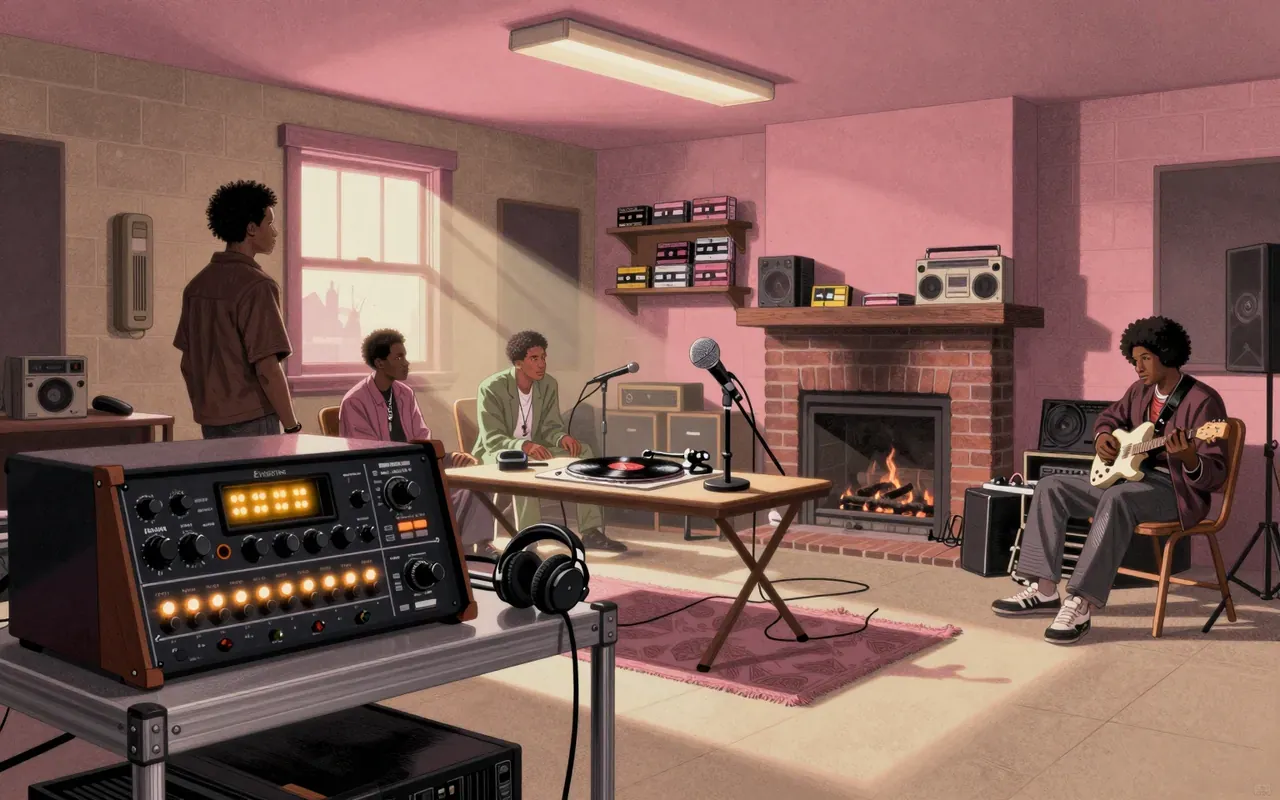
It sounds like a collage of funk, soul, doo-wop, psychedelic rock, and children’s music, stitched together with the Casio RZ-1 drum machine and Eventide Harmonizer. The production is sample-heavy, surreal, and deliberately bright — not gritty, not live-band warm, not boom-bap tight. Skits punctuate the flow like quiz show interludes. There is no live drum kit, no bass guitar solo, no vocal reverb that suggests a real room — only manipulated fragments, pitch-shifted voices, and synthetic textures.
What lands
The skits land as structural anchors, not filler. ‘Me Myself and I’ lands as a manifesto — minimal beat, clear vocal, anti-conformist hook. ‘The Magic Number’ lands through repetition and absurd logic. ‘Say No Go’ lands with its staccato rhythm and abrupt cut-offs. ‘Buddy’ lands with its layered ad-libs and call-and-response warmth.
What does not
It does not sound like late-1980s New York street rap. It does not use linear storytelling or autobiographical realism. It does not rely on looped breakbeats alone. It does not feature unprocessed vocals, live instrumentation as primary texture, or lyrical aggression as rhetorical device.
The ideas inside it
It proposes the ‘D.A.I.S.Y. Age’ — ‘Da Inner Sound, Y’all’ — as an ethos of peace, harmony, and sonic curiosity. It treats sampling as philosophical inquiry, not just technique. It rejects gangsta posturing without preaching; it substitutes wit for threat, collage for confrontation, and playfulness for polemic.
Who should hear it, and who should not
People who want hip-hop that prioritises texture over testimony, collage over chronology, and conceptual clarity over bravado. Not people who need linear narratives, vocal virtuosity, or instrumental virtuosity — this record foregrounds editing, not performance.
Is it worth your time
Yes. It repays attention on first listen and rewards repeated play. Its ideas are compact, its pacing brisk (24 tracks in 71 minutes), and its refusal to conform to late-1980s hip-hop orthodoxy remains audible, not just historical.