musicbriefs
2:02in production/ 2:02 · ceiling 15 min
Jazz

The Atomic Mr. Basie

Neal Hefti’s writing gives the Basie orchestra a coherent programme of arranged force and restraint.

Recorded in October 1957 and released in 1958, this album originally appeared as Basie and became known as The Atomic Mr. Basie. Neal Hefti composed and arranged the original programme. Later expanded editions add material from the sessions that was not part of that initial sequence.

Worth your time?

Yes. Hear the whole thing.

What works
    What does not
      Hear it if
      • Listeners interested in big-band coordination and composition
      Skip it if
      • Listeners seeking small-combo intimacy or freely unfolding forms
      The written brief1 min read

      What the record is and where it came from

      Recorded in October 1957 and released in 1958, this album originally appeared as Basie and became known as The Atomic Mr. Basie. Neal Hefti composed and arranged the original programme. Later expanded editions add material from the sessions that was not part of that initial sequence.

      How it sounds, and how it was made

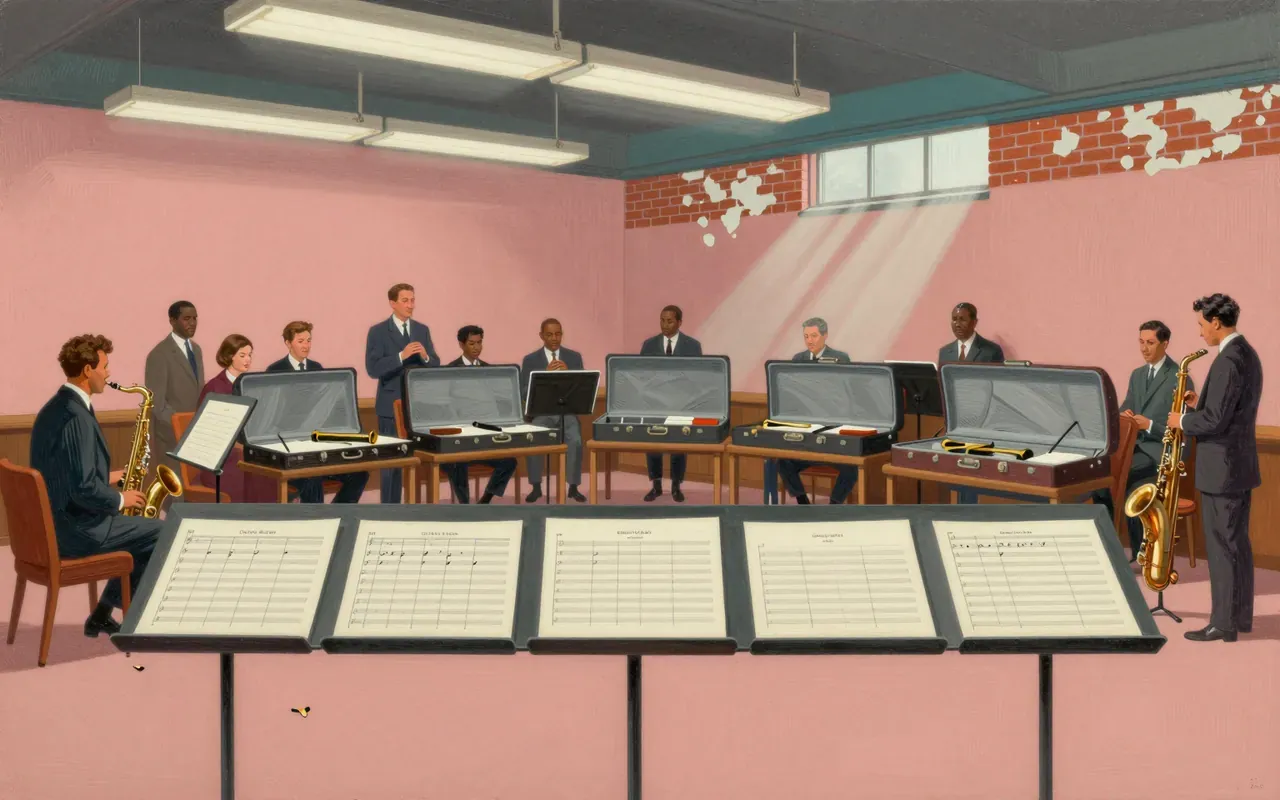
      The orchestra performs a unified set of charts rather than a miscellaneous collection of standards. Basie’s piano belongs to a larger arrangement of instrumental sections and featured voices. The musical interest lies in how a large group makes decisions of emphasis sound coordinated.

      What lands

      Hefti’s authorship gives the record an especially clear compositional identity. The band can move through different degrees of activity without losing the sense of one working language. A strong chart gives individual players a role inside a larger pattern rather than simply restricting them.

      What does not

      The composed framework may feel too settled for listeners who want improvisation to determine more of a piece’s direction. The explosive sleeve image can also encourage hearing only power, overlooking the control required to make a big band articulate.

      The ideas inside it

      Scale does not eliminate precision. A large ensemble can make small differences of entry and emphasis consequential because many people have to coordinate them. The album gives arrangement and performance equal claims on the result.

      Who should hear it, and who should not

      Hear it if you want to understand a big band through a coherent set of writing. It is less suitable when the desired experience is an open-ended small-group conversation.

      Is it worth your time

      Yes. Begin with the original programme before the added session material; Hefti’s concentrated contribution is a major part of its identity.
      Same genre · Jazz4 of 167
      9:08
      Ascenseur pour l’échafaudMiles Davis · 1958Ascenseur pour l’échafaud is the 1958 soundtrack album for Louis Malle’s Elevator to the Gallows, recorded in Paris in November 1957 by Miles Davis and a quartet of French and American musicians during a single improvised session.
      11:46
      Monk’s MusicThelonious Monk Septet · 1957Monk’s Music is a 1957 Thelonious Monk Septet album recorded in New York City on June 26. It features Coleman Hawkins and John Coltrane — their only recorded collaboration — and marks the sole studio meeting of Hawkins and Art Blakey. It was Riverside’s first Monk album issued in both mono and stereo, using distinct microphone setups resulting in markedly different sonic characteristics between the two versions — particularly reduced bass presence in stereo due to ceiling-suspended mics. 'Abide With Me' is performed by horns only; 'Ruby, My Dear' is a quartet of Monk, Hawkins, Ware, and Blakey; and Monk audibly cues Coltrane’s solo on 'Well, You Needn't'. Every track except 'Abide With Me' is a Monk original, and only 'Crepuscule with Nellie' had not been recorded before.
      10:20
      Coltrane Plays the BluesJohn Coltrane · 1962Coltrane Plays the Blues is a label-assembled 1962 compilation drawn from unissued October 1960 sessions at Atlantic Studios. Coltrane played tenor saxophone on five tracks and soprano on three. McCoy Tyner played piano on four of the six tracks — his absence from two marks the first pianoless trio since Coltrane’s Prestige years. Atlantic released it without Coltrane’s input or approval, after he had moved to Impulse Records. It is excluded from his official discography because he did not conceive or approve it as a leader during his lifetime.
      11:17
      At Last!Etta James · 1960Etta James’s 1960 debut is a calculated, string-draped entry into pop—neither raw blues nor jazz improvisation, but a vocal showcase built for radio, supper clubs, and legacy.
      Up next in Music

      Basket of Light

      The Pentangle · 1969 · 2:30

      Pentangle show how much movement an acoustic group can contain.

      2:30