musicbriefs
2:09in production/ 2:09 · ceiling 15 min
Jazz

The Blues and the Abstract Truth

Oliver Nelson makes familiar jazz forms newly revealing through the organisation of a remarkable ensemble.

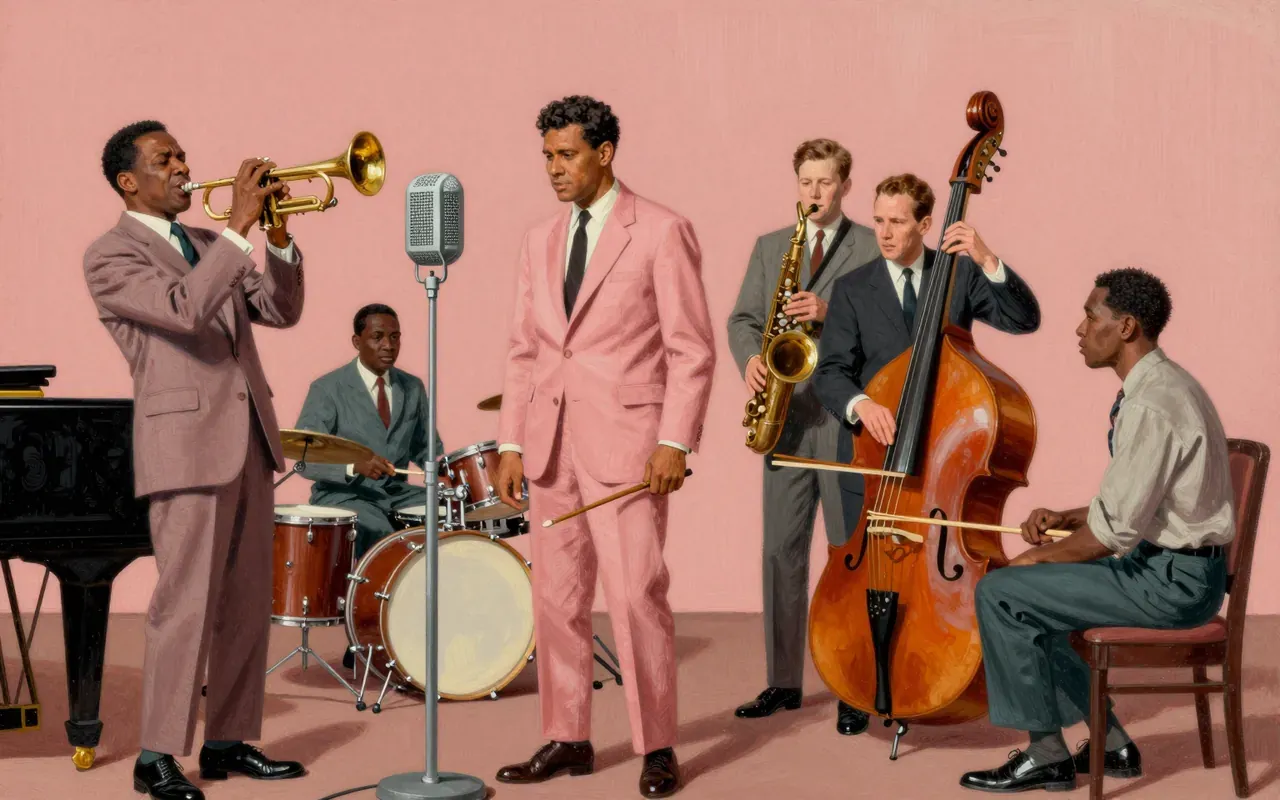
Oliver Nelson's The Blues and the Abstract Truth was released by Impulse! in 1961. Freddie Hubbard, Eric Dolphy, Bill Evans, Paul Chambers, Roy Haynes and George Barrow join Nelson. The personnel are striking, but the record's organising intelligence lies in the compositions and the relationships they create.

Worth your time?

Yes. Hear the whole thing.

What works
    What does not
      Hear it if
      • Listeners interested in jazz arranging as well as individual solos
      Skip it if
      • Listeners seeking either a conventional blues set or completely free improvisation
      The written brief1 min read

      What the record is and where it came from

      Oliver Nelson’s The Blues and the Abstract Truth was released by Impulse! in 1961. Freddie Hubbard, Eric Dolphy, Bill Evans, Paul Chambers, Roy Haynes and George Barrow join Nelson. The personnel are striking, but the record’s organising intelligence lies in the compositions and the relationships they create.

      How it sounds, and how it was made

      Horn voicings give the ensemble a defined sound before the solos begin. Barrow’s baritone saxophone is important to those voicings even though he does not solo. Piano, bass and drums support forms that adapt blues and other familiar structures instead of treating them as fixed containers.

      What lands

      “Stolen Moments” makes the distinction audible: its composed statement extends beyond the twelve-bar minor-blues framework used for improvisation. The arrangement lets a familiar basis support a less predictable shape. The celebrated soloists contribute to that design rather than making the album a sequence of unrelated showcases.

      What does not

      The title may promise a more radical abstraction than the music supplies to listeners expecting a complete break with established forms. Conversely, those wanting a straightforward blues programme may find the composed structures indirect. Its subtleties can also disappear when the solos receive all the attention.

      The ideas inside it

      An established form can remain productive when its assumptions are examined. Nelson changes the frame around improvisation without discarding its shared language. Barrow’s role makes a related point: an essential musical contribution need not involve an individually featured turn.

      Who should hear it, and who should not

      Hear it if you want to understand how arranging shapes a jazz group. It is less appropriate when your main interest is unstructured interaction or a conventional blues anthology.

      Is it worth your time

      Yes. Listen to the ensemble statements as carefully as the solos; that is where the album explains what holds its exceptional players together.

      Same genre · Jazz4 of 167
      9:43
      Eli and the Thirteenth ConfessionLaura Nyro · 1968Laura Nyro’s 1968 album Eli and the Thirteenth Confession is a densely layered, piano-driven work built from multi-tracked vocals, strings, and a rotating ensemble of session players. It merges pop form with avant-garde jazz sensibility and centres on themes of passion, love, death, and drugs. Widely regarded as one of her best works, it was written entirely by Nyro and arranged and co-produced by Charlie Calello.
      9:48
      Like Water for ChocolateCommon · 2000Like Water for Chocolate is a 2000 hip-hop album shaped by studio collaboration across Detroit and New York. Its sound is defined by space, incense-saturated atmosphere, and vocal interplay — not flash or density. It establishes Common as a thinker who works best in dialogue: with Jay Dee, with Slum Village, with Questlove, with DJ Premier. It falls short only in its length — the final third drifts without resetting the terms of engagement.
      10:06
      Frank Sinatra Sings for Only the LonelyFrank Sinatra · 1958Frank Sinatra Sings for Only the Lonely is a 1958 Capitol Records studio album defined by its torch-song repertoire, emotionally charged context—including Sinatra’s recent divorce and Riddle’s personal losses—and distinctive recording practices involving separate mono and stereo sessions with differing microphone setups. Its arrangements, crafted by Nelson Riddle, feature expressive instrumental solos by Harry Edison, Ray Sims, and Bill Miller. Though initially recorded with Riddle, the usable tracks came from a session led by Felix Slatkin, and the album marked the end of Capitol’s era of dual-format separate-recording techniques. The original stereo release omitted two tracks present on the mono version, and the album won the Grammy Award for Best Album Cover in 1959. It is widely regarded as one of Sinatra’s most introspective and artistically cohesive works, with Sinatra himself naming it his favorite album in the mid-1970s. The front cover, painted by Nicholas Volpe, depicts Sinatra as a sullen, Pagliacci-like clown, and the back cover features a lamppost—a recurring visual motif in Sinatra’s album art. The album was recorded during the transitional period when stereo was entering the marketplace, and Capitol’s engineering choices—including the use of eight microphones for mono and two or three for stereo—produced audible differences between formats, with audio engineer Steve Hoffman favoring the mono version. The album’s emotional gravity, arrangement precision, and sonic craftsmanship collectively establish it as a landmark in vocal jazz and concept-album history. The album’s legacy includes critical acclaim, chart success, and enduring cultural resonance, notably being named No. 1 on Q magazine’s list of the '15 Greatest Stoner Albums of All Time'.
      9:56
      The BridgeSonny Rollins · 1962The Bridge is Sonny Rollins’s 1962 studio album, recorded in January and February 1962 and released in April 1962. It marks his return after a three-year sabbatical and his debut for RCA Victor. The core quartet features Sonny Rollins on tenor saxophone, Jim Hall on electric guitar, Bob Cranshaw on double bass, and Ben Riley on drums — with Harry "H.T." Saunders substituting on drums for one track. The sessions were held across three dates: January 30 ("God Bless the Child"), February 13 ("Where Are You", "John S.", "You Do Something to Me"), and February 14 ("Without a Song", "The Bridge"). Produced by George Avakian and engineered by Ray Hall, the album was critically lauded and later inducted into the Grammy Hall of Fame in 2015.
      Up next in Music

      Blues Breakers with Eric Clapton

      John Mayall, Eric Clapton · 1966 · 2:06

      A guitar-forward studio album turns a working blues band into a model for rock players.

      2:06