What the record is and where it came from
Go Bo Diddley is Bo Diddley’s second album and first studio LP for Checker Records, released in July 1959. It compiles twelve tracks, four of them album-only, recorded in mono on an Ampex-350 tape recorder. Two songs — ‘You Don’t Love Me (You Don’t Care)’ and ‘Little Girl’ — date to his first Chess Records session on March 2, 1955.
How it sounds, and how it was made
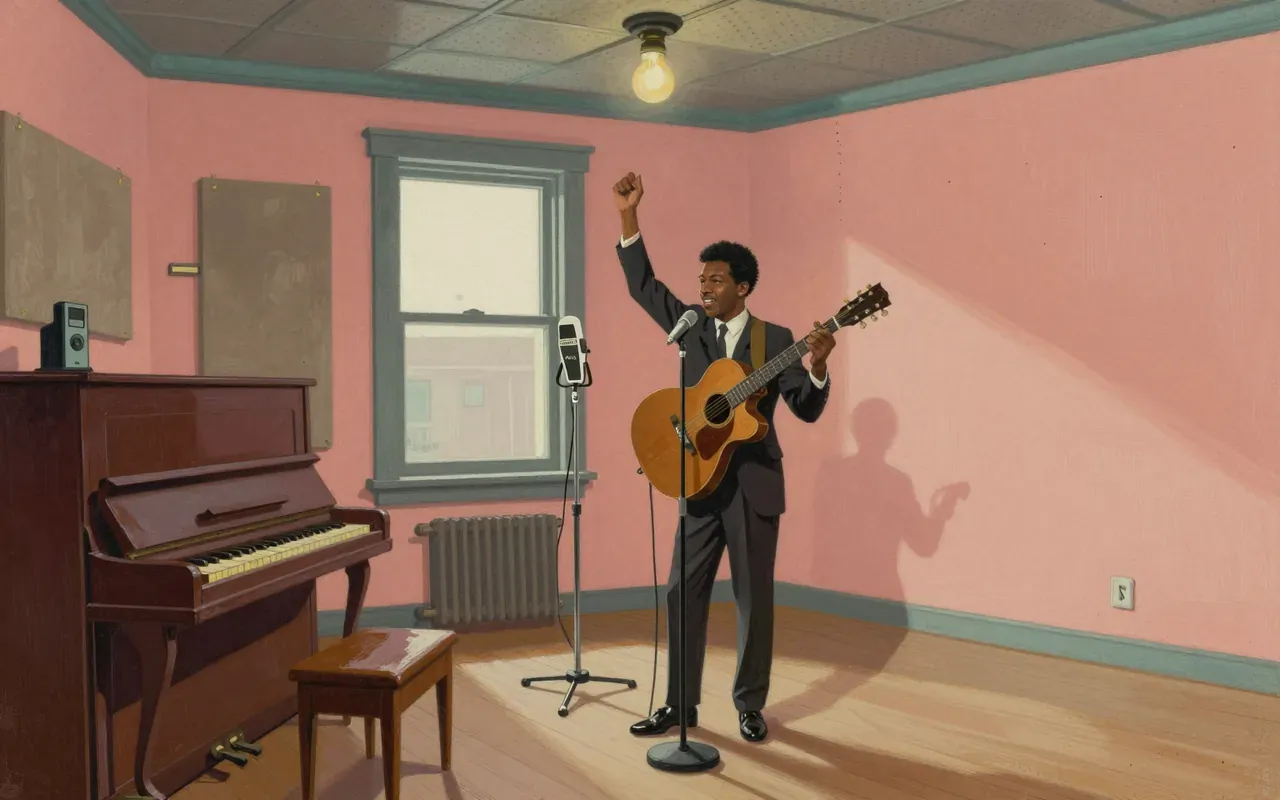
It sounds like mono tape captured in a single room, with Bo Diddley’s guitar and violin cutting through maracas, piano, bass, and two drummers. The Ampex-350 tape recorder gives it a tight, immediate compression — no reverb, no separation, no overdubs. Jerome Green’s maracas rattle close to the mic on every track he plays. On ‘Say Man’, his co-lead vocals sit right beside Bo’s, unfiltered and conversational. On ‘The Clock Strikes Twelve’, Bo’s violin enters raw and unvarnished — no studio polish, no doubling.
What lands
‘Say Man’ lands — its call-and-response banter, Green’s maracas snapping like castanets, Bo’s dry delivery, the whole thing sounding like a live wager in a packed club. ‘You Don’t Love Me (You Don’t Care)’ lands — its March 1955 take carries the urgency of a first attempt, unburdened by later studio habits. ‘Oh Yeah’ lands — its staccato guitar and clipped vocal are pure trigger, no setup needed.
What does not
It does not build momentum. It does not vary dynamics between tracks. It does not separate instruments in the mix — everything shares the same sonic space. It does not feature basslines that move beyond root notes. It does not use echo, reverb, or tape delay. There is no bridge, no breakdown, no instrumental solo that departs from the central pulse.
The ideas inside it
Rhythm as identity. Repetition as insistence. The hambone beat — not as ornament but as architecture. The maraca as metronome, the guitar as drum, the voice as call-and-response engine. No song drifts; none seeks resolution. Every lyric serves the groove, not the story.
Who should hear it, and who should not
Drummers should hear it. Producers working in mono should hear it. Anyone studying how rhythm sections lock without click tracks should hear it. Fans of polished arrangements, tonal variety, or lyrical narrative should not.
Is it worth your time
Yes, if you want to hear how rhythm was rebuilt from scratch in 1950s Chicago. No, if you expect cohesion, variation, or development across twelve tracks. It is not a sequence — it is a stack of takes, some from 1955, some cut four years later, all pressed into one flat plane of sound.