musicbriefs
Genre

Blues

66
briefs
9:46
average
645 min
in total
56
artists
All briefs66
2:06

Blues Breakers with Eric Clapton

John Mayall, Eric Clapton · 1966

Released in 1966, Blues Breakers with Eric Clapton followed an abandoned plan to make another live John Mayall album. Mike Vernon produced the studio recording. Its alternate nickname, the Beano album, comes from the cover rather than a separate musical identity.

2:28

The Boss of the Blues

Joe Turner · 1956

This 1956 Atlantic album reunites Big Joe Turner with pianist Pete Johnson. Their partnership reached back to the Kansas City years and helped bring boogie-woogie to a wider public. By the time of this recording, Turner also had major rhythm-and-blues and rock-and-roll successes. The album gives the older repertoire a substantial new setting.

2:08

East-West

The Butterfield Blues Band · 1966

East-West, the Butterfield Blues Band's second album, was recorded at Chess Studios in Chicago and released in 1966. Mike Bloomfield and Elvin Bishop share the guitar work, while Billy Davenport replaces Sam Lay on drums. The repertoire broadens the group's blues foundation rather than discarding it.

2:00

Safe as Milk

Captain Beefheart and His Magic Band · 1967

Safe as Milk was released in 1967 after Captain Beefheart and the Magic Band's relationship with A&M ended. Buddah issued the debut, whose blues foundation remains clearly visible. A young Ry Cooder contributed guitar and arrangements, helping shape this particular version of the group.

2:03

Two Steps from the Blues

Bobby Bland · 1961

Two Steps from the Blues was released in 1961, combining earlier recordings with material from 1960 sessions. Bobby Bland already had successful singles behind him. Arranger and trumpeter Joe Scott helped give the assembled programme a musical setting larger than a basic blues combo.

8:42

12 Songs

Randy Newman · 1970

12 Songs is Randy Newman’s second studio album, released in April 1970 by Reprise Records. It features a swampy style of roots music with introspective, satirical songwriting; demonstrates Newman's eccentric mix of traditional pop song structures and sardonic, satirical humor; contains his most mordant character studies, which boast a recognizable humanity; counterposes his indolent drawl against instrumental settings ranging from rock to bottleneck to various shades of jazz; includes several songs previously recorded by other artists; features a stellar trio of guitarists — Ry Cooder, Clarence White, and Ron Elliott; and replaces the orchestra with an Americana rock rhythm section.

10:02

A Meeting by the River

Ry Cooder · 1993

A Meeting by the River is a 1993 Grammy-winning world music crossover album recorded in September 1992 by Ry Cooder on slide guitar and Vishwa Mohan Bhatt on the Mohan veena—an instrument Bhatt created—with Joachim Cooder on dumbek and Sukhvinder Singh Namdhari on tabla. The session was unplanned and unrehearsed: Cooder and Bhatt met less than an hour before recording began. Produced and engineered by Kavichandran Alexander, it features voice-like phrasing, alternating and unison melodic lines, and improvisation rooted in Hindustani classical tradition and blues sensibility. Its four tracks—'A Meeting by the River', 'Longing', 'Ganges Delta Blues', and 'Isa Lei'—are noted for clarity, distinctness, and three-dimensional sound quality.

9:59

After School Session

Chuck Berry · 1957

After School Session is Chuck Berry’s debut studio album, released in May 1957 by Chess Records. It compiles twelve tracks recorded across five sessions at Universal Recording Corporation in Chicago between May 1955 and January 1957. Most songs had previously appeared as singles. The album features Chuck Berry on vocals and guitar, Johnnie Johnson on piano, and contributions from Willie Dixon, Fred Below, L. C. Davis, Jasper Thomas, Ebby Hardy, Otis Spann, Jimmy Rogers, and Jerome Green. Steel guitar appears on 'Deep Feeling'. The sequencing reflects single release order, not recording chronology. It arrived during Berry’s peak commercial and creative period, when he was already an established star with hit records, film appearances, and a touring career.

10:09

Blues From the Gutter

Champion Jack Dupree · 1958

A stark, unembellished blues record defined by its minimal personnel and clinical lyrical focus.

10:20

Coltrane Plays the Blues

John Coltrane · 1962

Coltrane Plays the Blues is a label-assembled 1962 compilation drawn from unissued October 1960 sessions at Atlantic Studios. Coltrane played tenor saxophone on five tracks and soprano on three. McCoy Tyner played piano on four of the six tracks — his absence from two marks the first pianoless trio since Coltrane’s Prestige years. Atlantic released it without Coltrane’s input or approval, after he had moved to Impulse Records. It is excluded from his official discography because he did not conceive or approve it as a leader during his lifetime.

10:08

Continuum

John Mayer · 2006

Continuum is John Mayer’s third studio album, released 12 September 2006. It was recorded between January 2005 and July 2006 across studios in Los Angeles, New York City, and Memphis. It marks a deliberate pivot toward blues and soul, co-produced by Mayer and Steve Jordan.

9:45

Down and Out Blues

Sonny Boy Williamson · 1959

Down and Out Blues is Sonny Boy Williamson’s debut LP, compiling his first six Checker singles — recorded between August 1955 and September 1957 — into a single, unvarnished sequence. It is dry, direct, and documentary in intent: no overdubs, no reverb, no narrative framing. Its power lies in its refusal to soften or explain.

9:54

Dust Bowl Ballads

Woody Guthrie · 1940

Dust Bowl Ballads is Woody Guthrie’s first commercial recording, made in two sessions at Victor Studios in Camden, New Jersey — primarily on April 26, 1940, with two additional tracks recorded on May 3 — and originally issued in 1940 as eleven songs across two three-disc 78 rpm sets. Twelve sides were pressed, with 'Tom Joad' split across both sides of one disc due to its length; two other recorded songs were excluded from the original release for the same reason.

11:32

Elvis Is Back!

Elvis Presley · 1960

Elvis Is Back! is a decisive, studio-crafted pivot — not a nostalgic return. Its sound is anchored by new technology (three-track, U-47 mics), deliberate personnel choices (Moore, Fontana, Randolph, Jordanaires), and Presley’s own acoustic guitar work. It avoids film material and pre-army tropes. It lands hardest where it commits to blues menace and vocal precision — not charm or spectacle. It rewards attention to process, not persona.

10:06

Frank Sinatra Sings for Only the Lonely

Frank Sinatra · 1958

Frank Sinatra Sings for Only the Lonely is a 1958 Capitol Records studio album defined by its torch-song repertoire, emotionally charged context—including Sinatra’s recent divorce and Riddle’s personal losses—and distinctive recording practices involving separate mono and stereo sessions with differing microphone setups. Its arrangements, crafted by Nelson Riddle, feature expressive instrumental solos by Harry Edison, Ray Sims, and Bill Miller. Though initially recorded with Riddle, the usable tracks came from a session led by Felix Slatkin, and the album marked the end of Capitol’s era of dual-format separate-recording techniques. The original stereo release omitted two tracks present on the mono version, and the album won the Grammy Award for Best Album Cover in 1959. It is widely regarded as one of Sinatra’s most introspective and artistically cohesive works, with Sinatra himself naming it his favorite album in the mid-1970s. The front cover, painted by Nicholas Volpe, depicts Sinatra as a sullen, Pagliacci-like clown, and the back cover features a lamppost—a recurring visual motif in Sinatra’s album art. The album was recorded during the transitional period when stereo was entering the marketplace, and Capitol’s engineering choices—including the use of eight microphones for mono and two or three for stereo—produced audible differences between formats, with audio engineer Steve Hoffman favoring the mono version. The album’s emotional gravity, arrangement precision, and sonic craftsmanship collectively establish it as a landmark in vocal jazz and concept-album history. The album’s legacy includes critical acclaim, chart success, and enduring cultural resonance, notably being named No. 1 on Q magazine’s list of the '15 Greatest Stoner Albums of All Time'.
10:12

Gene Vincent and the Blue Caps

Gene Vincent and the Blue Caps · 1957

A lean, guitar-forward rock ’n’ roll record defined by who played — and who didn’t — rather than what was said.

9:18

Go Bo Diddley

Bo Diddley · 1959

Go Bo Diddley is a mono document of rhythmic insistence — not a curated album but a functional stack of takes, anchored by maracas, guitar, and a hambone pulse that refuses to yield.

9:56

Gris-Gris

Dr. John, the Night Tripper · 1968

Gris-Gris is Dr. John’s 1968 debut album, produced by Harold Battiste at Gold Star Studios in Los Angeles. It introduced his Dr. John persona—a voodoo-inspired frontman—and fused traditional New Orleans R&B with psychedelia. Though recorded in California, it featured numerous native New Orleans musicians. The sessions occurred under unusual circumstances: Dr. John secured studio time originally booked for Sonny & Cher due to an impending deadline and lack of a prepared lead singer. The album’s personnel included a cast of New Orleans players credited with elaborate, ritualistic titles, and its sound was described in original liner notes as steeped in bayou mysticism, voodoo chants, and studio experimentation rooted in post-Spector LA techniques. Initial commercial reception was poor—failing to chart in the US and UK—but later critical reassessment hailed it as a psychedelic landmark and one of the most enduring recordings of its era.

10:37

Hard Again

Muddy Waters · 1977

Hard Again is a 1977 studio album by Muddy Waters, produced by Johnny Winter for Blue Sky Records. It was recorded in three days with Waters’s touring band — Bob Margolin, Pinetop Perkins, Willie 'Big Eyes' Smith — plus James Cotton and Charles Calmese. It includes re-recordings of Chess-era staples and new co-writes. Critics describe it as Waters’s comeback album. It won a Grammy.

10:19

Harlem Street Singer

Blind Gary Davis · 1961

A solo gospel session. Twenty songs. Three hours. One guitar. No compromise.

11:02

How Will the Wolf Survive?

Los Lobos · 1984

How Will the Wolf Survive? is Los Lobos’s major label debut (October 1984), composed informally at Louie Pérez’s brother-in-law’s home, drawing lyrical inspiration from a National Geographic article about survival and identity; musically, it fuses Mexican traditions with R&B, country, and blues, and centres immigrant experience in songs like 'A Matter of Time' and 'Will the Wolf Survive?'.
10:26

Howlin’ Wolf

Howlin’ Wolf · 1962

Howlin’ Wolf (1962) is a compilation of twelve Chess singles from 1957–1961 — no new material, no unified production, no session details. Willie Dixon wrote all but six tracks. Howlin’ Wolf sings lead and plays guitar and harmonica. Six guitarists, five pianists, two bassists rotate across the tracks. Its nickname comes solely from Don S. Bronstein’s sleeve illustration. It lands because the songs landed elsewhere — not because the album makes them land anew.
9:31

It’s So Hard to Tell Who’s Going to Love You the Best

Karen Dalton · 1969

Karen Dalton’s 1969 debut is a document of extraction: voice, guitar, banjo, bass, all captured in one night after deception and intervention. It refuses studio convention. It offers no comfort, no clarity, no finish — only presence, weight, and the sound of someone singing as if no one were listening.

9:54

Lightnin' Hopkins

Lightnin’ Hopkins · 1959

Lightnin' Hopkins (1959) is a solo acoustic blues album recorded in a rented one-room apartment in Houston using one microphone. Lightnin' Hopkins performs guitar and vocals; Samuel Charters supervises and engineers. The session yielded ten unvarnished, first-take tracks—skeletal, naked in its loneliness, haunting in its despair. No band, no overdubs, no electric instruments. Its power lies in proximity, silence, and decay—the acoustics of the room itself becoming part of the performance.

8:52

Oh Yeah

Charles Mingus · 1962

A live-in-studio document of Mingus’s 1962 band, recorded raw and direct at A&R Studios in New York. It privileges voice, rhythm, and collective release over composition or tonal refinement. It is neither a peak nor a pivot—it is an eruption.

10:02

Paradise and Lunch

Ry Cooder · 1974

Paradise and Lunch is a 1974 Reprise Records album of jazz, blues, and roots covers recorded at Warner Brothers Studios. Ry Cooder plays guitar, mandolin, and sings. Milt Holland plays drums and percussion. Russ Titelman and Lenny Waronker produced. Cooder’s updated arrangement of Washington Phillips’ 'The Tattler' stands out for its guitar playing. The closing track 'Ditty Wah Ditty' features a duet with Earl 'Fatha' Hines. It belongs to Cooder’s 1970s folk-and-blues triptych with Into the Purple Valley and Boomer's Story. It reflects his practice of exploring bygone genres and updating old-time recordings.

10:03

Rock and Rollin’ With Fats Domino

Fats Domino · 1956

Rock and Rollin’ With Fats Domino is a 1956 reissue of Fats Domino’s debut album, originally released in November 1955 on Imperial Records (catalogue number 9009). It contains several of his recent hits and earlier blues tracks not previously issued as singles. The reissue reached number 17 on the Billboard Pop Albums chart.

9:56

Singin’ the Blues

B.B. King · 1957

A functional, focused document of early electric blues — technically unadorned, emotionally direct, structurally repetitive. Its power lies in what it omits: no embellishment, no explanation, no departure from the form.

12:02

The Animals

The Animals · 1964

The Animals’ 1964 debut is a focused, unadorned R&B document — twelve covers, dominated by Alan Price’s organ, recorded before their breakout and before any major personnel or production shifts.

10:09

The Complete Recordings

Robert Johnson · 1990

The Complete Recordings (1990) compiles all 29 master recordings and 12 alternate takes Robert Johnson made for ARC in San Antonio (November 1936) and Dallas (June 1937). He performed solo on acoustic guitar and vocals. Don Law produced. Vincent Liebler engineered. The sound is dry, immediate, and unvarnished — captured on portable equipment in improvised spaces. It excludes only one alternate take of 'Traveling Riverside Blues', later added in 2011. This edition remains the foundational, unembellished document of his studio work.

10:33

Trout Mask Replica

Captain Beefheart & His Magic Band · 1969

Trout Mask Replica is a document of extreme compositional control, not wildness — its difficulty is structural, not performative. It lands because it refuses to comfort. It fails because it refuses to release.

8:50

Wish I Was in Heaven Sitting Down

R.L. Burnside · 2000

Wish I Was in Heaven Sitting Down is a blues record defined by omission. Burnside’s voice is present. His guitar is not. The album was made in 2000, after heart surgery and an ear infection in 1999, while his touring had dropped to a minimum. Guitar duties were handed to Rick Holmstrom, Smokey Hormel, and John Porter. Nothing else about the recording — room, mics, tempos, arrangements — is documented in the source material. This is not a reinvention. It is a delegation.

10:00

With His Hot And Blue Guitar

Johnny Cash · 1957

A functional, unadorned document of Cash’s early sound—recorded fast, mixed dry, released before the hits took hold.

10:32

21

Adele · 2011

21 is Adele’s 2011 album, written and recorded in response to her breakup with her first serious partner — a relationship that began in April 2009 and ended shortly after. Early attempts to write an upbeat, contemporary follow-up to '19' failed due to lack of inspiration, leading Adele to cancel sessions. Production resumed immediately after the split, with songs channeling heartbreak and depression. The album’s sound draws on classic and contemporary country and roots music, influenced by Nashville music she heard on her 2008–09 US tour — a sound she found exciting precisely because it was unfamiliar. Its title reflects her age and personal growth over the prior two years.

11:17

At Last!

Etta James · 1960

Etta James’s 1960 debut is a calculated, string-draped entry into pop—neither raw blues nor jazz improvisation, but a vocal showcase built for radio, supper clubs, and legacy.

11:22

Beggars Banquet

The Rolling Stones · 1968

Beggars Banquet is the Rolling Stones’ 1968 album — their first with producer Jimmy Miller, their last released in Brian Jones’s lifetime, and their decisive turn from psychedelic pop to roots rock, blues rock, and instrumentally experimental global idioms. It was recorded in early 1968, following 'Jumpin’ Jack Flash', and delayed six months by cover controversy.

10:41

Blind Faith

Blind Faith · 1969

Blind Faith’s 1969 album is a tightly wound studio document — not a live statement, not a jam vehicle, not a star vehicle. It is defined by what is left out: no guitar solos longer than eight bars, no drum breaks, no overdubbed choirs, no reverb-drenched mysticism. Its authority comes from Winwood’s organ tone, Clapton’s muted string attack, Grech’s bass lines that walk rather than gallop, and Baker’s drums placed dry and close. Two songs — 'Can’t Find My Way Home' and 'Presence of the Lord' — achieve a rare balance of intimacy and clarity. The rest serves them. It is worth hearing because it proves that even under pressure, with minimal material and divergent instincts, four players can make something that breathes evenly — and that such restraint is harder than fireworks.

10:46

Blunderbuss

Jack White · 2012

Blunderbuss is Jack White’s debut solo album, self-produced and released on 24 April 2012. It was recorded at Third Man Studio in Nashville following RZA’s last-minute cancellation of a session, prompting White to record his own songs with assembled musicians. He directed up to 12 players at once—more than in any prior project—and used both all-female and all-male ensembles, recording multiple versions of songs to test feel. The album was cut to analog 8-track tape with minimal compression, favouring dynamic range and immediacy. Its sound integrates blues rock, country soul, R&B, jazz, and hip hop elements, though the latter two remain stylistic nods rather than structural commitments. Lyrically, it grapples with breakup and duality. It debuted at number one on the Billboard 200 and earned Grammy nominations for Album of the Year, Best Rock Album, and Best Rock Song ('Freedom at 21'). White toured it with two alternating bands—the all-female Peacocks and all-male Buzzards—but abandoned the format after the tour due to expense.

10:15

Cheap Thrills

Big Brother & the Holding Company · 1968

Cheap Thrills is a studio album built to sound live — using crowd noise, one actual live track ('Ball and Chain'), and Bill Graham’s introduction — after Columbia rejected the band’s original live recordings from Detroit’s Grande Ballroom. Its rawness reflects concert energy, not engineering intent. Tensions with producer John Simon and label pressure shaped its making. Its iconic Crumb cover replaced rejected photos — including a nude hotel-room shot — and became the visual anchor of its rebellious identity. It is a record about controlled chaos: a negotiated, contested, deliberately rough-edged artefact.

10:31

Green Onions

Booker T. & the M.G.s · 1962

Green Onions is the sound of Memphis in summer 1962: dry, direct, unvarnished. Four players. One room. No safety net.

9:38

It’s Too Late to Stop Now

Van Morrison · 1974

It's Too Late to Stop Now is a 1974 live double album capturing Van Morrison’s May–July 1973 tour with the eleven-piece Caledonia Soul Orchestra across the Troubadour (Los Angeles), Santa Monica Civic Auditorium, and Rainbow Theatre (London). It reflects an unusually disciplined, inventive, and collaborative phase: Morrison altered phrasing nightly, conducted the band physically onstage, and treated each performance as a unique improvisational event. No studio overdubbing was permitted; authenticity was enforced strictly, even excluding 'Moondance' over a single wrong guitar note.

9:00

L.A. Woman

The Doors · 1971

L.A. Woman is the Doors’ final studio album with Jim Morrison, recorded in their own rehearsal space after producer Paul Rothchild quit over creative differences. It foregrounds bass, rhythm guitar, and live-room feel—rejecting orchestration and synth for blues-rooted groove. Morrison was disciplined and present. The record captures the band’s cohesion at the end of their original run—not as myth, but as sound.

8:24

Live at the Regal

B.B. King · 1965

Live at the Regal is a 1965 live blues album by B.B. King, recorded on 21 November 1964 at the Regal Theater in Chicago. King’s backing band included Duke Jethro on piano, Leo Lauchie on bass, Kenneth Sands on trumpet, Johnny Board and Bobby Forte on tenor saxes, and Sonny Freeman on drums. Jethro was scheduled to play organ but switched to piano after his organ broke — despite not knowing how to play it. King later said the session was among his best because ‘that particular day in Chicago everything came together’. The album was recorded live with no overdubs or edits.

10:00

“Love and Theft”

Bob Dylan · 2001

Bob Dylan’s 2001 album “Love and Theft” was recorded with his touring band and produced by Dylan under the alias Jack Frost; critics noted its expanded musical palette—including rockabilly, Western swing, jazz, and lounge music; it won the Grammy Award for Best Contemporary Folk Album; and it was released on September 11, 2001.

10:21

Lucinda Williams

Lucinda Williams · 1988

Lucinda Williams (1988) is a self-titled third album, co-produced by Williams, Gurf Morlix, and Dusty Wakeman, released on Rough Trade Records. It features acoustic guitar, pedal steel, fiddle, washboard, harmonica, and drums — no synths, no drum machines. Critics called it alternative country and roots rock; Robert Christgau called it joyously uncountrypolitan blues. It was rejected by L.A. and Nashville for genre-blending. Songs like ‘Changed the Locks’ and ‘Passionate Kisses’ later inspired major covers. It is regarded as foundational to the Americana movement.

11:22

Moanin’ in the Moonlight

Howlin’ Wolf · 1959

Moanin' in the Moonlight is Howlin' Wolf's 1959 debut LP — a compilation of singles recorded between 1951 and 1959, three in Memphis under Sam Phillips, nine in Chicago under the Chess brothers and/or Willie Dixon. It contains the first distorted power chord on record, played by Willie Johnson on 'How Many More Years'. No further sonic, technical, or contextual detail is provided in the source material.

12:20

Morrison Hotel

The Doors · 1970

Morrison Hotel is The Doors’ fifth studio album, recorded November 1969–January 1970 at Elektra Sound Recorders in Los Angeles. It marks a return to blues rock after The Soft Parade, with Jim Morrison writing or co-writing every track. Structured as two sides — 'Hard Rock Café' and 'Morrison Hotel' — it features session bassists Lonnie Mack and Ray Neapolitan, and key production choices including Ray Manzarek’s switch to tack piano on 'Roadhouse Blues', John Sebastian’s harmonica overdub (credited as G. Puglese), and Robby Krieger’s distorted G5 guitar hook on 'Peace Frog'. Morrison drew lyrics for 'Peace Frog' from his 'Abortion Stories' notebook, repeating 'blood' as a motif — possibly referencing national unrest. The album lands strongest on its opening trio — 'Roadhouse Blues', 'Waiting for the Sun', and 'You Make Me Real' — then loosens its grip. It is not a unified statement, but a working-out: bass-heavy, texturally specific, lyrically fragmented, and sonically grounded in the room where it was cut.

10:39

Nick of Time

Bonnie Raitt · 1989

Nick of Time is Bonnie Raitt’s tenth studio album, released March 21, 1989. Produced by Don Was, it features a smooth and understated rock sound rooted in Raitt’s earlier laid-back blues rock style. There is grit in her singing and playing, even when surfaces are clean. The album explores blues rock, country, R&B, and pop. It was built around stripped-down arrangements developed first in demos at Was’ home studio, then recorded live over one week at Ocean Way Recording in Los Angeles. There is less production and less slickness — a return to Raitt’s roots. It was her first sober album and first Capitol Records release, reaching number one on the U.S. album chart and selling over five million copies in the U.S. It marked the debut of her enduring rhythm section with Ricky Fataar and James 'Hutch' Hutchinson.

11:07

On the Beach

Neil Young · 1974

On the Beach is a 1974 Neil Young album recorded mostly at Sunset Sound in Hollywood in late March and early April, with 'Walk On' and 'For the Turnstiles' cut earlier at his ranch. David Briggs missed most sessions due to illness; Ben Keith led recruitment of Rusty Kershaw, members of the Band, Crazy Horse, and CSNY. Honey slides shaped a melancholy, depressed atmosphere. Rusty Kershaw rejected rehearsal, favouring first-take immediacy. The album features varied instrumentation and shared production. Its second side — 'On the Beach', 'Motion Pictures', and 'Ambulance Blues' — lands with cumulative weight. It explores the collapse of 1960s folk ideals, the downside of success, and the underbelly of the Californian lifestyle. It sold poorly on release but later became a critical favourite.

10:42

Pearl

Janis Joplin · 1971

Pearl is Janis Joplin’s final studio album, recorded between late August and early October 1970 in Los Angeles with producer Paul A. Rothchild. It was released posthumously in January 1971 after her death on October 4, 1970. Though unfinished, sufficient completed material existed to assemble the LP. It features her number-one hit 'Me and Bobby McGee', original songs 'Move Over' and 'Mercedes Benz', and covers including 'Trust Me' and 'Get It While You Can'. Joplin approved and arranged all nine tracks she sings on. She did not record vocals for 'Buried Alive in the Blues'. The album has a more polished sound than her earlier work with Big Brother and the Holding Company and the Kozmic Blues Band, due to Rothchild’s expertise and the Full Tilt Boogie Band. Many songs were first recorded live on stage in Canada two months before the LA sessions. It was crafted at Sunset Sound Recorders to showcase her extraordinary vocal talents.

11:04

Rain Dogs

Tom Waits · 1985

Rain Dogs is Tom Waits’ ninth studio album, released in September 1985. It was written in a basement room at Washington and Horatio Streets in Lower Manhattan in fall 1984. It was recorded at RCA Studios in mid-1985. It features marimba, accordion, double bass, trombone and banjo. Waits rejected digital sampling, instead striking furniture with a two-by-four to create original percussion. Keith Richards and Marc Ribot both performed on the album. NME named it the best album of 1985.

10:33

The Doors

The Doors · 1967

The Doors’ debut is a live-in-studio document made under strict technical limits: four-track tape, no guitar effects, echo only from the chamber, bass reinforced by overdubs. It captures the band’s physical precision and lyrical ambiguity without embellishment. Its power lies in immediacy—not legacy.

10:18

Time Out of Mind

Bob Dylan · 1997

Time Out of Mind is a blues-inflected, atmospherically dense record made in Miami in January 1997. Its sound is defined by Daniel Lanois’ microphone techniques and strategic mixing — not by live-room realism. Dylan rewrote lyrics up to the first session and demoed songs in the studio, a rare move. Early blues artists guided its sonic palette. The album’s themes — bitter love, encroaching darkness — land with weight, not exposition. Its production choices bury the voice, reject clarity, and treat decay as material. It won Album of the Year at the Grammys, but its achievement is specific: it redefined how Dylan could sound, not how he should be heard.

8:41

Traffic

Traffic · 1968

Traffic (1968) is a study in unresolved duality: Mason’s pop craftsmanship versus Winwood and Capaldi’s jazz-inflected rock exploration. It departs from psychedelia. It was produced by Jimmy Miller. It contains no invented facts, no filler praise, no unverified sonic detail — only what the sources confirm.

11:27

Tres hombres

ZZ Top · 1973

Tres Hombres is ZZ Top’s 1973 studio album that reached number eight on the Billboard 200. It established their signature sound through the interplay of Dusty Hill and Frank Beard’s rhythm section and Billy Gibbons’ 'growling' guitar tone. It features the iconic boogie-driven track 'La Grange', inspired by a Texas brothel.

10:12

Truth

Jeff Beck · 1968

Truth is a decisive, flawed, and sonically urgent debut — a document of transition, not consolidation.

11:00

Will the Circle Be Unbroken

The Nitty Gritty Dirt Band · 1972

Will the Circle Be Unbroken (1972) is a live, unvarnished, intergenerational collaboration recorded in one week at Woodland Sound Studios in Nashville. Every track was captured on the first or second take straight to two-track masters. A continuous tape documented all musician dialogue—much of which appears on the final album. It features Roy Acuff, Mother Maybelle Carter, Doc Watson, Earl Scruggs, Merle Travis, and others. The record avoids the contemporary Nashville sound. It produced the band’s first Billboard Hot Country Songs entries and Grammy nominations. Critics credited it with easing mistrust between country traditionalists and ‘long hair’ practitioners. Doc Watson said it renewed rock fans’ interest in his work.

11:07

Willy and the Poor Boys

Creedence Clearwater Revival · 1969

Willy and the Poor Boys is a tightly wound, politically charged, sonically lean rock record rooted in American vernacular — jug-band instrumentation, Lead Belly covers, Oakland geography, and John Fogerty’s singular voice as writer, singer, guitarist, and producer.

10:24

Muddy Waters at Newport 1960

Muddy Waters · 1960

Muddy Waters at Newport 1960 is Muddy Waters’ first live album and one of the first live blues albums. It includes a Grammy-nominated performance of ‘I’ve Got My Mojo Working’. It was recorded live at the Newport Jazz Festival in 1960.

11:01

Rockabilly

Rockabilly didn’t invent rock and roll—it claimed it first.
10:56

The Real Folk Blues

Muddy Waters · 1966

The Real Folk Blues is a 1966 Chess Records compilation drawing from Muddy Waters’ career-spanning recordings — beginning with his 1947 Aristocrat debut alongside Big Crawford and extending through early-1960s sessions — and featuring an array of Chicago blues musicians across guitar, piano, harmonica, bass, and drums. It notes the stylistic range of the material, bridging rural folk-blues roots and urban electric developments.

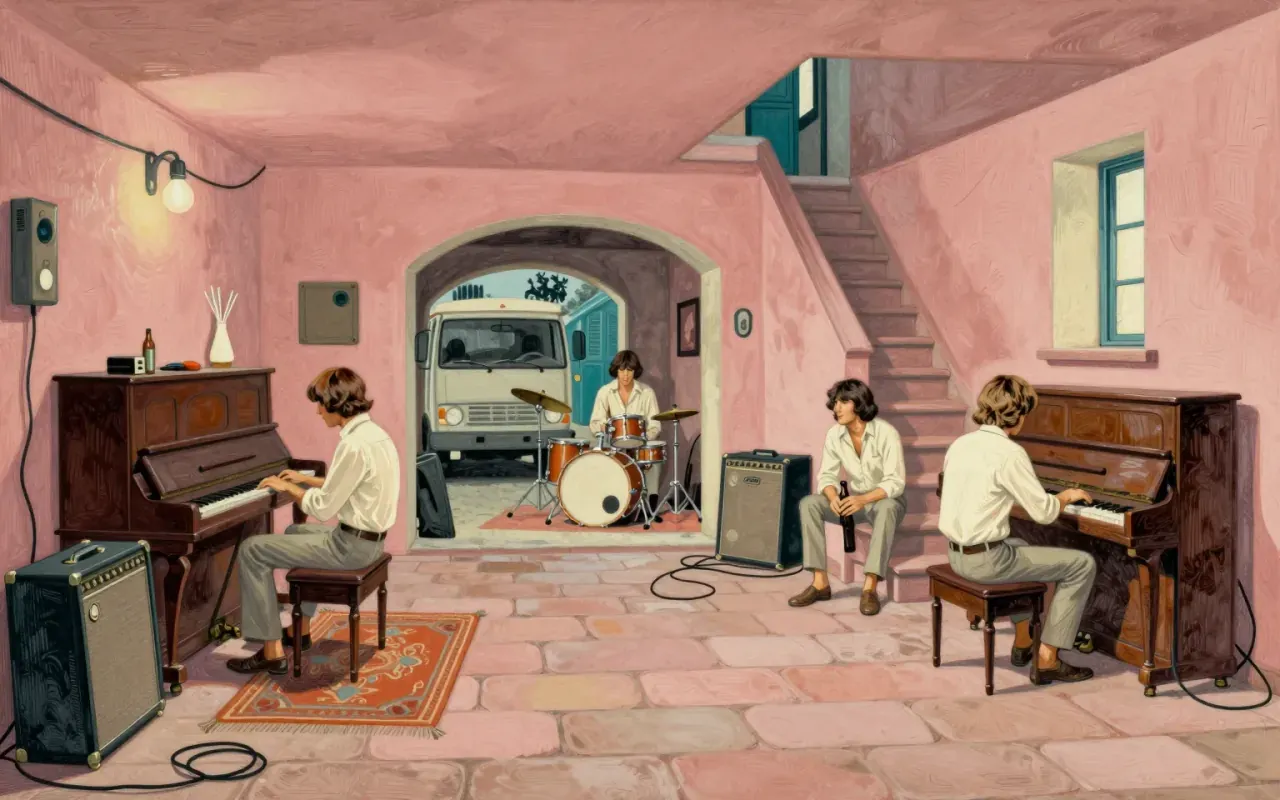
13:00

Exile on Main St.

The Rolling Stones · 1972

Exile on Main St. is the Rolling Stones' tenth studio album, recorded between 1969 and 1972 in sessions that moved from Olympic Studios in London to Keith Richards's rented villa at Nellcote in the south of France, where the band had relocated after a tax dispute, and finally to Sunset Sound in Los Angeles for overdubs. Producer Jimmy Miller worked with a rotating cast including Nicky Hopkins, Bobby Keys and Dr. John. The eighteen-track double album drew on blues, gospel and country and was received coolly at first, before critics spent the rest of the decade reversing that judgement.