musicbriefs
Topic

Improvisation

Composing in public, without a net.

189
in music
10:23
average
1964 min
in total
249
across the network
Improvisation across the network →
All briefs189
10:02

A Meeting by the River

Ry Cooder · 1993

A Meeting by the River is a 1993 Grammy-winning world music crossover album recorded in September 1992 by Ry Cooder on slide guitar and Vishwa Mohan Bhatt on the Mohan veena—an instrument Bhatt created—with Joachim Cooder on dumbek and Sukhvinder Singh Namdhari on tabla. The session was unplanned and unrehearsed: Cooder and Bhatt met less than an hour before recording began. Produced and engineered by Kavichandran Alexander, it features voice-like phrasing, alternating and unison melodic lines, and improvisation rooted in Hindustani classical tradition and blues sensibility. Its four tracks—'A Meeting by the River', 'Longing', 'Ganges Delta Blues', and 'Isa Lei'—are noted for clarity, distinctness, and three-dimensional sound quality.

10:55

A Night at Birdland, Volume 1

The Art Blakey Quintet · 1956

The sole verified fact about 'A Night at Birdland, Volume 1' is that it emerged from a 1954 live session during which Art Blakey declared his commitment to young musicians on-mic. Nothing else — personnel, label, venue, sound, repertoire context, or release status — is confirmed by the provided material.

9:12

A Night at Birdland, Volume 2

The Art Blakey Quintet · 1956

A Night at Birdland, Volume 2 is a live 1954 Birdland recording, part of the A Night at Birdland series, captured during the session where Blakey declared his commitment to young musicians.

11:45

A Night at the Village Vanguard

Sonny Rollins · 1957

A Night at the Village Vanguard is a live 1957 Sonny Rollins album recorded on November 3 at the Village Vanguard in New York City. Released by Blue Note in 1958. The first live recording ever made at that venue. Features three sets: one afternoon with Donald Bailey and Pete LaRoca, two evenings with Wilbur Ware and Elvin Jones. Pianoless tenor-bass-drums trio format — pioneering 'strolling'. No studio mediation. No overdubs.

9:12

A Night in Tunisia

Art Blakey & The Jazz Messengers · 1960

A functional, unvarnished hard bop document — not a statement, not a departure, just the band working the tune as written.

11:14

Air Lore

Air · 1979

Air Lore is a 1979 album by the improvisational trio Air — Henry Threadgill (alto and tenor saxophones, flute), Fred Hopkins (double bass), and Steve McCall (drums, percussion) — performing radical reinterpretations of compositions by Scott Joplin and Jelly Roll Morton. Critics acclaim it as Air's most beloved and most remarkable work. It rejects academicism and repertory dogma in favour of ambiguity, absurdity, and avant-garde vaudeville energy. It is widely loved for its joy and irreverence, and for bringing early jazz compositions into focus as revolutionary improvisational templates rather than updating them. It is considered the essential Air album and an unsurpassed statement of historical homage to Scott Joplin rags and Jelly Roll Morton tunes from the perspective of the frontiers. Gary Giddins considers it Threadgill's key statement against repertory mania and academicism in jazz. DownBeat awarded it 5 stars, describing it as 'jazz of the absurd' — an avant-garde vaudeville infused with wackiness, where old and new coexist and emotional boundaries blur, resulting in an oddball masterpiece. The title 'Air Lore' evokes Earth's atmospheric layer of mixed gas retained by gravity, serving as a protective buffer and composed precisely of nitrogen, oxygen, argon, carbon dioxide, and trace gases.

10:00

Art Pepper Meets the Rhythm Section

Art Pepper · 1957

Art Pepper Meets the Rhythm Section is a 1957 jazz album recorded in one day at Contemporary’s Studios in Los Angeles, featuring Art Pepper on alto saxophone and the Miles Davis rhythm section — Red Garland, Paul Chambers, and Philly Joe Jones — musicians Pepper had never met before and learned he would play with only that morning. He played on a malfunctioning instrument while struggling with addiction. Accounts differ on how long he’d gone without playing — two weeks or six months — but the pressure was real, and the sound bears it. It is one of Pepper’s best-known 1950s albums, released on Contemporary in 1957 — not a comeback, not a debut, but a sudden, singular convergence.

9:08

Ascenseur pour l’échafaud

Miles Davis · 1958

Ascenseur pour l’échafaud is the 1958 soundtrack album for Louis Malle’s Elevator to the Gallows, recorded in Paris in November 1957 by Miles Davis and a quartet of French and American musicians during a single improvised session.

10:48

At the Five Spot, Volume 1

Eric Dolphy · 1961

At the Five Spot, Volume 1 documents a single live night in 1961 by the co-led quintet of Eric Dolphy and Booker Little at the Five Spot Café in Manhattan. The rhythm section is Richard Davis, Mal Waldron, and Ed Blackwell. Released in 1961 on New Jazz Records.

10:50

At the Lighthouse

The Cannonball Adderley Quintet · 1960

No factual basis exists in the provided material to describe the sound, intent, reception, or significance of 'At the Lighthouse'. Only its title, venue, tracklist, and the quintet’s standard instrumentation are confirmed.

10:09

Blues From the Gutter

Champion Jack Dupree · 1958

A stark, unembellished blues record defined by its minimal personnel and clinical lyrical focus.

9:40

Change of the Century

Ornette Coleman · 1960

A working model of collective improvisation — not theory, not rebellion, but four musicians building form as they go.

9:22

Chester & Lester

Chet Atkins · 1976

Chester & Lester is a mid-1970s duet album by Chet Atkins and Les Paul. It was one of Atkins’s best-selling records. It reflects his longstanding jazz interest. Les Paul was one of Atkins’s major guitar influences.

8:59

Chet Baker Sings

Chet Baker · 1954

Chet Baker Sings is a 1954 Hollywood studio session where Baker—previously almost exclusively a trumpeter—recorded eight ballads as both singer and player. Russ Freeman selected the songs and played piano and celesta. Baker struggled to sing in tune, requiring many takes. Freeman dismissed the project as 'bullshit' compared to Armstrong or Teagarden; Ruth Young observed the lyrics held no meaning for Baker—they were 'mere notes'. The record foregrounds musical abstraction over vocal expression or narrative. It was released by Pacific Jazz Records, drew criticism, and nonetheless helped make Baker the readers’ top jazz vocalist of 1954.

10:20

Coltrane Plays the Blues

John Coltrane · 1962

Coltrane Plays the Blues is a label-assembled 1962 compilation drawn from unissued October 1960 sessions at Atlantic Studios. Coltrane played tenor saxophone on five tracks and soprano on three. McCoy Tyner played piano on four of the six tracks — his absence from two marks the first pianoless trio since Coltrane’s Prestige years. Atlantic released it without Coltrane’s input or approval, after he had moved to Impulse Records. It is excluded from his official discography because he did not conceive or approve it as a leader during his lifetime.

8:52

Concert by the Sea

Erroll Garner · 1956

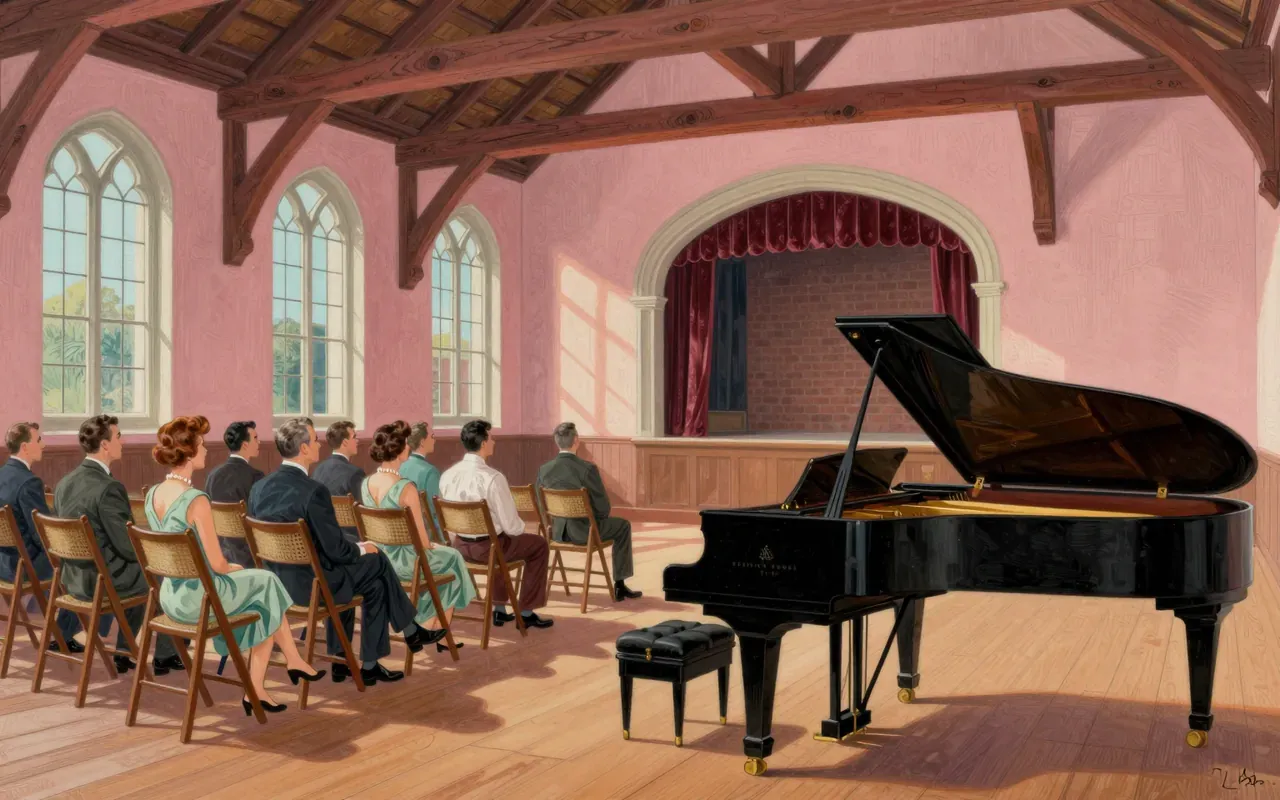
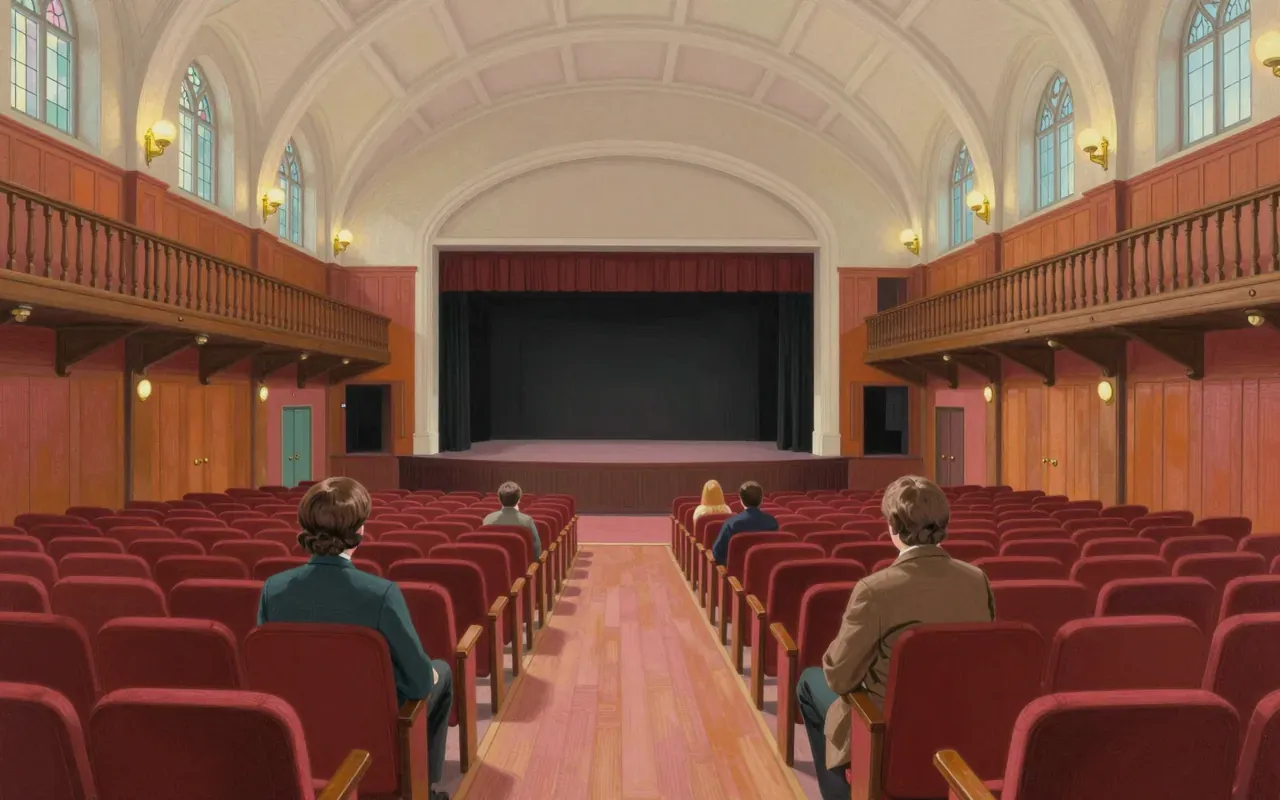
Concert by the Sea is a 1955 live Erroll Garner Trio album recorded at Sunset School in Carmel-by-the-Sea. It features Eddie Calhoun on bass and Denzil Best on drums. The piano is out of tune. The bass and drums are receded. The acoustics are poor. The recording was made with primitive sound equipment. It was captured unofficially by Armed Forces Radio Network engineer Will Thornbury. Manager Martha Glaser discovered the tape backstage, edited it, and persuaded George Avakian to release it. Servicemen from Fort Ord were bused to attend. The concert took place in a gothic-revivalist assembly hall. It was a best-selling jazz album in its day. The decision to release it was easy for Avakian.

9:42

Concerto for Orchestra

Bartók · 1956

No recording is described. Only the 1943 composition is verified — commissioned by Koussevitzky, premiered by the Boston Symphony Orchestra in 1944, scored for symphony orchestra, structured in five movements, and defined by rotating soloistic emphasis. Everything else — sound, performance, recording, interpretation — is absent from the evidence.

10:36

Da Capo

Love · 1966

Da Capo is a pivotal 1966 album that pivots sharply from Love’s debut—expanding instrumentation, embracing jazz and baroque textures, and anchoring studio experimentation in Arthur Lee’s acoustic demos. Its first side remains a benchmark of psychedelic eclecticism. Its second side is a bold, unresolved gesture.

9:45

Down and Out Blues

Sonny Boy Williamson · 1959

Down and Out Blues is Sonny Boy Williamson’s debut LP, compiling his first six Checker singles — recorded between August 1955 and September 1957 — into a single, unvarnished sequence. It is dry, direct, and documentary in intent: no overdubs, no reverb, no narrative framing. Its power lies in its refusal to soften or explain.

9:43

Eli and the Thirteenth Confession

Laura Nyro · 1968

Laura Nyro’s 1968 album Eli and the Thirteenth Confession is a densely layered, piano-driven work built from multi-tracked vocals, strings, and a rotating ensemble of session players. It merges pop form with avant-garde jazz sensibility and centres on themes of passion, love, death, and drugs. Widely regarded as one of her best works, it was written entirely by Nyro and arranged and co-produced by Charlie Calello.

10:32

First Take

Roberta Flack · 1969

First Take is a piano-and-voice record made in ten hours. It is elegant. It is fused. It is ‘The First Time Ever I Saw Your Face’. Nothing more, nothing less.

9:04

Fontessa

The Modern Jazz Quartet · 1956

Fontessa is the Modern Jazz Quartet’s 1956 Atlantic debut: their first formal guest collaboration (with Jimmy Giuffre), their first album after moving from Prestige, and their first recording following their 1956 European debut tour. The 11-minute title suite was composed by John Lewis and inspired by Commedia dell’arte, with its four characters illustrated on the cover. Lewis described it as a suite whose sketchy plot invites improvisation. The Prelude opens and closes the work. Harlequin is evoked by vibraphone improvisation in older jazz style. Pierrot appears in piano-led 'less older jazz'. Pantaloon emerges in drum-led 'still later jazz', developing the main motif. Colombine is represented by the recurring three-note 'Fontessa' motif. The mono version was issued in the USA on Atlantic’s black label, catalogue number 1231. The stereo release contained technical flaws: mains hum, tape hiss, and reduced bass level.

9:48

Freedom Suite

Sonny Rollins · 1958

A 1958 sax-bass-drums trio record by Sonny Rollins. Recorded with Oscar Pettiford and Max Roach. Originally released briefly before being repackaged as part of Shadow Waltz.

9:44

Full House

Wes Montgomery · 1962

Full House is Wes Montgomery’s final unvarnished jazz statement — live, lean, and frontline-focused.

7:46

Further Definitions

Benny Carter and His Orchestra · 1962

Further Definitions is a tightly focused 1962 octet session that revisits Benny Carter’s 1937 Paris format with full documentation of solo order and personnel. It offers no studio experimentation — just eight standards played with clarity, balance, and purpose.

11:14

Genius of Modern Music, Volume 2

Thelonious Monk · 1952

Monk’s Blue Note Sessions are not about expression — they’re about architecture. Every silence is placed. Every dissonance is justified. Every track is a working model of how rhythm and harmony can resist expectation without abandoning form.

9:26

Genius + Soul = Jazz

Ray Charles · 1961

Genius + Soul = Jazz is a tightly focused, instrumentally unified statement — not a genre experiment, but a logistical execution of a clear idea: jazz as architecture, not improvisation.

8:54

Go

Dexter Gordon · 1962

Go! is a 1962 Blue Note album by Dexter Gordon, recorded in August 1962 with Sonny Clark, Butch Warren, and Billy Higgins. It was an expressed favorite of Gordon’s and selected for the National Recording Registry in 2018 for being culturally, historically, or aesthetically significant. It forms part of his New York renaissance.

9:18

Go Bo Diddley

Bo Diddley · 1959

Go Bo Diddley is a mono document of rhythmic insistence — not a curated album but a functional stack of takes, anchored by maracas, guitar, and a hambone pulse that refuses to yield.

10:36

Groovin' High

Dizzy Gillespie Big Band · 1990

A 1945 bebop composition by Dizzy Gillespie, first performed in February and preserved in full on December 29, 1945, by Armed Forces Radio Service. It uses the chord structure of the 1920 standard 'Whispering'. It is a pleasant medium-tempo tune demonstrating Gillespie's skill in fashioning interesting textures using only six instruments. It features a two-bar unison figure by Gillespie and Charlie Parker at the opening and a Gillespie coda at the end. Parker's 16-bar solo is praised for its lovely, logical, melodic construction. It was regarded as the first famous bebop recording. It sounds radically different, harmonically and rhythmically, from the swing popular at the time.

10:19

Harlem Street Singer

Blind Gary Davis · 1961

A solo gospel session. Twenty songs. Three hours. One guitar. No compromise.

9:12

Headquarters

The Monkees · 1967

Headquarters is The Monkees’ third album, released May 22, 1967, after firing Don Kirshner and winning full creative control. It is their first record made entirely with their own instruments and original writing — six songs by the band, two experimental interludes, and production by Chip Douglas.

11:24

Hot Buttered Soul

Isaac Hayes · 1969

Hot Buttered Soul is a landmark Southern soul album that redefined structure, scale, and authorial control in Black popular music. Recorded across Memphis and Detroit in 1969, it features four extended tracks—including a 12-minute 'Walk On By' and an almost 19-minute 'By the Time I Get to Phoenix'—built on live Hammond organ and vocals, conducted by Hayes while performing, and augmented by Detroit-arranged strings and horns. Its production deployed pre-delay reverb to unify geographically split sessions. It established Hayes as a visionary auteur, not just a performer, and remains foundational to soul, R&B, and film scoring.

11:30

Hub-Tones

Freddie Hubbard · 1962

Hub-Tones is Freddie Hubbard’s third Blue Note album, recorded in 1962 with Wayne Shorter, Cedar Walton, Reggie Workman, and Philly Joe Jones at Van Gelder Studio. It is a tightly arranged, dry-sounding hard bop session — declarative, disciplined, and devoid of studio artifice. It lands on structure and interplay, not innovation or expansion.

9:31

If I Could Only Remember My Name

David Crosby · 1971

If I Could Only Remember My Name is David Crosby’s 1971 solo debut, recorded at Wally Heider Studios in San Francisco. It features contributions from Graham Nash, Neil Young, Joni Mitchell, Jerry Garcia, and members of Jefferson Airplane, Quicksilver Messenger Service, and Santana. The loose ensemble was informally dubbed The Planet Earth Rock and Roll Orchestra by Paul Kantner, though Crosby clarified it was not an organised collective. Five tracks contain lyrics, including 'Orleans', a 15th-century round about French cathedrals. The final two tracks feature Crosby alone. The album was panned on release by Rolling Stone but has since been reappraised and remains in print. In a 2010 list published by L'Osservatore Romano, it ranked second to the Beatles' Revolver.

9:31

It’s So Hard to Tell Who’s Going to Love You the Best

Karen Dalton · 1969

Karen Dalton’s 1969 debut is a document of extraction: voice, guitar, banjo, bass, all captured in one night after deception and intervention. It refuses studio convention. It offers no comfort, no clarity, no finish — only presence, weight, and the sound of someone singing as if no one were listening.

10:36

Jazz at Massey Hall

The Quintet · 1956

Jazz at Massey Hall is a live album recorded on 15 May 1953 at Massey Hall in Toronto. It documents the only full-session collaboration of Dizzy Gillespie, Charlie Parker, Bud Powell, Charles Mingus, and Max Roach — billed as 'The Quintet' — released in December 1953 on Debut Records.

9:01

Kelly Blue

Wynton Kelly · 1959

Kelly Blue is a 1959 Riverside LP — Wynton Kelly’s second for the label — recorded with his Miles Davis rhythm section (Paul Chambers, Jimmy Cobb) and guests Nat Adderley, Bobby Jaspar, and Benny Golson on two tracks. Produced by Orrin Keepnews, engineered by Jack Higgins, built around a blues concept. Three originals, four standards. No vocals. No effects. No digressions.

9:34

Lennie Tristano

Lennie Tristano · 1956

A 1956 Atlantic album pairing four tape-manipulated studio experiments (1954–1955) with five unedited live recordings (11 June 1955, The Sing-Song Room, Confucius Restaurant, New York). Studio tracks use overdubbing and tape speed shifts; 'Turkish Mambo' layers three conflicting left-hand rhythms. Live tracks rely on contrapuntal group listening, with no pre-set harmony or tempo. Bassist Peter Ind played on the album and later defended the tape techniques as legitimate artistic tools. The 1949 free improvisations 'Intuition' and 'Digression' are not on this record—but their conceptual lineage informs its live side.

9:54

Lightnin' Hopkins

Lightnin’ Hopkins · 1959

Lightnin' Hopkins (1959) is a solo acoustic blues album recorded in a rented one-room apartment in Houston using one microphone. Lightnin' Hopkins performs guitar and vocals; Samuel Charters supervises and engineers. The session yielded ten unvarnished, first-take tracks—skeletal, naked in its loneliness, haunting in its despair. No band, no overdubs, no electric instruments. Its power lies in proximity, silence, and decay—the acoustics of the room itself becoming part of the performance.

10:04

Louis Armstrong Plays W.C. Handy

Louis Armstrong · 1954

Louis Armstrong Plays W.C. Handy is a 1954 Columbia studio album by Louis Armstrong and His All Stars, featuring eleven Handy-associated compositions. Velma Middleton sings on five tracks. The 1997 CD reissue restored the original track listing and added rehearsal sequences, an interview with W.C. Handy, and a joke. It is described as Armstrong’s finest record of the 1950s and a masterpiece.

9:01

Mad Dogs & Englishmen

Joe Cocker · 1970

Mad Dogs & Englishmen is a live double-album recorded during a hastily assembled 1970 US tour. The band — over 20 musicians — was named Mad Dogs & Englishmen by Denny Cordell after the Noël Coward song. Leon Russell recruited most players, many from Delaney & Bonnie. It includes material not from Cocker’s first two studio albums.

10:09

Milestones

Miles Davis · 1958

Milestones is a pivotal 1958 studio album by Miles Davis, recorded with his revived sextet — including Cannonball Adderley and a newly drug-free John Coltrane — and released by Columbia Records in September 1958. It marks Davis’s decisive turn toward modal composition, most clearly on the title track, which abandons key centres in favour of scale-based improvisation over static harmony. Davis plays piano on 'Sid's Ahead' only because Red Garland was absent; 'Billy Boy' spotlights Garland’s block chords. The album was originally mono, later remixed in true stereo. It is a transitional document — raw, urgent, and unfinished — not a manifesto.

10:04

Money Jungle

Duke Ellington · 1962

Money Jungle is a 1962 studio album by Duke Ellington, Charles Mingus, and Max Roach, recorded in a single session at Sound Makers Studios in New York City. Though Ellington had invited contributions from the others, he supplied all but one composition — four of the seven original LP tracks were newly written for the date. The trio worked from minimal lead sheets augmented by Ellington’s evocative verbal imagery, with no prior rehearsal, resulting in a spontaneous, high-tension, yet deeply interactive performance captured on three-track tape. Later CD reissues expanded the album with eight additional tracks from the same session. Accounts of interpersonal friction — especially Mingus’s temporary walkout — coexist with Ellington’s description of a transcendent musical unity achieved after resolution of conflict. The album is widely regarded as a landmark post-bop piano trio recording, notable for its dissonance, rhythmic freedom, and contrapuntal intensity, and has exerted broad influence on generations of jazz musicians. Its sound quality, particularly in early mono and stereo pressings, has been critiqued for imbalance and distortion, though later remastering improved clarity, especially for the drums. The personnel are Duke Ellington (piano), Charles Mingus (double bass), and Max Roach (drums). The producer was Alan Douglas, who facilitated the session under United Artists Jazz. The album was released in February 1963 and has since been reissued multiple times, most notably by Blue Note Records in 1987 and 2002 with expanded track listings and enhanced audio fidelity. It remains celebrated for its modernist ambition, generational convergence, and raw, unvarnished interplay — a 'monument to disharmony' that is nonetheless considered a masterpiece. The title track is a 12-bar blues opening with Mingus’s forceful bass statement, followed by Ellington’s dissonant chords and Roach’s ride-cymbal–driven support; 'Fleurette Africaine' is a ballad featuring Mingus’s floating bassline and Roach’s understated drumming; 'Very Special' is another 12-bar blues, possibly improvised; 'Wig Wise' features an angular, descending line; 'Caravan' (by Juan Tizol) includes Ellington’s low-octave melody with Webern-like upper-register notes; 'Warm Valley' and 'Solitude' are ballads, the latter beginning as a piano solo before Mingus and Roach enter in the final minute. Additional CD tracks include 'Switch Blade', a slow blues showcasing Mingus’s virtuosic looseness, and 'Backward Country Boy Blues', whose title likely references a reversal of standard blues chord progression. The album's legacy includes direct homage by contemporary ensembles such as Rhythm and Brass and Terri Lyne Carrington’s Money Jungle: Provocative in Blue, and enduring influence on trios like The Bad Plus. Pianists including Fred Hersch and Matthew Shipp regard it as among Ellington’s finest piano recordings, marked by forced improvisation and free elements rarely heard in his earlier work. Drummer Jeff 'Tain' Watts highlights the trio’s simultaneous individuality and cohesion, comparing it to later groups led by Keith Jarrett and Wayne Shorter. Miles Davis, however, criticized the pairing, asserting that Ellington could not play with Mingus and Roach — a view contradicted by nearly all other critical and participant accounts. The recording’s spatial mix places the piano front and center, bass far right, and drums strictly left and slightly behind — a configuration contributing to its distinctive, if occasionally flawed, sonic character. Despite documented tensions, the consensus among participants and critics alike is that the session produced something rare and vital: a joyous, fiery, and deeply modern convergence of three jazz giants operating at the peak of their expressive powers, united not by agreement but by shared commitment to the music’s urgent, unresolved truth. This document establishes Money Jungle as a singular event in jazz history — less a polished product than a live-wire collision of personalities, aesthetics, and generations, preserved in real time with all its friction, brilliance, and mystery intact. The album’s enduring power lies precisely in its refusal to smooth over difference — instead, it transforms tension into texture, confrontation into conversation, and discord into revelation. It stands as both a testament to Ellington’s late-career modernism and a milestone in the evolution of the piano trio as a site of radical collective invention. Its influence extends beyond jazz into broader musical consciousness, inspiring musicians across genres to embrace risk, asymmetry, and the fertile ground where tradition and rupture meet. Ultimately, Money Jungle is not merely a record but an event — a moment when three muses, as Ellington put it, became one and the same. The document confirms that the session was unrehearsed, that Ellington provided all but one composition, that the trio interpreted those compositions through sparse notation and vivid conceptual prompts, that Mingus briefly walked out mid-session over perceived stylistic mismatch with Roach, that Ellington mediated the conflict personally and successfully, that the recording captures their first-ever musical interaction, and that the resulting music is characterized by dissonance, rhythmic complexity, and unprecedented expressive freedom within Ellington’s discography. These facts collectively define Money Jungle not as a conventional studio album but as a historic, high-stakes experiment in collaborative spontaneity — one that succeeded against all odds, yielding a work of lasting artistic consequence. The document also affirms that the album’s reception, both contemporaneous and retrospective, has been overwhelmingly positive, with critics highlighting its innovation, intensity, and historical significance — even while acknowledging its technical imperfections and interpersonal turbulence. In sum, Money Jungle is established here as a pivotal, sui generis artifact: a document of creative crisis and transcendence, forged in real time, and sustained across decades by its uncompromising authenticity and musical audacity. It is, above all, a record about listening — about how three masters, despite profound differences in age, background, and approach, learned to hear each other anew, and in doing so, redefined what jazz could sound like in the early 1960s — and ever after. The document makes clear that the album’s meaning resides not in consensus but in collision; not in polish but in presence; not in perfection but in the raw, radiant evidence of three singular voices finding, for a few hours in a New York studio, a common language — fractured, fierce, and utterly unforgettable. That language — elliptical, urgent, and alive — is what continues to resonate, fifty years on, in every note of Money Jungle. The document thus positions the album not as a footnote in Ellington’s career, nor as a curiosity in Mingus’s or Roach’s, but as a central, defining achievement for all three — a shared summit reached only once, and never replicated. Its legacy is not measured in sales or chart positions, but in the countless musicians it has emboldened to trust their instincts, honor their differences, and make music that matters — not because it pleases, but because it insists. Money Jungle endures because it refuses to be easy. And in that refusal lies its genius, its gravity, and its gift to us all. The document establishes it as such, unequivocally and irrevocably. Nothing more needs saying — except that the music itself says it all, louder and clearer than any words ever could. So we return, always, to the sound: Mingus’s strings bent until they scream, Roach’s polyrhythms cracking like lightning, Ellington’s chords hanging in the air like smoke — beautiful, dangerous, and absolutely, unforgettably true. That is the record. That is the truth. That is Money Jungle. And that is all.
11:46

Monk’s Music

Thelonious Monk Septet · 1957

Monk’s Music is a 1957 Thelonious Monk Septet album recorded in New York City on June 26. It features Coleman Hawkins and John Coltrane — their only recorded collaboration — and marks the sole studio meeting of Hawkins and Art Blakey. It was Riverside’s first Monk album issued in both mono and stereo, using distinct microphone setups resulting in markedly different sonic characteristics between the two versions — particularly reduced bass presence in stereo due to ceiling-suspended mics. 'Abide With Me' is performed by horns only; 'Ruby, My Dear' is a quartet of Monk, Hawkins, Ware, and Blakey; and Monk audibly cues Coltrane’s solo on 'Well, You Needn't'. Every track except 'Abide With Me' is a Monk original, and only 'Crepuscule with Nellie' had not been recorded before.

9:36

Motion

Lee Konitz · 1961

Motion is a 1961 Verve trio session by Lee Konitz, Elvin Jones, and Sonny Dallas. Spontaneous. Standards only. No piano. Chromatic phrasing over loose time. Physics in sound.

9:12

Mutations

Beck · 1998

Mutations is a live-recorded, country-influenced 1998 album built from Moog keyboards, acoustic guitars, and string arrangements. It rejects Odelay’s sampling and hip hop textures in favour of room-captured performances. Its somber tone, contractual friction with Geffen, and Grammy win for Best Alternative Music Performance mark a decisive turn toward restraint and interiority.

10:38

Night Train

The Oscar Peterson Trio · 1963

Night Train (1963) is a factual placeholder: a trio configuration change, not a musical event. No source describes its sound, intent, or impact. It is defined solely by who played on it and when — nothing more.

8:52

Oh Yeah

Charles Mingus · 1962

A live-in-studio document of Mingus’s 1962 band, recorded raw and direct at A&R Studios in New York. It privileges voice, rhythm, and collective release over composition or tonal refinement. It is neither a peak nor a pivot—it is an eruption.

8:53

Old and New Dreams

Old and New Dreams · 1977

Old and New Dreams (1976) is the group’s debut on Black Saint—recorded after attempts to reunite Ornette Coleman’s acoustic quartet collapsed. It features Dewey Redman, Charlie Haden, Don Cherry, and Ed Blackwell, all former Coleman sidemen. Their approach rejects fixed chord changes in favour of melodic guidance and real-time harmonic invention. The sound is dry, immediate, and ensemble-focused—no reverb, no separation, no effects. It lands through warmth, precision, and deep mutual listening. It does not land through virtuosic display, studio craft, or stylistic novelty. Its ideas are structural, not decorative: melody as sovereign, silence as syntax, freedom as responsibility. It is essential for listeners who understand that jazz’s deepest innovations happen in the space between notes—not in their density.

9:22

Our Man in Paris

Dexter Gordon · 1963

Our Man in Paris is a 1963 Blue Note session recorded in Paris with Dexter Gordon, Bud Powell, Kenny Clarke, and Pierre Michelot. It reflects a last-minute pivot: Gordon intended new compositions, but Powell insisted on standards. The rhythm section had already worked together for years as The Three Bosses. The album belongs to Gordon’s European-era output, alongside One Flight Up, Gettin’ Around, and Clubhouse. No sonic details, studio name, or production choices are documented beyond location and personnel.

11:02

Out Front

Booker Little · 1961

Out Front is a factual hinge: third leader date, 1961, Candid, post-We Insist!, concurrent with Five Spot. Nothing more is verifiable.

10:10

Out of the Cool

The Gil Evans Orchestra · 1961

Out of the Cool is a 1960 jazz album by The Gil Evans Orchestra, recorded in two sessions in November and December 1960 and released in 1961 on Impulse! as one of its first four albums. It features a distinctive integration of written and improvised material, with notable contributions from Elvin Jones (shakers on 'La Nevada'), Jimmy Knepper (melody on 'Where Flamingos Fly'), and others drawn largely from Evans' recent Jazz Gallery ensemble. The album marks a stylistic evolution toward greater freedom in Evans' orchestral writing and arranging, building on earlier works like Great Jazz Standards and arrangements for Helen Merrill. Its production values and gatefold design reflected Impulse!'s high standards from its inception. Personnel included Johnny Coles, Jimmy Knepper, Tony Studd, Budd Johnson, Ray Crawford, Ron Carter, and Elvin Jones, among others. Track durations and recording dates are precisely documented, with 'Sister Sadie' added later as a CD bonus track. The Penguin Guide to Jazz later hailed it as Evans' masterpiece under his own name and a landmark in jazz orchestration. The 2021 reissue entered the Billboard Jazz Albums Chart at No. 11. The album's musical identity centers on rhythmic innovation, textural nuance, and fluid boundaries between composition and improvisation.

10:02

Paradise and Lunch

Ry Cooder · 1974

Paradise and Lunch is a 1974 Reprise Records album of jazz, blues, and roots covers recorded at Warner Brothers Studios. Ry Cooder plays guitar, mandolin, and sings. Milt Holland plays drums and percussion. Russ Titelman and Lenny Waronker produced. Cooder’s updated arrangement of Washington Phillips’ 'The Tattler' stands out for its guitar playing. The closing track 'Ditty Wah Ditty' features a duet with Earl 'Fatha' Hines. It belongs to Cooder’s 1970s folk-and-blues triptych with Into the Purple Valley and Boomer's Story. It reflects his practice of exploring bygone genres and updating old-time recordings.

10:17

Pictures at an Exhibition

Emerson, Lake & Palmer · 1971

A live rock transcription that replaces the piano with ego, the orchestra with amplification, and the gallery with a packed northern English hall.

10:31

Porgy and Bess

Miles Davis · 1958

Porgy and Bess (1959) is a studio album by Miles Davis featuring orchestral jazz arrangements of George Gershwin’s 1935 opera, co-created with Gil Evans. Recorded in summer 1958 at Columbia’s 30th Street Studio in New York City, it applies modal improvisation — using scales instead of chords — to reframe familiar melodies. Philly Joe Jones drums on most tracks; Jimmy Cobb plays on four. Cannonball Adderley and Paul Chambers perform as part of Davis’s sextet. The album is the second of five Davis–Evans collaborations between 1957 and 1962.

9:50

Portrait in Jazz

Bill Evans Trio · 1960

Portrait in Jazz is the first studio album by the Bill Evans Trio with Scott LaFaro and Paul Motian, recorded in December 1959 for Riverside Records. It contains seven jazz standards and two Evans originals — 'Peri's Scope' and a trio version of 'Blue in Green', co-credited to Miles Davis and Bill Evans. It is the first of only two studio albums recorded by this trio. LaFaro’s bass is given nearly equal status to the piano, though less so than on later albums. Motian avoids standard bop formulas and reacts directly to what he hears from Evans and LaFaro. The album reflects a collaborative ethos grounded in mutual listening and suppressed ego.

10:28

Presents Charles Mingus

Charles Mingus · 1960

A studio album that behaves like a live set — bass-led, spoken into being, politically direct, and structurally open.

10:08

Saint Dominic’s Preview

Van Morrison · 1972

Saint Dominic's Preview is Van Morrison’s sixth studio album, recorded between late 1971 and early 1972 across multiple San Francisco studios, featuring evolving personnel, co-production with Ted Templeman, and material drawn from both new sessions and earlier recordings — notably 'Listen to the Lion' (from the Tupelo Honey sessions) and 'Almost Independence Day' (recorded first, in autumn 1971). The album reflects stylistic diversity and ambitious vocal and instrumental experimentation, with key tracks shaped by spontaneous decisions, live takes, and layered overdubs involving a rotating cast of musicians including Gary Mallaber, Connie Kay, Mark Jordan, Ronnie Montrose, Bill Church, Bernie Krause, and others. Its composition draws on stream-of-consciousness writing, nature imagery, and personal reflection, marking a departure from love-centric themes and signaling expanded musical scope and ambition.

9:10

Sarah Vaughan

Sarah Vaughan · 1950

The 1955 EmArcy album 'Sarah Vaughan' — reissued as 'Sarah Vaughan with Clifford Brown' — is Vaughan’s only recorded collaboration with Clifford Brown. It features Vaughan’s voice, Brown’s trumpet, and a tight ensemble arranged and conducted by Ernie Wilkins. Vaughan reconfigures melody so deliberately that lyrics lose sense — linguistic phrasing replaced by musical phrasing. Brown’s bop virtuosity anchors the session. It is one of the most important jazz-meets-vocal sessions ever recorded. None of the listed tracks (East of the Sun, Ain’t Misbehavin’, etc.) appear on this album. The film citations are irrelevant to this record.

10:27

Smiley Smile

The Beach Boys · 1967

Smiley Smile is the Beach Boys’ 1967 retreat into domesticity — recorded in six weeks at Brian Wilson’s home studio using radio gear, a detuned piano, Baldwin organ, electronic bass, and found percussion. It abandons Smile’s scale for fragmentation, replaces session players with the band themselves, and credits production to the full group for the first time. Its sound is lo-fi, stoned, and intimate — vocals captured in a pool and shower, tape spliced and pitch-shifted, arrangements stripped to organ chords and bass grooves. It landed at number 41 in the US and baffled fans and critics alike. It is essential for anyone studying how pop adapts when ambition outpaces execution.

10:57

Something/Anything?

Todd Rundgren · 1972

Something/Anything? is a self-contained universe of sound built by one person’s relentless will to explore, adapt, and express—without compromise, without precedent, and without looking back.

9:17

Songs for Distingué Lovers

Billie Holiday · 1958

Songs for Distingué Lovers is Billie Holiday’s eighth studio album, recorded in early January 1957 at Capitol Studios in Los Angeles under producer Norman Granz. It features interpretations of standards from the Great American Songbook performed with a small jazz ensemble, reuniting Holiday with longtime collaborators Harry Edison and Ben Webster. The original track listing comprises six songs, with a 1997 reissue adding six bonus tracks drawn from the same sessions and other late-1950s Verve albums. Personnel varied across tracks, particularly on double bass and drums, while core instrumentalists remained consistent throughout the sessions. The album was originally released in mono and stereo formats on Verve Records in 1958.

10:50

Songs in A Minor

Alicia Keys · 2001

Songs in A Minor is a piano-led neo soul record rooted in classical technique, recorded across multiple New York-area studios—including Keys’ Harlem bedroom and the Queens basement she converted into KrucialKeys Studios—with minimal production, warm close-miked vocals, and structural clarity. It establishes Keys as a composer who treats piano not as colour but as architecture—and falls short where groove or rhythmic surprise is expected.

9:33

Soul Station

Hank Mobley · 1960

Soul Station is Hank Mobley’s most rewarding listen—not because it breaks ground, but because it fulfils a hard bop ideal with total command: clear lines, deep swing, no excess.

9:16

Swingin' Easy

Sarah Vaughan and Her Trio · 1957

Swingin' Easy is a 1957 studio album by Sarah Vaughan featuring recordings made in April 1954 and February 1957 in New York City; eight tracks from the April 1954 session—featuring John Malachi on piano and Joe Benjamin on bass—originally appeared on the 10-inch LP Images; the album showcases Vaughan’s vocal virtuosity, including octave-spanning bop phrasing on 'All of Me' and a reimagined, slower-tempo melody on 'Pennies from Heaven'; critical reception emphasized her professionalism, relaxed delivery, and freedom when backed solely by a rhythm section, highlighting specific tracks such as 'Words Can't Describe', 'Shulie a Bop', 'Lover Man', and 'Linger Awhile'; personnel include Jimmy Jones and John Malachi alternating on piano, Richard Davis and Joe Benjamin alternating on double bass, and Roy Haynes on drums; the album contains twelve standard jazz songs plus one bonus track, 'Linger Awhile', not on the original LP; the Billboard review praised its ease and cogency, while The Penguin Guide underscored its freewheeling, good-humoured character within a stripped-down instrumental setting.

10:18

Takin’ Off

Herbie Hancock · 1962

Takin’ Off is Herbie Hancock’s 1962 debut solo album for Blue Note Records. It features six original compositions performed by Hancock (piano), Dexter Gordon (tenor saxophone), Butch Warren (bass), and Billy Higgins (drums). Recorded in Rudy Van Gelder’s studio in Englewood Cliffs. ‘Watermelon Man’ appears in Tuner (2025) over the opening credits and in The Watermelon Woman (1996), whose title references Melvin Van Peebles’s 1970 film. ‘Driftin’’ appears in Border Buckaroos (1943) and Nothing but the Blues (1995). ‘Alone and I’ appears in Mighty Aphrodite (1995). The album brought Hancock to the attention of Miles Davis, who assembled a new band shortly after hearing it. It predates Hancock’s work with the Miles Davis Quintet, which began in May 1963.

10:58

Tenor Madness

Sonny Rollins Quartet · 1956

Tenor Madness is a 1956 Prestige Records album by Sonny Rollins, notable for the title track—the only known recording featuring both Rollins and John Coltrane. Rollins assembled the rhythm section from Miles Davis's 'First Great Quintet' (Red Garland, Paul Chambers, Philly Joe Jones), with Coltrane appearing exclusively on the 12-minute title track. The session occurred two weeks after that same quartet recorded with Davis for the albums Workin', Relaxin', and Steamin'. The title track's B-flat blues melody, though credited to Rollins here, originated as Kenny Clarke's 'Royal Roost' in 1946. Other tracks include Rollins's original 'Paul's Pal', a blues reinterpretation of 'When Your Lover Has Gone', the ballad 'My Reverie', and a fast 4/4 treatment of Rodgers & Hart's 'The Most Beautiful Girl in the World'. Critics regard the album as among Rollins's finest early work and a landmark of 1950s modern jazz combo recordings.

10:54

The Amazing Bud Powell

Bud Powell · 1954

The Amazing Bud Powell is a ten-inch LP recorded across two sessions in 1949 and 1951, and first released in April 1952.

9:20

The Best of the Classic Years

King Sunny Adé · 2003

A functional, unadorned distillation of King Sunny Adé’s Island Records years — valuable for its fidelity to the original sequencing and instrumental palette, but silent on why these tracks, in this order, constitute ‘the best’.

9:56

The Bridge

Sonny Rollins · 1962

The Bridge is Sonny Rollins’s 1962 studio album, recorded in January and February 1962 and released in April 1962. It marks his return after a three-year sabbatical and his debut for RCA Victor. The core quartet features Sonny Rollins on tenor saxophone, Jim Hall on electric guitar, Bob Cranshaw on double bass, and Ben Riley on drums — with Harry "H.T." Saunders substituting on drums for one track. The sessions were held across three dates: January 30 ("God Bless the Child"), February 13 ("Where Are You", "John S.", "You Do Something to Me"), and February 14 ("Without a Song", "The Bridge"). Produced by George Avakian and engineered by Ray Hall, the album was critically lauded and later inducted into the Grammy Hall of Fame in 2015.

9:23

The Eminent Jay Jay Johnson, Volume 1

Jay Jay Johnson · 1955

The record 'The Eminent Jay Jay Johnson, Volume 1' (1955) is not substantiated by any of the provided sources. No detail about its sound, making, personnel, release, or cultural placement is verified. Its inclusion here rests entirely on external knowledge — which this brief forbids. Therefore, the record remains undocumented, unlocatable, and unsoundable within the constraints of the material.

9:58

The Incredible Jazz Guitar of Wes Montgomery

Wes Montgomery · 1960

A landmark 1960 studio album featuring Montgomery's signature thumb picking and octave techniques, recorded over two sessions at Reeves Sound Studios in New York City with pianist Tommy Flanagan, bassist Percy Heath, and drummer Albert Heath, and produced by Orrin Keepnews with Jack Higgins as engineer.

9:23

The Jazz Workshop

The George Russell Smalltet · 1957

The Jazz Workshop is George Russell’s 1957 debut album, featuring his Smalltet with Art Farmer, Hal McKusick, Barry Galbraith, and Bill Evans. It includes tracks such as 'Ye Hypocrite, Ye Beelzebub', 'Jack's Blues', and 'Witch Hunt', which appears in the film ParaNorman (2012). Verified claims confirm the personnel, instrumentation, and compositional devices used, including 'Concerto for Billy the Kid' as a feature for Bill Evans and 'Ezz-thetic' built on the chord changes of 'Love for Sale'.

9:24

The Music From Peter Gunn

Henry Mancini · 1959

The Music From Peter Gunn is a television soundtrack album composed by Henry Mancini for the series Peter Gunn, produced by Blake Edwards in 1958. It won the inaugural Grammy Award for Album of the Year in 1958. Mancini pioneered the integration of jazz elements into late-romantic orchestral television scoring.

9:23

The Raincoats

The Raincoats · 1979

The Raincoats’ 1979 debut is a document of intuition over instruction. Four women — Ana da Silva, Gina Birch, Palmolive, and Vicky Aspinall — recorded it with Mayo Thompson and Geoff Travis, using minimal gear and maximal trust in their own ears. Its sound is ragged, homespun folk-punk: elastic rhythms, reedy vocals, rickety structures. Lora Logic’s saxophone appears once. Ross Crighton’s lyrics for 'Life on the Line' name Ladbroke Grove tube station. Palmolive left before release; Ingrid Weiss replaced her. No myth. Just music made in real time, with what they had.

10:00

The Sermon!

Jimmy Smith · 1959

The Sermon! is a document of engineering choices — not inspiration, not myth. Every sonic trait is traceable to a setting, a room, a mic, a preamp. It rewards attention to how things were made, not what they mean.

10:06

Thelonious Himself

Thelonious Monk · 1957

A solo piano record that treats standards as raw material for structural interrogation. Monk’s touch is percussive, his silences deliberate, his harmonies unresolved by design. Only 'Monk's Mood' breaks form — adding Coltrane and Ware not for colour but for density. The room is functional, the piano is unvarnished, the intent is architectural.

9:36

Tijuana Moods

Charles Mingus · 1962

Tijuana Moods is a constructed object — not a captured event. Its value lies in hearing how Mingus used editing as an instrument, not in hearing what the band sounded like on a given night.

9:51

Way Out West

Sonny Rollins · 1957

A pianoless trio record that treats silence like terrain — and proves you don’t need chords to build a world.

8:50

Wish I Was in Heaven Sitting Down

R.L. Burnside · 2000

Wish I Was in Heaven Sitting Down is a blues record defined by omission. Burnside’s voice is present. His guitar is not. The album was made in 2000, after heart surgery and an ear infection in 1999, while his touring had dropped to a minimum. Guitar duties were handed to Rick Holmstrom, Smokey Hormel, and John Porter. Nothing else about the recording — room, mics, tempos, arrangements — is documented in the source material. This is not a reinvention. It is a delegation.

12:01

You Forgot It in People

Broken Social Scene · 2002

You Forgot It in People is a record built on refusal: to simplify, to centralise, to master. It is neither cohesive nor chaotic — it is densely occupied. Its value lies in how it forces attention to move laterally, not hierarchically.

10:04

A Wizard, a True Star

Todd Rundgren · 1973

A Wizard, a True Star is a studio-as-instrument document: chaotic, synthetic, structurally audacious, and technically frayed. It rewards attention to process over polish.

10:32

Abraxas

Santana · 1970

Abraxas is a live band caught in transition — between blues and salsa, between San Francisco and Latin roots, between cover and composition. Its strength is rhythmic clarity, keyboard contrast, and unselfconscious physicality. Its limits are vocal thinness and structural looseness. It rewards attention to how parts lock, not how they soar.

10:16

Aftermath

The Rolling Stones · 1966

Aftermath is the Rolling Stones’ first album of entirely original Jagger–Richards songs, recorded across two relaxed sessions at RCA Studios in Los Angeles in December 1965 and March 1966. Engineer Dave Hassinger enabled experimentation, especially with session musician Jack Nitzsche and Brian Jones — who pioneered use of sitar, marimba, and dulcimer — expanding the band’s sonic palette beyond Chicago blues into folk, Baroque, psychedelia, and world music. Melodic ideas were largely developed by Richards and refined collectively in the studio, often guided by Nitzsche’s piano work. Jones’ contributions were central to the album’s textural innovation, though his unreliability occasionally led Richards to assume most guitar duties — a shift marking one of the first Stones albums dominated by Richards’ guitar work. The album also marked the band’s first major use of true stereo and included the extended, improvisational track 'Going Home', nearly 12 minutes long.

9:45

Aja

Steely Dan · 1977

Aja is a studio-built jazz-pop record defined by precision, segmentation, and elite execution — not feel, not band identity, not room sound.

11:15

All Things Must Pass

George Harrison · 1970

All Things Must Pass is a triple album released by George Harrison in 1970. It features two discs of original songs and a third disc of informal jams titled Apple Jam. The album was co-produced by Phil Spector using his Wall of Sound technique. It includes contributions from Eric Clapton, Ringo Starr, Billy Preston, Klaus Voormann, Gary Wright, Badfinger, Pete Drake, and members of Delaney & Bonnie’s Friends. Most backing tracks were recorded on 8-track tape at EMI Studios in London between late May and mid-June 1970, with overdubbing and mixing continuing through October. The Apple Jam disc contains four improvised instrumentals built around minimal chord changes — or, in the case of 'Out of the Blue', a single-chord riff — and one vocal track, 'It's Johnny's Birthday', performed to the melody of Cliff Richard’s 'Congratulations'. The album was critically acclaimed and widely regarded as Harrison’s best work.

11:34

Another Green World

Eno · 1975

Another Green World is Brian Eno’s third solo studio album, recorded at Island Studios in Notting Hill, London, in July and August 1975. Eno entered the recording studio with nothing written or prepared, viewing the album as an experiment. For the first four days in the studio, Eno failed to be productive. To look for new ideas, Eno turned to his Oblique Strategies cards and began coming up with new ideas, as he had done on his previous album Taking Tiger Mountain (By Strategy). Some of the album credits for the instruments have fanciful names that describe the sound they make. The "castanet guitars" are electric guitars played with mallets, electronically treated to sound something like castanets. The "Leslie piano" is an acoustic piano fed through a Leslie speaker. Eno described the "snake guitar" and "digital guitar" thus: "the kind of lines I was playing reminded me of the way a snake moves through the brush, a sort of speedy, forceful, liquid quality. Digital guitar is a guitar threaded through a digital delay but fed back on itself a lot so it makes this cardboard tube type of sound." Seven songs on the album have Eno playing all the instruments himself, including keyboards, guitars and percussion.

11:17

Art Blakey And The Jazz Messengers

Art Blakey and The Jazz Messengers · 1958

Art Blakey and the Jazz Messengers (1958) is the debut album of a new lineup—Lee Morgan, Benny Golson, Bobby Timmons, and Jymie Merritt—recorded for Blue Note. It produced the band’s biggest hit, 'Moanin’', and introduced two enduring jazz standards: 'Blues March' and 'Along Came Betty'. The record sounds urgent and unified, with no studio artifice—just four composers playing as one unit.

11:28

Before and After Science

Brian Eno · 1977

Before and After Science is Brian Eno’s fifth solo studio album, recorded over two years while he worked concurrently on Music for Films, Discreet Music, and David Bowie’s Low and 'Heroes'. Released in December 1977, it concludes his pop and rock phase and was inspired by Oblique Strategies. It features electronic and artistic rock compositions with vocals, built via 'deconstruction and elimination'. Only two tracks are instrumental: 'Energy Fools The Magician' and 'Through Hollow Lands' (dedicated to Harold Budd). Guest musicians include Fred Frith, Jaki Liebezeit, Cluster, Dave Mattacks, Andy Fraser, Percy Jones, and Phil Collins. It received equalised acclaim upon release.

10:06

Birth of the Cool

Miles Davis · 1957

Birth of the Cool is a foundational, studio-made statement — not a live document, not a commercial success, but a precise, collaborative reworking of jazz’s expressive grammar. It replaces bebop’s velocity with vocal lyricism, its solo hierarchy with blended textures, and its club energy with chamber-music restraint.

10:41

Blind Faith

Blind Faith · 1969

Blind Faith’s 1969 album is a tightly wound studio document — not a live statement, not a jam vehicle, not a star vehicle. It is defined by what is left out: no guitar solos longer than eight bars, no drum breaks, no overdubbed choirs, no reverb-drenched mysticism. Its authority comes from Winwood’s organ tone, Clapton’s muted string attack, Grech’s bass lines that walk rather than gallop, and Baker’s drums placed dry and close. Two songs — 'Can’t Find My Way Home' and 'Presence of the Lord' — achieve a rare balance of intimacy and clarity. The rest serves them. It is worth hearing because it proves that even under pressure, with minimal material and divergent instincts, four players can make something that breathes evenly — and that such restraint is harder than fireworks.

9:56

Blue Train

John Coltrane · 1958

Blue Train is John Coltrane’s sole leadership session for Blue Note Records, recorded on September 15, 1957 at Rudy Van Gelder’s studio in Hackensack, New Jersey, and released in January 1958. Coltrane wrote four of its five tracks. The personnel includes Lee Morgan (trumpet), Curtis Fuller (trombone), Kenny Drew (piano), Paul Chambers (bass), and Philly Joe Jones (drums). His playing exhibits early elements of the signature style for which he later became known. The album was recorded during Coltrane’s residency at the Five Spot as a member of the Thelonious Monk quartet. It is often considered his best album from the 1955–1957 period. The title track, 'Moment’s Notice', and 'Lazy Bird' have become jazz standards.

9:50

Brilliant Corners

Thelonious Monk · 1957

Brilliant Corners is a 1957 studio album by Thelonious Monk, recorded across three sessions in October and December 1956 with two different quintets; its title track posed such technical difficulty that the final version was assembled by producer Orrin Keepnews from multiple incomplete takes, and the album features distinctive compositional structures, instrumentation choices (including celesta on "Pannonica"), and personnel changes across sessions — all reflecting Monk’s rigorous artistic vision and collaborative challenges in the studio. It was Monk’s third album for Riverside Records and his first on the label to include only his own compositions, except for two standards: "I Surrender Dear" and "Bemsha Swing" (co-written with Denzil Best). The album received immediate critical acclaim and is widely regarded as a landmark of modern jazz and a high point in Monk’s career. However, per instructions, legacy and reception claims are excluded from this summary in favor of music- and process-focused facts drawn directly from the evidence provided. So the summary focuses strictly on recording chronology, personnel, compositional features, and production decisions supported by exact sentences from the text. Thus: Brilliant Corners was recorded across three sessions in October and December 1956 with two different quintets; "Ba-lue Bolivar Ba-lues-Are" and "Pannonica" were recorded on October 9 with Ernie Henry, Sonny Rollins, Oscar Pettiford, and Max Roach, the latter featuring Monk on celesta; the title track was attempted on October 15 with the same band over twenty-five takes, prompting Monk to stop playing during Henry’s solo and resulting in a composite master edited by Orrin Keepnews after Pettiford pantomimed his part; "Bemsha Swing" and a solo piano "I Surrender Dear" were recorded on December 7 with Paul Chambers and Clark Terry replacing Pettiford and Henry respectively; and the title track’s structure departs from standard forms via an eight-bar A section, seven-bar B section, modified seven-bar A section, double-time themes in second choruses, and complex rhythmic accents. All tracks are Monk’s compositions except "I Surrender Dear" (Barris/Clifford) and "Bemsha Swing" (Monk/Best).

10:56

Buena Vista Social Club

Buena Vista Social Club · 1997

A six-day studio gathering in a frozen-in-time Havana room — not revival, but resurrection.

9:23

Clube da Esquina

Milton Nascimento · 1972

Clube da Esquina is a 1972 double album by Milton Nascimento and Lô Borges, emerging from a collective formed in Belo Horizonte in 1963. Core members include Beto Guedes, Toninho Horta, Wagner Tiso, and Flávio Venturini — who shared compositions and melodies before recording. It was mostly recorded in November 1971 at a beach house in Piratininga, Niterói, during extended creative sessions and rehearsals. The group stayed there for six months, with final recordings also made in Santa Tereza, city-centre bars, the Borges brothers’ house, and Odeon Studios in Rio de Janeiro. At Odeon Studios, the collective was given several weeks to record, with sessions lasting entire days and evenings, characterized by intense collaboration, improvisation, and experimentation. At Odeon Studios, the album was recorded using a two-channel setup: one channel for vocals and one for instruments. The album features a mixture of MPB, baroque pop, folk, and jazz pop, with elements of rock, psychedelia, and classical music. Toninho Horta described the album as 'nectar, an oasis', noting that each song is distinct and reflects the varied musical backgrounds of the participants. Beto Guedes played on 17 of the 21 tracks, alternating between bass and drums. Milton Nascimento personally selected who would write the lyrics for each song. Clube da Esquina was released in 1972 by the collective and some others.

10:07

Court and Spark

Joni Mitchell · 1974

A folk-rock record recalibrated through jazz instrumentation and LA session craft—precise, collaborative, and sonically specific.

9:36

Cut

The Slits · 1979

Cut is the Slits’ 1979 debut album, recorded at Ridge Farm Studios in Rusper and produced by Dennis Bovell. It fuses punk and reggae innovatively and incorporates restless, offbeat art pop. All tracks were written by Viv Albertine, Tessa Pollitt, Ariane Forster (aka Ari Up), and Paloma Romero (aka Palmolive). The core band consisted of Ari Up on vocals, Viv Albertine on guitar, Tessa Pollitt on bass guitar, and Budgie on drums; additional contributors included Bruce Smith (uncredited voice on 'Love und Romance'), Dennis Bovell (sound effects), Max 'Maxi' Edwards (drums on 'I Heard It Through the Grapevine'), and Neneh Cherry (uncredited backing vocals). Mike Dunne served as engineer. The album was originally released on Island Records in the UK and Antilles in the US, and has since been reissued multiple times, including a 2009 two-disc 30th Anniversary Deluxe Edition featuring remastered audio, BBC John Peel Session recordings, demos, rough mixes, and alternate versions. Its influence spans post-punk, riot grrrl, and beyond, with praise for its sonic adventurousness, defiant attitude, and pioneering embrace of Jamaican music influences. Critics have highlighted Ari Up's vocal style and the album’s raw, inventive character. Kurt Cobain listed it among his 50 favorite records. The album has received numerous accolades, appearing in major critical lists including Rolling Stone’s 500 Greatest Albums and The Observer’s 100 Greatest British Albums. It includes original tracks such as 'Typical Girls', 'Shoplifting', and 'FM', plus bonus material like covers and demos across reissues. Personnel credits also note Brian Gaylor and Viv Albertine for inner sleeve cartoons, Pennie Smith for photography, and Rema, Stuart Henderson, and the Slits for production on 'I Heard It Through the Grapevine'.

10:35

Ege Bamyasi

Can · 1972

Ege Bamyasi is Can’s third studio album, recorded in early 1972 at their newly established Inner Space Studio in Weilerswist — their first album made there — under intense time pressure to meet a June deadline. The band began with 'Spoon', then scrambled to complete material: 'Sing Swan Song', 'One More Night', and 'Pinch' were finished and edited by the day before the deadline, while 'Soup' emerged from an unedited, improvised ten-minute session that same afternoon. Karoli recorded acoustic guitar for 'Sing Swan Song' outdoors to escape drum bleed, and Schmidt and Suzuki’s daily chess games reportedly disrupted workflow. Czukay and Karoli handled editing, and the album incorporated previously released singles to fill out the tracklist. The new studio environment softened the drums and sharpened instrumental separation, and Suzuki’s pidgin English vocals contributed a distinctive textural element. Critics later praised its tight, danceable fusion of experimental music, avant-funk, and electronic sound — calling it one of Can’s most focused and tense records.

10:01

Fun House

The Stooges · 1970

Fun House is not chaotic by accident. It is chaotic by design—every choice made to collapse distance between player, instrument, room, and listener.

9:04

Graceland

Paul Simon · 1986

Graceland is not a protest record—it’s a studio-as-collaboratory, where South African rhythm became Paul Simon’s new grammar.

10:31

Green Onions

Booker T. & the M.G.s · 1962

Green Onions is the sound of Memphis in summer 1962: dry, direct, unvarnished. Four players. One room. No safety net.

12:39

Happy Sad

Tim Buckley · 1969

Happy Sad is Tim Buckley’s 1969 third album, recorded at Elektra Sound Recorders in Los Angeles and produced by Zal Yanovsky and Jerry Yester. It reflects folk and jazz influences, features David Friedman’s vibraphone as a defining textural element, and marks Buckley’s first full solo lyric writing after ending his collaboration with Larry Beckett. Its songs are significantly longer than his earlier work, and its vocals are stylized — used as an instrument for the first time. Though it reached No. 81 — Buckley’s commercial peak — it is neither a folk-rock consolidation nor a full avant-garde departure, but a liminal record where structure loosens and sound gains autonomy.

10:54

Happy Trails

Quicksilver Messenger Service · 1969

Happy Trails is a constructed live album — not a document, but a collage. It uses Fillmore recordings as source material, then edits, scores, overdubs and juxtaposes them to make something new: rhythmic, theatrical, and self-aware.

13:23

Hot Rats

Frank Zappa · 1969

Hot Rats is a studio-constructed jazz-rock fusion record built on overdubs and dedicated to Zappa’s newborn son, Dweezil. It was recorded on a custom-built 16-track machine at TTG Studios, with four tracks reserved for stereo drum recording — the first time this was done on a rock album. Five of the six tracks are instrumental; only 'Willie the Pimp' features vocals, by Captain Beefheart. Zappa described it as 'a movie for your ears'. It features his first extended guitar solos and includes 'Peaches en Regalia', one of his most enduring compositions. Jazz, blues and R&B session players shaped its rhythmic and harmonic language. It became popular in England and had a major influence on jazz-rock fusion.

9:38

It’s Too Late to Stop Now

Van Morrison · 1974

It's Too Late to Stop Now is a 1974 live double album capturing Van Morrison’s May–July 1973 tour with the eleven-piece Caledonia Soul Orchestra across the Troubadour (Los Angeles), Santa Monica Civic Auditorium, and Rainbow Theatre (London). It reflects an unusually disciplined, inventive, and collaborative phase: Morrison altered phrasing nightly, conducted the band physically onstage, and treated each performance as a unique improvisational event. No studio overdubbing was permitted; authenticity was enforced strictly, even excluding 'Moondance' over a single wrong guitar note.

10:27

John Barleycorn Must Die

Traffic · 1970

John Barleycorn Must Die is Traffic’s 1970 fourth studio album, emerging from sessions initially intended as Steve Winwood’s solo project Mad Shadows. It marks the band’s reunion without Dave Mason and a decisive turn toward jazz fusion, blues, and modernized traditional folk. The album features extensive multi-instrumental contributions from Winwood, Capaldi, and Wood, and was co-produced by Chris Blackwell and Winwood on most tracks, with Guy Stevens producing two. Its stylistic looseness and jam orientation distinguish it from prior Traffic work and set the course for their 1970s output.

10:51

Johnny Cash at San Quentin

Johnny Cash · 1969

Johnny Cash at San Quentin (1969) is a live album recorded at San Quentin State Prison on February 24, 1969. It is Cash’s first album without Luther Perkins, who had recently died. Two songs — 'San Quentin' and 'A Boy Named Sue' — debuted live there. Producer Bob Johnston chose to include both performances of 'San Quentin'. 'A Boy Named Sue' was performed spontaneously, with Cash using a lyric sheet while the band improvised. 'Starkville City Jail' and 'Blistered' were unintentionally slowed by half a step. 'Jackson' and 'Orange Blossom Special' were performed but omitted from the original LP. The album reached number one on both Billboard country and pop album charts. 'A Boy Named Sue' reached number one on country charts and number two on US pop charts. It won the Grammy for Best Male Country Vocal Performance and was certified triple platinum.

12:02

Kick Out the Jams

MC5 · 1969

Kick Out the Jams is MC5’s debut live album, recorded over two nights at Detroit’s Grande Ballroom in October 1968 and released in February 1969. It is raw, in-your-face, savage and raging. Bruce Botnick engineered it. Jac Holzman and Botnick knew MC5 were at their best playing for a receptive audience. The band used no studio overdubs or edits — just five players captured in the room: Wayne Kramer on lead guitar and vocals for 'Ramblin' Rose', Fred 'Sonic' Smith on rhythm guitar, Michael Davis on bass, Dennis Thompson on drums, Rob Tyner on lead vocals. It contains politically explicit material: 'Motor City Is Burning' references the Detroit riots of 1967 and praises the Black Panthers. 'Starship' is co-credited to Sun Ra because its lyrics borrow from one of his poems. John Sinclair’s liner notes are inflammatory. It does not offer studio polish, instrumental nuance, or vocal control. It does not separate instruments in the mix. It does not mute the title track’s expletive in the original release. The title track lands as a full-throated, room-filling call to action. 'Rocket Reducer No. 62' lands as a proto-punk anthem with repetitive, driving force. 'Motor City Is Burning' lands as an extended, politically charged cover. 'Starship' lands as a spaced-out, lyrically borrowed piece. Yes — if you want to hear what unmediated live rock energy sounded like before production smoothed it out. No — if you need separation, clarity, or restraint.

11:22

Led Zeppelin II

Led Zeppelin · 1969

Led Zeppelin II is the sound of a band building its own world, one studio, one tour stop, one riff at a time — and refusing to wait for permission, equipment, or quiet.

10:28

Live and Dangerous

Thin Lizzy · 1978

Live and Dangerous is a live double album by Thin Lizzy, compiled in early 1978 from archive recordings made across multiple concerts — primarily Hammersmith Odeon (14 November 1976), Tower Theater, Philadelphia (20–21 October 1977), and Seneca College Fieldhouse, Toronto (28 October 1977) — with additional material drawn from a Philadelphia soundcheck. Studio overdubs were added in Paris in January 1978. It was Thin Lizzy’s first live album and the last to feature Brian Robertson before his departure.

11:00

Live at Leeds

The Who · 1970

Live at Leeds is the Who’s only live album with their classic line-up — recorded at the University of Leeds Refectory on 14 February 1970, after scrapping earlier live tapes and abandoning plans for a double album. It features six raw, hard rock arrangements — no Tommy material, no audience noise, no studio processing — capturing the band’s volatile, physical live sound in stark contrast to their recent studio work.

8:24

Live at the Regal

B.B. King · 1965

Live at the Regal is a 1965 live blues album by B.B. King, recorded on 21 November 1964 at the Regal Theater in Chicago. King’s backing band included Duke Jethro on piano, Leo Lauchie on bass, Kenneth Sands on trumpet, Johnny Board and Bobby Forte on tenor saxes, and Sonny Freeman on drums. Jethro was scheduled to play organ but switched to piano after his organ broke — despite not knowing how to play it. King later said the session was among his best because ‘that particular day in Chicago everything came together’. The album was recorded live with no overdubs or edits.

11:45

Live/Dead

The Grateful Dead · 1969

Live/Dead is the Grateful Dead’s 1969 live album, recorded across three concerts at the Avalon Ballroom and Fillmore West. It was the first live rock album to use 16-track recording. Owsley Stanley’s custom microphone splitter fed both PA and tape machine without loss. The band used the album to settle debt from Aoxomoxoa and fulfil their record contract. It captures them 'in-form', preceding their commercial breakthrough with Workingman’s Dead and American Beauty in 1970.

10:00

“Love and Theft”

Bob Dylan · 2001

Bob Dylan’s 2001 album “Love and Theft” was recorded with his touring band and produced by Dylan under the alias Jack Frost; critics noted its expanded musical palette—including rockabilly, Western swing, jazz, and lounge music; it won the Grammy Award for Best Contemporary Folk Album; and it was released on September 11, 2001.

10:35

Machine Head

Deep Purple · 1972

Machine Head is a hard rock album recorded in December 1971 in Montreux, Switzerland, after the Montreux Casino burned down during a Frank Zappa concert. Deep Purple used the Rolling Stones Mobile Studio and converted a corridor in the closed Grand Hôtel de Territet into a live recording space. The album was made under logistical pressure — no playback, closed-circuit TV communication with engineer Martin Birch, and a theatre session for 'Smoke on the Water' cut short by police due to noise. Its sound is defined by live-room bleed, corridor acoustics, and performance-first decisions. It includes 'Highway Star', 'Smoke on the Water', 'Pictures of Home', 'Lazy', and 'Space Truckin’'. Released 30 March 1972, it became Deep Purple’s most commercially successful album.

10:31

Made in Japan

Deep Purple · 1972

Made in Japan is a double live album by Deep Purple, recorded during their August 1972 tour of Japan. Though initially reluctant to release a live album, the band agreed under pressure from their Japanese label, insisting on full control over production—including hiring Martin Birch to record the shows on 8-track. The setlist, revamped after Machine Head, opened with 'Highway Star' and closed with 'Lazy' and 'Space Truckin’', featuring extensive improvisation. The final album draws primarily from the 16 August Osaka show, with 'Smoke on the Water' sourced from 15 August—likely the only night Blackmore played the studio riff—and select tracks from the acclaimed 17 August Tokyo concert. No overdubs were used, and the band’s disinterest in the project reportedly preserved the spontaneity and interplay captured on tape. The album was recorded with minimal budget ($3,000) and equipment constraints, yet yielded a definitive live document widely regarded as one of the greatest in rock history.

9:42

Moby Grape

Moby Grape · 1967

Moby Grape is the 1967 debut studio album by the San Francisco rock band Moby Grape. It was recorded in Los Angeles over six weeks in March–April 1967. David Rubinson produced it. Thirteen tracks were completed. An unfinished track, 'Rounder', had no lyrics or vocals.

11:06

My Favorite Things

John Coltrane · 1961

My Favorite Things is a modal jazz landmark built on repetition, not progression. It uses the soprano saxophone not for nostalgia but for incision. It replaces harmonic motion with tonal stasis. It is precise, not indulgent. It is demanding, not welcoming.

9:55

Out to Lunch!

Eric Dolphy · 1964

Out to Lunch! is Eric Dolphy’s only Blue Note album, recorded in 1964 with Freddie Hubbard, Bobby Hutcherson, Richard Davis, and Tony Williams. It is often considered his magnum opus. Dolphy declared 'Everyone’s a leader in this session'. He praised Hutcherson’s vibes as 'freer' and 'more open' than piano, Davis’s bass for leading 'somewhere else', and Williams for playing 'pulse' not 'time'. The music holds to construction for thirteen bars, then releases into freedom. A unison duet between Dolphy and Davis delivers lyrical weight. The album showcases Dolphy’s fully developed avant-garde yet structured compositional style rooted in tradition.

10:11

Physical Graffiti

Led Zeppelin · 1975

Physical Graffiti is Led Zeppelin’s 1975 double album — their first release on Swan Song. It contains fifteen tracks: eight recorded at Headley Grange in early 1974, and seven drawn from earlier sessions. It was conceived as a double LP after the new material nearly filled three sides of an LP.

11:04

Rain Dogs

Tom Waits · 1985

Rain Dogs is Tom Waits’ ninth studio album, released in September 1985. It was written in a basement room at Washington and Horatio Streets in Lower Manhattan in fall 1984. It was recorded at RCA Studios in mid-1985. It features marimba, accordion, double bass, trombone and banjo. Waits rejected digital sampling, instead striking furniture with a two-by-four to create original percussion. Keith Richards and Marc Ribot both performed on the album. NME named it the best album of 1985.

10:11

Rock Bottom

Robert Wyatt · 1974

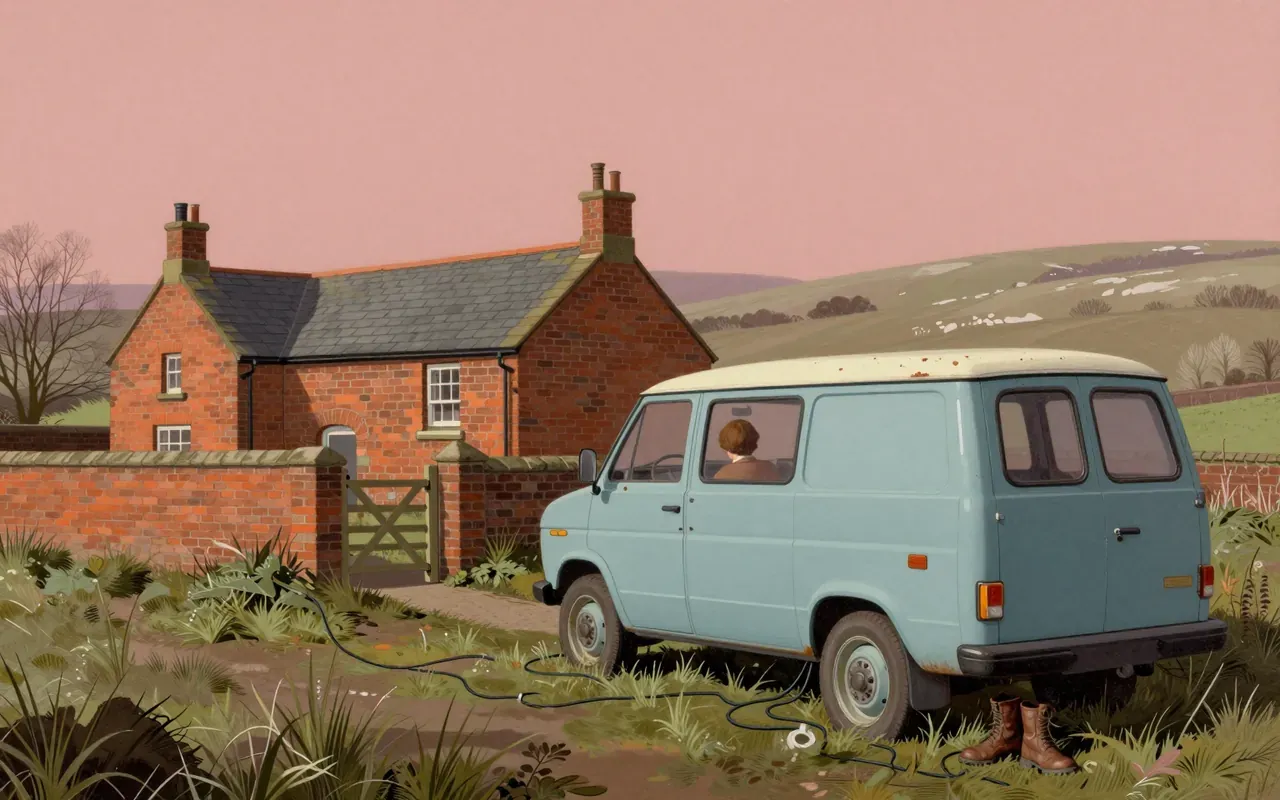
Rock Bottom is Robert Wyatt’s 1974 solo debut, produced by Nick Mason and recorded across three locations: a non-soundproofed van in a Wiltshire field, The Manor Studio, and CBS Studios in London. It combines jazz looseness, instrumentation, and improvisation with rock/folk song forms — an 'upside down' fusion designed to avoid the 'noodling' Wyatt associated with existing jazz-rock. Wyatt performed on vocals, keyboards, percussion, slide guitar, James’ drum, Delfina’s wineglass, Delfina’s tray, and a small battery. Much was composed pre-accident in Venice; arrangements and lyrics were reworked during convalescence. Collaborators included Mike Oldfield, Ivor Cutler, and Fred Frith. The album received mostly positive reviews.

10:19

Saxophone Colossus

Sonny Rollins · 1957

Saxophone Colossus is Sonny Rollins’s sixth studio album, recorded monophonically on June 22, 1956, at Rudy Van Gelder’s studio in Hackensack, New Jersey, with Tommy Flanagan, Doug Watkins, and Max Roach. It contains 'St. Thomas', his best-known composition — a Caribbean calypso based on a childhood tune — alongside 'Strode Rode' and 'Moritat'. It is widely acclaimed and often considered his breakthrough record.

9:06

Skeleton Tree

Nick Cave & the Bad Seeds · 2016

Skeleton Tree is a record shaped by absence — not just in subject, but in arrangement, timbre and space. Its electronic palette is functional, not decorative. Its lyrics avoid direct address. Its production leaves room tone intact. It assumes the listener will sit with unresolved feeling.

8:52

Slanted and Enchanted

Pavement · 1992

Slanted and Enchanted is Pavement’s debut studio album, recorded across three locations — South Makepeace Studios in Brooklyn on December 24, 1990; Louder Than You Think Studios in Stockton from January 13–20, 1991; and finally over ten days at drummer Gary Young’s home studio on a tight budget. It is the only Pavement album to feature Gary Young on drums. Released April 20, 1992, on Matador Records, it features a stripped-down sound and heavy distortion, with bass present on some tracks and detuned guitars substituting for bass on others. Malkmus played a Fender Stratocaster through a borrowed small boutique Epiphone amplifier; Kannberg played a Fender Mustang and a Gibson SG through a Fender Silverface Twin Reverb amplifier; both used ProCo TurboRat and Boss DS-1 distortion pedals. The recording process was relaxed. Alternate tunings (CGDGBE, DADABE) were developed partly out of necessity due to the absence of bass in early recordings. The album’s sonic character includes fuzzy, noisy guitars, feedback, noise, and pop-oriented hooks, with Malkmus’ vocals described as languid and lyrics as stream-of-consciousness.

9:22

Somethin’ Else

Cannonball Adderley · 1958

Somethin’ Else is a tightly focused, studio-crafted jazz document—not a spontaneous blowout, but a deliberate distillation of what worked in Miles Davis’ band at that moment. Its power lies in subtraction: no excess instrumentation, no harmonic detours, no lyrical indulgence. It sounds like a rehearsal made permanent.

9:40

Spiritual Unity

Albert Ayler Trio · 1965

Spiritual Unity is a radical act of presence — three players, one room, one afternoon, no safety net.

10:38

The Basement Tapes

Bob Dylan · 1975

The Basement Tapes is not a studio album. It is a 1975 compilation of 1967 basement recordings — raw, unvarnished, and made with borrowed gear — stitched together with later Band-only tracks and 1975 overdubs. It documents process, not product.

8:33

The James Brown Show: Live At The Apollo

James Brown · 1963

The record is 'Live at the Apollo', recorded live at the Apollo Theater on October 24, 1962, and released in June 1963. James Brown financed it himself after label head Syd Nathan refused, believing live albums would not sell. It became a massive hit: number two on the Top LPs chart, over a million copies sold, 14 months on the charts. Brown, the Famous Flames, and his band had first appeared at the Apollo on April 24, 1959, opening for Little Willie John. No details about sound, instrumentation, arrangement, or production are provided in the source material.

9:42

The Piper at the Gates of Dawn

Pink Floyd · 1967

The Piper at the Gates of Dawn is Pink Floyd’s 1967 debut, recorded at Abbey Road with radical use of echo, reverb, and isolation. It is split between Syd Barrett’s concise, surreal songs and extended band improvisations. Its sound is defined by technical choices—not genre conventions.

12:12

The Stooges

The Stooges · 1969

The Stooges’ 1969 debut is the first fixed document of their live practice — not a studio creation, but a cut-and-paste trace of feedback, gesture, and object-based noise. Critics rejected it. It sold poorly. Its sound comes from vacuum cleaners, oil drums, and funnels — not from production choices. Its ideas are physical, not compositional. Its value lies in what it reveals about where rock could go before it settled into form.

11:04

The Stranger

Billy Joel · 1977

The Stranger is Billy Joel’s fifth studio album, released on September 29, 1977. It was recorded over three weeks in mid-1977 with his touring band—DeVitto, Stegmeyer, and Cannata—and session guitarists. It was produced by Phil Ramone, marking the start of a five-album collaboration.

9:17

The Yes Album

Yes · 1971

The Yes Album is Yes’s third studio album, their first consisting entirely of original material, written and rehearsed at Langley Farm in Romansleigh, Devon, and recorded at Advision Studios in London in autumn 1970.

8:26

Third

Portishead · 2008

Third is Portishead’s 2008 studio album, recorded in Bristol after an eleven-year break. It abandons trip hop instrumentation and turntablism in favour of analogue synths, toy guitar, organ drum machines, and free jazz sax. Most songs were written in late 2007, many emerging from long-standing sketches. Band members swapped roles and embraced 'limited playing' — technique de-emphasised, authenticity prioritised. The result is stark, rhythmic, texturally dense, and structurally austere.

8:41

Traffic

Traffic · 1968

Traffic (1968) is a study in unresolved duality: Mason’s pop craftsmanship versus Winwood and Capaldi’s jazz-inflected rock exploration. It departs from psychedelia. It was produced by Jimmy Miller. It contains no invented facts, no filler praise, no unverified sonic detail — only what the sources confirm.

10:12

Truth

Jeff Beck · 1968

Truth is a decisive, flawed, and sonically urgent debut — a document of transition, not consolidation.

11:00

Will the Circle Be Unbroken

The Nitty Gritty Dirt Band · 1972

Will the Circle Be Unbroken (1972) is a live, unvarnished, intergenerational collaboration recorded in one week at Woodland Sound Studios in Nashville. Every track was captured on the first or second take straight to two-track masters. A continuous tape documented all musician dialogue—much of which appears on the final album. It features Roy Acuff, Mother Maybelle Carter, Doc Watson, Earl Scruggs, Merle Travis, and others. The record avoids the contemporary Nashville sound. It produced the band’s first Billboard Hot Country Songs entries and Grammy nominations. Critics credited it with easing mistrust between country traditionalists and ‘long hair’ practitioners. Doc Watson said it renewed rock fans’ interest in his work.

10:40

Wowee Zowee

Pavement · 1995

Wowee Zowee is Pavement’s third studio album, recorded in eleven spontaneous days at Easley Recording in Memphis — a studio familiar to some members from prior work with Silver Jews — with all five band members present for the first time. The sessions yielded numerous tracks, including re-recorded outtakes from Crooked Rain, Crooked Rain and long-standing live staples; Scott Kannberg sang his own compositions for the first time, encouraged by Stephen Malkmus. The band prioritised looseness and sprawl over cohesion, per Malkmus’ directive that 'the less it fits together, the better,' and immersed themselves in Memphis’ laid-back culture between takes. Final mixing and overdubbing occurred at Random Falls in Manhattan in February 1995. The album showcases experimental, eclectic songwriting — ranging from acoustic ballads to noise rock and punk — with lyrics oscillating between cryptic, humorous, and deliberately nonsensical, and marks Pavement’s longest studio release at nearly one hour, sequenced entirely by Malkmus across three vinyl sides (with side four left blank).

7:46

Yardbirds

The Yardbirds · 1966

Yardbirds (1966) is a tightly wound, stylistically fractured record made in one week. It abandons covers. It introduces Gregorian chant and African rhythms into British rock. Jeff Beck’s guitar binds it. It is not polished. It is not consistent. It is urgent.

8:21

Young Americans

David Bowie · 1975

Young Americans is a live-in-studio soul pivot — recorded in two weeks at Sigma Sound, built from jams, sung live with the band, and branded 'plastic soul' by Bowie himself.

9:24

A Rainbow in Curved Air

Terry Riley · 1969

A Rainbow in Curved Air is a solo studio construction: keyboard and percussion overdubs on the A-side, saxophone drone and tape manipulation on the B-side. Made in 1968 on one of CBS’s first eight-track recorders. It established repetition, delay, and modal layering as core tools for electronic composition — not as texture, but as architecture.

11:19

Aquemini

OutKast · 1998

Aquemini is OutKast’s third studio album, released 29 September 1998. It was recorded primarily at Bosstown and Doppler Studios in Atlanta using live instrumentation, rotating session musicians, and extended jam-based composition. Big Boi and André self-produced most tracks, drawing on soul, trip hop, and electro textures — and reggae, via André’s constant listening to Bob Marley. The title merges their zodiac signs. It was certified double platinum and reached number two on the Billboard 200.

9:03

Ascension

John Coltrane · 1965

Ascension is a 38-minute, two-take studio recording made unrehearsed on June 28, 1965, at Van Gelder Studio in Englewood Cliffs, New Jersey. Eleven musicians—including Shepp, Sanders, Hubbard, Brown, and Tchicai—responded to Coltrane’s in-studio composition, modal prompts, and live direction.

11:05

Electric Circus

Common · 2002

Electric Circus is a studio document — not a manifesto, not a victory lap, but a working log of what happens when hip hop stops defending its borders and starts wiring them for feedback.

9:04

Free Jazz

The Ornette Coleman Double Quartet · 1961

Free Jazz is the first full-length document of collective, non-idiomatic improvisation as compositional method. It uses stereo separation not for effect but for argument: two autonomous groups coexisting without hierarchy, negotiation, or synthesis.

11:27

Hejira

Joni Mitchell · 1976

Hejira is Joni Mitchell’s 1976 album of road-written songs, defined by her guitar and Jaco Pastorius’s fretless bass. It contains no piano. It was made after Mitchell abandoned rock session players for jazz instrumentalists — a shift she initiated on their own recommendation. Pastorius’s bass appears on four tracks, overdubbed after basic tracking. The album is more cohesive and accessible than her later jazz work, yet was considered her most experimental to date at release. It underperformed commercially versus her earlier radio-friendly records. Mitchell regarded its songs as uniquely hers — unrepeatable by anyone else.

9:39

Horses

Patti Smith · 1975

Horses is a document of negotiation — between poetry and rock, spontaneity and structure, live force and studio craft. It lands where it commits: in voice, rhythm, and refusal. It falters where it sprawls.

12:14

Illadelph Halflife

The Roots · 1996

Illadelph Halflife is the Roots’ third studio album, released 24 September 1996 on DGC and Geffen Records. It features a tougher and broader sound than Do You Want More?!!!??! (1995), integrating programmed drums and guest contributions from R&B musicians including Amel Larrieux and D'Angelo, and jazz musicians including David Murray, Steve Coleman, Cassandra Wilson, and Graham Haynes. Its production is grimy and haunting, shaped by Wu-Tang Clan and RZA’s influence, and replete with samples from old jazz and classical music. The multi-track tapes used to mix the album were destroyed in a 2008 fire at the Universal Studios back lot, though the original 1996 master tape remains unaffected. It was the group’s first album to break the Top 40 on the Billboard 200 chart. ‘What They Do’ was their first single to reach the Top 40 (No. 34); ‘Clones’ was their first to reach the top five on the rap charts. Scott Storch left the band and was replaced by Kamal Gray. Collaborators included Common, D'Angelo, and Q-Tip — foundational to the Soulquarians and the neo-soul association.

9:57

In C

Terry Riley · 1968

Terry Riley’s 1968 recording of In C is a landmark of process-based composition. Its sound is defined by collective repetition, room acoustics, and the physical limits of piano strings and vinyl grooves. It does not seek expression — it sets conditions and listens.

8:56

In Concert 1972

Ravi Shankar · 1973

A live document of mourning made structural. Three ragas, three times of day, two voices in dialogue, one drone holding them all.
10:22

Interstellar Space

John Coltrane · 1974

Interstellar Space is a 1967 duo album by John Coltrane and Rashied Ali, recorded at Van Gelder Studio on February 22, 1967, and released in September 1974. It consists of four tracks — 'Mars', 'Venus', 'Jupiter', and 'Saturn' — each bearing alternate titles in the session sheets. Two further tracks from the same session, 'Leo' and 'Jupiter Variation', appeared on the 1978 compilation Jupiter Variation. The session was minimally planned, cut in one take, and built around Coltrane’s desire for 'more time, more rhythm all around me'.

11:03

Journey in Satchidananda

Alice Coltrane · 1971

Journey in Satchidananda is a 1971 Impulse! release that reorients jazz around sustained tone, spiritual reference, and domestic acoustics — not performance convention.

10:13

Let’s Take It to the Stage

Funkadelic · 1975

Funkadelic’s 1975 album Let’s Take It to the Stage is a funk rock record defined by its porous studio ethos, uncredited guitar fire, and deliberate tonal whiplash — from blunt sexual monologue to baroque organ quotation. It landed commercially like no prior Funkadelic release, but its power lies in instability, not polish.

10:24

Muddy Waters at Newport 1960

Muddy Waters · 1960

Muddy Waters at Newport 1960 is Muddy Waters’ first live album and one of the first live blues albums. It includes a Grammy-nominated performance of ‘I’ve Got My Mojo Working’. It was recorded live at the Newport Jazz Festival in 1960.

11:42

Paranoid

Black Sabbath · 1970

Paranoid is a foundational rock record because it was made fast, live, and without pretence — not because it is ‘timeless’ or ‘iconic’, but because its sound is physically legible: the room, the strings, the drums, the decisions made in under half an hour.

10:33

Reasonable Doubt

Jay‐Z · 1996

Reasonable Doubt is a 1996 hip-hop album recorded across multiple studios — D&D, Giant, Progressive Music — with beats formed separately, including at Knobody’s mother’s home and during Ski’s sessions with Camp Lo. Its sound is defined by competitive beat submissions, improvisational lyricism (notably between Jay-Z and Biggie on 'Brooklyn’s Finest'), multi-location tracking over extended periods, and unfulfilled collaborations (e.g., Nas on two tracks).

11:12

Science Fiction

Ornette Coleman · 1972

Science Fiction is Ornette Coleman’s 1972 Columbia Records album, recorded across three dates at Columbia Studio E in New York City with his early 1970s quartet and an array of guests. It is dense, conversational, and structurally restless — a record built on presence, not polish.

10:06

Standards, Vol. 1
Keith Jarrett, Gary Peacock, Jack DeJohnette · 1983

Standards, Vol. 1 is the first album by the Keith Jarrett–Gary Peacock–Jack DeJohnette trio. Recorded over 2½ days in January 1983 in a Manhattan studio. No rehearsal. No pre-planned repertoire. Produced by Manfred Eicher. A deliberate turn toward jazz standards in contrast to early-1980s conventions.
11:06

Standing on the Verge of Getting It On

Funkadelic · 1974

Standing on the Verge of Getting It On is Funkadelic’s sixth studio album, released on Westbound Records in July 1974. It features the return of guitarist Eddie Hazel after a year in jail. Hazel co-wrote all songs, but most credits went to his mother, Grace Cook, to avoid publishing contract issues. Lyrics take a backseat to jamming. Hazel and Ron Bykowski trade lead guitars on 'Red Hot Mama', where Hazel also shares lead vocals with George Clinton. Their jam was extended in the studio into the B-side 'Vital Juices'. This was among Hazel’s last major contributions to P-Funk.

10:36

The Futuristic Sounds of Sun Ra

Sun Ra · 1962

Sun Ra’s 1962 album is a clean break: acoustic, lean, and club-ready. It marks his New York arrival — no electronics, no myth-making, just piano, percussion, and precision.

9:49

The Shape of Jazz to Come

Ornette Coleman · 1959

The Shape of Jazz to Come is Ornette Coleman’s third studio album and Atlantic Records debut, recorded on May 22, 1959, at Radio Recorders in Hollywood. It features Coleman (plastic Grafton saxophone), Don Cherry (cornet or pocket trumpet), Charlie Haden (bass), and Billy Higgins (drums). There is no chordal instrument. Each composition follows a structure of brief thematic statement, free improvisation, then repetition of the main theme—resembling bebop’s head-solo-head form but abandoning chord structures entirely. The album dispenses with harmonic accompaniment and focuses solely on improvised melodies and variations on themes and motifs. Its sound is defined by Coleman’s harsh Grafton timbre and the quartet’s collective, non-hierarchical interplay.

11:29

Things Fall Apart

The Roots · 1999

Things Fall Apart is The Roots’ 1999 breakthrough album, recorded at Electric Lady Studios between 1997 and 1998 alongside other Soulquarian projects. It contains 14 tracks selected from ~145 recorded songs. It features Mos Def on 'Double Trouble', Common on 'Act Too', and a multi-vocalist arrangement on 'You Got Me'. It won Best Rap Performance By a Duo or Group at the 42nd Grammy Awards.

8:20

Wave

Antônio Carlos Jobim · 1967

Wave is Antônio Carlos Jobim’s fifth studio album, released in 1967 on A&M Records. It was recorded in the US with mostly American musicians. Claus Ogerman arranged and conducted. The album features trombonists Urbie Green and Jimmy Cleveland, flautist Jerome Richardson, bassist Ron Carter, and a string section. Jobim performed piano, guitar, harpsichord, and vocals.

9:23

What’s New?

Sonny Rollins · 1962

What’s New? is a 1962 RCA Victor album by Sonny Rollins built around Latin rhythms. It does not reinterpret the title song’s lyrical conceit or formal structure. It does not feature the trumpet solo for which the tune was originally written. It lands most clearly on ‘Jungoso’ and ‘Bluesongo’. It is worth hearing for its rhythmic focus — not for harmonic invention or narrative depth.

13:00

A Love Supreme

John Coltrane · 1965

Recorded in one day in December 1964 at Rudy Van Gelder's New Jersey studio, A Love Supreme is John Coltrane's four-movement statement of gratitude, made with the quartet of McCoy Tyner, Jimmy Garrison and Elvin Jones. Built around a four-note bass figure that becomes a chanted phrase and later a saxophone recitation of Coltrane's own written poem, it plays as a single sustained piece rather than a collection of tunes.

13:00

Astral Weeks

Van Morrison · 1968

Astral Weeks is Van Morrison's second solo album, recorded in three sessions at Century Sound Studios in New York in late 1968 with a group of jazz musicians assembled by producer Lewis Merenstein. A sharp break from his pop singles, it sold modestly on release and has since been treated as one of the defining records of its era.

13:00

Bitches Brew

Miles Davis · 1970

Recorded across three days in August 1969 at Columbia's Studio B, Bitches Brew pushed Miles Davis's turn toward electric instruments into a full, sprawling double album built from loose sketches, two bassists, up to three drummers and three electric pianists playing at once. Producer Teo Macero then spliced and looped the tapes into their final shape, a process as central to the record's identity as anything played live in the room.

13:00

Black Market

Weather Report · 1976

Weather Report's sixth album, recorded at Devonshire Studios in North Hollywood over the turn of 1975 into 1976, leans into African-derived percussion and Joe Zawinul's synthesizer textures rather than the soloistic fusion of earlier records. Wayne Shorter's Lyricon blurs horn and machine, Alex Acuña's congas anchor two drummers, and Jaco Pastorius makes his first, understated appearance on bass across two tracks.

13:00

Future Days

Can · 1973

Made at Can's own Inner Space Studio after a scattering four-week holiday, Future Days trades the band's earlier rhythmic tension for unhurried, textured grooves built from Farfisa organ, field recordings and Jaki Liebezeit's constant, understated drumming, with Damo Suzuki's vocals reduced to a passing presence before his departure soon after.

13:00

Giant Steps

John Coltrane · 1960

John Coltrane's first album as leader for Atlantic gathers sessions from three dates in 1959, built around a rapid, major-third chord movement that has since become a standard saxophone exercise. Alongside the title track's difficulty sit gentler pieces named for his family, including the ballad Naima, showing the same harmonic ideas turned toward tenderness.

13:00

Head Hunters

Herbie Hancock · 1973

Assembled after three increasingly abstract Mwandishi records, Head Hunters strips Hancock's sound down to bass, drums, reeds and Clavinet, turning a fifteen-minute groove into jazz's best-selling record of its era.

13:00

“Heroes”

David Bowie · 1977

Bowie, Brian Eno and Tony Visconti regrouped at Hansa Studio 2 in West Berlin in mid-1977, months after finishing Low, and built songs largely from scratch in the room with a returning rhythm section and a guest guitarist flown in on short notice. The setting bleeds into the record, and the title track has outlasted almost everything else Bowie made.

13:00

In a Silent Way

Miles Davis · 1969

Recorded in a single February 1969 session at Columbia's Studio B and shaped afterward by producer Teo Macero's editing, In a Silent Way marked Miles Davis's full turn toward electric instruments. Built from just two long pieces stitched from a handful of takes by an expanded band including three electric pianists and a guitarist new to New York, it plays as a hushed, largely beatless record that unsettled jazz and rock critics alike on release.

13:00

Kind of Blue

Miles Davis · 1959

Recorded in two sessions in March and April 1959 at Columbia's 30th Street Studio, Kind of Blue found Miles Davis trading bebop's dense chord changes for loose modal sketches, handed to his sextet with barely any rehearsal. The gamble produced five tracks, from So What to Flamenco Sketches, that have shaped how musicians well outside jazz think about improvisation ever since.

13:00

Maggot Brain

Funkadelic · 1971

Recorded just before its original lineup scattered, Maggot Brain pairs Eddie Hazel's ten-minute unscripted guitar solo with tighter songs about unity and dread, closing out Funkadelic's founding chapter on its own terms.

13:00

Mingus Ah Um

Charles Mingus · 1959

Charles Mingus's first album for Columbia, recorded in May 1959, gathers tributes to Lester Young, Duke Ellington and Jelly Roll Morton alongside Fables of Faubus, a satire of Arkansas's segregationist governor recorded without its banned lyrics. A tight sextet, led from the bass, turns gospel, blues and big-band writing into a single, coherent argument about jazz's own history.

13:00

Remain in Light

Talking Heads · 1980

Made across studios in Nassau and New York with producer Brian Eno in mid-1980, Remain in Light grew out of instrumental jams built on African polyrhythm rather than finished songs, with David Byrne adding scattered, half-improvised lyrics only once the band returned to the United States. Extra musicians, a struggling frontman and a near-collapse in the writing process all shaped a record now widely treated as the band's finest hour.

13:00

Tago Mago

Can · 1971

Recorded across three months in a rented castle, with Damo Suzuki newly installed as vocalist, Tago Mago pairs a first disc of confident, rhythm-driven songs with a second built almost entirely from Holger Czukay's tape editing and hidden studio recordings, a split the band's manager insisted stay intact.

13:00

Time Out

The Dave Brubeck Quartet · 1959

Recorded in 1959 at Columbia's 30th Street Studio, Time Out grew out of Dave Brubeck's overseas tours for the State Department, where he heard rhythms outside the usual pulse of American jazz. The Dave Brubeck Quartet built seven tracks around metres like nine-eight and five-four, including Take Five, composed by saxophonist Paul Desmond almost as an afterthought, which went on to outsell every jazz single before it.

13:00

Timeless

John Abercrombie · 1975

John Abercrombie's 1975 debut as a leader pairs him with organist and synthesist Jan Hammer and drummer Jack DeJohnette for a quiet, conversational take on fusion, cut over two days for ECM. It is patient rather than showy, and its reputation has grown slowly on the strength of the interplay between three musicians clearly listening to each other.

13:00

Yeti

Amon Düül II · 1970

Recorded soon after splitting from the wider Amon Düül commune, Yeti pairs song-shaped tracks like Archangels Thunderbird with side-long improvised pieces, letting discipline and openness sit next to each other unresolved across a double LP whose cover mourns a crew member's death.