musicbriefs
8:48in productionCh. 1 · Aria + 30/ 8:48 · ceiling 15 min
Classical

Goldberg Variations

Bach’s only keyboard work published in his lifetime is a machine for thinking in bass lines — not a portrait of the soul.

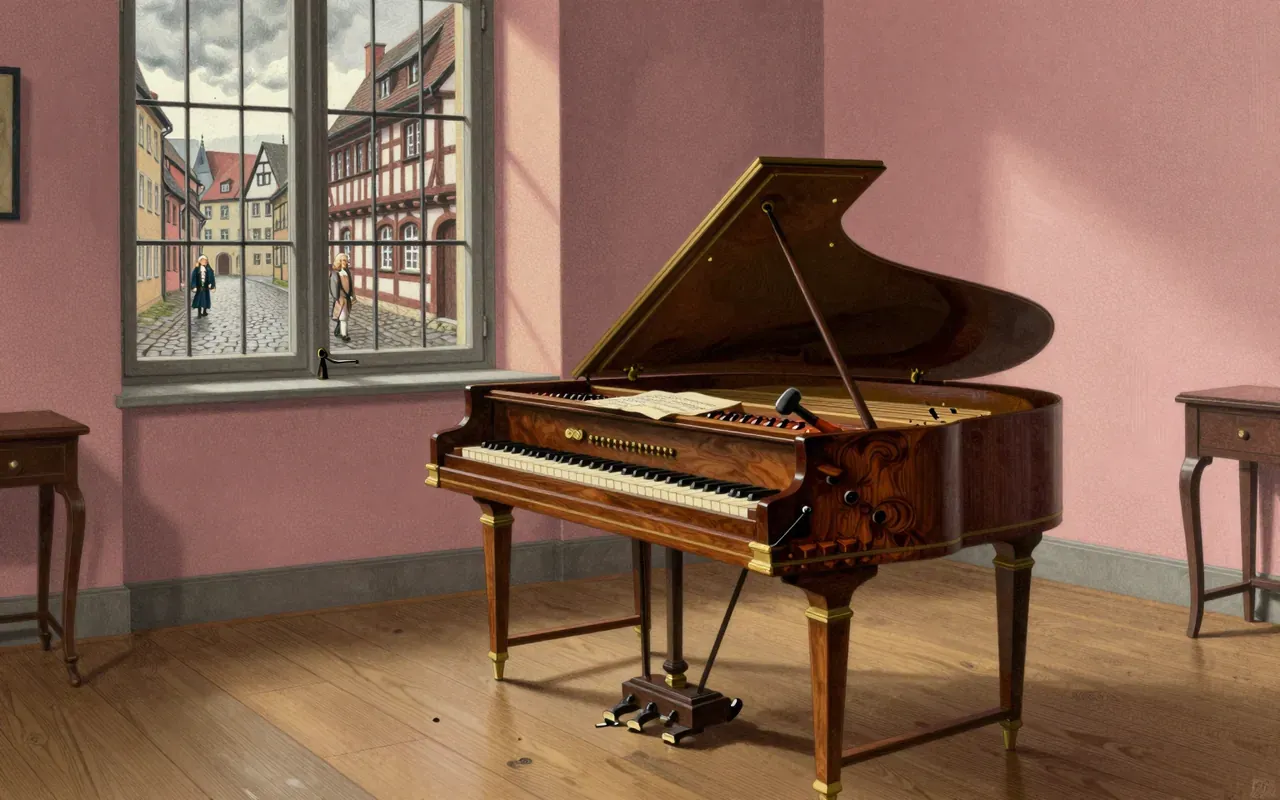
The Goldberg Variations is a 1741 harpsichord work by J.S. Bach. It contains an aria and thirty variations built on the aria’s bass line and chord progression — not its melody. Bach specified a two-manual instrument and marked eleven variations for two manuals, three for either. It was published during his lifetime by Balthasar Schmid of Nuremberg using engraved copper plates. It is the fourth and final volume of the Clavier-Übung series and contains nine canons.

Chapters & takeaways4
  1. 1:04
    Aria + 30

    It begins with an aria, then thirty variations — no orchestra, no voice, no deviation.

  2. 2:13
    Two Manuals, Not One

    It demands a two-manual harpsichord — and tells you exactly which variations need both hands on separate keyboards.

  3. 3:50
    Bass Line, Not Tune

    The variations ignore the aria’s melody entirely — they rebuild everything from its bass and chords.

  4. 5:15
    Copper Plates, Not Type

    Its 1741 publication used engraved copper plates — so the notes are in the publisher’s handwriting, not type.

Running order6
  1. 01
    Aria Variations 1 - 511:41
  2. 02
    Variations 6 - 107:43
  3. 03
    Variations 11 - 1514:07
  4. 04
    Variations 16 - 209:18
  5. 05
    Variations 21 - 2515:31
  6. 06
    Variations 26 - 3014:00
Worth your time?

Yes. Hear the whole thing.

4.5/ 5
What works
  • bass-line-as-scaffold
  • canon-as-architecture
  • manual-distribution-as-rhythm
  • exact-aria-return
What does not
  • melody-driven
  • dynamically expressive
  • improvisatory
  • orchestrated
Hear it if
  • counterpoint-listeners
  • baroque-instrumentalists
  • structural-thinkers
Skip it if
  • romantic-phrasers
  • dynamic-shapers
  • melody-first-listeners
The written brief1 min read

What the record is and where it came from

The Goldberg Variations is a 1741 keyboard composition by Johann Sebastian Bach. It consists of an aria and thirty variations. It was published during Bach’s lifetime by his friend Balthasar Schmid of Nuremberg using engraved copper plates. It is the fourth and final volume of the Clavier-Übung series.

How it sounds, and how it was made

The Goldberg Variations is a harpsichord work. Bach specified a two-manual instrument. Variations 8, 11, 13, 14, 17, 20, 23, 25, 26, 27 and 28 require both manuals. Variations 5, 7 and 29 are playable on one or two. The variations are built on the aria’s bass line and chord progression — not its melody.

What lands

The two-manual requirement lands. So does the bass-line foundation. The nine canons land as structural anchors. The return of the aria lands as closure — exact, unadorned, inevitable.

What does not

It does not rely on melodic quotation. It does not use orchestration, dynamics, or pedal effects. It does not include improvisation cues, tempo markings beyond ‘Andante’ for Variation 25, or expressive indications beyond manual specification.

The ideas inside it

The piece treats variation as architectural logic. It uses a fixed bass and harmonic scaffold to generate contrast: texture, manual distribution, rhythm, density. Canons appear every third variation from 3 to 27. The aria returns at the end, unchanged.

Who should hear it, and who should not

Anyone who wants to hear how counterpoint works in real time should hear it. Anyone expecting Romantic expression or modern phrasing should not.

Is it worth your time

Yes. It is the only major keyboard work Bach published in his lifetime. It was issued in 1741 as the fourth and final Clavier-Übung volume. Its structure — aria plus thirty variations, nine of them canons — is self-contained and rigorously conceived.
Same genre · Classical4 of 17
Up next in Music

good kid, m.A.A.d city

Kendrick Lamar · 2012 · 8:10

This isn’t a gangsta rap album — it’s a courtroom where the defendant is also the judge, the jury, and the witness.

8:10