Verdi didn’t write an opera—he wired a dramatic circuit board using brass, humming men, and a cello in the dark.
Rigoletto (1989) is a recording of Verdi’s 1851 opera, premiered at La Fenice in Venice. It uses offstage band, onstage chamber strings, and pit orchestra as distinct dramatic agents. Its innovations include melody assigned to low woodwinds and strings—not voices—in key duets; humming chorus as diegetic wind; and continuous pacing that replaces sectional numbers. Censorship shaped its structure: the Duke substitutes for royalty, and 'La donna è mobile' was rehearsed in isolation to control its impact. It contains only one conventional double aria and no concerted act finales. Julian Budden calls it revolutionary—comparable to Beethoven’s Eroica—for dissolving barriers between recitative and melody.
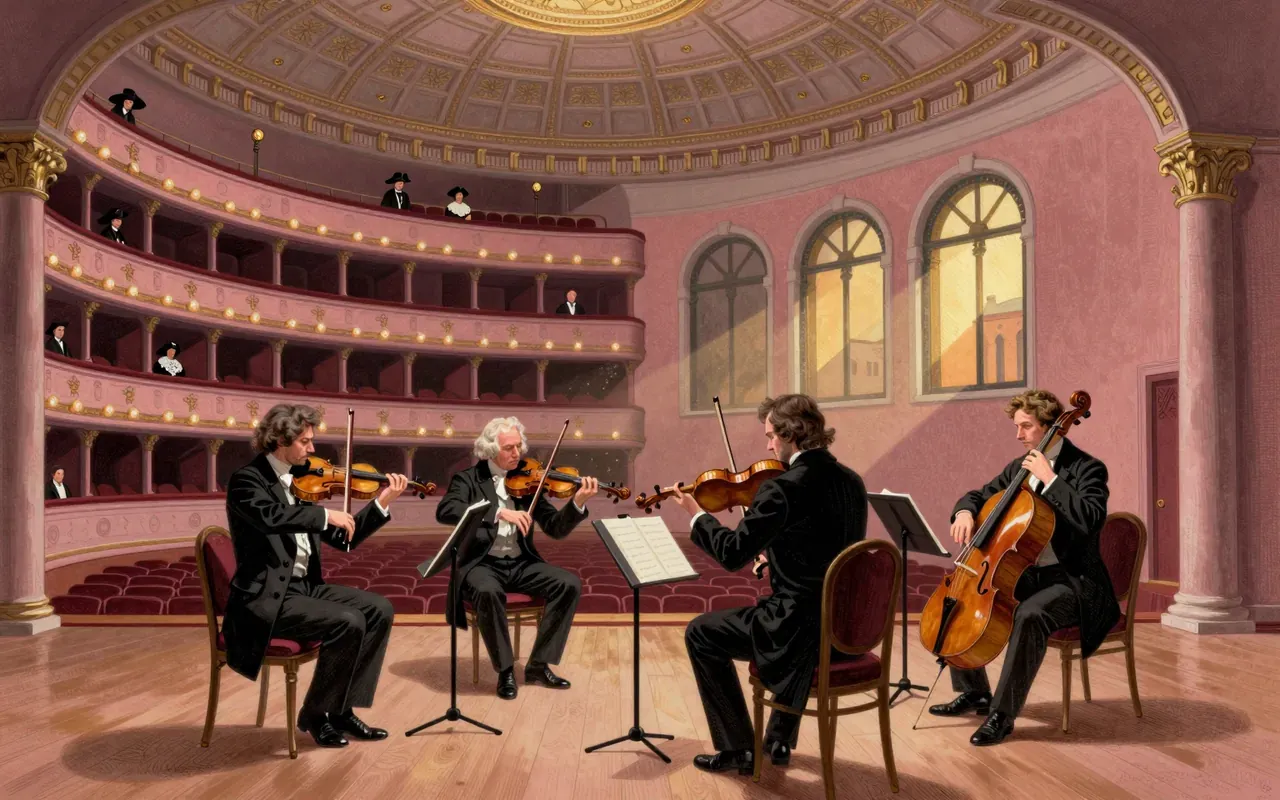
The preludio and opening scene deploy three separate instrumental layers—pit, offstage band, onstage strings—to replace sectional numbers with continuous drama.
2:47
Melody Is Not Where You Sing It
Melody migrates from voice to orchestra: cello and bass carry menace in the Rigoletto–Sparafucile duet; the quartet splits melody across four characters’ vocal lines.
4:06
Wind You Can Plot With
The storm scene uses humming chorus and bass strings as plot devices—not effects—and dissolves the line between recitative and aria across the whole score.
5:51
A Hit Held Back, A Mood Built In
Verdi withheld 'La donna è mobile' from rehearsals and built contrast into the score’s architecture: jolly offstage music against sinister onstage dialogue.
Running order37
01
Rigoletto: Preludio2:32
02
Rigoletto: Atto I, scena 1. “Della mia bella incognita borghese”1:31
03
Rigoletto: Atto I, scena 1. “Questa o quella”1:36
04
Rigoletto: Atto I, scena 1. “Partite? Crudele!”1:22
05
Rigoletto: Atto I, scena 1. “In testa che avete”0:51
06
Rigoletto: Atto I, scena 1. “Gran nuova! gran nuova!”2:22
07
Rigoletto: Atto I, scena 1. “Ch'io gli parli”3:31
08
Rigoletto: Atto I, scena 1. “O tu che la festa”1:11
09
Rigoletto: Atto I, scena 2. “Quel vecchio maledivami!”4:50
10
Rigoletto: Atto I, scena 2. “Pari siamo!”3:46
11
Rigoletto: Atto I, scena 2. “Figlia!... Mio padre!... Deh, non parlare al misero”6:22
12
Rigoletto: Atto I, scena 2. “Ah, veglia, o donna”5:21
13
Rigoletto: Atto I, scena 2. “Giovanna?... ho dei rimorsi... T'amo! T'amo, ripetilo”2:44
14
Rigoletto: Atto I, scena 2. “È il sol dell'anima... Che m'ami, deh ripetimi”3:58
15
Rigoletto: Atto I, scena 2. “Addio, addio! speranza ed anima”1:04
16
Rigoletto: Atto I, scena 2. “Gualtier Maldè!... Caro nome”6:41
17
Rigoletto: Atto I, scena 2. “Riedo! perché?... Silenzio!...”2:05
18
Rigoletto: Atto I, scena 2. “Zitti, zitti, moviamo a vendetta”1:28
19
Rigoletto: Atto I, scena 2. “Soccorso, padre mio... Vittoria!”1:21
01
Rigoletto: Atto II. “Ella mi fu rapita!”2:27
02
Rigoletto: Atto II. “Parmi veder le lagrime“2:38
03
Rigoletto: Atto II. “Duca, Duca!... Ebben?... Scorrendo uniti remota via”2:12
04
Rigoletto: Atto II. “Possente amor... Oh qual pensiero”3:14
05
Rigoletto: Atto II. “Povero Rigoletto!”3:41
06
Rigoletto: Atto II. “Cortigiani, vil razza dannata“4:22
07
Rigoletto: Atto II. “Mio padre!... Ite di qua voi tutti!”1:46
08
Rigoletto: Atto II. “Tutte le feste al tempio”6:39
09
Rigoletto: Atto II. “Compiuto pur quanto”1:06
10
Rigoletto: Atto II. “Sì, vendetta, tremenda vendetta“2:03
11
Rigoletto: Atto III. “E l'ami?... Sempre”2:11
12
Rigoletto: Atto III. “La donna è mobile”2:47
13
Rigoletto: Atto III. “Un dì, se ben rammentomi”1:32
14
Rigoletto: Atto III. “Bella figlia dell'amore”4:14
15
Rigoletto: Atto III. “Venti scudi hai tu detto?... La donna è mobile”3:47
16
Rigoletto: Atto III. “È amabile invero... Ascolta, anzi facil ti svelo un progetto”5:29
17
Rigoletto: Atto III. “Della vendetta alfin giunge l'istante... La donna è mobile”4:38
18
Rigoletto: Atto III. “Chi mai, chi è qui in sua vece?”6:22
Worth your time?
Yes. Hear the whole thing.
4.5/ 5
What works
preludio’s curse theme
quartet’s four-character counterpoint
storm scene’s humming chorus and bass strings
What does not
conventional double aria
concerted act finales
Hear it if
listeners who care how orchestration drives drama
those studying how constraints shape form
Skip it if
those seeking vocal showcase
those seeking historical reenactment
The written brief2 min read
What the record is and where it came from
A 1989 recording of Verdi’s Rigoletto, composed for La Fenice in Venice and premiered in March 1851. It is based on Victor Hugo’s Le roi s’amuse, adapted after censorship forced substitution of a Duke for the King.
How it sounds, and how it was made
The preludio builds from quiet brass to a full-orchestra outcry, then subsides into intensifying drum rolls and brass. Offstage dance music contrasts with onstage chamber strings playing an elegant minuet. The Rigoletto–Sparafucile duet gives melody to solo cello, solo bass, and low woodwinds—not voices. A male chorus hums through closed mouths to evoke wind in the storm scene. The quartet assigns distinct vocal identities: Duke’s ardent melody, Maddalena’s laughter, Gilda’s sobbing figure, Rigoletto’s implacable revenge line.
What lands
The preludio’s curse theme. The stark contrast of offstage dance versus onstage minuet. The quartet’s four-character counterpoint. The humming chorus as wind. The storm scene’s integration of oboe, piccolo, and bass strings into narrative action.
What does not
It does not rely on conventional double arias—only one appears. It does not use concerted act finales. It does not treat storm music as interlude; it embeds it in plot. It does not assign melody to voices in the Rigoletto–Sparafucile duet.
The ideas inside it
It treats music as dramatic infrastructure—not decoration. It replaces sectional numbers with continuous flow. It makes censorship a compositional constraint: the Duke stands in for royalty, and ‘La donna è mobile’ is withheld until performance to control its reception.
Who should hear it, and who should not
Listeners who care how orchestration drives drama—not just singers’ virtuosity. Those studying how constraints (censorship, venue, instrumentation) shape form. Not those seeking vocal showcase or historical reenactment.
Is it worth your time
Yes—if you want to hear how Verdi dissolved formal boundaries between recitative and melody, used three separate instrumental layers (pit, offstage band, onstage strings), and built drama through orchestral texture rather than vocal display.