musicbriefs
Topic

Mathematics

The language that keeps turning out to describe things it was not built for.

2
in music
9:00
average
18 min
in total
67
across the network
Mathematics across the network →
All briefs2
video still
8:48

Goldberg Variations

Johann Sebastian Bach · 1986

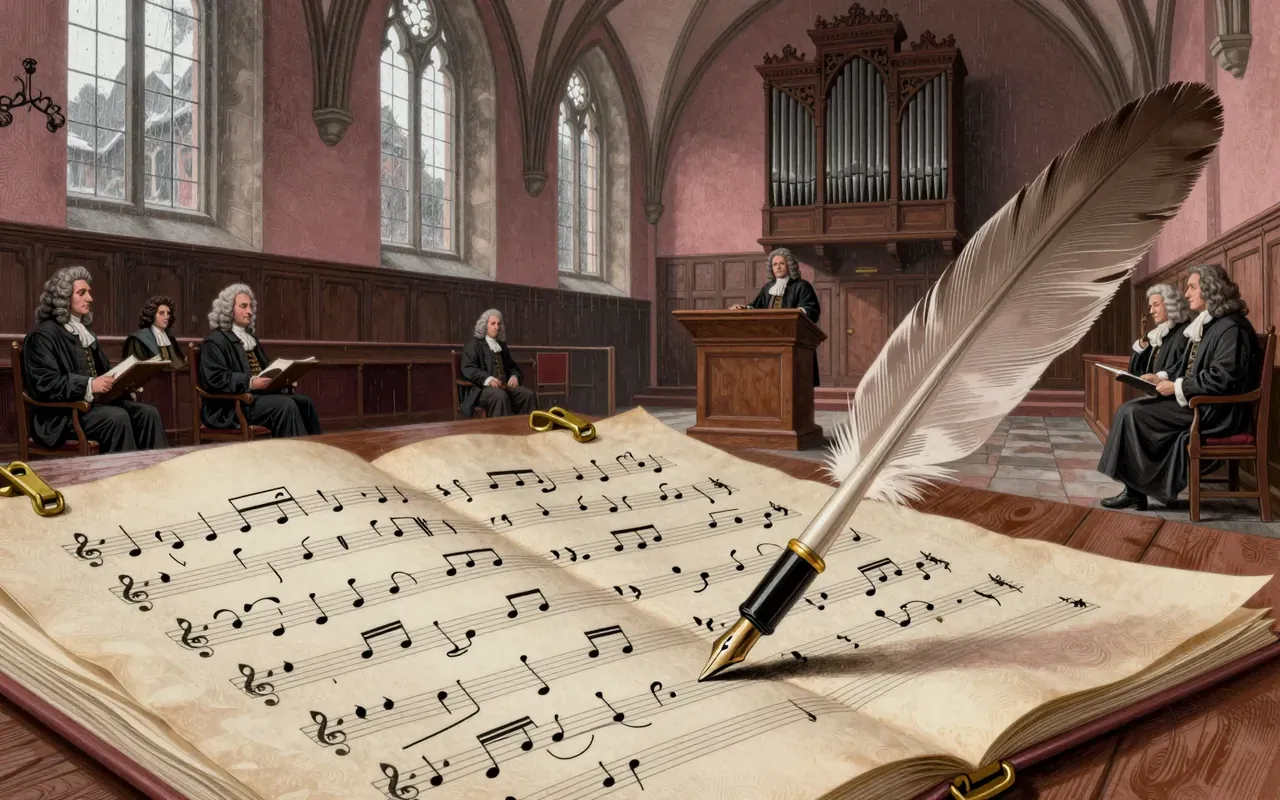
The Goldberg Variations is a 1741 harpsichord work by J.S. Bach. It contains an aria and thirty variations built on the aria’s bass line and chord progression — not its melody. Bach specified a two-manual instrument and marked eleven variations for two manuals, three for either. It was published during his lifetime by Balthasar Schmid of Nuremberg using engraved copper plates. It is the fourth and final volume of the Clavier-Übung series and contains nine canons.
video still
9:11

The Art of Fugue

Johann Sebastian Bach · 1995

The Art of Fugue is not a piece to be performed. It is a set of problems posed in musical notation. Its 1995 recording makes no claim to solve them — only to present the lines as clearly as possible. It is austere. It is complete in its incompleteness. It asks only that you follow the voices.

More from music

All briefs →
video still
9:24

A Rainbow in Curved Air

Terry Riley · 1969

A Rainbow in Curved Air is a solo studio construction: keyboard and percussion overdubs on the A-side, saxophone drone and tape manipulation on the B-side. Made in 1968 on one of CBS’s first eight-track recorders. It established repetition, delay, and modal layering as core tools for electronic composition — not as texture, but as architecture.

video still
9:11

Aida

Giuseppe Verdi · 1989

A studio recording of Verdi’s Aida, made in 1989. Contains all vocal and orchestral numbers across four acts. Omits Verdi’s rejected overture. No source material describes performers, conductor, recording venue, or engineering choices.

video still
9:33

Akhnaten

Philip Glass · 1987

A low, dark opera built by deleting violins — and a Western fantasy dressed as ancient ritual.

video still
9:18

…And Justice for All

Metallica · 1988

…And Justice for All is Metallica’s 1988 studio album, recorded January–May at One on One Recording Studios in Los Angeles. It is defined by its dry, sterile production, inaudible bass, clicking drums, and thin guitar buzz—results of a methodical, instrument-by-instrument process overseen partly by Flemming Rasmussen (who joined six weeks in) and mixed by Thompson and Barbiero in Rasmussen’s absence. Jason Newsted recorded bass alone. Hetfield prioritised a hard vibe over singing. The album premiered at Brooklyn’s L’Amour in September 1988.