Saved
Electronic · Ambient & experimental

Laurie Anderson

She didn’t use tech to sound futuristic—she used it to make listening feel like labour.

Worth your time?4.5/5Yes.Hear the whole thing.What works, what does not, who it is for ↓
10:17in productionCh. 1 · Car Horns First/ 10:17 · ceiling 15 min
4 chapters · 10:17Ceiling 15:00

The brief is written and checked. The video joins this page when it is cut.4 chapters · 1 min read · 10:17 planned

Read the brief

Laurie Anderson’s early work established a method: build an instrument, set a physical limit, and let the audience witness the strain between human intention and material constraint.

Chapters & takeaways4
  1. 1:08
    Car Horns First

    Her first piece was a 1969 symphony played on automobile horns.

  2. 2:45
    Ice as Timer

    Duets on Ice ended only when the ice melted—no clock, no script, just physics.

  3. 4:16
    Tape-Bow Violin

    The 1977 tape-bow violin replaced horsehair with magnetic tape and turned playback into gesture.

  4. 6:06
    Devices for Doubt

    She invented devices to ask one question: what happens to intimacy when machines mediate speech?

1 more chapterFewer chapters
Worth your time?

Yes. Hear the whole thing.

4.5/ 5
What works
  • Duets on Ice
  • tape-bow violin pieces
  • early spoken-word recordings with audio drag
What does not
  • culture/arts
  • culture/cities
  • culture/ideas
  • culture/society
Hear it if
  • artists working with sound
  • designers of interactive systems
  • anyone tired of tech-as-magic narratives
Skip it if
  • fans of polished pop storytelling
  • listeners who want emotional clarity over structural inquiry
Who should hear it, and who should skipHide who it is for
The written brief1 min read

What the thing is

Laurie Anderson is a New York–based performance artist who built instruments to interrogate communication itself.

Where it came from

She emerged from 1970s New York City’s downtown scene, where she fused violin training, sculptural thinking and experimental sound practice.

What it gets right

It treats technology as a material, not a metaphor. Her tape-bow violin (1977) and car-horn symphony (1969) make circuits, magnetism and resonance tangible.

What it gets wrong

It assumes voice distortion always deepens meaning. Her pitch-shifted ‘audio drag’ filters often flatten affect rather than reveal it.

Why it matters now

Her work prefigures today’s friction between human speech and algorithmic voice—without mistaking novelty for insight.

Is it worth your time

Yes—if you care about how artists test the limits of language, sound and time through physical objects and durational rules.

Same genre · Electronic4 of 117
10:16
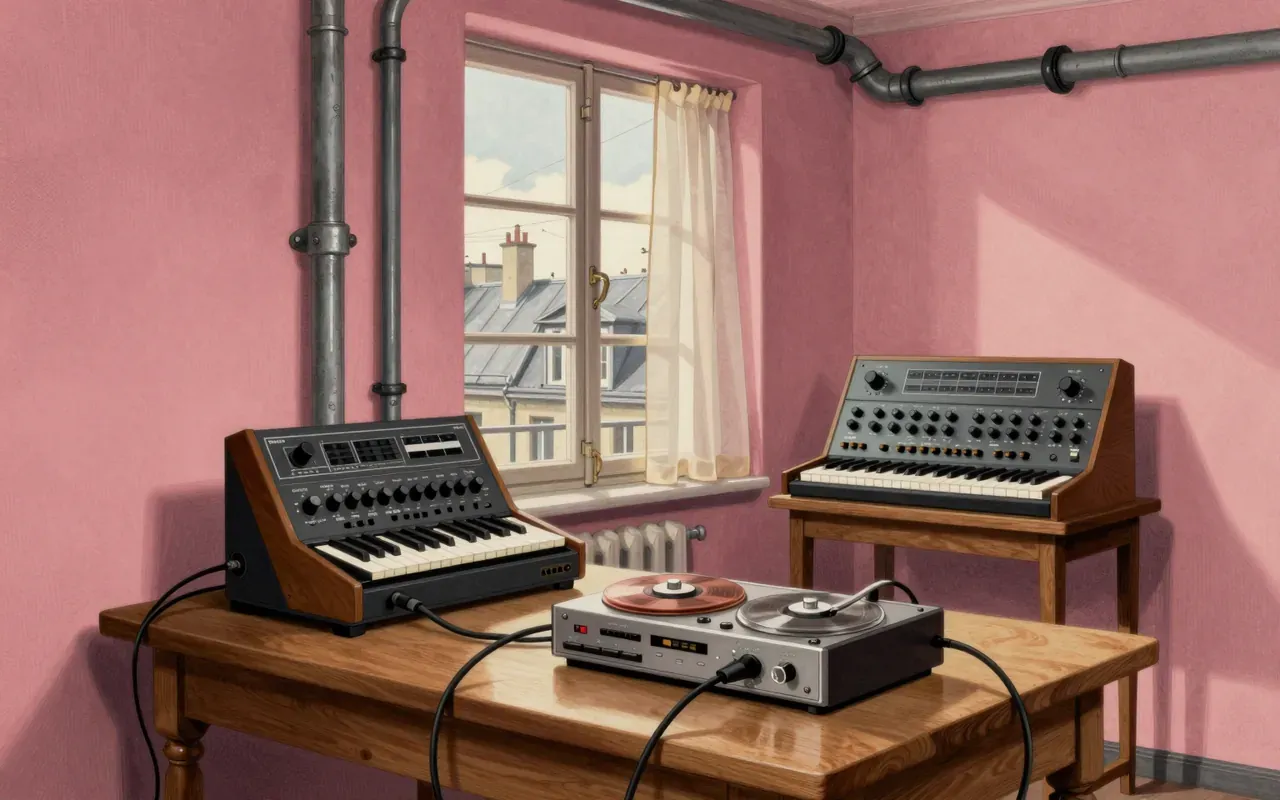
OxygèneJean Michel Jarre · 1976Oxygène is a six-part electronic suite recorded in a Paris kitchen between August and November 1976. Jarre used EMS VCS 3 and Synthi AKS synthesizers, a Scully 8-track, Revox tape delay, AKG stereo reverb, EMT plate reverb, and eight stereo echoes. A partially functional Mellotron appears in Part II. The album evokes environmental themes through sound design rooted in musique concrète techniques. It made Jarre famous internationally after initial rejection by record companies.
11:34
HomogenicBjörk · 1997Homogenic is Björk’s third studio album, recorded in Spain in 1996 after halting London sessions due to media attention following a stalker’s murder attempt. Produced with Mark Bell, Guy Sigsworth, Howie B, and Markus Dravs, it fuses chilly strings from the Icelandic String Octet, stuttering abstract beats, and unconventional instruments like accordion and glass harmonica. It is conceptually rooted in Iceland — embodying volcanic rawness and technological modernity — and intended as a simple, one-flavoured departure from her earlier eclecticism. It retains electronic dance-music and techno-futurism but abandons the sweet melodies and peppy dance collages of Debut and Post. 'Unravel' incorporates a traditional Icelandic choral technique blending speech and song. Björk composed melodies on a Casio keyboard and involved non-professionals like babysitter Rebecca Storey in production. The album was delayed due to vocal dissatisfaction and cover reshoots, and released in September 1997.
10:20
Speak & SpellDepeche Mode · 1981Speak & Spell is Depeche Mode’s 1981 debut: ten tracks recorded live on 8-track with an ARP 2600, built from songs played live for a year, written mostly by Vince Clarke, co-produced by Daniel Miller. It reached UK #10. Critics split: Melody Maker praised it; Rolling Stone dismissed it as ‘PG-rated fluff’. It established synth-pop as functional pop—not experimental, not atmospheric, not ironic—just direct, repeatable, and built for broadcast.
10:08
Body TalkRobyn · 2010Body Talk is Robyn’s seventh studio album, released 22 November 2010 as the culminating full-length replacement for a planned third mini-album in the Body Talk trilogy. It functions both as a standalone record and as a curated compilation — drawing select tracks from Body Talk Pt. 1 (June 2010) and Pt. 2 (September 2010), plus five new songs. Its centrepiece collaboration is ‘Time Machine’ with Max Martin, described by Robyn as a nostalgic, full-circle return to songcraft. The album produced three top-10 singles — ‘Dancing On My Own’, ‘Hang with Me’, and ‘Indestructible’ — and received unanimous critical acclaim and three Grammy nominations. It reflects Robyn’s 2010 strategy of rapid, self-motivated release: she prioritised immediacy and inspiration over traditional album cycles, rejecting commercial calculation in favour of sustained creative flow.
Up next in Music

Grunge

1985 · 8:25

Grunge wasn’t invented in Seattle—it was named there after the fact, then sold everywhere else.

8:25