musicbriefs
10:07in productionCh. 1 · Where and when/ 10:07 · ceiling 15 min
Rock

Master of Puppets

Metallica made a dry, sober, anti-synth metal record in a Danish studio—and changed nothing but their own standards.

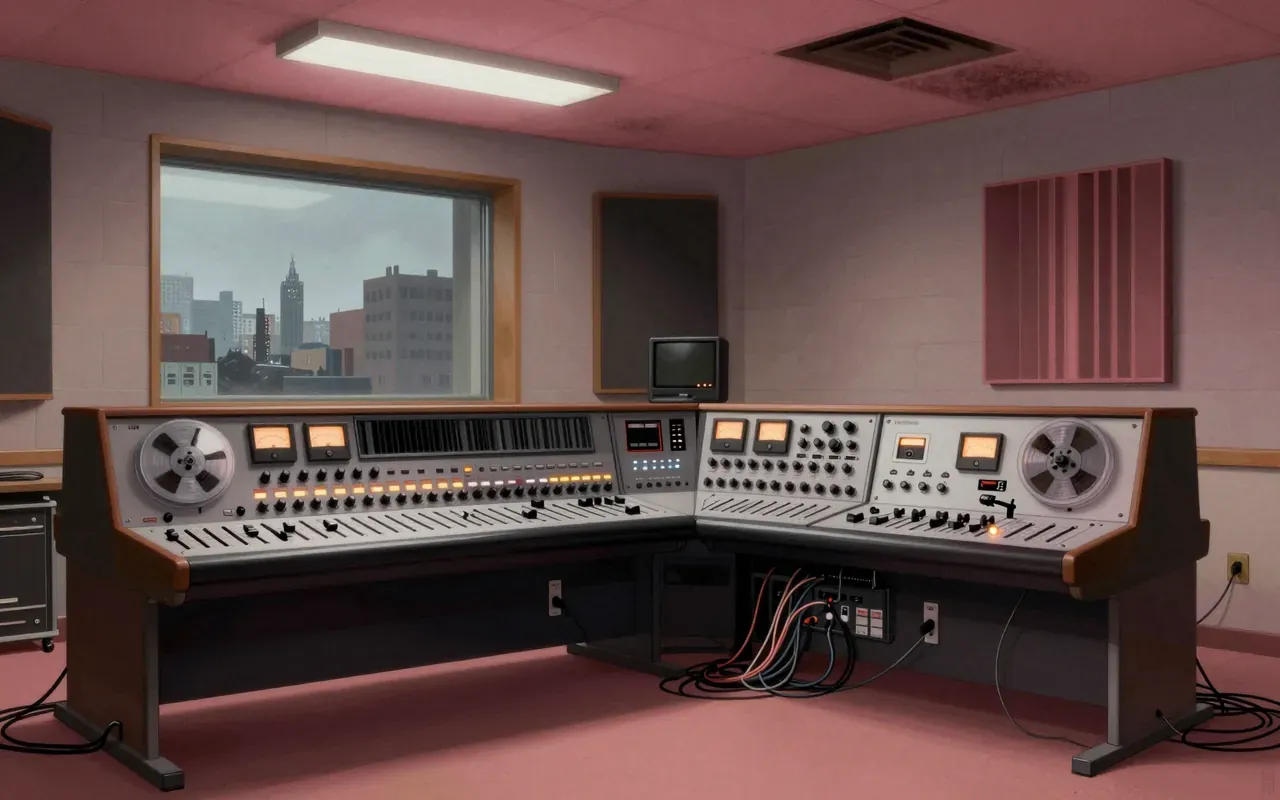
A dry, precise, sober metal record made in Copenhagen to escape American studio acoustics. No synths. No gloss. No myth-making during recording. Themes: drugs, militaries, religion, rage, insanity, monsters.

Chapters & takeaways4
  1. 1:02
    Where and when

    Recorded in Copenhagen between September and December 1985, then released on March 3, 1986.

  2. 2:35
    Why it took longer

    They chose Denmark for its acoustics, worked sober, and spent longer in the studio than before—out of ambition, not accident.

  3. 3:52
    No myth, just work

    They arrived with finished demos and treated the sessions as routine—not as a landmark.

  4. 5:25
    What it rejects—and what it names

    No synths. No gloss. Themes of control, corruption, and collapse—drugs, militaries, religion, madness.

Running order8
  1. 01
    Battery5:12

    Heard in Metallica: Through the Never (2013)

  2. 02
  3. 03
    The Thing That Should Not Be6:39
  4. 04
    Welcome Home (Sanitarium)6:28
  5. 05
    Disposable Heroes8:21

    Heard in Sounds Like a Revolution (2010)

  6. 06
    Leper Messiah5:43
  7. 07
    Orion8:28

    Heard in Metallica: Through the Never (2013)

  8. 08
    Damage, Inc.5:31

    Heard in Global Metal (2007)

Film placements are the ones described in each film's own entry, so the list is partial rather than complete.

Worth your time?

Yes. Hear the whole thing.

4.5/ 5
What works
  • Battery
  • Master of Puppets
  • Orion
  • Damage, Inc.
What does not
  • synthesizers
  • slick production
  • improvisation
  • American studio acoustics
Hear it if
  • listeners who value rhythmic discipline over mood
  • listeners who prefer instrumental clarity over texture
  • listeners who respond to thematic directness
Skip it if
  • those who prefer lo-fi
  • those who prefer improvisation
  • those who prefer lyrical abstraction
The written brief1 min read

What the record is and where it came from

Metallica’s third studio album. Recorded at Sweet Silence Studios in Copenhagen from September 1 to December 27, 1985. Released March 3, 1986.

How it sounds, and how it was made

It sounds dry, tight, and room-conscious—recorded at Sweet Silence Studios in Copenhagen to avoid American studio acoustics. The band used no synthesizers. They played sober on recording days. Flemming Rasmussen produced. Kirk Hammett studied with Joe Satriani; Lars Ulrich took drum lessons. Demos were fully formed before arrival. Only minor compositional changes happened in the studio.

What lands

The riffing lands with physical force: palm-muted precision, layered tremolo, abrupt tempo shifts, and bass lines that lock with drums rather than float. ‘Orion’ lands as instrumental architecture—no vocals, no solos as spectacle, just arrangement as argument.

What does not

It does not use synthesizers. It does not rely on slick production. It does not sound like contemporaneous glam metal. It does not feel improvised or spontaneous—it feels rehearsed, precise, and deliberate.

The ideas inside it

It explores religious and military leaders, rage, insanity, monsters, and drugs. It does not explore love, hope, irony, or domestic life.

Who should hear it, and who should not

Listeners who value rhythmic discipline over mood, instrumental clarity over texture, and thematic directness over ambiguity. Not for those who prefer lo-fi, improvisation, or lyrical abstraction.

Is it worth your time

Yes—if you want a tightly wound, anti-glam metal record built for volume, velocity, and structural control. It is not for listeners who need warmth, looseness, or tonal ambiguity.
Same genre · Rock4 of 29
9:18
…And Justice for AllMetallica · 1988…And Justice for All is Metallica’s 1988 studio album, recorded January–May at One on One Recording Studios in Los Angeles. It is defined by its dry, sterile production, inaudible bass, clicking drums, and thin guitar buzz—results of a methodical, instrument-by-instrument process overseen partly by Flemming Rasmussen (who joined six weeks in) and mixed by Thompson and Barbiero in Rasmussen’s absence. Jason Newsted recorded bass alone. Hetfield prioritised a hard vibe over singing. The album premiered at Brooklyn’s L’Amour in September 1988.
9:59
Back in BlackAC/DC · 1980Back in Black is AC/DC’s 1980 album, recorded over seven weeks from mid-April to May 1980 at Compass Point Studios in the Bahamas. It followed Bon Scott’s death. Brian Johnson replaced him as vocalist. The songwriting began with Scott and concluded with Johnson.
11:36
Born in the U.S.A.Bruce Springsteen · 1984Born in the U.S.A. is a 1984 rock-pop album by Bruce Springsteen, recorded with the E Street Band in New York City from January 1982 to March 1984. It draws material from the Nebraska demo tape. Its title track is a bitter commentary on Vietnam veterans, but its anthemic music and title led to widespread misinterpretation. Chuck Plotkin judged the full-band performances as less meaningful, less compelling, and less honest than the demos. The album was co-produced by Springsteen, Jon Landau, Steven Van Zandt, and Chuck Plotkin. Toby Scott engineered at the Power Station in April 1982. 'Cover Me' was originally written for Donna Summer. The recording sessions yielded 70–90 songs.
10:50
Born to RunBruce Springsteen · 1975A meticulously constructed studio artifact — not a live document — built on tension, layering, and unresolved sonic ambition.
Up next in Music

Master of Reality

Black Sabbath · 1971 · 10:16

Heaviness here is not attitude—it’s anatomy, tuning, and studio time.

10:16