musicbriefs
2:34in production/ 2:34 · ceiling 15 min
Afrobeat & Latin

Shakara

Two extended performances reveal Africa 70’s musical coordination and the limits of Fela’s social satire.

Released in 1972 and recorded in Lagos the previous year, Shakara contains two substantial pieces: “Lady” and “Shakara (Oloje).” Fela Kuti fronts Africa 70, with Tony Allen on drums. The short track list gives each argument a large share of the album's space.

Worth your time?

Selectively. Start with the brief, then hear the parts we point at.

What works
    What does not
      Hear it if
      • Listeners interested in early Afrobeat and willing to engage critically with its lyrics
      Skip it if
      • Listeners seeking short songs or an uncomplicated political hero
      The written brief2 min read

      What the record is and where it came from

      Released in 1972 and recorded in Lagos the previous year, Shakara contains two substantial pieces: “Lady” and “Shakara (Oloje).” Fela Kuti fronts Africa 70, with Tony Allen on drums. The short track list gives each argument a large share of the album’s space.

      How it sounds, and how it was made

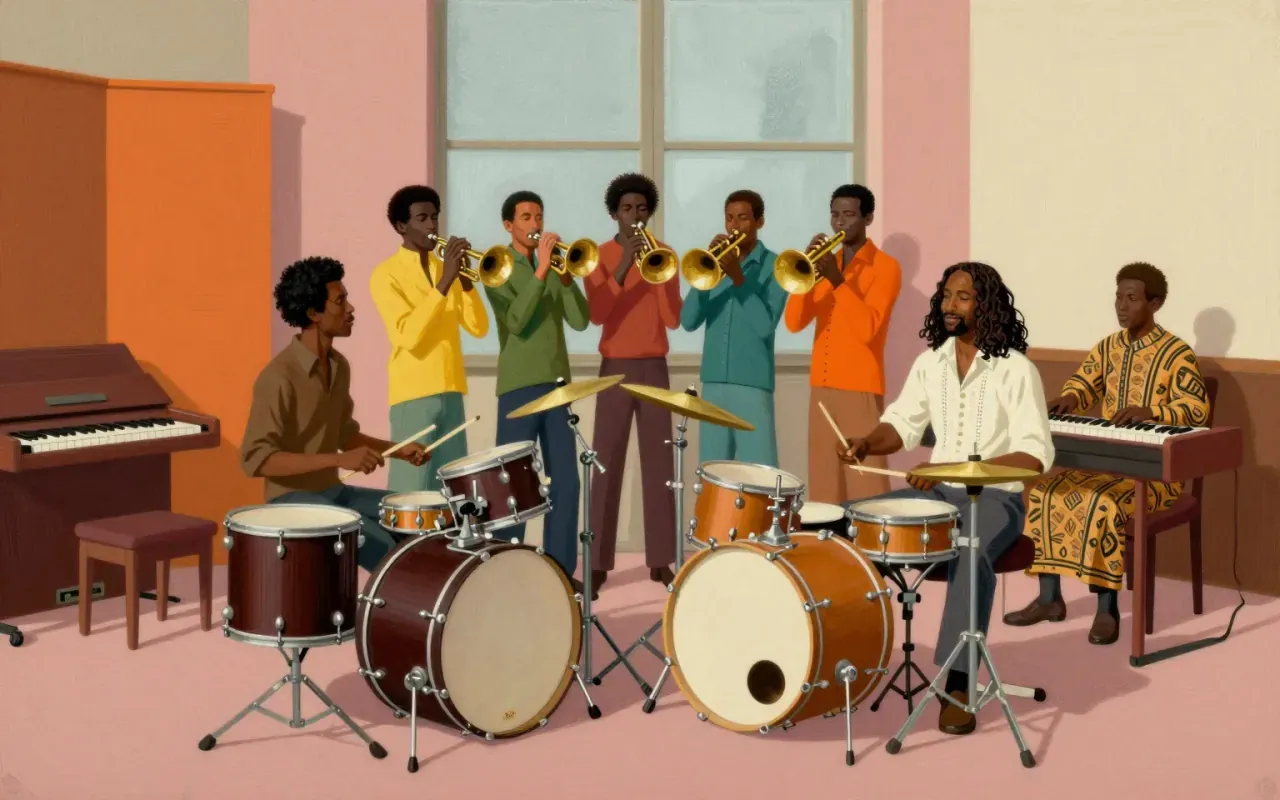
      The official catalogue identifies the interaction of guitarists Tutu Shoronmu and Segun Edo as a key feature. Their repeated parts contribute melody and rhythm together. Horns, keyboards, percussion and voice operate within the larger ensemble.

      This is useful music for listening to relationships between parts. A repeated figure need not become the foreground event to matter; the way it supports other figures can be the point.

      What lands

      Two long performances make it possible to settle into a band rather than repeatedly start again with a new song. The title piece directs its satire at people who exaggerate their influence and importance. Its target is readily recognisable beyond the particular circumstances of the recording.

      The musical appeal lies in shared organisation. Paying attention to a guitar part alongside the drums gives a more specific entrance than treating the whole performance as an undifferentiated groove.

      What does not

      “Lady” attacks women embracing feminist independence. That stance makes the album’s satire uneven: the challenge to inflated male importance sits beside a restrictive view of women’s behaviour. Musical accomplishment does not resolve that contradiction. The extended format also gives little relief if either the repetition or the argument loses you.

      The ideas inside it

      A musician can resist some forms of authority while defending others. Shakara rewards listening that keeps that distinction open. Admiration for the band’s work can coexist with disagreement about the social roles its leader prescribes.

      Who should hear it, and who should not

      Hear it for Africa 70’s ensemble organisation and an early example of Fela’s social commentary. It will be less satisfying if you need a rapid sequence of contrasting songs or expect every political position to be liberating.

      Is it worth your time

      Selectively. Begin with the title piece, then hear “Lady” with attention to its argument. The record is musically instructive and politically mixed; both features belong in an honest account of its value.
      Same genre · Afrobeat & Latin4 of 31
      2:36
      Army ArrangementFela Kuti · 1985Army Arrangement belongs to Fela Kuti's mid-1980s work with Egypt 80. Its title song examines Nigeria's transition from military to civilian government, while “Government Chicken Boy,” included on editions of the album, attacks obedient service to authority. Political institutions change their presentation; Fela asks who continues to benefit.
      13:00
      Fela's London SceneFela Kuti, Nigeria 70 · 1971Made on tour in London rather than at home in Lagos, Fela's London Scene pairs Fela Kuti and Nigeria 70 with a second drummer, Ginger Baker, for five extended tracks built on horn riffs and dense percussion. Lighter on political narrative than Kuti's mid-seventies work, it is best heard as the sound of a band finding the architecture it would spend the rest of the decade refining.
      13:00
      Expensive ShitFela Kuti · 1975Recorded in 1975 out of the Kalakuta Republic compound, Expensive Shit compresses Fela Kuti's long standoff with Nigeria's police into two extended Africa '70 tracks: a title piece built from a real, absurd arrest, and Water No Get Enemy's gentler appeal to a Yoruba proverb about nature's staying power. Short in length, it is unusually complete for a Kuti record.
      2:08
      Opposite PeopleFela Kuti, Africa 70 · 1977Opposite People is a 1977 Fela Kuti and Africa 70 album, originally released by Decca Afrodisia. Its two tracks approach social behaviour through apparently ordinary examples. Later paired reissues with Sorrow Tears and Blood can obscure the identity of this original programme.
      Up next in Music

      Sheer Heart Attack

      Queen · 1974 · 2:02

      Queen sharpen their theatrical range into a more immediate set of rock and pop songs.

      2:02