Saved
Folk & singer-songwriter · Rock

Sigh No More

This isn’t folk revival — it’s folk weaponised.

Worth your time?3.5/5Yes.Hear the whole thing.What works, what does not, who it is for ↓
11:09in productionCh. 1 · No Instruments, No Problem/ 11:09 · ceiling 15 min
4 chapters · 11:09Ceiling 15:00

The brief is written and checked. The video joins this page when it is cut.4 chapters · 2 min read · 11:09 planned

Read the brief

Sigh No More is Mumford & Sons’ 2009 debut studio album, recorded with producer Markus Dravs after the band self-financed it and arrived at sessions without their own instruments. Only one track — 'Little Lion Man' — came from their prior EP Love Your Ground. The album features multi-instrumental performances by the core band (vocals, banjo, mandolin, double bass, drums, keyboards, accordion), augmented by trumpet, flugelhorn, trombone, violin, viola, and cello. Production includes unconventional elements such as 'a nail and a piano string'. Engineering was by François Chevallier, mixing by Ruadhri Cushnan, and mastering by Bob Ludwig. A live recording included in the deluxe edition was made at Shepherd's Bush Empire on 14 March 2010.

Chapters & takeaways4
  1. 1:00
    No Instruments, No Problem

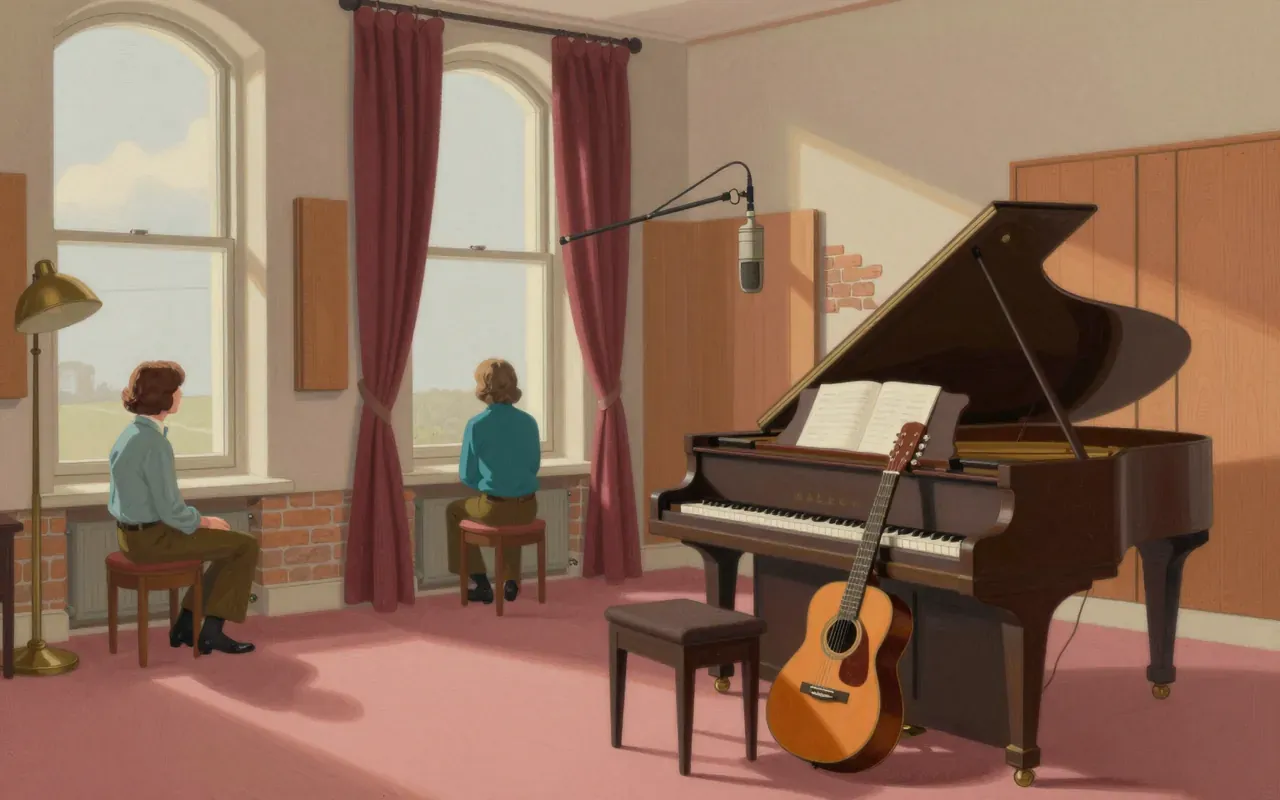
    They recorded it broke — no instruments, no label, no safety net.

  2. 2:30
    The Room Was Full

    Banjo, mandolin, double bass, and brass — all played live, all bleeding into each other.

  3. 4:17
    A Clean Break

    Only one song carried over from their past — everything else was built from scratch.

  4. 6:06
    Cash Bought Clarity

    Self-financing wasn’t romantic — it was tactical, to keep control of the sound.

1 more chapterFewer chapters
Running order12
  1. 01
    Sigh No More3:28

    Heard in Much Ado About Nothing (1993)Much Ado About Nothing (2012)

  2. 02
    The Cave3:38

    Heard in Avengers: Age of Ultron (2015)

  3. 03
    Winter Winds3:39
  4. 04
    Roll Away Your Stone4:24
  5. 05
    White Blank Page4:14
  6. 06
    I Gave You All4:20
  7. 07
    Little Lion Man4:05
  8. 08
    Timshel2:53
  9. 09
    Thistle & Weeds4:49
  10. 10
    Awake My Soul4:15
  11. 11
    Dust Bowl Dance4:43
  12. 12
    After the Storm4:08

Film placements are the ones described in each film's own entry, so the list is partial rather than complete.

Worth your time?

Yes. Hear the whole thing.

3.5/ 5
What works
  • rhythm
  • lyric density
  • instrumental interplay
  • vocal urgency
What does not
  • electronic
  • polished
  • restrained
  • ambient
Hear it if
  • listeners who value acoustic immediacy
  • fans of American roots music
  • readers of classic literature
Skip it if
  • listeners seeking sonic abstraction
  • those allergic to group vocals
  • anyone needing silence between phrases
Who should hear it, and who should skipHide who it is for
The written brief2 min read

What the record is and where it came from

Sigh No More is Mumford & Sons’ 2009 debut studio album. They self-financed it. It was recorded with producer Markus Dravs. Only one track — ‘Little Lion Man’ — came from their earlier EP Love Your Ground.

How it sounds, and how it was made

It sounds like a live room full of acoustic instruments played hard: banjo, mandolin, double bass, drums, and vocals pushed into the red. Brass and strings enter only on select tracks. The production uses minimal overdubs and avoids studio polish — the room is present, the breath audible. Markus Dravs recorded it with the band self-financing, after they arrived without their own instruments.

What lands

The rhythm section lands first — the kick drum and double bass lock into a galloping pulse that forces movement. Then the banjo and mandolin cut through with staccato attack. Then the four-part harmonies, raw and unblended, land like fists on a table.

What does not

It does not sound like a studio construct. There are no programmed beats, no synth pads, no vocal tuning, no ambient washes. It does not linger in ambiguity — every line pushes forward. It does not separate the sacred from the secular; it collapses them into shared breath and sweat.

The ideas inside it

It draws from Shakespeare, Macbeth, The Odyssey, Steinbeck, and Chesterton — not as references but as scaffolding for spiritual questioning. It treats faith as a wrestling match, not a doctrine. The lyrics are literary but never academic; they land in the throat, not the head.

Who should hear it, and who should not

People who miss the weight of acoustic instruments played at volume. People who want lyrics that quote Shakespeare but sound like they were shouted in a pub after midnight. People who still reach for records that feel made by hands, not algorithms.

Is it worth your time

Yes, if you want to hear how folk rock sounded when it re-entered the mainstream with physical urgency and no digital smoothing. No, if you expect subtlety, space, or restraint.
Same genre · Folk & singer-songwriter4 of 174
8:58
Fleet FoxesFleet Foxes · 2008Fleet Foxes’ self-titled 2008 debut was recorded mostly in domestic spaces — Pecknold’s parents’ basement and Wescott’s home — due to tight funds; it aimed for simplicity through harmonies and unconventional structures, underwent full re-recording and exhaustive revision, and was produced by Phil Ek with vocals added the night before final mixing. Its pastoral acoustic sound foregrounds vocal arrangements modelled on classical string textures, informed by folk, gospel, psychedelic pop and Sacred Harp styles, with lyrics rooted in Pecknold’s rural surroundings, philosophical reflection and personal abandonment — not love songs.
9:22
IllinoisSufjan Stevens · 2005Illinois is a tightly wound studio artefact—self-recorded, self-performed, self-constrained. Its power lies in how much it builds from so little: cheap mics, narrow bandwidth, and total solitude. It is not about Illinois. It is about what one person can assemble when they treat geography as grammar, not gospel.
11:21
Tea for the TillermanCat Stevens · 1970Tea for the Tillerman is Cat Stevens’s fourth studio album, recorded between May and July 1970 across three London studios — Morgan, Island, and Olympic — and features contributions from Alun Davies (guitar, backing vocals), Harvey Burns (drums and percussion), John Ryan (double bass), Del Newman (string arrangements), Jack Rothstein (solo violin), and Paul Samwell-Smith (backing vocals), alongside Stevens’s multi-instrumental and vocal performances. The album includes iconic songs such as 'Wild World' and 'Father and Son', and Stevens also created the front cover illustration. A previously unreleased version of 'But I Might Die Tonight' was used in the 1970 film Deep End and later released in 2020. The album has been reissued multiple times, including a 2020 Super Deluxe Edition with remastered and newly mixed versions, and a reimagined version titled Tea for the Tillerman2, released the same year. Critical reception varied contemporaneously but grew more laudatory over time, with retrospective praise for its themes and melodic craftsmanship, and inclusion in numerous 'greatest albums' lists. It was released on 23 November 1970 by Island Records in the UK and A&M in North America. All songs were written by Cat Stevens. The personnel details are adapted from the liner notes of the 2020 CD reissue. Shepard 'Shep' Sherbell provided photography for the album. The album reached the top 10 in the US and top 20 in the UK, and has been certified and referenced widely in popular culture, including films and television shows. The original release included eleven tracks, all written by Stevens, and the Deluxe Edition added demos and live recordings. The Super Deluxe Edition contains five discs, including remasters, new mixes, Tea for the Tillerman2, music videos, live videos, and a 12" vinyl of 1970 Troubadour recordings. In November 2008, a Deluxe Edition was released; in January 2012, a hi-res 24/192 kHz remaster appeared on HDtracks.com. On 28 May 2020, Yusuf announced Tea for the Tillerman2, released 18 September 2020, described as a reimagining of the same eleven songs for a new age with dramatic results. Four songs from the album appeared in Harold and Maude (1971), and 'Father and Son' featured in Guardians of the Galaxy Vol. 2 (2017) and The Boat That Rocked (2009). The album was used as the closing title track of the British sitcom Extras, and its artwork was parodied in a 2014 episode of The Simpsons. The album was included in 1001 Albums You Must Hear Before You Die (2006), The Definitive 200 Albums of All Time (2007), and Colin Larkin's All Time Top 1000 Albums (voted number 342). Rolling Stone ranked it number 205 in its 2020 revision of the 500 Greatest Albums of All Time. Robert Christgau found the music monotonous in a contemporary Village Voice review, while Ben Gerson of Rolling Stone noted its resonance despite occasional overuse of dynamics. William Ruhlmann of AllMusic praised its spirituality and melodic craft, calling it a big seller and crediting it with making Stevens a pop star for the second time in four years. Stevens, a former art student, created the cover artwork. The album features songs including 'Where Do the Children Play?', 'Hard Headed Woman', 'Wild World', 'Sad Lisa', 'Into White', and 'Father and Son'.
11:27
Fox Confessor Brings the FloodNeko Case · 2006Fox Confessor Brings the Flood is a tightly controlled act of withholding — in lyric, structure, and space. Its power lies in what it omits, not what it declares.
Up next in Music

Silent Shout

The Knife · 2006 · 7:57

This isn’t electronic music with soul — it’s electronic music that surgically removes the soul and replaces it with mirrors.

7:57