Saved
Jazz

Way Out West

A pianoless trio record that treats silence like terrain — and proves you don’t need chords to build a world.

Worth your time?4.5/5Yes.Hear the whole thing.What works, what does not, who it is for ↓
9:51in productionCh. 1 · No piano. No problem./ 9:51 · ceiling 15 min
4 chapters · 9:51Ceiling 15:00

The brief is written and checked. The video joins this page when it is cut.4 chapters · 2 min read · 9:51 planned

Read the brief

A pianoless trio record that treats silence like terrain — and proves you don’t need chords to build a world.

Chapters & takeaways4
  1. 1:08
    No piano. No problem.

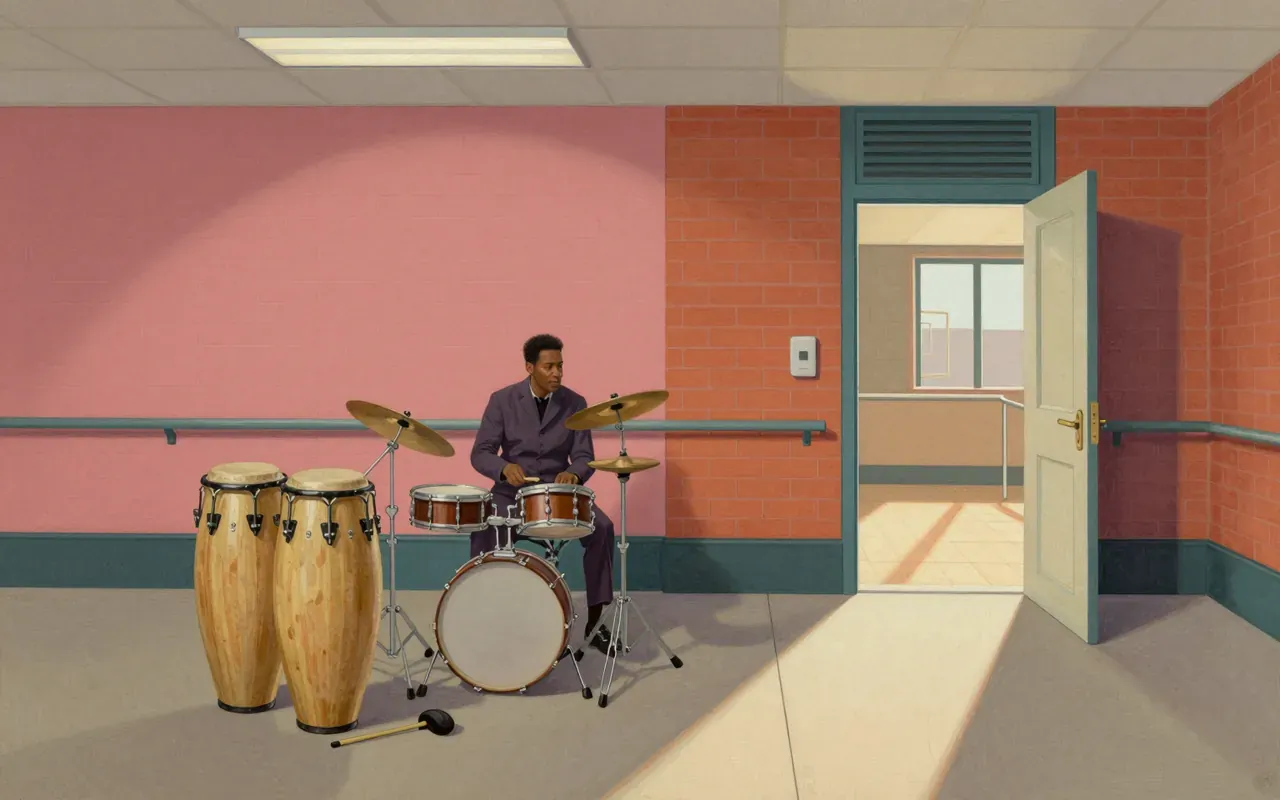
    This was Rollins’ first album with only bass and drums — a radical reduction that defined his 'strolling' approach.

  2. 3:10
    Three a.m. in LA

    Recorded at 3 a.m. in Los Angeles with two new collaborators — Brown and Manne — half the album was cut in four hours.

  3. 5:13
    Cowboy hat, not costume

    The title, cover, and song choices — 'Wagon Wheels', 'I’m an Old Cowhand' — tie the record to Western geography and repertoire.

  4. 6:48
    Longer, not louder

    The CD reissue adds alternate takes — twice as long, with extended solos from all three players.

1 more chapterFewer chapters
Running order6
  1. 01
    I'm an Old Cowhand5:43

    Heard in Rhythm on the Range (1936)Back in the Saddle (1941)Men in Black 3 (2012)

  2. 02
    Solitude7:52
  3. 03
    Come, Gone7:51
  4. 04
    Wagon Wheels10:10

    Heard in Korkoro (2009)

  5. 05
    There Is No Greater Love5:16

    Heard in The Anniversary Party (2001)Amy (2015)

  6. 06
    Way Out West6:29

Film placements are the ones described in each film's own entry, so the list is partial rather than complete.

Worth your time?

Yes. Hear the whole thing.

4.5/ 5
What works
  • the opening riff of 'Way Out West'
  • 'Solitude'
  • 'Come, Gone'
What does not
  • swing like a big band
  • groove like a soul record
  • resolve tension with lush harmony
  • use reverb, echo, or tape delay
Hear it if
  • jazz listeners who value texture over tempo
  • drummers and bassists studying interplay
  • anyone curious how much a saxophone can do without chordal support
Skip it if
  • those who need melody anchored by piano voicings
  • those who need steady backbeat
Who should hear it, and who should skipHide who it is for
The written brief2 min read

What the record is and where it came from

It is Sonny Rollins’ first pianoless trio album. Recorded in 1957 for Contemporary Records in Los Angeles. Features Ray Brown on bass and Shelly Manne on drums — both first-time collaborators. Includes Western-themed standards like ‘I’m an Old Cowhand’ and ‘Wagon Wheels’.

How it sounds, and how it was made

It sounds like a tenor saxophone moving freely over bass and drums in an empty room. No piano fills space. The bass is acoustic, the drums are dry and immediate. The session began at 3:00 a.m. and produced half the album in four hours. That urgency remains in the takes — no second-guessing, no overdubs, no reverb added later.

What lands

The opening riff of ‘Way Out West’ lands — a swaggering, blues-drenched theme played with dry attack and wide vibrato. ‘Solitude’ lands — slow, exposed, the bass and drums holding silence like breath. ‘Come, Gone’ lands — its asymmetrical phrasing and sudden stops force attention on shape, not speed.

What does not

It does not swing like a big band. It does not groove like a soul record. It does not resolve tension with lush harmony. It does not use reverb, echo, or tape delay. It does not include any song written by Rollins.

The ideas inside it

The idea is strolling: bass and drums as rhythmic and melodic companions, not just timekeepers. The idea is contrast: East Coast improviser, West Coast location, country-western songbook. The idea is constraint as liberation — no chords, no safety net, no piano to fall back on.

Who should hear it, and who should not

Jazz listeners who value texture over tempo. Drummers and bassists studying interplay. Anyone curious how much a saxophone can do without chordal support. Not for those who need melody anchored by piano voicings or steady backbeat.

Is it worth your time

Yes, if you want to hear how much space three players can make feel full. No, if you need harmonic scaffolding or studio polish.
Same genre · Jazz4 of 167
10:19
Saxophone ColossusSonny Rollins · 1957Saxophone Colossus is Sonny Rollins’s sixth studio album, recorded monophonically on June 22, 1956, at Rudy Van Gelder’s studio in Hackensack, New Jersey, with Tommy Flanagan, Doug Watkins, and Max Roach. It contains 'St. Thomas', his best-known composition — a Caribbean calypso based on a childhood tune — alongside 'Strode Rode' and 'Moritat'. It is widely acclaimed and often considered his breakthrough record.
9:23
What’s New?Sonny Rollins · 1962What’s New? is a 1962 RCA Victor album by Sonny Rollins built around Latin rhythms. It does not reinterpret the title song’s lyrical conceit or formal structure. It does not feature the trumpet solo for which the tune was originally written. It lands most clearly on ‘Jungoso’ and ‘Bluesongo’. It is worth hearing for its rhythmic focus — not for harmonic invention or narrative depth.
9:48
Freedom SuiteSonny Rollins · 1958A 1958 sax-bass-drums trio record by Sonny Rollins. Recorded with Oscar Pettiford and Max Roach. Originally released briefly before being repackaged as part of Shadow Waltz.
11:45
A Night at the Village VanguardSonny Rollins · 1957A Night at the Village Vanguard is a live 1957 Sonny Rollins album recorded on November 3 at the Village Vanguard in New York City. Released by Blue Note in 1958. The first live recording ever made at that venue. Features three sets: one afternoon with Donald Bailey and Pete LaRoca, two evenings with Wilbur Ware and Elvin Jones. Pianoless tenor-bass-drums trio format — pioneering 'strolling'. No studio mediation. No overdubs.
Up next in Music

We Insist! Max Roach’s Freedom Now Suite

Max Roach · 1961 · 9:11

A jazz suite built on a single historical deadline — not a sound, but a statement.

9:11