A terminal problem
Ambient 1: Music for Airports is Brian Eno’s 1978 release on EMI, four pieces totalling around forty-eight minutes, credited to Eno alone with contributions from Robert Wyatt on piano and three singers recording individual notes. The idea traces to a wait at a German airport that left Eno unimpressed by the piped music on offer, and to an earlier accident at home where a record of harp music played too quietly against rain became something he could not adjust and had to simply let happen. Eno had already tried the territory on his 1975 record Discreet Music, but here he named it: ambient music, a term the album is credited with putting into circulation, made not as a mood but as a working method built from loops rather than performance.
Loops instead of a band
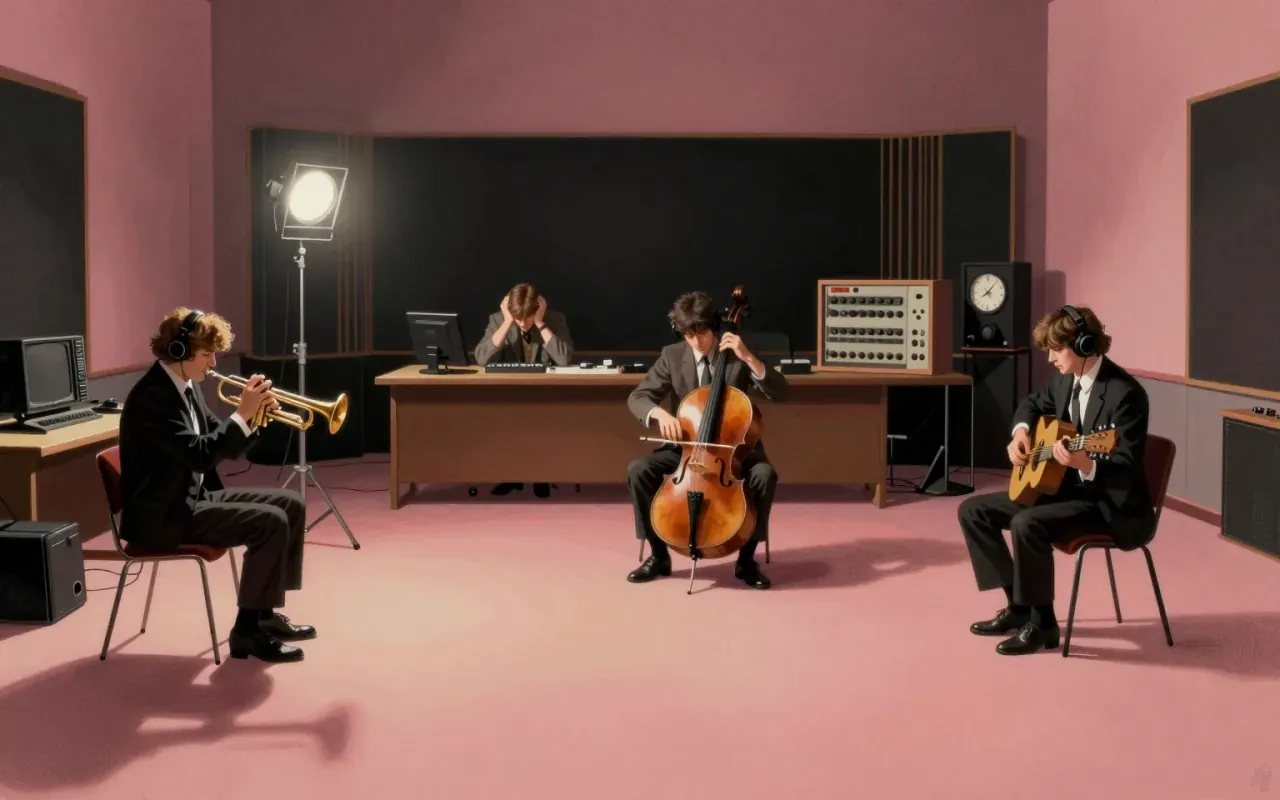
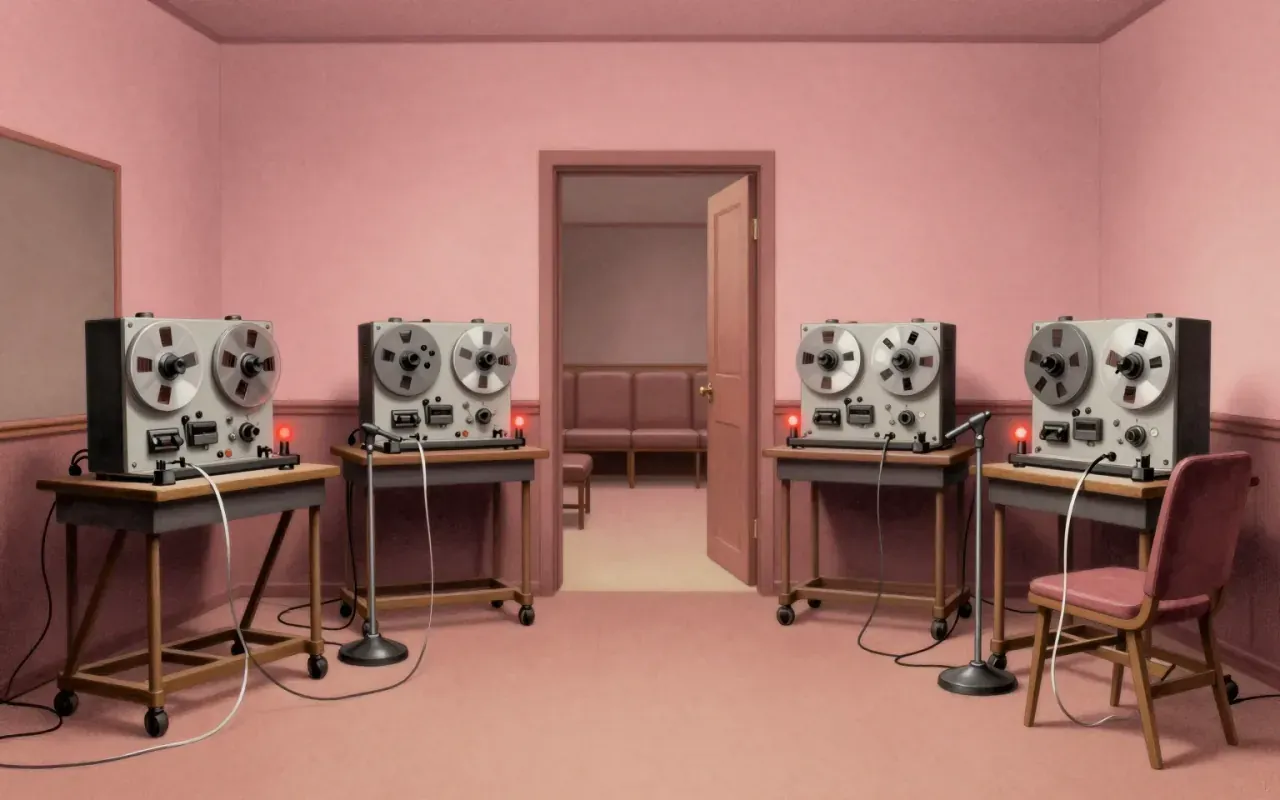
Nothing here was played straight through as a song. Eno recorded single notes from three German singers, guitar from Fred Frith, and piano from Robert Wyatt, then converted the material into tape loops of differing, sometimes accidental lengths, run simultaneously so their phases drift against each other rather than lock into a beat. One piece uses an ARP 2600 synthesiser slowed down and layered with three kinds of delay to get a thick, sustained tone Eno said he could not have produced on any other instrument. There is no drum part on the record at all. The engineering, split between Eno, Dave Hutchins, Conny Plank and Rhett Davies across sessions in London and Cologne, is really an act of arranging silence and repetition rather than tracking a band.
The piano piece
The piano piece works because its melody was never fully composed: two pianists playing without clearly hearing one another produced separate lines that only cohere by chance, and that mismatch gives the track its only real tune on the record. The synthesiser piece rewards close listening for its texture alone, the slowed tone and layered echo doing the work a chord change would elsewhere. Across all four pieces the lack of a fixed shape becomes a strength rather than a gap, letting the listener’s attention set the pace instead of the arrangement. It sounds designed rather than merely quiet, which is a harder trick than the plainness suggests and is easy to undervalue on a first pass.
What refuses to resolve
The record’s flatness of dynamics, which is deliberate, is also its most exposed nerve: nothing builds, nothing releases, and a listener expecting either will find four pieces that sit at roughly the same temperature throughout. Eno wanted it austere and unemotional, by his own description, and that choice costs the album any sense of arrival. The vocal-loop pieces in particular can feel closer to a demonstration of a technique than a finished composition, their wordless, non-vibrato voices sitting oddly outside ordinary singing. Listeners hoping for the warmth of a song, even an ambient one, may find the record colder than its reputation suggests, and its four-track total leaves little room to recover if one piece does not land for a given ear.
Furniture, not wallpaper
The record works from an idea borrowed loosely from Erik Satie’s furniture music, the notion that sound could be built to blend into a room rather than demand a chair and full attention, and Eno pushed that idea toward something that could still be interesting under scrutiny. He has also described a connection between the album and the idea of death, framing an airport as a place where mortality quietly surfaces, and wanting the record to offer some calm around that rather than distraction from it. The loops themselves embody a small argument about authorship: once set running, they configure themselves, and Eno’s job was closer to setting conditions than dictating outcomes, an idea about composition as much as about airports.
Who it suits
This suits listeners who already have some patience for ambient or minimalist music, or who are curious where the genre’s vocabulary of drones and loops actually began, since the record is as much a founding document as a listening experience in its own right. Producers interested in tape manipulation will find the ARP 2600 piece and the mismatched-loop technique worth studying on their own terms. It does not suit anyone hoping for a song in the ordinary sense, or a way into Eno’s catalogue through hooks and choruses; there is no chorus here to hold onto. Listeners who need music to actively engage with, rather than sit alongside, will likely find the pacing frustrating rather than calming, and that reaction says as much about the listener’s expectations as about the record’s design.
Does it still work
Judged as a listening object rather than as a historical marker, it holds up: the calm it produces is not the calm of blandness, and repeated plays reveal detail in the loops that a single pass misses, particularly in how the vocal pieces slowly desynchronise. Its influence on decades of ambient and electronic music is now so thoroughly absorbed that the record can sound less radical than it was, which is itself a kind of tribute. Whether it is worth an hour depends on what a listener wants from that hour; as a study in restraint, in what a record can do while asking almost nothing of the listener, it remains a genuinely useful and still quietly rewarding way to spend the time, even outside an airport.