Saved
Rock

Here’s Little Richard

This isn’t rock and roll history — it’s the sound of the dam breaking.

Worth your time?5/5Yes.Hear the whole thing.What works, what does not, who it is for ↓
10:23in productionCh. 1 · Two Cities, One Sound/ 10:23 · ceiling 15 min
4 chapters · 10:23Ceiling 15:00

The brief is written and checked. The video joins this page when it is cut.4 chapters · 2 min read · 10:23 planned

Read the brief

Here’s Little Richard is not a retrospective — it is the moment rock and roll became audible. Twelve tracks. No fat. No delay. Just piano, voice, horns, bass, and drums — locked in, loud, and unrepentant.

Chapters & takeaways4
  1. 1:07
    Two Cities, One Sound

    Eleven tracks were cut in New Orleans with the same core band; two were cut in Los Angeles with different players.

  2. 2:29
    Piano Is a Role, Not a Given

    Little Richard plays piano on ten tracks — but not on "Baby" or "Oh Why?", where others step in.

  3. 3:39
    The New Orleans Core

    Lee Allen, Alvin "Red" Tyler, Frank Fields, and Earl Palmer anchor eleven tracks — absent only from "True Fine Mama" and "She's Got It".

  4. 5:42
    A Hit-Driven Compilation

    Six singles and six filler tracks — standard for 1957, not a curated statement but a commercial consolidation.

1 more chapterFewer chapters
Running order12
  1. 01
  2. 02
    True Fine Mama2:39
  3. 03
    Can't Believe You Wanna Leave2:24
  4. 04
    Ready Teddy2:05

    Heard in The Girl Can't Help It (1956)

  5. 05
  6. 06
    Slippin' and Slidin'2:25

    Heard in The Delinquents (1989)Casino (1995)Frequently Asked Questions About Time Travel (2009)

  7. 07
    Long Tall Sally2:07

    Heard in Don't Knock the Rock (1956)Birth of the Beatles (1979)The Year of Living Dangerously (1982)Predator (1987)

  8. 08
    Miss Ann2:14

    Heard in Let It Be (1970)

  9. 09
    Oh Why?2:06

    Heard in A Lady's Morals (1930)Ferry Cross the Mersey (1964)

  10. 10
    Rip It Up2:20

    Heard in Don't Knock the Rock (1956)Keep On Rockin' (1969)Let It Be (1970)Book of Love (1990)

  11. 11
    Jenny Jenny2:02

    Heard in Jenny Jenny (1966)Keep On Rockin' (1969)The London Rock and Roll Show (1973)

  12. 12
    She's Got It2:09

    Heard in The Girl Can't Help It (1956)

Film placements are the ones described in each film's own entry, so the list is partial rather than complete.

Worth your time?

Yes. Hear the whole thing.

5/ 5
What works
  • the opening shout of "Tutti Frutti"
  • the staccato piano triplets on "Ready Teddy"
  • the honking tenor break on "Long Tall Sally"
  • the stop-time punch of "Rip It Up"
What does not
  • develop themes
  • modulate keys
  • build arrangements across tracks
  • feature guitar solos, string sections, or background choirs
Hear it if
  • anyone who needs to hear how rock and roll sounded before it had a name
  • anyone who thinks rhythm sections are background
  • anyone who confuses restraint with sophistication
Skip it if
  • listeners who require narrative arc
  • listeners who require lyrical ambiguity
  • listeners who require instrumental variation
Who should hear it, and who should skipHide who it is for
The written brief2 min read

What the record is and where it came from

Little Richard’s debut album. Released March 4, 1957, by Specialty Records. Six hit singles — including “Tutti Frutti”, “Long Tall Sally”, “Rip It Up”, “Ready Teddy”, “Slippin’ and Slidin’”, and “Jenny Jenny” — plus six unreleased tracks. Compiled shortly after Richard moved to Los Angeles following the breakthrough of “Tutti Frutti” in late 1955 and early 1956.

How it sounds, and how it was made

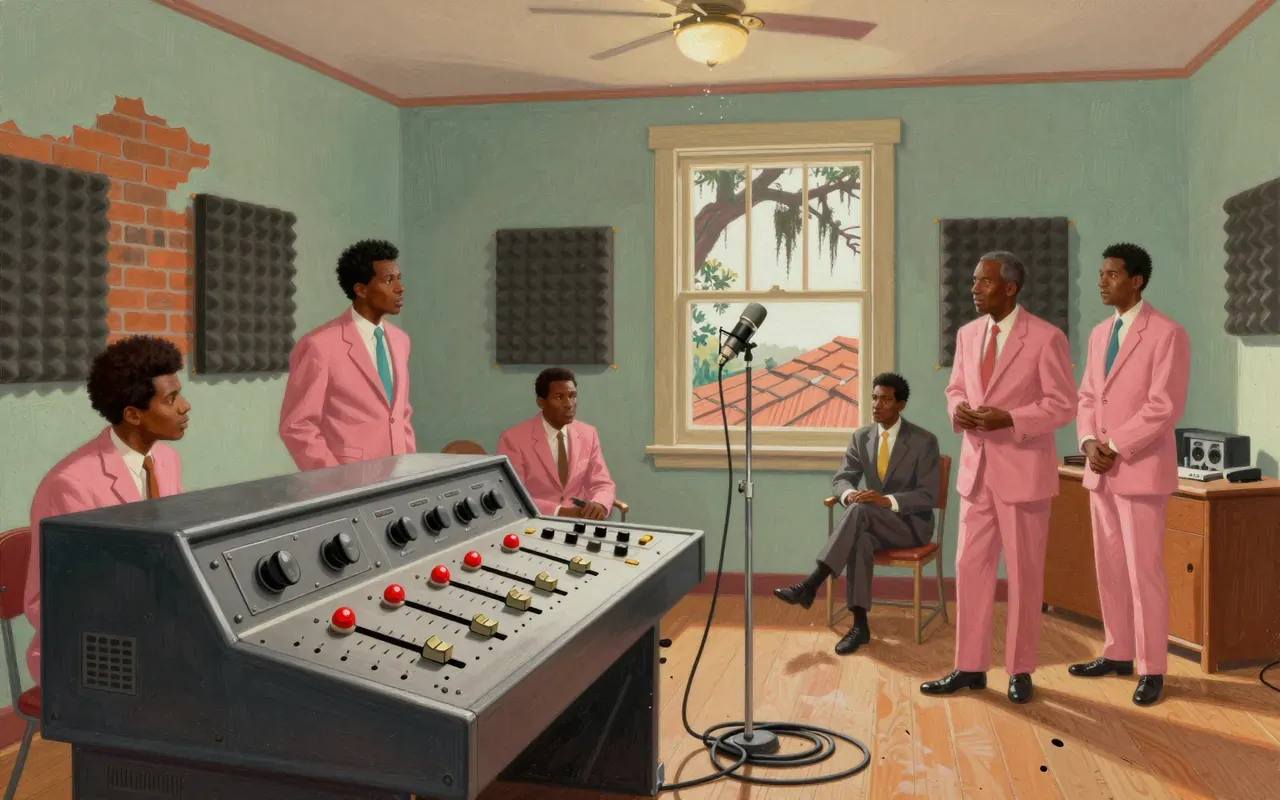
Twelve tracks, all produced by Robert “Bumps” Blackwell. Eleven cut in New Orleans with Lee Allen on tenor sax, Alvin “Red” Tyler on baritone sax, Frank Fields on bass, Earl Palmer on drums — and Little Richard on piano and vocals. Two tracks — “True Fine Mama” and “She’s Got It” — recorded in Los Angeles with different personnel. Little Richard does not play piano on “Baby” (track 5) or “Oh Why?” (track 9); Huey Smith plays piano on track 5. The room is not described, but the ensemble is tight, horn-heavy, rhythm-forward, and built for immediacy — no reverb, no overdubs, no separation.

What lands

The opening shout of “Tutti Frutti”, the staccato piano triplets on “Ready Teddy”, the honking tenor break on “Long Tall Sally”, the stop-time punch of “Rip It Up”, the call-and-response collapse on “Slippin’ and Slidin’” — all land with physical force. They are designed to move bodies, not minds.

What does not

It does not develop themes. It does not modulate keys. It does not build arrangements across tracks. It does not feature guitar solos, string sections, or background choirs. It does not slow down, soften, or reflect.

The ideas inside it

Joy as rebellion. Gospel energy stripped of liturgy. Piano as percussion. Voice as instrument, not narrator. Sex as rhythm, not story. A Black Southern man claiming space, volume, and velocity in a segregated industry — without apology, without explanation.

Who should hear it, and who should not

Anyone who needs to hear how rock and roll sounded before it had a name. Anyone who thinks rhythm sections are background. Anyone who confuses restraint with sophistication. Not for listeners who require narrative arc, lyrical ambiguity, or instrumental variation.

Is it worth your time

Yes. It is twelve songs, under two and a half minutes each, with no dead air. Every track has a vocal hook, a horn stab, and a backbeat that locks in before the first chorus. It demands attention, not contemplation.

Same genre · Rock4 of 319
9:22
Ocean RainEcho & the Bunnymen · 1984Ocean Rain is Echo & the Bunnymen’s 1984 orchestral post-punk album, written in 1983 and recorded across Paris, Bath, and Liverpool. It features a 35-piece orchestra, self-production on 'The Killing Moon', and vocal re-recording in Liverpool after dissatisfaction with Paris takes. Three singles charted — 'The Killing Moon' (UK Top 10), 'Silver' (No. 30), and 'Seven Seas' (No. 16). It reached No. 4 on the UK Albums Chart and was certified gold in 1984. Its legacy rests on structural use of strings, not lyrical or rhythmic innovation.
2:13
To Bring You My LovePJ Harvey · 1995To Bring You My Love was released in 1995 after the breakup of the original PJ Harvey trio. Harvey co-produced it with Flood and John Parish, using a new group of collaborators. The change allows the record to develop a more elaborately arranged setting for its accounts of longing.
11:18
Little EarthquakesTori Amos · 1991A piano-and-voice record that refuses to comfort — it names trauma, rejects polish, and builds its power on what it leaves out.
9:57
Blood Sugar Sex MagikRed Hot Chili Peppers · 1991Blood Sugar Sex Magik was recorded over 30 days in seclusion at Houdini’s former Los Angeles mansion, where the band installed a full studio; Frusciante, Kiedis, and Flea each occupied private rooms and pursued individual creative work between sessions; Kiedis recorded all vocals in his room; the album was written more rapidly than its predecessor and marked a stylistic shift—reducing heavy metal guitar riffs and foregrounding Frusciante’s melodic songwriting—under Rick Rubin’s production guidance, which included collaborative input on drum beats, guitar melodies, and lyrics; the setting and process fostered lyrical completion and structural refinement, moving away from pure jam-based composition toward more deliberate song forms while retaining funk-punk roots and integrating new textures and emotional range.
Up next in Music

High Violet

The National · 2010 · 8:38

A record that replaces catharsis with compression — every note calibrated for weight, not lift.

8:38