musicbriefs
9:28in productionCh. 1 · RZA’s Handprint/ 9:28 · ceiling 15 min
Hip-hop

Ironman

A flooded basement forced a new vocal sound — and Ghostface Killah emerged more exposed, more urgent, and more himself.

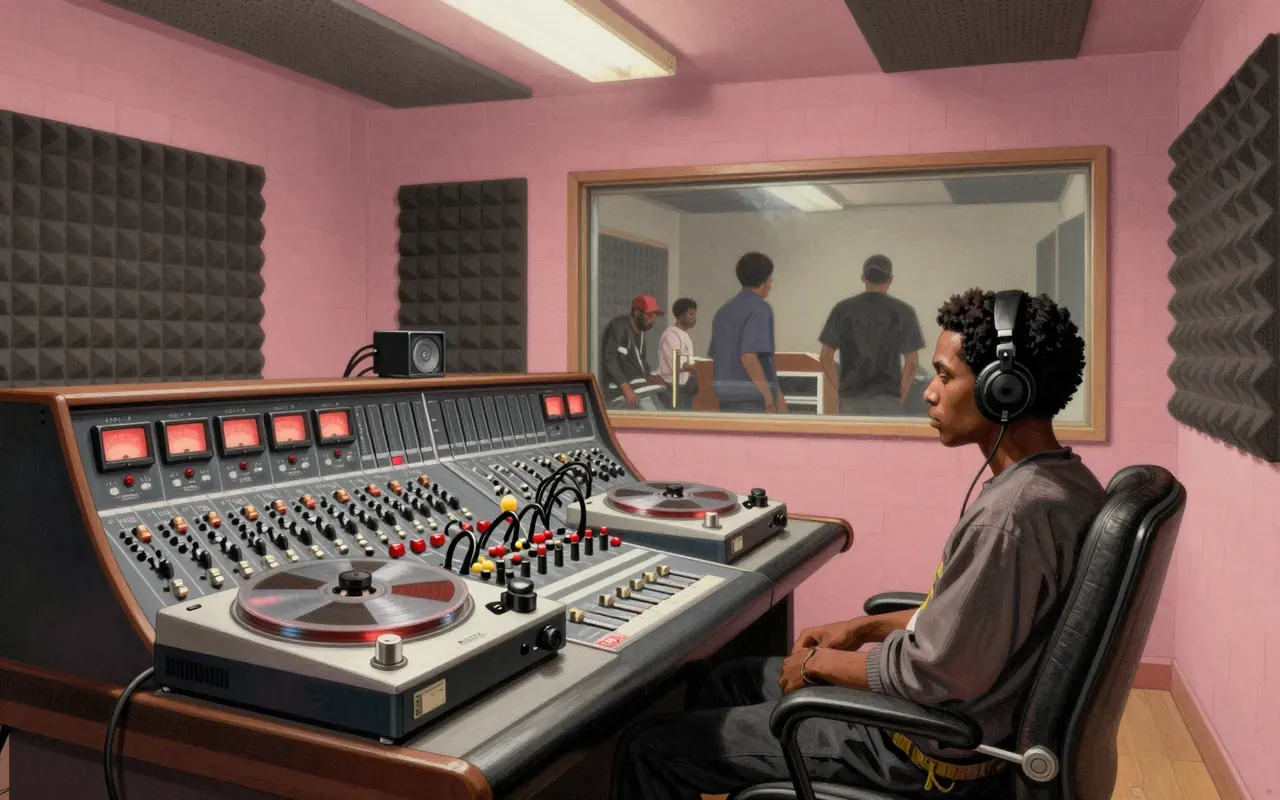
Ironman is Ghostface Killah’s 1996 solo debut, produced almost entirely by RZA using dark keyboard tones and early-1970s soul samples drawn from blaxploitation films. A flood destroyed the original studio, forcing vocals to be recorded elsewhere with different equipment — altering Ghostface’s voice and deepening his vulnerability. The album features substantial storytelling rap and Ghostface’s signature uptempo, stream-of-consciousness rhyming. Though billed as a solo record, Ghostface appears alone on only four tracks; Raekwon and Cappadonna feature heavily. Two songs originated in film soundtracks. Critics received it well.

Chapters & takeaways5
  1. 0:43
    RZA’s Handprint

    RZA produced every track but one — a near-total sonic signature.

  2. 2:23
    Soul and Shadow

    Dark keyboards meet early-1970s soul — no synths, no drums from the future.

  3. 4:15
    The Flood Changed the Voice

    The flood changed the mic chain — and Ghostface’s voice became less shielded, more human.

  4. 5:00
    Rap as First-Person Cinema

    Uptempo stream-of-consciousness and full narratives like '260' define the writing.

  5. 6:00
    Solo in Name Only

    Only four tracks are Ghostface alone — and two songs came from film soundtracks.

Running order17
  1. 01
    Iron Maiden4:47

    Heard in The Seventh Seal (1957)Monty Python's Life of Brian (1979)Falling Down (1993)Black Widow (2021)

  2. 02
    Wildflower3:27

    Heard in Heavy Metal Parking Lot (1986)

  3. 03
    The Faster Blade2:28
  4. 04
    2602:47
  5. 05
    Assassination Day4:18
  6. 06
    Poisonous Darts2:16
  7. 07
    Winter Warz4:41
  8. 08
    Box in Hand3:15
  9. 09
    Fish3:50
  10. 10
    Camay4:34
  11. 11
    Daytona 5004:41
  12. 12
  13. 13
    Black Jesus4:37

    Heard in Grow House (2017)

  14. 14
    After the Smoke Is Clear3:17
  15. 15
    All That I Got Is You5:21
  16. 16
    The Soul Controller6:50
  17. 17
    Marvel5:10

    Heard in Iron Man (2008)

Film placements are the ones described in each film's own entry, so the list is partial rather than complete.

Worth your time?

Yes. Hear the whole thing.

4.5/ 5
What works
  • The soulful-yet-harsh production works.
  • Ghostface’s vulnerability works.
  • The uptempo stream-of-consciousness works.
  • The storytelling in '260' works.
What does not
  • It does not replicate the vocal conditions of prior Wu-Tang releases.
  • It does not position Ghostface as infallible.
  • It does not avoid collaboration.
Hear it if
  • For listeners who value texture over polish.
  • For those who hear voice as instrument, not just message.
  • For people who want rap that breathes like lived experience.
Skip it if
  • Not for listeners who need consistent solo dominance.
  • Not for those who prefer Wu-Tang’s earlier, drier vocal timbre.
  • Not for people who treat albums as mood furniture.
The written brief1 min read

What the record is and where it came from

Ironman is Ghostface Killah’s 1996 solo debut. It is a Wu-Tang solo album with heavy internal collaboration. It was released after Ghostface’s group achieved breakthrough success with Enter the Wu-Tang (36 Chambers).

How it sounds, and how it was made

RZA uses dark keyboard tones and early-1970s soul samples. The vocals were recorded in a different studio with different equipment after a flood destroyed the original basement studio. The production draws prominently on blaxploitation films. The album is almost entirely produced by RZA — all but one track.

What lands

The soulful yet harsh feel lands. Ghostface’s vulnerability lands. The uptempo, stream-of-consciousness rhyming lands. The storytelling in ‘260’ lands.

What does not

Ghostface does not appear as sole rapper on most tracks — only four do. The album does not avoid collaboration: Raekwon and Cappadonna feature heavily. It does not replicate the sonic conditions of prior Wu-Tang recordings due to the flood-induced studio shift.

The ideas inside it

Ghostface adopts a more vulnerable persona than on earlier Wu-Tang solo projects. The album features substantial storytelling rap. Ghostface’s uptempo, stream-of-consciousness rhyming style dominates. Two songs originated in film soundtracks.

Who should hear it, and who should not

People who want to hear how soul samples and blaxploitation textures can anchor raw, first-person rap storytelling should hear it. People who expect consistent solo dominance or unchanged Wu-Tang vocal tone should not.

Is it worth your time

Yes. It rewards attention to texture, storytelling, and vocal vulnerability. It is not background music.
Same genre · Hip-hop4 of 56
11:19
AqueminiOutKast · 1998Aquemini is OutKast’s third studio album, released 29 September 1998. It was recorded primarily at Bosstown and Doppler Studios in Atlanta using live instrumentation, rotating session musicians, and extended jam-based composition. Big Boi and André self-produced most tracks, drawing on soul, trip hop, and electro textures — and reggae, via André’s constant listening to Bob Marley. The title merges their zodiac signs. It was certified double platinum and reached number two on the Billboard 200.
10:42
ASTROWORLDTravis Scott · 2018ASTROWORLD is Travis Scott’s third studio album, named after the defunct Houston theme park. Recorded between 2016 and 2018, final sessions took place in Hawaii with Mike Dean, Nav, Frank Dukes, Sonny Digital, WondaGurl, Sheck Wes, Gunna, Wheezy, Don Toliver, Allen Ritter and Amir 'Cash' Esmailian. Mike Dean played keyboards on track 4, guitar on track 17, and synthesizer on track 17. Stevie Wonder played harmonica on track 5. John Mayer played guitar on tracks 8, 11 and 13. Sheldon Ferguson played guitar on track 12. Nineteen85 played bass on track 17. Isaiah Gage played cello on track 17. The album was released on August 3, 2018, debuted at number one on the Billboard 200 with 537,000 album-equivalent units in its first week, and was met with widespread critical acclaim.
11:02
Atrocity ExhibitionDanny Brown · 2016Atrocity Exhibition is Danny Brown’s third studio album, released in 2016 after signing with Warp Records. It is named after a Joy Division song. Paul White produced all tracks except ‘Really Doe’ (Black Milk), ‘Pneumonia’ (Evian Christ), and unspecified contributions from The Alchemist. Guest appearances include Kendrick Lamar, Ab-Soul, Earl Sweatshirt, B-Real, Kelela, and Petite Noir. The album draws stylistic influence from Talking Heads and Joy Division — and, while writing it, Brown also drew inspiration from Björk. It received continued critical acclaim but reduced commercial sales.
9:25
Beats, Rhymes and LifeA Tribe Called Quest · 1996Beats, Rhymes and Life is a tightly wound, sonically restrained document of a group at breaking point — not a triumph, but a testimony.
Up next in Music

It Takes a Nation of Millions to Hold Us Back

Public Enemy · 1988 · 11:10

Hip-hop’s first full-throated declaration of war on the mix desk—and the mind.

11:10