Saved
Punk & post-punk · Rock

Live at the Witch Trials

A studio album called 'Live' — recorded in one day, mixed the next, and built on refusal: of polish, of explanation, of compromise.

Worth your time?4.5/5Yes.Hear the whole thing.What works, what does not, who it is for ↓
10:21in productionCh. 1 · Not Live/ 10:21 · ceiling 15 min
4 chapters · 10:21Ceiling 15:00

The brief is written and checked. The video joins this page when it is cut.4 chapters · 2 min read · 10:21 planned

Read the brief

Live at the Witch Trials is The Fall’s debut studio album — recorded in one day, mixed the next, and built on refusal: of polish, of explanation, of compromise.

Chapters & takeaways4
  1. 1:08
    Not Live

    It is not live — despite the title, it is a studio document made under pressure.

  2. 2:12
    One Day, One Room

    Recorded in one day, mixed the next — illness and time limits shaped its sound.

  3. 3:48
    The Driver’s Voice

    The time-caller on 'Music Scene' is the band’s driver — not an actor, not a clock, but a real person named only by his father’s profession.

  4. 6:33
    Old Songs, Sharp Targets

    Songs predate the lineup — credits go to Tony Friel and Una Baines — and lyrics fix on menial labour, drugs, and the music industry.

1 more chapterFewer chapters
Running order11
  1. 01
    Frightened5:03

    Heard in The Birth of a Nation (1915)Snow White and the Seven Dwarfs (1937)The Shining (1980)Schindler's List (1993)

  2. 02
    Crap Rap 2 / Like to Blow2:08
  3. 03
    Rebellious Jukebox2:58
  4. 04
    No Xmas for John Quays4:39
  5. 05
    Mother-Sister!3:22

    Heard in Battle of Pottsburg Bridge (1912)

  6. 06
    Industrial Estate2:01
  7. 07
    Underground Medecin2:10
  8. 08
    Two Steps Back5:06
  9. 09
    Live at the Witch Trials0:51
  10. 10
    Futures and Pasts2:39
  11. 11
    Music Scene8:00

    Heard in Renaldo and Clara (1978)24 Hour Party People (2002)A Mighty Wind (2003)It's All Gone Pete Tong (2004)

Film placements are the ones described in each film's own entry, so the list is partial rather than complete.

Worth your time?

Yes. Hear the whole thing.

4.5/ 5
What works
  • the abrasive insistence of 'Rebellious Jukebox'
  • the tape manipulation on 'Music Scene'
  • the closing fade of 'Underground Medecin'
  • the driver’s voice calling times on 'Music Scene'
What does not
  • offer catharsis
  • follow verse-chorus structures
  • smooth over rhythmic weaknesses or sonic roughness
  • clarify its lyrics
Hear it if
  • people who want music that treats the studio as a site of confrontation, not perfection
  • people who respond to sardonic detachment, visceral anger, and melancholic resignation in equal measure
  • people who hear rhythm as incantation, not groove
Skip it if
  • people who require singalong hooks
  • people who need linear storytelling
  • people who need tonal comfort
Who should hear it, and who should skipHide who it is for
The written brief2 min read

What the record is and where it came from

It is The Fall’s debut studio album. Not live. Recorded 15 December 1978 at Camden Sound Suite. Mixed the next day by Bob Sargeant. Made under duress: Mark E. Smith was ill; five days of studio time were cut to two. Some tracks originate from earlier lineups, crediting Tony Friel and Una Baines.

How it sounds, and how it was made

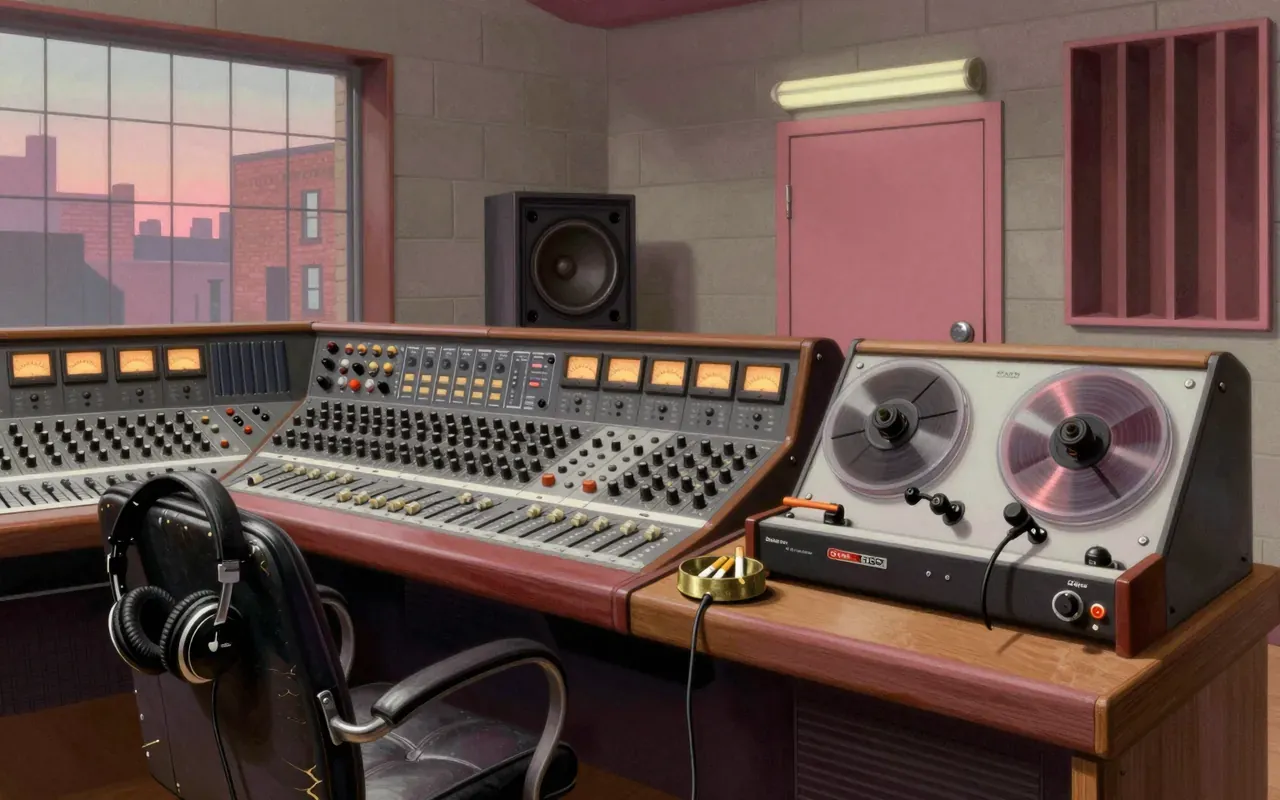
It sounds dry, close-miked, and unvarnished. Recorded live-in-studio in one day at Camden Sound Suite, with minimal overdubs and no studio polish. The room’s ambience is sparse — no reverb, no bleed beyond what the mics caught. Guitar dissonance, bass-driven propulsion, and drumming that alternates between martial precision and unhinged swing define its rhythmic identity. Mark E. Smith’s spoken-sung, sneering vocal delivery is placed front and centre, raw and confrontational.

What lands

The abrasive insistence of ‘Rebellious Jukebox’ lands as a mission statement. The tape manipulation on ‘Music Scene’ lands as documentary intrusion. The closing fade of ‘Underground Medecin’ lands as unresolved unease. The voice calling times on ‘Music Scene’ lands as a non-musical, cinematic layer — real, specific, unscripted.

What does not

It does not offer catharsis. It does not follow verse-chorus structures. It does not smooth over rhythmic weaknesses or sonic roughness. It does not clarify its lyrics. It does not separate poetry from noise — it holds them in precarious balance.

The ideas inside it

It contains ideas about alienation, institutional critique, and social marginality — anchored in concrete observation, not abstraction. It links ‘Industrial Estate’ to deindustrialisation, ‘Music Scene’ to media distortion, and ‘No Xmas for John Quays’ to drug use. Its irony is structural: a studio album titled ‘Live’, a time-caller who is the band’s driver, not a clock.

Who should hear it, and who should not

People who want music that treats the studio as a site of confrontation, not perfection. People who respond to sardonic detachment, visceral anger, and melancholic resignation in equal measure. People who hear rhythm as incantation, not groove. Not people who require singalong hooks, linear storytelling, or tonal comfort.

Is it worth your time

Yes. It is worth your time if you want music that refuses to explain itself, demands active listening, and rewards repeated attention with new textures and meanings. It is not worth your time if you need melodic resolution, narrative clarity, or studio refinement.
Same genre · Punk & post-punk4 of 91
9:10
Eternally YoursThe Saints · 1978Eternally Yours is The Saints’ 1978 second album, produced by Chris Bailey and Ed Kuepper, featuring an R&B-influenced sound with horn arrangements and new bassist Algy Ward. Recorded at Wessex Studios under the original title International Robots, the sessions yielded stripped-down versions later issued as bonus tracks. Bailey regarded it as the band’s first proper release—distinct from the demo character of their debut—though its horn-heavy approach reportedly alienated some listeners at the time. Retrospective assessments have elevated it as a punk classic, praised for consistency, variety, and influence, with endorsements from major musicians including Kurt Cobain and Mark Lanegan.
9:42
Q: Are We Not Men? A: We Are Devo!DEVO · 1978Q: Are We Not Men? A: We Are Devo! is a controlled demolition of rock vocabulary. It replaces swing with syncopated rigidity. It replaces vocal expression with monotone delivery. It replaces room sound with dead air. It establishes post-punk as architecture, not attitude. It falls short only where it tries to be funny — the jokes land flat because the music refuses to wink.
10:53
Rocket to RussiaRamones · 1977Rocket to Russia is the Ramones’ third studio album, recorded in August 1977 at Mediasound Studios in a former Episcopalian church in Midtown Manhattan. With a budget of $25,000–$30,000—most spent on production—the band prioritised speed, using first takes almost exclusively. Ed Stasium engineered and mixed most of it; Tony Bongiovi’s involvement was limited to final mastering at Power Station. The album reached No. 49 on the Billboard 200, yielded the band’s highest-charting single (‘Rockaway Beach’ at No. 66), and was hailed by Rolling Stone’s Dave Marsh as ‘the best American rock & roll of the year’. Its sound is tighter, brighter, and more pop-oriented than earlier releases, integrating surf and bubblegum influences while retaining the band’s signature velocity and brevity.
9:48
BlondieBlondie · 1976Blondie (1976) is a tightly wound debut that uses girl group tropes as weapons — not winks. Gottehrer’s production is clean, dry, and unflinching. The band’s rejection of retro and pop labels is audible in every detached vocal, every abrupt cut, every organ stab that refuses to soothe. It is not warm. It is not deep. It is precise.
Up next in Music

Live Through This

Hole · 1994 · 8:47

A record built in one week, with no safety net — where every crack in the voice is kept, and every bass line is final.

8:47