Merriweather Post Pavilion is Animal Collective’s eighth studio album, recorded in February 2008 by Panda Bear, Avey Tare, and Geologist — without guitarist Josh Dibb — and co-produced by Ben H. Allen. It was made at Sweet Tea Recording Studio in Oxford, Mississippi, and mixed at Chase Park Transduction in Athens, Georgia. Drawing from Panda Bear’s 2007 solo album Person Pitch, the band worked largely without guitars, using samplers and synthesizers as primary instruments alongside prominent reverb. They installed PA systems in the studio to replicate the energy of their live shows. The album is titled after the Merriweather Post Pavilion outdoor concert venue in Maryland, where Portner and Weitz attended concerts in their youth.
Film placements are the ones described in each film's own entry, so the list is partial rather than complete.
Worth your time?
Yes. Hear the whole thing.
4.5/ 5
What works
lushness
spatial consistency
synthetic warmth
What does not
guitar
dry production
linear songwriting
Hear it if
producers
sound designers
fans of textural pop
Skip it if
lyric-focused listeners
acoustic purists
narrative-driven fans
Who should hear it, and who should skipHide who it is for
The written brief1 min read
What the record is and where it came from
Merriweather Post Pavilion is Animal Collective’s eighth studio album, recorded in February 2008 by Panda Bear, Avey Tare, and Geologist — without guitarist Josh Dibb — and co-produced by Ben H. Allen.
How it sounds, and how it was made
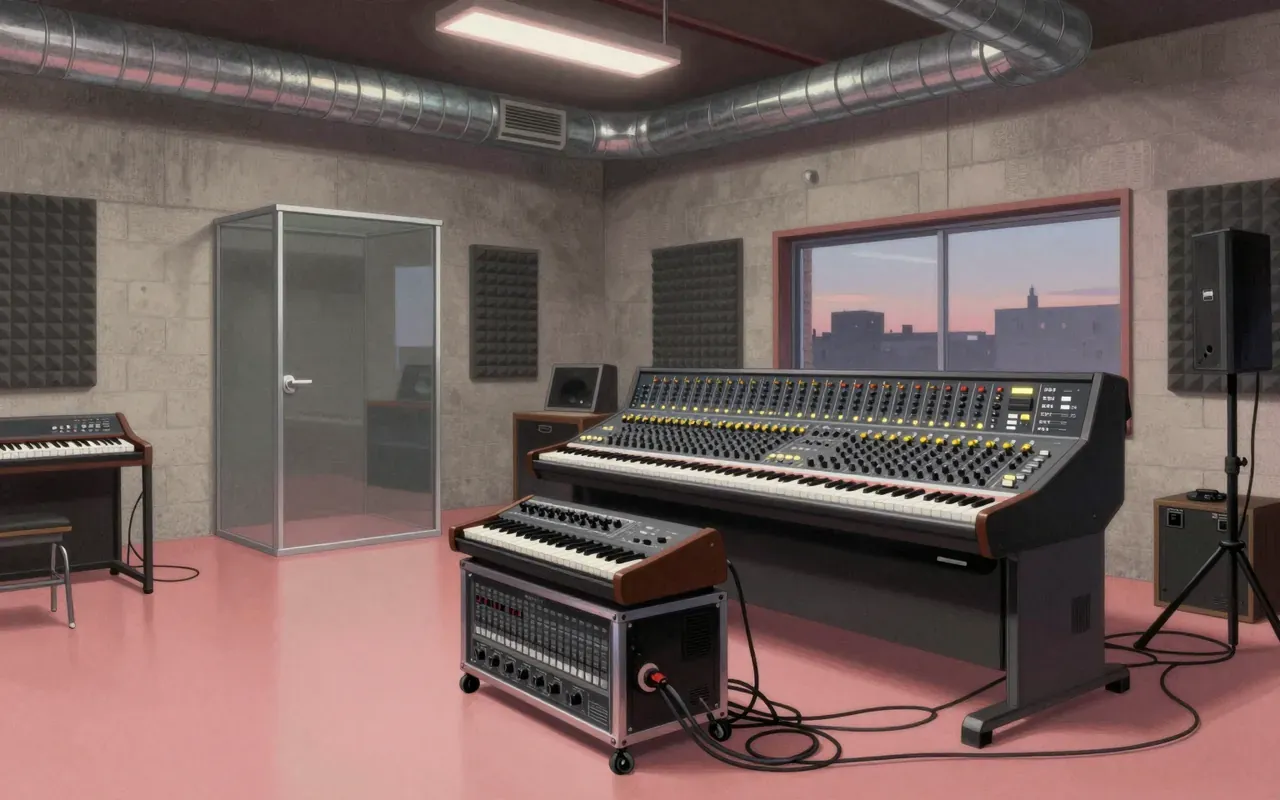
It sounds like reverb-heavy psychedelic pop built from samplers and synthesizers — Roland SP-404/SP-555, Roland SH2, Novation Bass Station, Juno 60, Eventide H3000 Ultra-Harmonizer — with no guitars. The band installed PA systems in the studio to replicate live energy. They tracked meticulously, one instrument at a time, in Sweet Tea Studio’s room.
What lands
The lush reverb blankets every element evenly. The synth bass lines lock into steady, buoyant pulses. The vocal harmonies float just above the mix, layered and slightly blurred. The samplers trigger looping, sun-drenched motifs that feel both handmade and weightless.
What does not
It does not rely on guitar-driven arrangements. It does not sound like a live band playing together in real time. It does not use dry, close-mic’d acoustic sources.
The ideas inside it
The record explores cohesion through repetition, intimacy through reverb, and collective identity through trio-based composition — all while working without a guitarist who had been central to earlier records.
Who should hear it, and who should not
People who want to hear how reverb can function as architecture. People who listen for how space is built into a track. People who care about the difference between a sampler’s grain and a synth’s sheen. Not people looking for lyrical exposition or linear narrative.
Is it worth your time
Yes. It repays attention to texture, spatial design, and the tension between synthetic precision and organic warmth.