musicbriefs
13:00in productionCh. 1 · A film shoot, a new studio, a persona/ 13:00 · ceiling 15 min
Prog & art rock

Station to Station

Made by a man who says he barely remembers making it, Station to Station turns a Los Angeles breakdown into six tracks of cold, precise groove that point straight at Berlin.

David Bowie's tenth album, cut at Cherokee Studios in late 1975 while he shot a film and lived on a diet of peppers and cocaine, sets the funk band from Young Americans against a new, mechanical pulse borrowed from German records. The result is the hinge between his LA period and the trilogy that followed.

Chapters & takeaways7
  1. 0:08
    A film shoot, a new studio, a persona

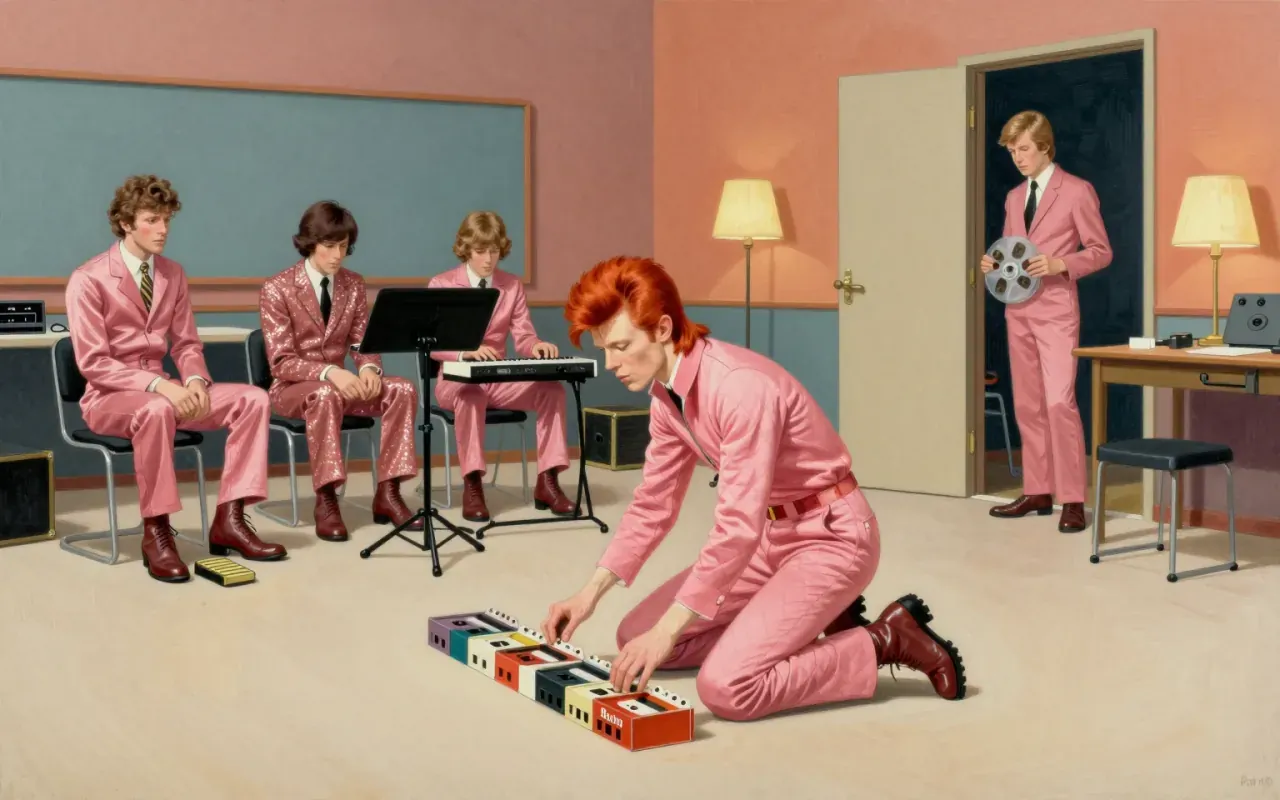
    The record grew out of a break in filming, a fresh Hollywood studio, and a character Bowie needed to hide inside.

  2. 1:51
    The band that would carry the decade

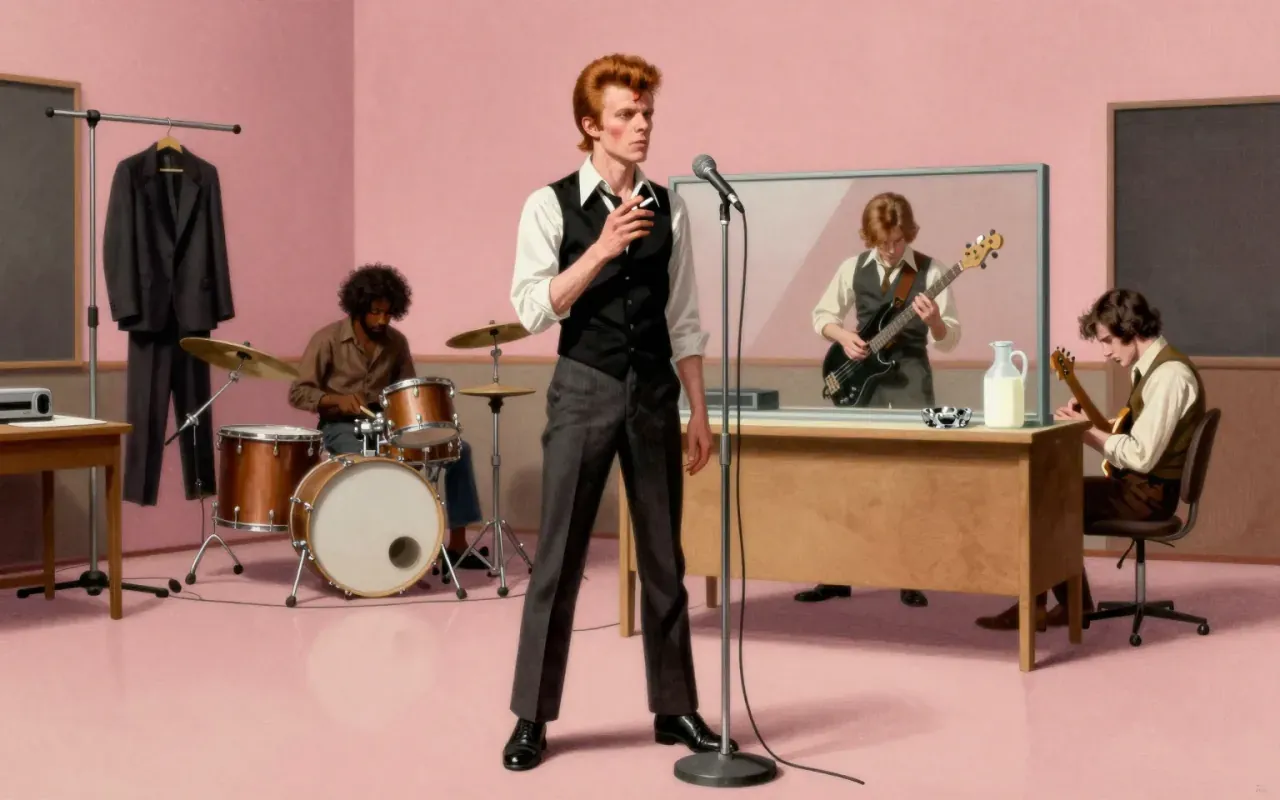
    Alomar, Murray and Davis lock in here as the rhythm section Bowie kept for years, with Slick and Bittan filling out the room.

  3. 3:43
    Six tracks, one long pulse

    The title piece runs on a mechanical drive rather than a chorus, and the shorter songs orbit around it.

  4. 5:34
    A record its maker can barely recall

    Bowie's own account of the sessions is patchy, and that gap between the tape's control and the chaos behind it is part of the story.

  5. 7:26
    Nietzsche, Crowley and a man between stations

    The lyrics run through occult reading and religious dread, tracking someone searching for solid ground rather than finding it.

  6. 9:17
    A closing cover with its own story

    Wild Is the Wind arrives as tribute rather than filler, prompted by another singer's version and a studio visitor's approval.

  7. 11:09
    Where it sits in the catalogue

    Transitional on paper, it plays as one of the most complete records Bowie made under the worst conditions of his career.

Worth your time?

Yes. Hear the whole thing.

4.5/ 5
What works
  • the rhythm section's discipline under a producer with no time limit
  • the title track's slow mechanical build
  • the closing cover as a genuine tribute rather than a contractual filler
  • the sense of a record made at the edge of collapse that still holds together
What does not
  • the record offers little biographical clarity, since its maker later said he recalled almost none of it
  • the occult references can read as gesture rather than argument
  • the back half asks more patience than the side-long opener rewards for casual listening
Hear it if
  • listeners who want Bowie's rock and soul records without the gloss
  • fans of the Berlin trilogy curious where it started
  • anyone interested in bands as sound engines rather than backing groups
  • collectors of mid-seventies studio craft
Skip it if
  • listeners who want a tidy concept record
  • anyone after guitar solos over groove
  • casual fans wanting the hits-first entry point
The written brief4 min read

A film shoot, a new studio, a persona

Station to Station is David Bowie’s tenth studio album, released on RCA in January 1976 and recorded mostly at Cherokee Studios on Fairfax Avenue in Los Angeles the previous autumn. He arrived there fresh from shooting a film role, with the commercial reach of Young Americans behind him and, by his own later account, a serious cocaine problem shaping his days. The record became the vehicle for a new stage persona, a controlled, aristocratic figure built to stand apart from the man living through it. Six songs and thirty-eight minutes came out of a studio Bowie is said to have approved within seconds of arriving, choosing it partly because it offered privacy from the press that had followed him through the previous year.

The band that would carry the decade

Bowie and engineer-turned-co-producer Harry Maslin ran the sessions with an open clock and a five-room facility that gave them room to experiment. The band assembled here — guitarist Carlos Alomar, bassist George Murray and drummer Dennis Davis — became Bowie’s rhythm section for the rest of the seventies, joined on this record by guitarist Earl Slick and, arriving mid-session at Slick’s suggestion, pianist Roy Bittan, on loan from Bruce Springsteen’s touring band. The material kept the funk backbone of the previous album but pushed it against a colder, repeating pulse drawn from German records Bowie was listening to at the time. Songs were built and rebuilt in the room rather than arriving finished, several of them composed from scratch during the two months of recording.

Six tracks, one long pulse

The side-long title track carries the record’s ambition, moving through a slow mechanical build before it opens into something closer to a rock song. Golden Years, finished quickly and released as a single while the album was still being made, supplies the immediate hook the rest of the record withholds. Word on a Wing and TVC 15 sit between the two extremes, and the closing cover of Wild Is the Wind, first sung by Johnny Mathis in the 1950s, gives the record a warmth the other five tracks avoid. Bowie recorded it after hearing Nina Simone’s version and meeting her, and a studio visit from Frank Sinatra, who praised the take, is credited with settling its place as the closer.

A record its maker can barely recall

The record’s chief limitation is one it cannot help: Bowie later said he remembered almost nothing about making it, having been in a state of severe drug dependency throughout, and that gap sits oddly against how disciplined the finished tape sounds. Listeners hoping for the lyric sheet to explain itself will find gestures toward mythology and religion rather than a worked-through argument. The pacing also asks something of the listener — after a ten-minute opener, the middle stretch can feel like a comedown, and the album’s reputation rests more on its best moments and its influence than on total consistency across all six songs.

Nietzsche, Crowley and a man between stations

Underneath the groove sits a set of preoccupations Bowie was reading his way through that autumn: Nietzsche, Aleister Crowley, mythology, and a fear of Los Angeles itself, a city he would later say should be erased. The title track’s repeated invocation of stations suggests movement without arrival, a search for spiritual footing conducted by someone too unwell to trust his own judgment. That tension between a narrator claiming control and a set of lyrics circling collapse gives the record its unease, and it reads less like a concept than like a man working something out in real time, on tape, before an audience.

A closing cover with its own story

This suits listeners who already know Bowie’s mid-seventies run and want the record where the funk of Young Americans starts bending toward something stranger and more European. It rewards anyone curious about a backing band operating as a single instrument, and about how much a producer with no schedule can pull out of a group. It will do less for someone wanting his most accessible songs in one place, or a listener who prefers lyrics that resolve into a clear statement. The occult framing and the unevenness of the middle stretch may also test patience that a greatest-hits approach to Bowie doesn’t require.

Where it sits in the catalogue

Yes. Station to Station earns its reputation as a hinge record, closing out the Los Angeles period it was made in and opening the path to the trilogy that followed once Bowie left for Europe at the end of the tour. It is not the friendliest entry point into his catalogue, and its lyrics reward context more than they reward close reading on their own. But as a document of a band finding a new gear under a producer willing to let the sessions run long, and as the record that set the rhythm section for years to come, it holds up as one of the most striking arguments in his catalogue for chaos producing precision.
Same genre · Prog & art rock4 of 76
13:00
“Heroes”David Bowie · 1977Bowie, Brian Eno and Tony Visconti regrouped at Hansa Studio 2 in West Berlin in mid-1977, months after finishing Low, and built songs largely from scratch in the room with a returning rhythm section and a guest guitarist flown in on short notice. The setting bleeds into the record, and the title track has outlasted almost everything else Bowie made.
13:00
LowDavid Bowie · 1977Made after Bowie left a Los Angeles addiction behind for Europe, Low pairs Tony Visconti's harmonized drum sound with Brian Eno's ambient textures, opening with fractured songs before giving its second side over to instrumental mood pieces.
13:00
The Rise and Fall of Ziggy Stardust and the Spiders From MarsDavid Bowie · 1972Recorded fast at Trident Studios with Mick Ronson's guitar doing much of the heavy lifting, Ziggy Stardust turns a loosely stitched science-fiction plot into cover for songwriting about sex, stardom and ruin that the early-seventies charts would not otherwise have carried under Bowie's own name.
9:42
Paris 1919John Cale · 1973Paris 1919 is John Cale’s third solo studio album, recorded in 1972–1973 at Sunwest Studios in Los Angeles and produced by Chris Thomas to add objectivity. It features Lowell George, Richie Hayward, Wilton Felder, and the UCLA Symphony Orchestra — uncredited on the original LP. Musically, it departs from Cale’s experimental tendencies toward an orchestral singer-songwriter style influenced by Brian Wilson, the Bee Gees, and Procol Harum’s 1972 live album. Lyrically, it references the 1919 Paris Peace Conference, Dylan Thomas, and Graham Greene. Critically acclaimed upon release and since, it is widely regarded as Cale’s most accessible and traditionally structured solo work — and retrospectively considered his masterpiece.
Up next in Music

Sticky Fingers

The Rolling Stones · 1971 · 13:00

Free of their old label and one founding member down, the Stones made a leaner record than usual and let a working zip on the sleeve handle some of the provocation the songs treated more plainly.

13:00