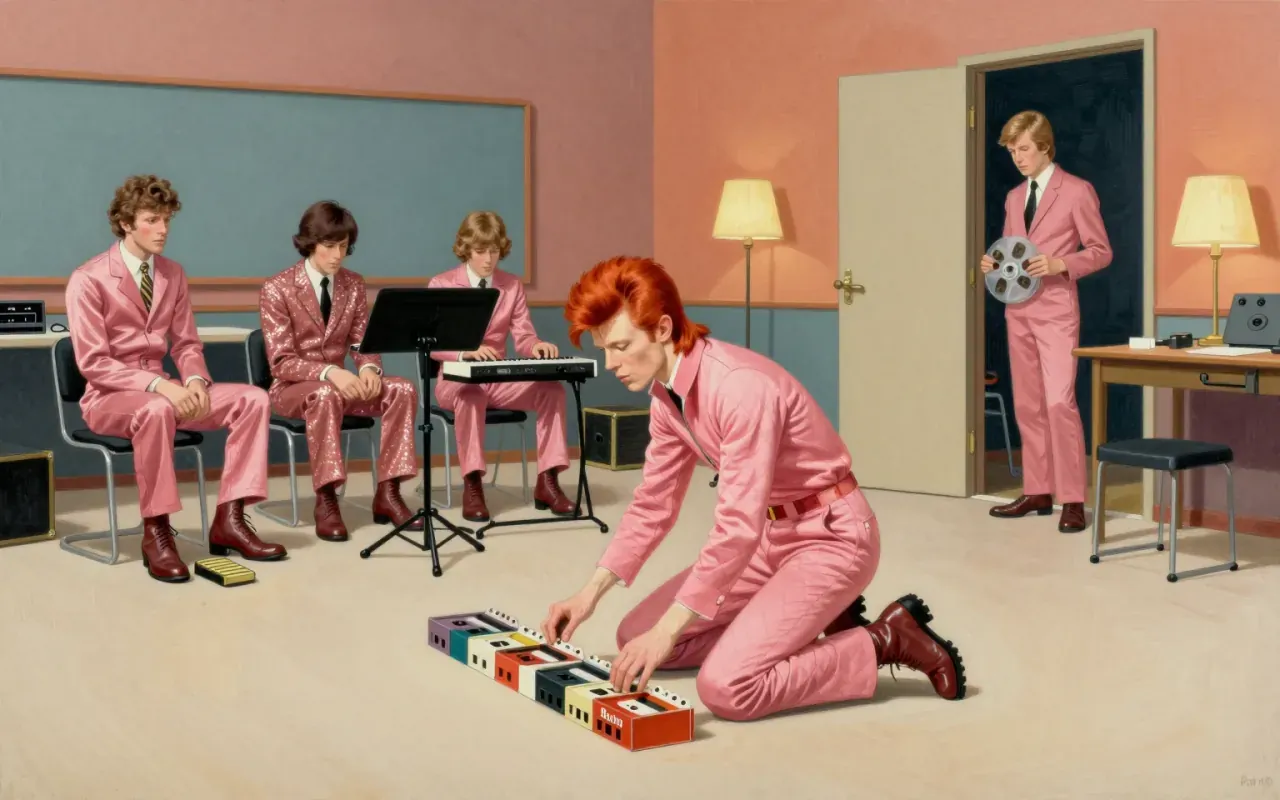
A story written after the songs
The Rise and Fall of Ziggy Stardust and the Spiders From Mars is David Bowie’s fifth album, recorded at Trident Studios in London between November 1971 and February 1972 and released on RCA in June that year. Bowie produced it with Ken Scott, backed by Mick Ronson on guitar, Trevor Bolder on bass and Mick Woodmansey on drums, the same players who had just finished Hunky Dory with him. Most of the songs were written and tracked before anyone settled on a story to hang them from; the concept, a doomed alien rock star sent to warn a dying Earth, was assembled afterward around music that already existed. RCA had asked for a single, which is how the last-minute addition “Starman” ended up replacing an earlier title track on the running order.
How Ronson’s guitar and a fast band built it
Sessions moved fast: the band would cut a song, listen back, and redo it on the spot if it missed, which is why some early takes of “Star” and “Hang On to Yourself” were scrapped and rerecorded within days. Ronson ran his electric guitar through a wah pedal into a Marshall stack rated at a hundred watts, while Bowie stuck to acoustic rhythm guitar and, unlike on the previous record, actually told Ronson what he wanted out of a solo instead of leaving him to guess. Rick Wakeman’s harpsichord appears once as a holdover from the Hunky Dory sessions, but keyboards otherwise recede as Ronson’s guitar and string writing take over. Scott has said most of Bowie’s vocals across their four records together were first takes, cut live with the band rather than layered on afterward.
What the persona lets the songs do
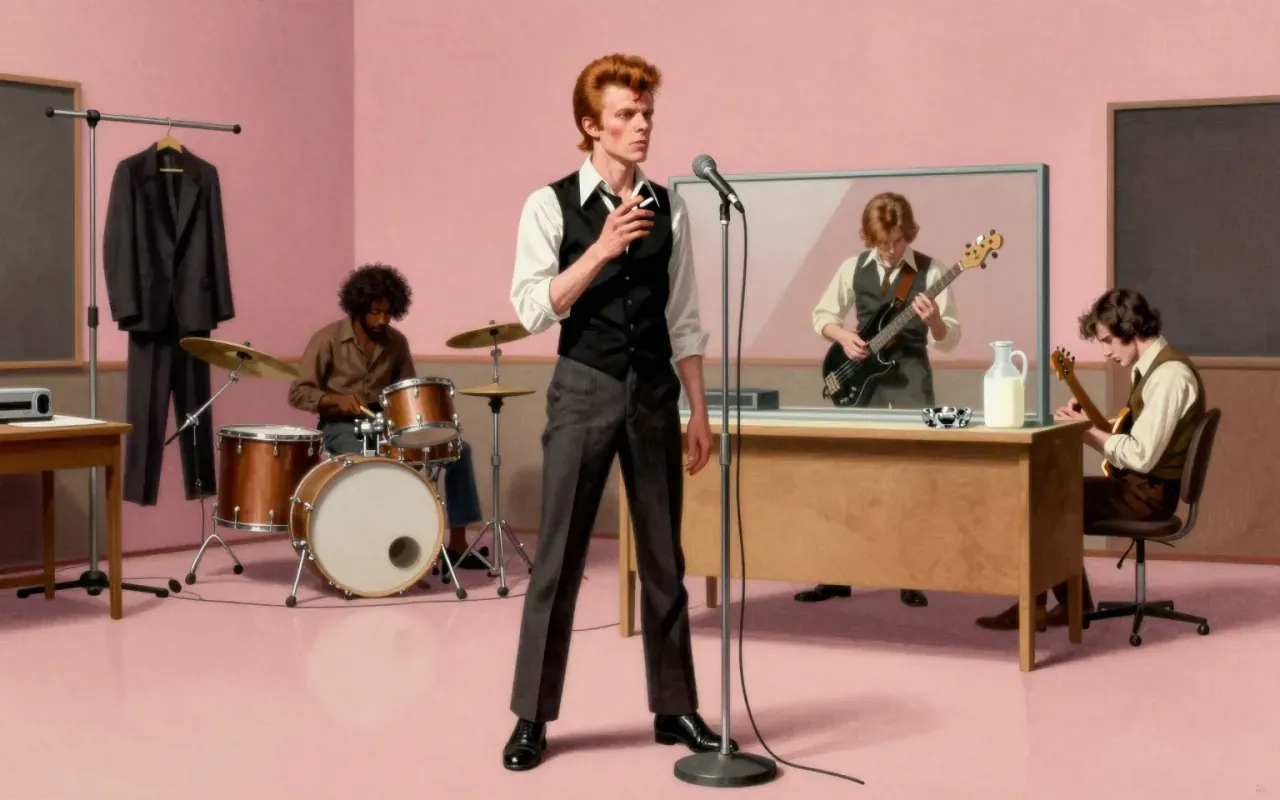
The album earns its reputation on the strength of its writing rather than its concept, which barely survives close inspection. “Five Years” and “Rock ’n’ Roll Suicide” bookend the record with real dramatic shape, and Ronson’s guitar carries “Moonage Daydream” and “Suffragette City” with a force that still sounds immediate. What lands hardest is the persona itself as a vehicle: Bowie uses Ziggy to sing about fame, sex and collapse more directly than his own name would have allowed him to at the time, and the band plays it with a conviction that outstrips the loose plot stitched around it. The Heddon Street cover photograph, ordinary London street furniture behind an extraordinary figure, gets at the same trick the songs pull off.
Where the concept comes apart
The story does not really hold together. Songs written for other purposes, a cover of Ron Davies, sketches from a scrapped side project, were folded in after the fact, and the narrative arc a listener is meant to trace between “Five Years” and “Rock ’n’ Roll Suicide” depends more on sequencing than on anything stated in the lyrics. A few tracks lean hard on generic early-seventies rock moves and would sit unremarkably on records with no concept attached at all. Anyone drawn in expecting a coherent science-fiction narrative, in the way the sleeve notes and later interviews suggest one, will find gaps that only Bowie’s own retrospective explanations paper over.
Artifice as the real subject
Underneath the alien-messiah plot is a much plainer question about artifice: whether a persona can say true things a person cannot. Bowie built Ziggy from real figures, most notably the unstable rock and roller Vince Taylor, and used the distance a costume provides to write about bisexuality, drug use and stardom’s cost more openly than the pop charts of 1972 generally allowed. The record also documents a specific working method, write first, explain later, that treats meaning as something applied to music rather than built into it from the start. That approach argues, implicitly, that a rock album can function like a novel assembled from short stories: the parts were not written to fit a whole, but a whole gets found in them anyway.
Who the record actually serves
This is for listeners interested in glam rock’s actual mechanics, in how a guitarist and a producer turn a set of demos into a persona, and in Bowie’s run of early-seventies albums generally; newcomers to that run could reasonably start here rather than with Hunky Dory. It also rewards anyone curious about how far a costume can carry lyrical content that plain first-person songwriting would have made harder to release at the time. It is a poor fit for listeners who want their concept albums to actually cohere as narrative, or who find early glam’s theatrical excess, the eyeliner and the science-fiction trappings, distracting from songs that mostly do not need the costume to work.
Songs first, concept second
Yes, on the songs alone, and the reputation the record carries as Bowie’s most complete early statement is earned even before the concept is taken into account. The best evidence is how well individual tracks travel outside the story, “Starman” and “Suffragette City” both worked as singles stripped of any Ziggy framing, which tells you the songwriting was doing more work than the plot. Where it falls short is expecting the science-fiction scaffolding to bear real weight; it does not, and never fully did even at the time of release. Judged as a set of songs about fame and collapse dressed up in a costume, rather than as the concept album it is sold as, it holds up completely.