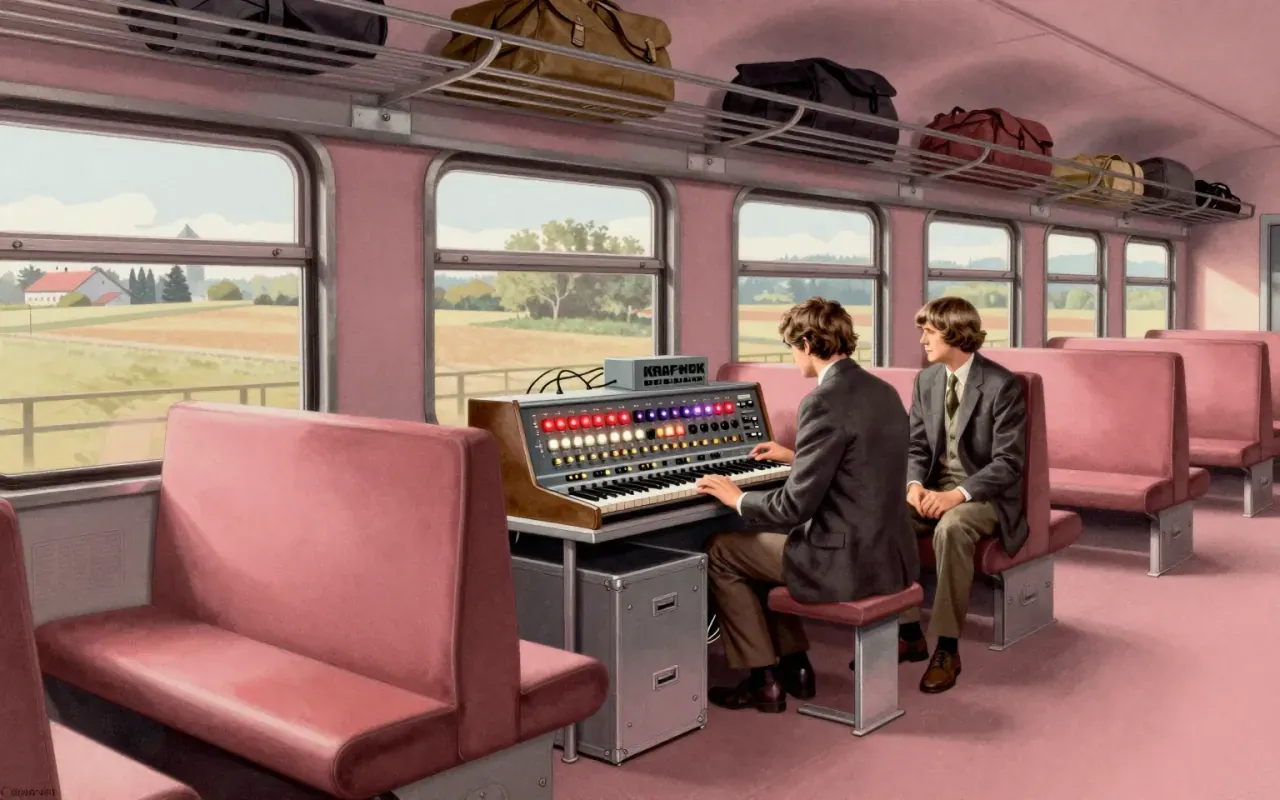
What the record is and where it came from
An overdubbed electronic album recorded in 1968 and released in 1969. Riley performed every instrument using an early CBS eight-track recorder. It grew from his all-night improvisatory concerts and fuses jazz phrasing with Hindustani classical modality.
How it sounds, and how it was made
The title track layers Riley’s overdubbed electric organ, two electric harpsichords (Baldwin and RMI Rock-Si-Chord), dumbec, and tambourine. It opens with placid chords, then introduces right-hand keyboard lines that flutter and pirouette over pulsing rhythms. The calmer second half uses shorter, high-register keyboard lines syncopating with a modal base. ‘Poppy Nogood’ is saxophone-based, built from tape loops, edits, and delay — all performed by Riley.
What lands
The title track’s rhythmic pulse and keyboard interplay land with physical clarity. The B-side’s saxophone drone lands as immersive texture — sustained, breathing, slightly unstable.
What does not
It does not use synthesizers. It does not feature orchestration, vocals, or external collaborators. It does not rely on harmonic progression or verse-chorus form.
The ideas inside it
Improvisation as architecture. Modal repetition as propulsion. Tape delay and overdubbing not as effects but as compositional logic — where time folds, layers accumulate, and drone becomes narrative.
Who should hear it, and who should not
Producers working with tape, modular systems, or loop-based composition should hear it. Listeners who value rhythm as structure — not just groove — should hear it. Those expecting melodic development or conventional songwriting should not.
Is it worth your time
Yes. It is one of the earliest professional eight-track recordings and a direct conduit from Hindustani raga and jazz improvisation into electronic music’s structural vocabulary.