What the record is and where it came from
A 1956 Atlantic Records album titled ‘Lennie Tristano’, compiling four studio experiments recorded 1954–1955 in Tristano’s New York home studio, plus five concert recordings from 11 June 1955 at The Sing-Song Room, Confucius Restaurant, New York.
How it sounds, and how it was made
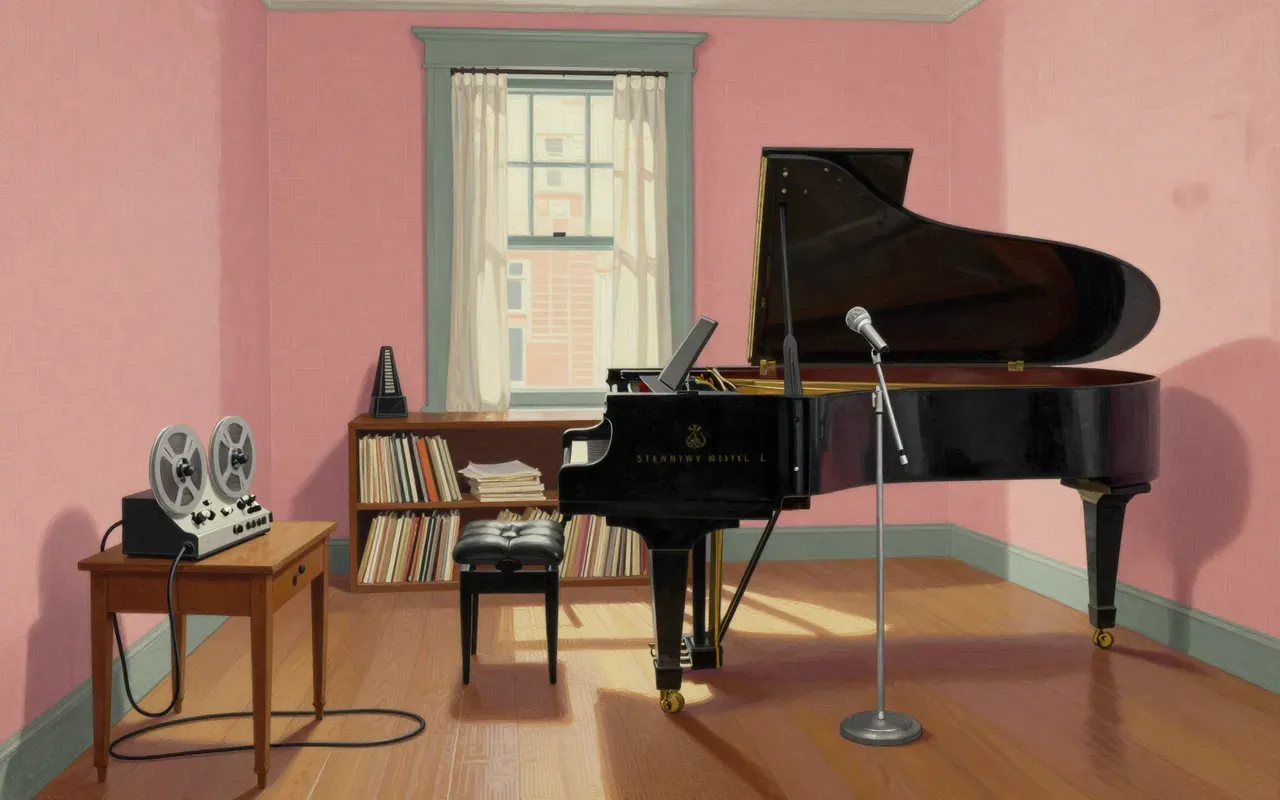
The first four tracks were made in Tristano’s home studio using tape speed manipulation and piano overdubbing. On ‘Turkish Mambo’, three conflicting piano tracks run simultaneously: left hands in five, six and seven beats; right hands improvise freely. Tracks 5–9 are unedited live recordings from The Sing-Song Room, Confucius Restaurant, New York, on 11 June 1955. No information is given about microphones, room acoustics, tempo, key, or instrumentation beyond piano, bass, and the presence of a quintet/sextet context.
What lands
The studio tracks land as precise, disorienting experiments: ‘Line Up’ and ‘East Thirty-Second’ sound unnervingly fast, but Tristano refused to confirm whether tape speed was altered. ‘Turkish Mambo’ lands as a rhythmic puzzle—three left-hand pulses coexisting without syncopation or resolution. The live tracks land as cohesive, conversational, and anchored by bassist Peter Ind’s walking lines and Tristano’s linear phrasing.
What does not
It does not unify its two halves. The studio tracks do not anticipate the live ones. There is no shared personnel named across both sessions. It does not use drums. It does not cite or rework the film-associated standards in ways the source material describes—no arrangement detail, no tempo shift, no lyrical reference, no dramatic framing from Penny Serenade or Hannah and Her Sisters appears in the evidence.
The ideas inside it
The record holds two distinct philosophies: one side treats tape as an instrument—layering, speeding, isolating rhythm from harmony; the other side commits to real-time group intuition, with no pre-set harmony, tempo or melody. Both reject bebop’s rhythmic and harmonic scaffolding. Neither relies on soloist–rhythm section hierarchy.
Who should hear it, and who should not
People who listen to how musicians listen—not just what they play. People curious about pre-digital tape craft. People who value contrapuntal group logic over solo virtuosity. Not people seeking consistent tone, narrative arc, or bebop fluency.
Is it worth your time
Yes—if you want to hear jazz where structure is built from contrapuntal listening, not chord changes or swing time. No—if you expect continuity between studio and live sides, or if you need harmonic grounding to follow improvisation.