musicbriefs
9:10in productionCh. 1 · The Booga Basement/ 9:10 · ceiling 15 min
Hip-hop

The Score

Hip-hop as audio film: every voice on this record is borrowed, repeated, and recontextualised — nothing is original, everything is intentional.

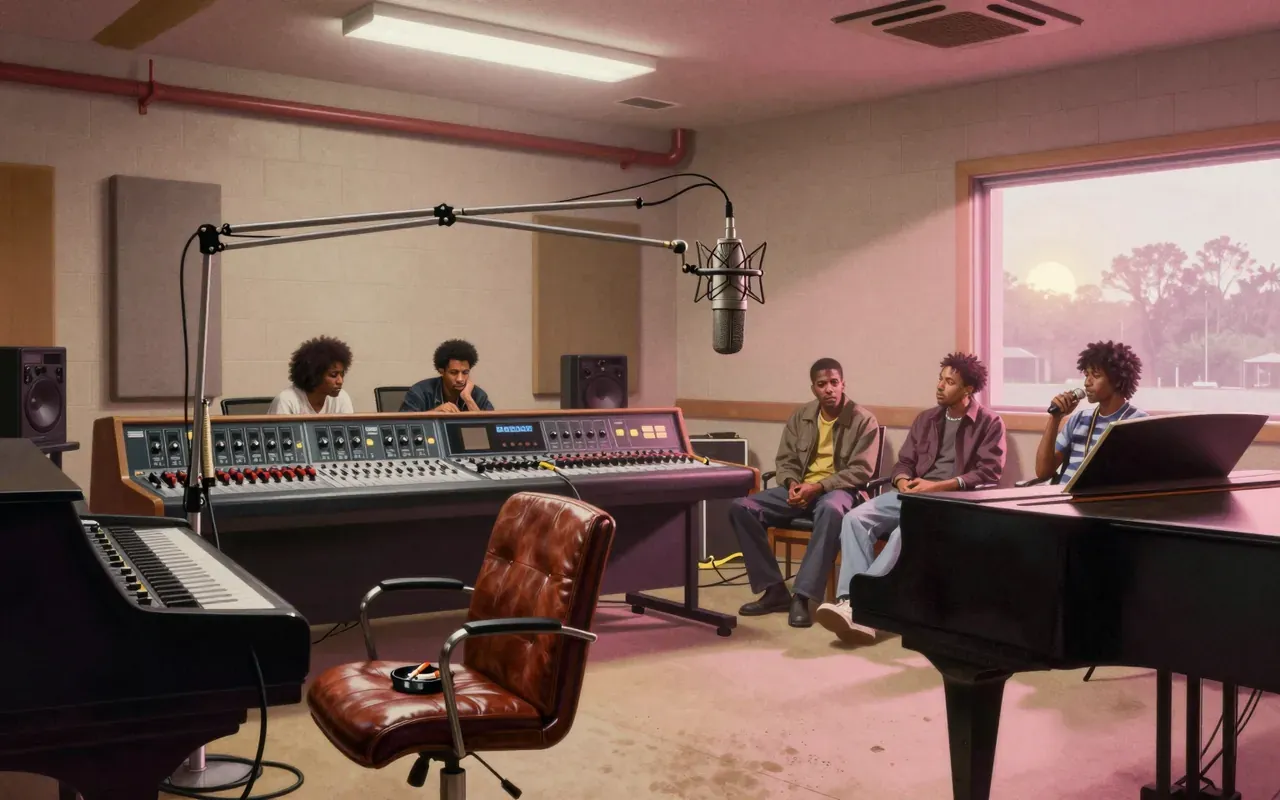
The Score is a 1996 hip-hop album recorded in a basement with live guitar, DJ scratches and heavy interpolation — structured like a radio play, not a collection of songs.

Chapters & takeaways4
  1. 1:16
    The Booga Basement

    Recorded in a basement with no pressure — calm, unconscious, feel-good.

  2. 2:37
    Three Methods, One Room

    Live guitar and DJ scratches sit alongside sampled melodies — no single method dominates.

  3. 3:48
    Borrowed Voices

    Every chorus and sample is borrowed — but never hidden. Interpolation is structural, not decorative.

  4. 4:52
    Audio Film

    It’s built like a radio play — cuts, breaks, recurring themes — not a playlist.

Running order17
  1. 01
    Red Intro1:52
  2. 02
    How Many Mics4:29
  3. 03
    Ready or Not3:47
  4. 04
    Zealots4:21
  5. 05
    The Beast5:37

    Heard in Alien (1979)

  6. 06
    Fu-Gee-La4:20
  7. 07
    Family Business5:44
  8. 08
    Killing Me Softly4:59

    Heard in Making It (1971)The Drowning Pool (1975)The Hot Spot (1990)

  9. 09
    The Score5:02

    Heard in The Godfather (1972)Days of Thunder (1990)Titanic (1997)The Dark Knight (2008)

  10. 10
    The Mask4:51
  11. 11
    Cowboys5:23
  12. 12
    No Woman, No Cry4:33

    Heard in Mille Soya (2004)Black Panther: Wakanda Forever (2022)

  13. 13
    Manifest/Outro6:00
  14. 14
    Fu-Gee-La (Refugee Camp remix)4:23
  15. 15
    Fu-Gee-La (Sly & Robbie mix)5:28
  16. 16
    Mista Mista2:43
  17. 17
    Fu-Gee-La (Refugee Camp Global remix)4:21

Film placements are the ones described in each film's own entry, so the list is partial rather than complete.

Worth your time?

Yes. Hear the whole thing.

4.5/ 5
What works
  • Ready or Not
  • Killing Me Softly
  • Fu-Gee-La
  • The Score
What does not
  • separate voice from beat
  • isolate instruments
  • use digital precision
  • avoid repetition
Hear it if
  • producers who work with samples
  • listeners who notice how a voice reappears across tracks
  • people who hear structure in sequencing
Skip it if
  • people who need high-fidelity separation
  • people who need lyrical exposition
The written brief2 min read

What the record is and where it came from

A 1996 hip-hop album recorded from June to November 1995 in Wyclef Jean’s uncle’s basement — the Booga Basement — using a $135,000 advance to equip the space. It is the Fugees’ second and final studio album as a trio.

How it sounds, and how it was made

It sounds like a basement studio: close-miked vocals, warm tape saturation, live guitar bleeding into sampled strings. Wyclef Jean’s guitar appears on ‘Family Business’. DJ Skribble’s scratches cut across ‘Manifest/Outro’. Every track is built on sampled melodies — Teena Marie’s ‘Ooo La La La’ in ‘Fu-Gee-La’, the Delfonics’ ‘Ready or Not (Here I Come)’ in ‘Ready or Not’, Poor Righteous Teachers’ ‘Rock Dis Funky Joint’ in ‘Manifest/Outro’. ‘The Score’ stitches vocal fragments from all 13 original album tracks. Production was shared among all three Fugees, Diamond D, Salaam Remi and Jerry Duplessis.

What lands

The chorus of ‘Ready or Not’ lands with the Delfonics’ falsetto suspended over a sparse, skittering beat. ‘Killing Me Softly’ lands with Lauryn Hill’s voice unadorned, riding a slow, warm bed of strings and brushed snare. ‘Fu-Gee-La’ lands with its Teena Marie interpolation snapping into place like a gear engaging.

What does not

It does not separate voice from beat. It does not isolate instruments. It does not use digital precision — no quantised drums, no pitch-corrected vocals, no synthetic basslines. It does not avoid repetition — ‘Fu-Gee-La’ repeats its chorus eight times; ‘The Score’ replays its own DNA.

The ideas inside it

It frames hip-hop as an ‘audio film’: linear, radio-shaped, with cuts, breaks and recurring motifs. Lauryn Hill called it a hip-hop version of The Who’s Tommy — a story told through sequencing, interpolation and self-reference, not lyrics alone.

Who should hear it, and who should not

Producers who work with samples. Listeners who notice how a voice reappears across tracks. People who hear structure in sequencing, not just bars. Not people who need high-fidelity separation or lyrical exposition — this record tells its story through placement, not explanation.

Is it worth your time

Yes — if you want hip-hop that treats sampling as narrative architecture, not just texture. No — if you expect polished separation, wide stereo fields or modern dynamic range. It rewards attention to how voices and fragments are reassembled, not how loud or clean it sounds.
Same genre · Hip-hop4 of 60
10:29
3 Feet High and RisingDe La Soul · 19893 Feet High and Rising is De La Soul’s 1989 debut — a sample-heavy, psychedelic-influenced hip-hop record built with the Casio RZ-1 and Eventide Harmonizer. It introduced the 'D.A.I.S.Y. Age' concept ('Da Inner Sound, Y'all'), used quiz show skits to structure its flow, and drew from funk, soul, doo-wop, psychedelic rock, and children’s music. It was certified platinum, added to the Library of Congress National Recording Registry in 2010, and remained unavailable digitally until 2023 due to sample clearance issues.
10:01
Fantastic Vol. 2Slum Village · 2000Fantastic, Vol. 2 is a foundational Detroit hip-hop document because it refuses to explain itself — it simply occupies space with warmth, restraint, and unbroken groove.
12:22
Speakerboxxx / The Love BelowOutKast · 2003A double album released 23 September 2003 after two years of work. It comprises Big Boi’s Speakerboxxx and André 3000’s The Love Below — two solo projects packaged as one OutKast release under pressure from Arista Records, which rejected separate releases.
11:19
AqueminiOutKast · 1998Aquemini is OutKast’s third studio album, released 29 September 1998. It was recorded primarily at Bosstown and Doppler Studios in Atlanta using live instrumentation, rotating session musicians, and extended jam-based composition. Big Boi and André self-produced most tracks, drawing on soul, trip hop, and electro textures — and reggae, via André’s constant listening to Bob Marley. The title merges their zodiac signs. It was certified double platinum and reached number two on the Billboard 200.
Up next in Music

The Stone Roses

The Stone Roses · 1989 · 11:28

A record so dissatisfied with itself it became definitive.

11:28