musicbriefs
10:49in productionCh. 1 · Made by Memphis/ 10:49 · ceiling 15 min
Disco, funk & soul

I’m Still in Love With You

This is soul stripped to its rhythmic spine and vocal breath — no catharsis, just commitment held in place.

A tightly arranged, dry-sounding Memphis soul record built on repetition, restraint, and vocal intimacy.

Chapters & takeaways4
  1. 1:08
    Made by Memphis

    Willie Mitchell and the Hi Rhythm Section built this sound — not Green alone.

  2. 2:52
    No Room for Echoes

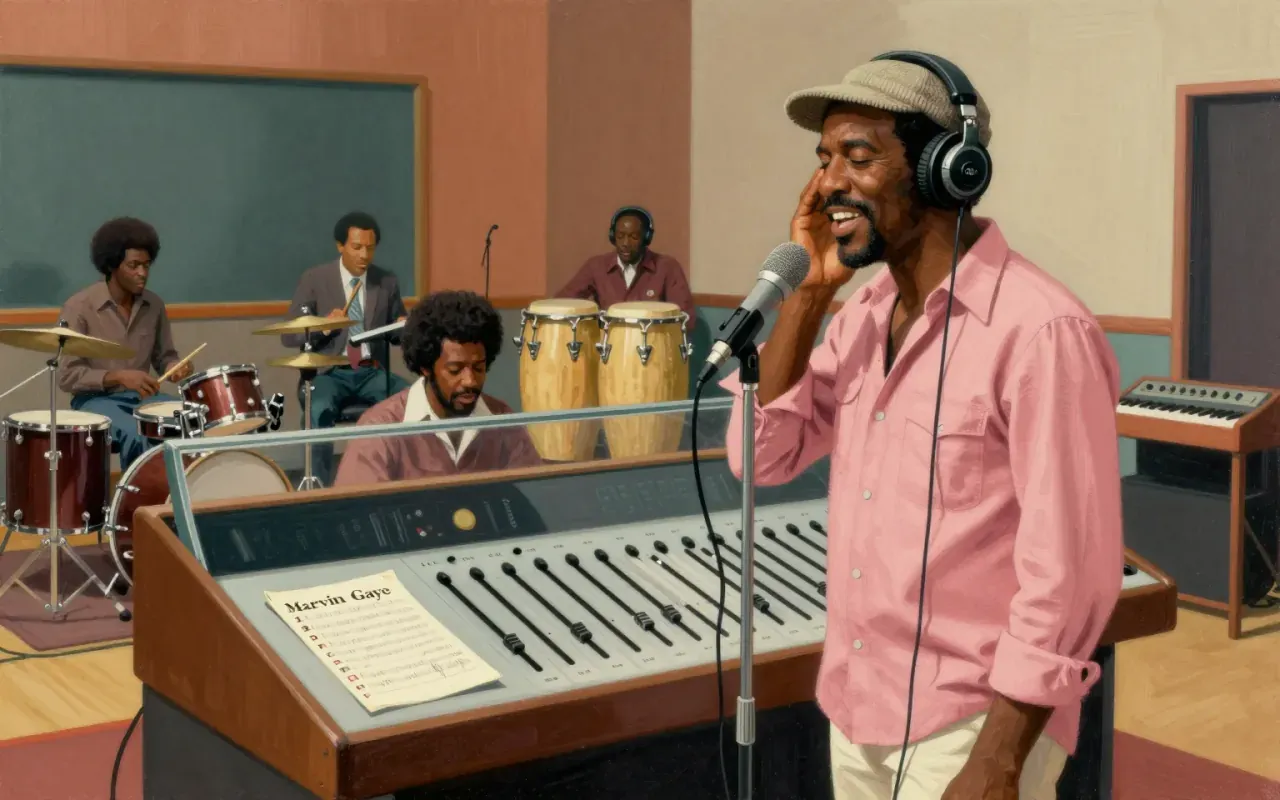
    No reverb, no strings, no choirs — just bass, drums, guitar, horns, and voice in a dry room.

  3. 5:00
    Three Anchors

    The title track, 'Love and Happiness', and 'Simply Beautiful' carry the album’s weight — not the covers.

  4. 7:24
    Certainty, Not Conflict

    It assumes love is already decided — so it sings from stillness, not struggle.

Running order9
  1. 01
    I’m Still in Love With You3:16

    Heard in Your Cheatin' Heart (1964)

  2. 02
    I’m Glad You’re Mine3:02
  3. 03
    Love and Happiness5:09
  4. 04
    What a Wonderful Thing Love Is3:44
  5. 05
    Simply Beautiful4:14

    Heard in A Doll's House (1973 Garland film) (1973)

  6. 06
    Oh, Pretty Woman3:25

    Heard in Pretty Woman (1990)

  7. 07
    For the Good Times6:32
  8. 08
    Look What You Done for Me3:09
  9. 09
    One of These Good Old Days3:18

Film placements are the ones described in each film's own entry, so the list is partial rather than complete.

Worth your time?

Yes. Hear the whole thing.

4.5/ 5
What works
  • I’m Still in Love With You
  • Love and Happiness
  • Simply Beautiful
What does not
  • build to crescendos
  • feature call-and-response with a choir
  • use gospel cadences or blues-based chord progressions
  • reference place, politics, or personal history
Hear it if
  • people who value space in music
  • people who notice how a bass line holds time without rushing
  • people who hear warmth in a dry room
Skip it if
  • people who need lyrical exposition
  • people who need structural surprise
  • people who need sonic density
The written brief1 min read

What the record is and where it came from

It is Al Green’s October 1972 album ‘I’m Still in Love With You’. It was recorded in Memphis. It went platinum. It produced a top-10 Billboard Hot 100 hit.

How it sounds, and how it was made

The record was made with producer Willie Mitchell and the Hi Rhythm Section. It uses Memphis soul’s signature tight, dry room sound. Guitars are muted and percussive. Bass lines lock into steady sixteenth-note grooves. Horns enter sparingly — stabs, not swells. Vocals sit close and warm, with minimal reverb. No synthesizers. No drum machines. No overdubbed strings or choirs.

What lands

The title track lands: a slow, unhurried vocal line over a cushioned groove. ‘Love and Happiness’ lands: a longer form, but still anchored by the same bass pulse and horn punctuation. ‘Simply Beautiful’ lands: its melody is clear, its phrasing unhurried, its texture uncluttered.

What does not

It does not build to crescendos. It does not feature call-and-response with a choir. It does not use gospel cadences or blues-based chord progressions. It does not reference place, politics, or personal history.

The ideas inside it

Love as devotion, not drama. Love as daily choice, not revelation. Love as quiet persistence — in the face of doubt, distance, time. The album avoids conflict, resolution, narrative. It assumes love is already settled. It sings from inside that certainty.

Who should hear it, and who should not

People who value space in music. People who notice how a bass line holds time without rushing. People who hear warmth in a dry room. Not people who need lyrical exposition, structural surprise, or sonic density.

Is it worth your time

Yes, if you want to hear how restraint and repetition build emotional gravity in soul. No, if you expect dramatic shifts, virtuosic solos or lyrical complexity.


Same genre · Disco, funk & soul4 of 33
10:59
Amazing GraceAretha Franklin · 1972A live gospel album recorded over two nights in a Los Angeles Baptist church in January 1972, featuring Aretha Franklin, Rev. James Cleveland, and the Southern California Community Choir. Piano, choir, claps, stomps, and Franklin’s voice — unvarnished, unrehearsed, unseparated from the room. No studio polish. No overdubs except one track moved for vinyl length. Reinterprets gospel standards — including Mahalia Jackson’s 'How I Got Over' — as living tradition, not museum piece. Filmed for a concert film released 46 years later.
11:19
AqueminiOutKast · 1998Aquemini is OutKast’s third studio album, released 29 September 1998. It was recorded primarily at Bosstown and Doppler Studios in Atlanta using live instrumentation, rotating session musicians, and extended jam-based composition. Big Boi and André self-produced most tracks, drawing on soul, trip hop, and electro textures — and reggae, via André’s constant listening to Bob Marley. The title merges their zodiac signs. It was certified double platinum and reached number two on the Billboard 200.
10:23
ArrivalABBA · 1976Arrival is ABBA’s fourth studio album, recorded between August 1975 and September 1976 at Metronome and Glen studios in Stockholm. It produced three major international singles — 'Dancing Queen', 'Money, Money, Money', and 'Knowing Me, Knowing You' — each defined by precise studio execution and clear emotional framing. The album reached number one in the UK, Australia, and parts of Europe, and number three in Canada and Japan.
10:28
Call MeAl Green · 1973Call Me is Al Green’s sixth album, released in April 1973 — though one source says July 18 — and produced by Green and Willie Mitchell. It emerged from Green’s long partnership with Mitchell and the Hi Rhythm Section. Charles Hodges plays Hammond organ and piano. Jack Hale Sr. plays trombone. Charles Chalmers arranges horns and sings background vocals. Howard Grimes drums. Leroy Hodges plays bass. The room is tight, dry, and close-miked — no reverb tail, no bleed between instruments. The three top-10 singles land: 'Call Me (Come Back Home)', 'Here I Am (Come and Take Me)', and 'You Ought to Be with Me'. Each uses the same tight rhythm bed, layered background vocals, and Green’s clipped, urgent phrasing — all anchored by Hodges’ Hammond organ stabs and Grimes’ drum pocket. It does not break from the Green-Mitchell template. There are no new textures, no structural risks, no instrumental solos, no lyrical abstraction. The groove stays locked. The vocal delivery stays contained. Devotion as discipline. Longing as ritual. Love as a vow repeated until it sticks. The lyrics circle return, apology, and presence — never confession, never explanation. People who want to hear how a signature sound is maintained, not reinvented. Not for those seeking rupture, expansion, or rawness — this is polished, rehearsed, repeatable. Yes. It holds up as a precise, controlled exercise in Memphis soul craft — not a leap forward, but a refinement of what Green and Mitchell had already built.
Up next in Music

In C

Terry Riley · 1968 · 9:57

A piano string snaps — and the whole piece keeps going.

9:57