musicbriefs
Topic

Love

The subject with the largest literature and the least agreement.

37
in music
11:08
average
412 min
in total
67
across the network
Love across the network →
All briefs37
10:56

Amor Prohibido

Selena · 1994

Amor Prohibido is Selena’s fourth studio album, released 22 March 1994. It was recorded over six months at Manny Guerra’s San Antonio studio, engineered by Brian "Red" Moore, squeezed between touring and boutique openings. Keyboard sequencing opened the first session — which ran until 4 a.m. — followed by instrumental tracking, then Selena’s vocals (completed in two weeks), then two weeks of post-production. The band rehearsed all music in advance. Progress stalled; the band rushed to meet a deadline. The album explores forbidden love, infidelity, and heartbreak. It popularised Tejano music among a younger and wider audience than at any other time in the genre’s history. It spawned four US Latin number-one singles: 'Amor Prohibido', 'Bidi Bidi Bom Bom', 'No Me Quidra Más', and 'Fotos Y Recuerdos'. It became one of the best-selling Latin albums in the US and was among the best-selling US albums of 1995 — certified 36× platinum by the RIAA for 2.16 million album-equivalent units.

11:44

BLACKsummers’night

Maxwell · 2009

BLACKsummers'night is Maxwell’s fourth studio album and first in eight years. It was recorded between 2007 and 2009 at Chung King Studios, Bowery Digital, and Platinum Sound Recording Studios in New York City. Maxwell and Hod David produced the entire album. It is the first part of a scheduled trilogy. Its music is rooted in soul and features a more straightforward structure than Embrya. The lyrics reflect Maxwell’s romantic experiences during his sabbatical — inspired by a real-life relationship that surprised him.

9:43

Eli and the Thirteenth Confession

Laura Nyro · 1968

Laura Nyro’s 1968 album Eli and the Thirteenth Confession is a densely layered, piano-driven work built from multi-tracked vocals, strings, and a rotating ensemble of session players. It merges pop form with avant-garde jazz sensibility and centres on themes of passion, love, death, and drugs. Widely regarded as one of her best works, it was written entirely by Nyro and arranged and co-produced by Charlie Calello.

10:35

Greatest Hits

Al Green · 1975

A definitive, no-frills distillation of Al Green’s Memphis soul peak — precise, warm, and deeply rhythmic.

9:12

II

Boyz II Men · 1994

II is a 1994 Motown album by Boyz II Men. It sold over 12 million copies in the US and won the 1995 Grammy for Best R&B Album. Its sound is defined by high-profile producers — Tim & Bob (five tracks), Babyface (two), Jimmy Jam and Terry Lewis (two) — and Boyz II Men’s songwriting and production on several tracks. More than 20 songs were recorded; most were omitted. The interlude 'Khalil' honours road manager Roderick 'Khalil' Rountree, killed in Chicago in May 1992. No technical or sonic detail beyond these facts is established in the sources.

9:24

Love Deluxe

Sade · 1992

Love Deluxe is a controlled, atmospheric R&B record built on restraint and texture rather than groove or spontaneity.

11:09

The Diary of Alicia Keys

Alicia Keys · 2003

Alicia Keys’ second album is a tightly controlled pivot into traditional soul — piano-forward, lyrically interior, and commercially unassailable. It lands its strongest ideas early and often, but offers no structural surprises. Its power lies in consistency, not rupture.

10:20

You Got My Mind Messed Up

James Carr · 1967

A 1967 soul record defined by vocal immediacy, structural economy, and emotional precision — not myth, not legacy, but sound made in a specific room, with specific tools, at a specific time.

10:42

3rd

Big Star · 1978

Big Star’s Third/Sister Lovers is not a polished artefact—it is a document of dissolution. Recorded in late 1974 at Ardent Studios with producer Jim Dickinson, it features Alex Chilton and Jody Stephens working alongside a rotating group of Memphis musicians—including drummer Richard Rosebrough and vocalist Lesa Aldridge, whose parts were later erased. The sessions ended in early 1975 with 250 plain-label promos pressed, but label interest failed in New York and California. The band broke up before the album was titled. Dickinson framed his role as removing ‘oppressive production’ to enable Chilton’s integrity—not to shape a marketable product. The result is a stark, emotionally extreme, and stylistically fractured record that diverges entirely from Big Star’s earlier power-pop. Its cult status rests on its honesty, not its polish.

10:07

69 Love Songs

The Magnetic Fields · 1999

69 Love Songs is the Magnetic Fields’ sixth studio album, released on September 7, 1999, by Merge Records. It is a three-volume concept album comprising 69 love songs, all written by Stephin Merritt. Conceived as a theatrical revue inspired by Stephen Sondheim and Charles Ives’ 114 Songs, it was composed largely at Dick’s Bar in New York. The album features ukulele, banjo, accordion, cello, mandolin, flute, xylophone, Marxophone, synthesizers, guitars, and effects. Shirley Simms, Dudley Klute, L.D. Beghtol, and Claudia Gonson each sing lead on six songs; Daniel Handler plays accordion; Christopher Ewen serves as guest arranger/synthesist. It is the band’s best-known work.

10:46

Blunderbuss

Jack White · 2012

Blunderbuss is Jack White’s debut solo album, self-produced and released on 24 April 2012. It was recorded at Third Man Studio in Nashville following RZA’s last-minute cancellation of a session, prompting White to record his own songs with assembled musicians. He directed up to 12 players at once—more than in any prior project—and used both all-female and all-male ensembles, recording multiple versions of songs to test feel. The album was cut to analog 8-track tape with minimal compression, favouring dynamic range and immediacy. Its sound integrates blues rock, country soul, R&B, jazz, and hip hop elements, though the latter two remain stylistic nods rather than structural commitments. Lyrically, it grapples with breakup and duality. It debuted at number one on the Billboard 200 and earned Grammy nominations for Album of the Year, Best Rock Album, and Best Rock Song ('Freedom at 21'). White toured it with two alternating bands—the all-female Peacocks and all-male Buzzards—but abandoned the format after the tour due to expense.

11:02

Diamond Life

Sade · 1984

Diamond Life is Sade’s debut studio album, recorded in six weeks at Power Plant Studios in London in 1983. Fifteen songs were written collectively by the band—except 'Smooth Operator', co-written solely by Sade Adu and Ray St. John—and produced by Robin Millar. The band developed the album’s musical direction collaboratively, rehearsing each song in detail before recording. The album blends soul, jazz, and sophisti-pop, with lyrics focused on love; its instrumentation includes prominent basslines, smooth drums, subtle guitar, brass, and keyboards. Specific recording details include using a real piano and Fender Rhodes painstakingly synced, manual mixing for 'Cherry Pie' with six people at the desk simultaneously, and Adu composing 'When Am I Going to Make a Living' on a cleaning ticket during financial hardship. The album opens with 'Smooth Operator' and closes with a cover of Timmy Thomas’s 'Why Can't We Live Together'.

9:18

Golden Hour

Kacey Musgraves · 2018

Golden Hour is a pop-country record that merges acoustic instruments with electronics to evoke lightness, love, and cosmic scale. Its sound is smooth, its themes universal, its production deliberate. It does not challenge genre boundaries — it dissolves them quietly.

9:49

In the Wee Small Hours

Frank Sinatra · 1955

A monophonic 12-inch LP recorded in five late-night sessions in a small Hollywood studio. Sparse arrangements. No brass or strings on early tracks. Sinatra’s voice — maturing, controlled, rhythmically agile — carries the weight. Sequenced as 'the Ava album'. Melancholy is structural, not decorative.

11:16

Let’s Stay Together

Al Green · 1972

Al Green’s Let’s Stay Together (1972) is his fourth studio album, recorded at Royal Recording Studio in Memphis, Tennessee, and produced by Willie Mitchell. It launched his classic period, yielded his first number-one pop and R&B hit, and became his first gold-certified album. The Hi Rhythm Section, horn ensemble, and tightly arranged background vocals define its sound — precise, warm, and unhurried. It is soul music as craft, not spectacle.

10:21

Lucinda Williams

Lucinda Williams · 1988

Lucinda Williams (1988) is a self-titled third album, co-produced by Williams, Gurf Morlix, and Dusty Wakeman, released on Rough Trade Records. It features acoustic guitar, pedal steel, fiddle, washboard, harmonica, and drums — no synths, no drum machines. Critics called it alternative country and roots rock; Robert Christgau called it joyously uncountrypolitan blues. It was rejected by L.A. and Nashville for genre-blending. Songs like ‘Changed the Locks’ and ‘Passionate Kisses’ later inspired major covers. It is regarded as foundational to the Americana movement.

9:22

Rapture

Anita Baker · 1986

Rapture is Anita Baker’s second studio album, released in March 1986 on Elektra Records after she secured creative control and production authority under her new contract. It followed initial slow sales of the debut single 'Watch Your Step' but gained momentum with the mid-tempo ballad 'Sweet Love', ultimately yielding four hit singles and two Grammy Awards in 1987. The album was promoted through The Rapture Tour and later released on home video as A Night of Rapture. It sold over eight million copies worldwide by 1988, five million in the United States alone. Baker's involvement in production and song selection reflects her expanded artistic autonomy at Elektra following her legal departure from Beverly Glen. No details about recording sessions, musicians, studios, or technical decisions are provided in the source text. The document emphasizes commercial performance, chart positions, and award outcomes rather than musical craft or studio process.

10:50

Songs of Love and Hate

Leonard Cohen · 1971

Songs of Love and Hate is Leonard Cohen’s third studio album, released in 1971. It follows Songs of Leonard Cohen (1967) and Songs from a Room (1969). It is part of his early sequence of folk music albums. Most of the album was recorded at Columbia Studio A in Nashville between 22 and 26 September 1970. 'Sing Another Song, Boys' was recorded live at the Isle of Wight Festival on 30 August 1970. Further recording took place at Trident Studios in London. Cohen reunited with producer Bob Johnston and brought back guitarist Ron Cornelius, who led the backing band called The Army. Cohen described 'Joan of Arc' as exploring how humans meet and embrace their destiny. He stated that 'Famous Blue Raincoat' is about a man writing to another man who had an affair with his wife, and that the title references his own blue Burberry raincoat. Cohen expressed dissatisfaction with 'Famous Blue Raincoat', feeling it was unfinished and revealed its compositional 'carpentry', though he praised its tune and some images. Cohen's syncopated classical guitar 'chop' is especially prominent on 'Avalanche', and he considered 'Dress Rehearsal Rag' unreperformable by him. Songs of Love and Hate was not referenced in the document as having been used in film soundtracks or performed on BBC TV.

10:53

The Lexicon of Love

ABC · 1982

A studio-crafted pop record that merges disco rhythm, post-punk economy, and Broadway lyricism — built on orchestral arrangement and early digital texture, not personality or grit.

11:59

This Is Happening

LCD Soundsystem · 2010

This Is Happening is documented solely as a chronologically situated artifact — not as a musical work with internal qualities.

10:18

Time Out of Mind

Bob Dylan · 1997

Time Out of Mind is a blues-inflected, atmospherically dense record made in Miami in January 1997. Its sound is defined by Daniel Lanois’ microphone techniques and strategic mixing — not by live-room realism. Dylan rewrote lyrics up to the first session and demoed songs in the studio, a rare move. Early blues artists guided its sonic palette. The album’s themes — bitter love, encroaching darkness — land with weight, not exposition. Its production choices bury the voice, reject clarity, and treat decay as material. It won Album of the Year at the Grammys, but its achievement is specific: it redefined how Dylan could sound, not how he should be heard.

9:48

Blood on the Tracks

Bob Dylan · 1975

Blood on the Tracks is a 1975 folk-singer-songwriter album by Bob Dylan, recorded across two studios—five tracks in New York in September 1974, five in Minneapolis in December 1974—following his estrangement from his wife. It features spontaneous structural shifts, reactive musicianship, and unvarnished accompaniment. Critics called it 'trashy' and 'shoddy'. It is essential listening for songwriters, optional for everyone else.

10:37

Can’t Get Enough

Barry White · 1974

Can’t Get Enough (1974) is Barry White’s breakthrough album — defined by two signature hits: “Can’t Get Enough of Your Love, Babe”, his first US number one on the Billboard Hot 100, and “You’re the First, the Last, My Everything”, which topped the UK charts.

11:05

The River

Bruce Springsteen · 1980

A 20-track double album released in October 1980. Springsteen’s fifth album. Conceived as a band record to capture the E Street Band’s live sound. Built from over 50 recorded songs. Originally planned as a single LP titled The Ties That Bind, scrapped in late 1979.

10:38

Tunnel of Love

Bruce Springsteen · 1987

Tunnel of Love is a 1987 studio album by Bruce Springsteen. It is not officially an E Street Band album. Springsteen recorded most of it himself using drum machines and synthesizers. The record is sedate and contemplative. It reflects maturely on love found, lost and squandered. The full E Street Band sound is included only selectively. Roy Bittan played synthesizers on 'Tunnel of Love' and acoustic piano on 'Brilliant Disguise'. Danny Federici played Hammond organ on 'Tougher Than the Rest', 'Spare Parts', and 'Brilliant Disguise'. Clarence Clemons contributed backing vocals on 'When You're Alone'. Nils Lofgren performed a guitar solo on 'Tunnel of Love' and backing vocals on 'When You're Alone'. Patti Scialfa provided backing vocals on 'Tunnel of Love', 'One Step Up', and 'When You're Alone'.

13:00

A Love Supreme

John Coltrane · 1965

Recorded in one day in December 1964 at Rudy Van Gelder's New Jersey studio, A Love Supreme is John Coltrane's four-movement statement of gratitude, made with the quartet of McCoy Tyner, Jimmy Garrison and Elvin Jones. Built around a four-note bass figure that becomes a chanted phrase and later a saxophone recitation of Coltrane's own written poem, it plays as a single sustained piece rather than a collection of tunes.

13:00

Blue

Joni Mitchell · 1971

Written and produced entirely by Joni Mitchell and recorded at A&M Studios in Hollywood through late 1970 and early 1971, Blue works through the end of her relationship with Graham Nash, a new one with James Taylor, and a daughter she had given up for adoption years earlier. Built mostly around her own guitar, piano and Appalachian dulcimer with a handful of guest players, it became the record against which her later work, and much of the singer-songwriter movement that followed, has been measured.

13:00

Fleetwood Mac

Fleetwood Mac · 1975

Fleetwood Mac's second self-titled album is the record where a band in crisis became the group that would make Rumours. Recorded fast at Sound City in Los Angeles with new arrivals Lindsey Buckingham and Stevie Nicks, it trades one songwriting voice for three, and though not every track carries equal weight, the hits and the quieter songs beside them still hold up fifty years on.

13:00

Giant Steps

John Coltrane · 1960

John Coltrane's first album as leader for Atlantic gathers sessions from three dates in 1959, built around a rapid, major-third chord movement that has since become a standard saxophone exercise. Alongside the title track's difficulty sit gentler pieces named for his family, including the ballad Naima, showing the same harmonic ideas turned toward tenderness.

13:00

Harvest

Neil Young · 1972

Harvest turned an accident into Neil Young's biggest record. Unable to stand for long after hurting his back, he wrote and sang from a brace, recruited Nashville session players he called the Stray Gators, and folded in the London Symphony Orchestra for two tracks. The result gave him a number one single and a sound so widely copied he spent much of the next decade running from it.

13:00

Heaven or Las Vegas

Cocteau Twins · 1990

On their sixth album the Cocteau Twins let daylight into their sound: Elizabeth Fraser's voice sits further forward, Simon Raymonde's bass fills the space Robin Guthrie's shrinking studio time left behind, and private upheaval, a new daughter, a dead father, shapes the record from underneath without ever being named.

13:00

Let’s Get It On

Marvin Gaye · 1973

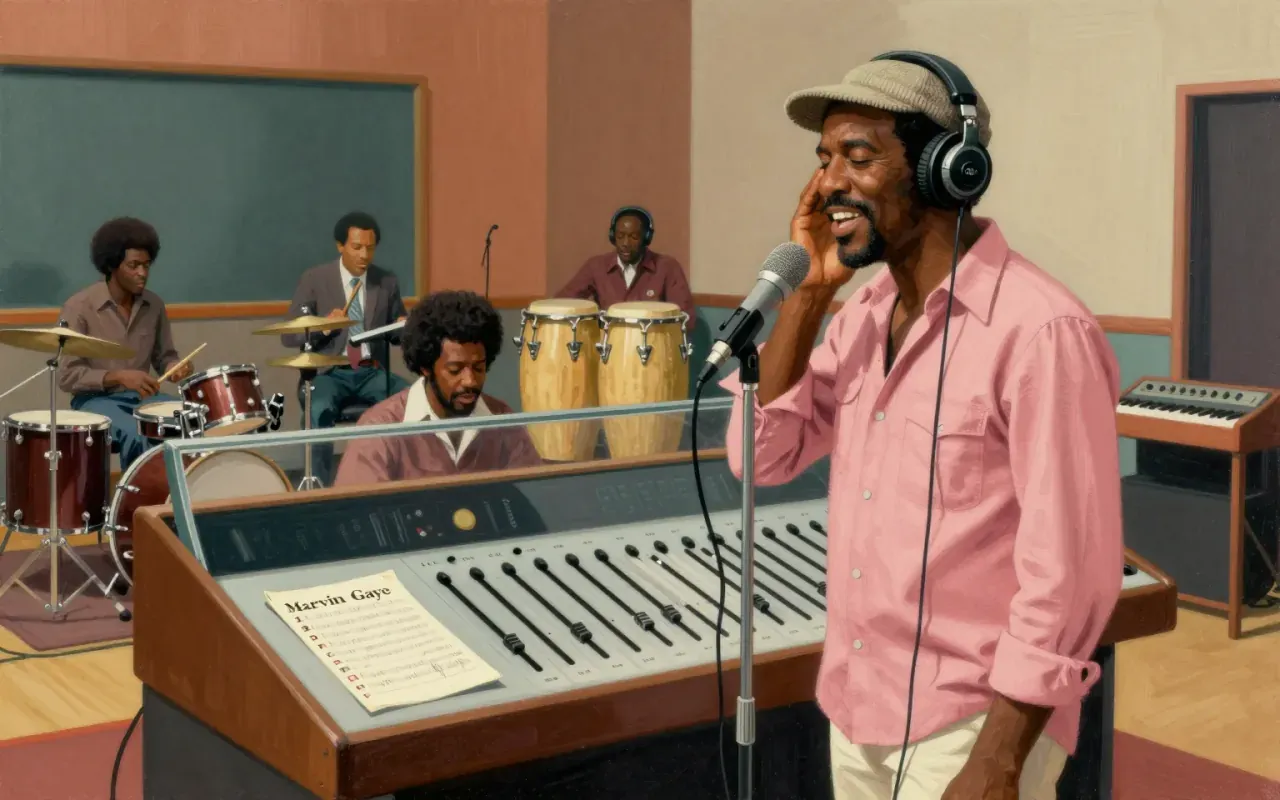
Built across three years and two coasts, Let's Get It On finds Marvin Gaye multi-tracking his own voice into a private choir, treating physical desire as material as weighty as anything on his more overtly political previous record.

13:00

Tapestry

Carole King · 1971

Recorded at A&M's Hollywood studios with James Taylor and a small circle of session players, Tapestry lets Carole King sing her own catalogue for the first time, trading polish for conviction across twelve mostly piano-led songs.

13:00

The Miseducation of Lauryn Hill

Lauryn Hill · 1998

Written and largely produced by Lauryn Hill after she left the Fugees and became pregnant, The Miseducation of Lauryn Hill mixes hip-hop, soul and reggae recorded partly at Tuff Gong in Kingston, built around live instrumentation and a set of collaborators later credited only after a lawsuit.