musicbriefs
13:00in productionCh. 1 · A one-man band at Motown/ 13:00 · ceiling 15 min
Disco, funk & soul

Innervisions

Stevie Wonder plays nearly every note himself and turns a synthesizer built for two men into an argument with a decade.

Recorded largely single-handed with the TONTO synthesizer rig and released three days before the car crash that nearly ended his career, Innervisions finds Stevie Wonder swapping love songs for reportage, from drug addiction and urban decay to a coded jab at the White House.

Chapters & takeaways7
  1. 0:08
    A one-man band at Motown

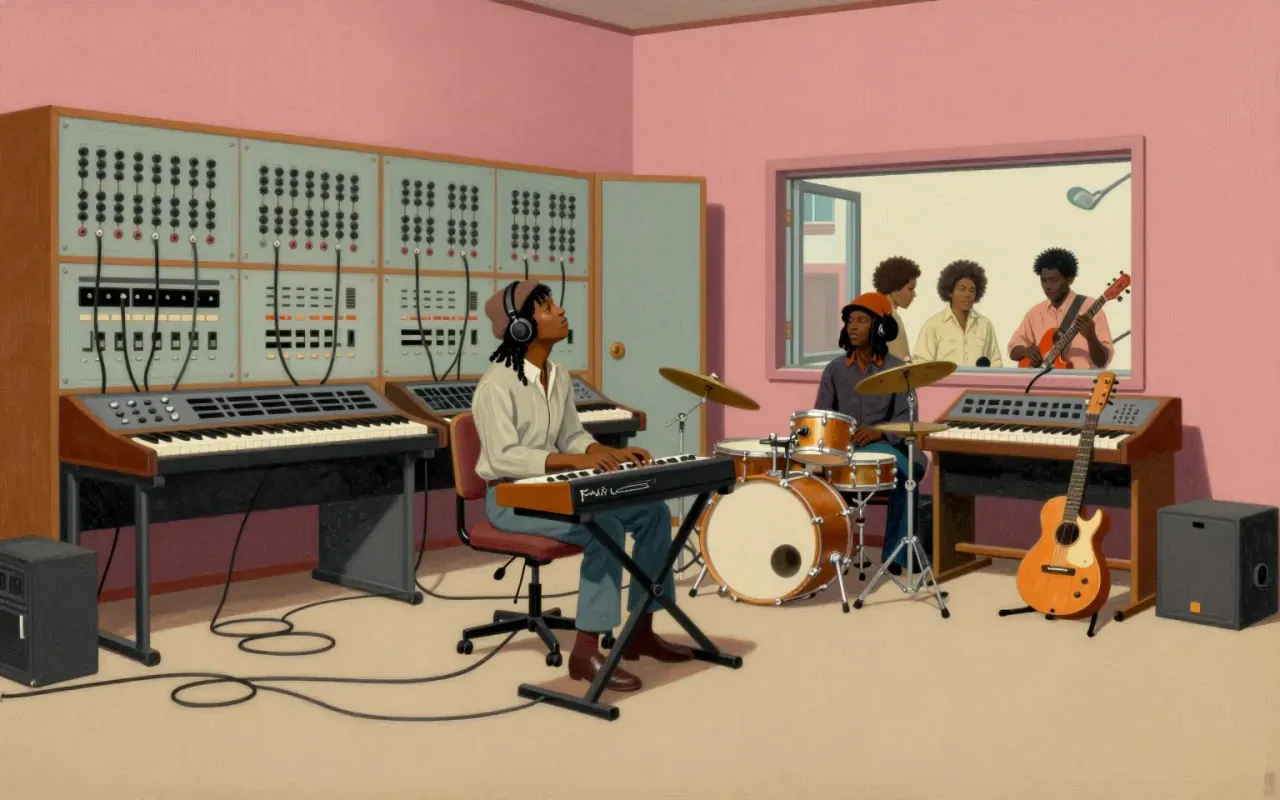
    Wonder wrote, produced and played almost everything himself, leaning on the modular TONTO synthesizer rig built by Malcolm Cecil and Robert Margouleff.

  2. 1:51
    The machines in the mix

    Moog and Rhodes textures stand in for a full band, and street noise is spliced directly into the record's centrepiece.

  3. 3:43
    Ghetto reportage and gospel warmth

    The strongest tracks trade romance for reportage, pairing a provoked, worn-out vocal with plainly voiced ballads.

  4. 5:34
    Where the reach exceeds the grasp

    The closing political jab and a mid-album meditation on faith both promise more than their vague writing delivers.

  5. 7:26
    Faith, addiction and inner sight

    The record links private faith to public injustice, using the synthesizer as a tool for argument rather than novelty.

  6. 9:17
    Who should press play

    Best suited to listeners tracing synthesizers into Black pop and songwriting that treats current events as material.

  7. 11:09
    Forty-four minutes, one pivot point

    A short record that covers enormous ground, made more resonant by the accident that followed its release.

Worth your time?

Yes. Hear the whole thing.

4.5/ 5
What works
  • The TONTO textures
  • "Living for the City"'s street-sound splice
  • The album's range across a short runtime
  • Wonder's multi-instrumental control
What does not
  • The closing political jab lacks bite
  • A couple of ballads feel underpowered without a full band
Hear it if
  • Listeners tracing synthesizers into Black pop
  • Stevie Wonder completists
  • Anyone interested in field recording used as texture
Skip it if
  • Listeners wanting an unbroken run of hits
  • Anyone cold on message-driven soul
The written brief4 min read

A one-man band at Motown

Innervisions is Stevie Wonder’s sixteenth album, released by Tamla in August 1973 not long after Music of My Mind and Talking Book had already reset expectations of what he could do alone in a studio. He wrote and produced almost the entire record himself, playing drums, piano, Moog and Rhodes across nine tracks, with the synthesizer rig known as TONTO — built by Malcolm Cecil and Robert Margouleff — standing in for whole sections of a band. Where his earlier work leaned on romantic balladry, this one reaches for reportage and reflection, moving between drug use, systemic racism and religious questioning. Three days after release, Wonder was badly hurt in a road accident in North Carolina, a collision that left him in a coma and briefly cost him his sense of smell, and the record’s arrival just ahead of that event has coloured how it gets discussed ever since.

The machines in the mix

Cecil and Margouleff had been steering Wonder toward this rig for two years by this point, and Innervisions is where the partnership pays off most completely. The Moog stands in for bass, horns and string pads in turn, while Rhodes piano gives the ballads their warmth against Wonder’s own live drumming. A rotating cast of players fills in where he steps back — Malcolm Cecil and Scott Edwards on bass, David T. Walker on electric guitar — but the credits show how much of the record is a solo performance dressed up as a band. On “Living for the City”, the studio band gives way to recordings of traffic, voices and sirens spliced against the music, an early attempt in soul to let the outside world into the mix rather than keep it at the door.

Ghetto reportage and gospel warmth

“Living for the City” carries the album’s most convincing writing, tracing one man’s route from the rural South to a northern city and ending on him locked up. Wonder and his producers pushed for a rawer vocal on the last verse, and it sounds genuinely worn rather than performed, a small piece of studio manipulation that earns its keep. Elsewhere “Higher Ground” moves with an urgency that has outlasted its era, propelled by a low end that never settles. The ballads carry weight too — “All in Love Is Fair” and “Golden Lady” are plain enough that they could be mistaken for filler, until the arrangements reveal how carefully each one is voiced against the mix around it.

Where the reach exceeds the grasp

The record’s reach for social comment does not land evenly. “He’s Misstra Know-It-All” closes the album on a note that reads as pointed commentary aimed at a sitting president, but the vagueness that lets it dodge specifics also blunts it — it never quite lands the punch its position promises. “Jesus Children of America” tries to hold several arguments about faith and hypocrisy inside one song and ends up saying less than its title suggests. Because Wonder plays so much of the record himself, a handful of tracks also feel thin where a full band might have pushed harder against him — the ideas are there, but the arrangement sometimes settles for adequate rather than following them through.

Faith, addiction and inner sight

Innervisions treats the synthesizer as an instrument of ideas rather than novelty, using it to sketch a version of soul music that could carry an argument. Wonder works through faith, addiction, injustice and love as connected material rather than separate songs, circling the idea that clarity comes from paying attention to what is actually happening around you rather than looking away. The title itself gestures at interior sight standing in for the eyes he does not have, a private frame placed over very public subject matter. It is a record built on the premise that a single musician, given the right tools, could say as much as an entire band and studio system.

Who should press play

Anyone curious about how synthesizers entered Black American popular music before they became a dance-floor tool should start here — the TONTO sound design still repays close listening. It also rewards listeners drawn to songwriting that treats current events as material without turning preachy, and to arrangements where a single musician’s fingerprints are on almost every part. It is less suited to anyone wanting a straight run of hits — several tracks ask for patience rather than delivering an immediate hook, and the record’s most political statements need context to land fully.

Forty-four minutes, one pivot point

Innervisions earns its reputation less through any one song than through the range it covers in forty-four minutes, moving from ghetto to gospel to synthesizer experiment without losing its own voice. It won Album of the Year at the following spring’s Grammys, and the accident that followed its release only sharpened the sense that this was a record made at a pivot point in one performer’s life. Judged only on craft, its command of the TONTO rig alone would make it worth an hour of attention. Judged on ambition, it is a rare case of a pop record actually catching up with its own reach.
Same genre · Disco, funk & soul4 of 142
8:02
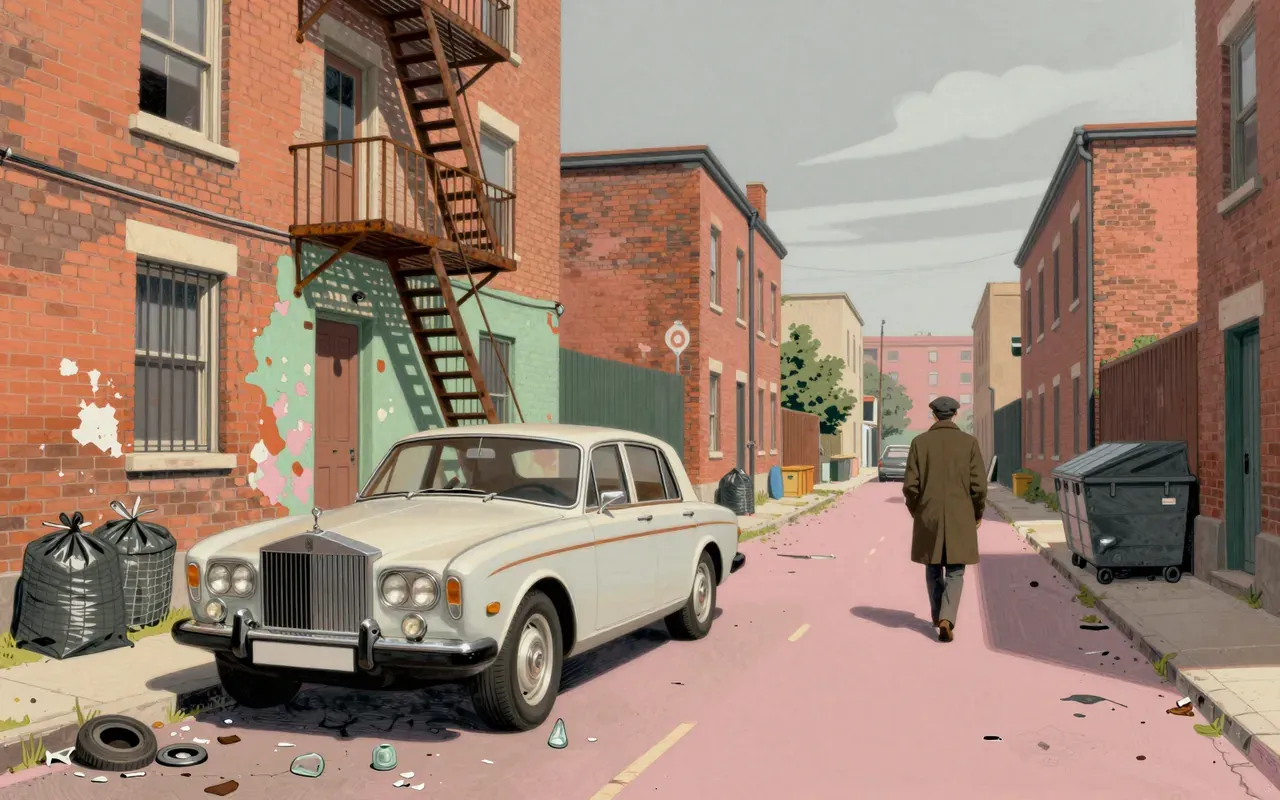
The World Is a GhettoWar · 1972The World Is a Ghetto is War’s fifth studio album, released in late 1972 on United Artists Records. It synthesises soul, funk, blues, and psychedelia with production likened to Curtis Mayfield’s Curtis and Marvin Gaye’s What’s Going On. Its cover—a flat-tyred Rolls-Royce in a ghetto—uses a blue-and-black palette to reflect its melancholy character. Critics noted its conceptual ambition but divided on pacing: Gordon Fletcher praised its mastery in communicating ghetto life; Robert Christgau dismissed it as 'blackstrap-rock'. It was originally issued in quadraphonic 8-track and reissued in Dolby Atmos for its 50th anniversary.
13:00
Songs in the Key of LifeStevie Wonder · 1976Made after Stevie Wonder seriously considered leaving music to work with disabled children abroad, and released only once he had signed one of the largest recording contracts in history, this double album plus bonus EP moves through faith, parenthood, injustice and romance while Wonder plays the overwhelming majority of the instruments himself.
11:04
Live at the Harlem Square Club, 1963Sam Cooke · 1985Live at the Harlem Square Club, 1963 is a live album recorded on January 12, 1963, at the Harlem Square Club in Miami — a small, historically Black venue in Overtown — and released by RCA Records in June 1985 after being shelved for over two decades. RCA found the recordings too loud, raw and raucous — inconsistent with the international pop star image they were cultivating for Cooke — and shelved them. Executive Gregg Geller rediscovered the tapes in 1985 and issued the album that year. Three mixes exist: the 1985 issue, a version included on the 2000 box set The Man Who Invented Soul, and a 2005 remaster from RCA.
9:54
CurtisCurtis Mayfield · 1970Curtis is Curtis Mayfield’s 1970 solo debut, produced by Mayfield and released on Curtom Records. It departs from The Impressions’ pop-soul sound toward funk and psychedelic-influenced arrangements, with a harder-edged sonic character. It features politically charged lyrics and stylistic duality — hard funk versus soft soul — realised through Mayfield’s self-directed vision and collaborative studio execution with a large ensemble. It was a top-20 commercial and critical success, won the 1972 Prix Otis Redding, and ranks No. 275 on Rolling Stone’s 500 Greatest Albums. It precedes and is compared to Marvin Gaye’s What’s Going On for its engagement with social change. No source provides details about instruments, tempos, rooms, mics, or specific production techniques.
Up next in Music

Kind of Blue

Miles Davis · 1959 · 13:00

Miles Davis handed his band scales instead of chords and, in two afternoons with almost no rehearsal, made the record most often called jazz's high-water mark.

13:00