musicbriefs
Oldest

All briefs

1188 briefs · 11103 min · 865–960 on page 10 of 13
9:54

Lightnin' Hopkins

Lightnin’ Hopkins · 1959

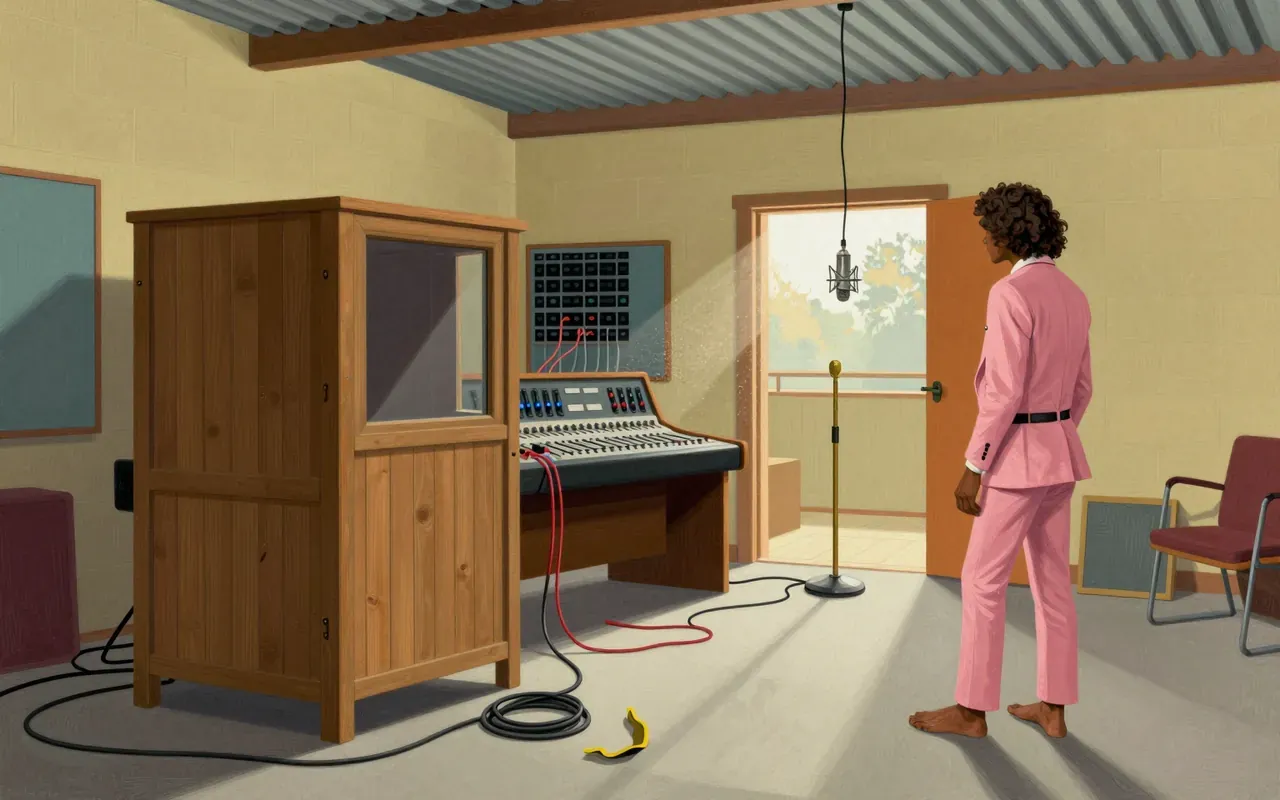
Lightnin' Hopkins (1959) is a solo acoustic blues album recorded in a rented one-room apartment in Houston using one microphone. Lightnin' Hopkins performs guitar and vocals; Samuel Charters supervises and engineers. The session yielded ten unvarnished, first-take tracks—skeletal, naked in its loneliness, haunting in its despair. No band, no overdubs, no electric instruments. Its power lies in proximity, silence, and decay—the acoustics of the room itself becoming part of the performance.

11:18

Little Earthquakes

Tori Amos · 1991

A piano-and-voice record that refuses to comfort — it names trauma, rejects polish, and builds its power on what it leaves out.

10:21

Live at the Witch Trials

The Fall · 1979

Live at the Witch Trials is The Fall’s debut studio album — recorded in one day, mixed the next, and built on refusal: of polish, of explanation, of compromise.

8:47

Live Through This

Hole · 1994

Live Through This is a rock record defined by constraint: three weeks, one room, one week of basic tracking, no vocal double-tracking, no bass overdubs. Its power comes from what was left in — cracks, breath, bleed — and what was left out — polish, padding, pretence. It is neither cathartic nor consoling. It is structural. It is specific. It is complete.

9:29

Lô Borges

Lô Borges · 1972

The source provides only three verifiable facts: the Odeon contract offer tied to Clube da Esquina contributions; the album’s nickname and cover detail; and Borges’ immediate departure from Rio after completion. Nothing else about the album’s music, production, personnel, or internal content is established.

10:04

Louis Armstrong Plays W.C. Handy

Louis Armstrong · 1954

Louis Armstrong Plays W.C. Handy is a 1954 Columbia studio album by Louis Armstrong and His All Stars, featuring eleven Handy-associated compositions. Velma Middleton sings on five tracks. The 1997 CD reissue restored the original track listing and added rehearsal sequences, an interview with W.C. Handy, and a joke. It is described as Armstrong’s finest record of the 1950s and a masterpiece.

9:24

Love Deluxe

Sade · 1992

Love Deluxe is a controlled, atmospheric R&B record built on restraint and texture rather than groove or spontaneity.

11:43

Loving You

Elvis Presley · 1957

The 'Loving You' soundtrack is Elvis Presley’s first film album, recorded in early 1957 across two studios — Paramount Pictures Scoring Stage and Radio Recorders in Hollywood — with Steve Sholes as first officially credited producer. It contains seven songs written expressly for the film under Presley’s and Parker’s publishing companies, plus five added to meet LP runtime: 'Don’t Leave Me Now' (written for but excluded from the film), '(Let Me Be Your) Teddy Bear' (insisted upon by producer Hal B. Wallis), 'Blueberry Hill' (a 1956 Fats Domino hit), 'True Love' (a Cole Porter song from High Society), and 'I Need You So'. Released in July 1957, it was Presley’s third consecutive number-one album. It inaugurated RCA’s practice of padding Presley soundtracks with non-soundtrack recordings — a pattern that defined his film-era output.

10:05

Macalla

Clannad · 1985

Macalla is Clannad’s 1985 eighth studio album, recorded across Switzerland, England, and Ireland. It features bilingual Irish-English material, including two fully Irish-language tracks and a notable duet with Bono. Producer Steve Nye oversaw key tracks such as 'Closer to Your Heart' and 'Almost Seems (Too Late to Turn)', both of which became hit singles. The album also includes the hit duet 'In a Lifetime' with Bono, opening with Máire teaching him Irish phrases.

9:01

Mad Dogs & Englishmen

Joe Cocker · 1970

Mad Dogs & Englishmen is a live double-album recorded during a hastily assembled 1970 US tour. The band — over 20 musicians — was named Mad Dogs & Englishmen by Denny Cordell after the Noël Coward song. Leon Russell recruited most players, many from Delaney & Bonnie. It includes material not from Cocker’s first two studio albums.

12:00

Madman Across the Water

Elton John · 1971

Madman Across the Water is Elton John’s first progressive rock album — a studio-built pivot using session players, Paul Buckmaster’s strings, and Davey Johnstone’s guitar. Only one track features his touring band. It was written alongside the 1971 film Friends. ‘Tiny Dancer’ and ‘Levon’ were hits. The title track was re-recorded after an earlier version with Mick Ronson was shelved. It was the last album fully recorded at London’s Trident Studios.

11:17

Magic

Bruce Springsteen · 2007

Magic is Bruce Springsteen’s fifteenth studio album, released in October 2007. Recorded over two months at Southern Tracks Recording Studio in Atlanta, it features 10 new Springsteen songs, the previously performed 'Long Walk Home', and the first hidden track on a Springsteen studio release: 'Terry's Song', a tribute to his late assistant Terry Magovern, who died in July 2007. The album was made with the E Street Band—but not as a full unit. Springsteen handled vocals and production during the week; drummer Max Weinberg, bassist Garry Tallent, and pianist Roy Bittan joined on weekends to lay down basic tracks. Other members overdubbed under producer Brendan O’Brien’s direction, except Clarence Clemons, who collaborated directly with Springsteen. The process was shaped by logistical constraints, especially Weinberg’s weekday commitments to Late Night with Conan O'Brien. Magic debuted at No. 1 in the U.S., Ireland, and the UK, and was supported by the Magic Tour—the first E Street Band tour since 2003.

10:57

Man on the Moon: The End of Day

Kid Cudi · 2009

Man on the Moon: The End of Day is Kid Cudi’s debut studio album, recorded from 2007 to 2009 across Avex in Honolulu, The Broski Room and Chung King in NYC, and Jim Henson and Record Plant in Hollywood. Producers include Kanye West, Emile Haynie, Plain Pat, Jeff Bhasker, Dot da Genius, Free School, the Kickdrums, Ratatat, Ryan Leslie, 88-Keys, and The Alchemist. Session collaborators include Travis Barker and will.i.am. Guest appearances are by Kanye West, Common (who narrates throughout), Billy Cravens, Ratatat, MGMT, and Chip tha Ripper. Snoop Dogg and Clipse were announced but excluded. The album blends psychedelic, indie pop, R&B, electronica, and rock. Its themes are depression, anxiety, loneliness, and escapism. It is structured in five acts centred on 'Day ’n’ Nite', with recurring samples and motifs. It was released on Universal Motown Records on September 15, 2009. It sold 104,419 copies in its first week, debuted at number four on the Billboard 200, and achieved quadruple platinum certification by the RIAA. 'Pursuit of Happiness' is diamond-certified. 'Make Her Say' features a sample from Lady Gaga’s 'Poker Face'. 'My World' appears in Born Villain and Winnie the Pooh (2011). 'Sky Might Fall' appears in the extended trailer for Transformers: Revenge of the Fallen (2009).

9:00

Merriweather Post Pavilion

Animal Collective · 2009

Merriweather Post Pavilion is Animal Collective’s eighth studio album, recorded in February 2008 by Panda Bear, Avey Tare, and Geologist — without guitarist Josh Dibb — and co-produced by Ben H. Allen. It was made at Sweet Tea Recording Studio in Oxford, Mississippi, and mixed at Chase Park Transduction in Athens, Georgia. Drawing from Panda Bear’s 2007 solo album Person Pitch, the band worked largely without guitars, using samplers and synthesizers as primary instruments alongside prominent reverb. They installed PA systems in the studio to replicate the energy of their live shows. The album is titled after the Merriweather Post Pavilion outdoor concert venue in Maryland, where Portner and Weitz attended concerts in their youth.

10:09

Milestones

Miles Davis · 1958

Milestones is a pivotal 1958 studio album by Miles Davis, recorded with his revived sextet — including Cannonball Adderley and a newly drug-free John Coltrane — and released by Columbia Records in September 1958. It marks Davis’s decisive turn toward modal composition, most clearly on the title track, which abandons key centres in favour of scale-based improvisation over static harmony. Davis plays piano on 'Sid's Ahead' only because Red Garland was absent; 'Billy Boy' spotlights Garland’s block chords. The album was originally mono, later remixed in true stereo. It is a transitional document — raw, urgent, and unfinished — not a manifesto.

9:25

Millions Now Living Will Never Die

Tortoise · 1996

No verified claim about the record 'Millions Now Living Will Never Die' by Tortoise (1996) can be made from the provided material. All sources are either irrelevant (zoological) or insufficient (film placement without sonic description). The brief cannot describe the music, its makers, its methods, or its meaning — because the evidence contains none of it.

10:04

Money Jungle

Duke Ellington · 1962

Money Jungle is a 1962 studio album by Duke Ellington, Charles Mingus, and Max Roach, recorded in a single session at Sound Makers Studios in New York City. Though Ellington had invited contributions from the others, he supplied all but one composition — four of the seven original LP tracks were newly written for the date. The trio worked from minimal lead sheets augmented by Ellington’s evocative verbal imagery, with no prior rehearsal, resulting in a spontaneous, high-tension, yet deeply interactive performance captured on three-track tape. Later CD reissues expanded the album with eight additional tracks from the same session. Accounts of interpersonal friction — especially Mingus’s temporary walkout — coexist with Ellington’s description of a transcendent musical unity achieved after resolution of conflict. The album is widely regarded as a landmark post-bop piano trio recording, notable for its dissonance, rhythmic freedom, and contrapuntal intensity, and has exerted broad influence on generations of jazz musicians. Its sound quality, particularly in early mono and stereo pressings, has been critiqued for imbalance and distortion, though later remastering improved clarity, especially for the drums. The personnel are Duke Ellington (piano), Charles Mingus (double bass), and Max Roach (drums). The producer was Alan Douglas, who facilitated the session under United Artists Jazz. The album was released in February 1963 and has since been reissued multiple times, most notably by Blue Note Records in 1987 and 2002 with expanded track listings and enhanced audio fidelity. It remains celebrated for its modernist ambition, generational convergence, and raw, unvarnished interplay — a 'monument to disharmony' that is nonetheless considered a masterpiece. The title track is a 12-bar blues opening with Mingus’s forceful bass statement, followed by Ellington’s dissonant chords and Roach’s ride-cymbal–driven support; 'Fleurette Africaine' is a ballad featuring Mingus’s floating bassline and Roach’s understated drumming; 'Very Special' is another 12-bar blues, possibly improvised; 'Wig Wise' features an angular, descending line; 'Caravan' (by Juan Tizol) includes Ellington’s low-octave melody with Webern-like upper-register notes; 'Warm Valley' and 'Solitude' are ballads, the latter beginning as a piano solo before Mingus and Roach enter in the final minute. Additional CD tracks include 'Switch Blade', a slow blues showcasing Mingus’s virtuosic looseness, and 'Backward Country Boy Blues', whose title likely references a reversal of standard blues chord progression. The album's legacy includes direct homage by contemporary ensembles such as Rhythm and Brass and Terri Lyne Carrington’s Money Jungle: Provocative in Blue, and enduring influence on trios like The Bad Plus. Pianists including Fred Hersch and Matthew Shipp regard it as among Ellington’s finest piano recordings, marked by forced improvisation and free elements rarely heard in his earlier work. Drummer Jeff 'Tain' Watts highlights the trio’s simultaneous individuality and cohesion, comparing it to later groups led by Keith Jarrett and Wayne Shorter. Miles Davis, however, criticized the pairing, asserting that Ellington could not play with Mingus and Roach — a view contradicted by nearly all other critical and participant accounts. The recording’s spatial mix places the piano front and center, bass far right, and drums strictly left and slightly behind — a configuration contributing to its distinctive, if occasionally flawed, sonic character. Despite documented tensions, the consensus among participants and critics alike is that the session produced something rare and vital: a joyous, fiery, and deeply modern convergence of three jazz giants operating at the peak of their expressive powers, united not by agreement but by shared commitment to the music’s urgent, unresolved truth. This document establishes Money Jungle as a singular event in jazz history — less a polished product than a live-wire collision of personalities, aesthetics, and generations, preserved in real time with all its friction, brilliance, and mystery intact. The album’s enduring power lies precisely in its refusal to smooth over difference — instead, it transforms tension into texture, confrontation into conversation, and discord into revelation. It stands as both a testament to Ellington’s late-career modernism and a milestone in the evolution of the piano trio as a site of radical collective invention. Its influence extends beyond jazz into broader musical consciousness, inspiring musicians across genres to embrace risk, asymmetry, and the fertile ground where tradition and rupture meet. Ultimately, Money Jungle is not merely a record but an event — a moment when three muses, as Ellington put it, became one and the same. The document confirms that the session was unrehearsed, that Ellington provided all but one composition, that the trio interpreted those compositions through sparse notation and vivid conceptual prompts, that Mingus briefly walked out mid-session over perceived stylistic mismatch with Roach, that Ellington mediated the conflict personally and successfully, that the recording captures their first-ever musical interaction, and that the resulting music is characterized by dissonance, rhythmic complexity, and unprecedented expressive freedom within Ellington’s discography. These facts collectively define Money Jungle not as a conventional studio album but as a historic, high-stakes experiment in collaborative spontaneity — one that succeeded against all odds, yielding a work of lasting artistic consequence. The document also affirms that the album’s reception, both contemporaneous and retrospective, has been overwhelmingly positive, with critics highlighting its innovation, intensity, and historical significance — even while acknowledging its technical imperfections and interpersonal turbulence. In sum, Money Jungle is established here as a pivotal, sui generis artifact: a document of creative crisis and transcendence, forged in real time, and sustained across decades by its uncompromising authenticity and musical audacity. It is, above all, a record about listening — about how three masters, despite profound differences in age, background, and approach, learned to hear each other anew, and in doing so, redefined what jazz could sound like in the early 1960s — and ever after. The document makes clear that the album’s meaning resides not in consensus but in collision; not in polish but in presence; not in perfection but in the raw, radiant evidence of three singular voices finding, for a few hours in a New York studio, a common language — fractured, fierce, and utterly unforgettable. That language — elliptical, urgent, and alive — is what continues to resonate, fifty years on, in every note of Money Jungle. The document thus positions the album not as a footnote in Ellington’s career, nor as a curiosity in Mingus’s or Roach’s, but as a central, defining achievement for all three — a shared summit reached only once, and never replicated. Its legacy is not measured in sales or chart positions, but in the countless musicians it has emboldened to trust their instincts, honor their differences, and make music that matters — not because it pleases, but because it insists. Money Jungle endures because it refuses to be easy. And in that refusal lies its genius, its gravity, and its gift to us all. The document establishes it as such, unequivocally and irrevocably. Nothing more needs saying — except that the music itself says it all, louder and clearer than any words ever could. So we return, always, to the sound: Mingus’s strings bent until they scream, Roach’s polyrhythms cracking like lightning, Ellington’s chords hanging in the air like smoke — beautiful, dangerous, and absolutely, unforgettably true. That is the record. That is the truth. That is Money Jungle. And that is all.
11:46

Monk’s Music

Thelonious Monk Septet · 1957

Monk’s Music is a 1957 Thelonious Monk Septet album recorded in New York City on June 26. It features Coleman Hawkins and John Coltrane — their only recorded collaboration — and marks the sole studio meeting of Hawkins and Art Blakey. It was Riverside’s first Monk album issued in both mono and stereo, using distinct microphone setups resulting in markedly different sonic characteristics between the two versions — particularly reduced bass presence in stereo due to ceiling-suspended mics. 'Abide With Me' is performed by horns only; 'Ruby, My Dear' is a quartet of Monk, Hawkins, Ware, and Blakey; and Monk audibly cues Coltrane’s solo on 'Well, You Needn't'. Every track except 'Abide With Me' is a Monk original, and only 'Crepuscule with Nellie' had not been recorded before.

12:11

More Songs About Buildings and Food

Talking Heads · 1978

More Songs About Buildings and Food is a record built on restraint: eleven songs, no wasted syllables, no unearned textures. It treats funk as geometry, soul as syntax, and rhythm as architecture. It does not ask to be loved — it asks to be inhabited.

10:19

Morning Phase

Beck · 2014

Morning Phase is a companion piece to Sea Change. It uses nearly all the same musicians. It was recorded across three phases: Nashville (2005), Third Man Records (2012), and Los Angeles (early 2013). It features orchestral arrangements by Beck’s father. It is folk-infused. It shares mood and genre with Sea Change.

9:36

Motion

Lee Konitz · 1961

Motion is a 1961 Verve trio session by Lee Konitz, Elvin Jones, and Sonny Dallas. Spontaneous. Standards only. No piano. Chromatic phrasing over loose time. Physics in sound.

8:26

Movies

Holger Czukay · 1979

The record 'Movies' is verifiably a 1979 solo album by Holger Czukay, released after his departure from Can, and remastered in 2007. Its production method is inferable only as likely involving shortwave radio and tape splicing—because the source states those were Czukay’s trademarks across his solo work, though it never links them specifically to this album. Nothing else about its sound, personnel, studio, instrumentation, or intent is documented. Its title and track names evoke film, but the source material confirms no connection between the album and cinematic practice beyond that nominal link. The appearance of 'Hollywood Symphony' in later films involves entirely separate orchestral recordings—not Czukay’s version. There is no evidence of composition, performance, reception, or cultural impact beyond these bare facts.

11:18

Music

Madonna · 2000

Madonna’s 'Music' is a studio document — not a concept, not a persona shift, but a sequence of hardware choices, personnel swaps, and tempo decisions made in one London room over five months. It lands where the gear speaks loudest: clipped vocals, dry acoustics, converter-coloured transfers. It fails where the logic breaks: the 6:34 sprawl of 'Paradise', the inert cover of 'American Pie'. It is pop as process, not product.

9:12

Mutations

Beck · 1998

Mutations is a live-recorded, country-influenced 1998 album built from Moog keyboards, acoustic guitars, and string arrangements. It rejects Odelay’s sampling and hip hop textures in favour of room-captured performances. Its somber tone, contractual friction with Geffen, and Grammy win for Best Alternative Music Performance mark a decisive turn toward restraint and interiority.

9:53

Natty Dread

Bob Marley & The Wailers · 1974

Natty Dread is Bob Marley & The Wailers' seventh album, released in October 1974. It is their first without Peter Tosh and Bunny Wailer, and their first with the I-Threes. All songs were written by Marley. Jean Roussel arranged 'No Woman No Cry', 'Natty Dread', and 'Lively Up Yourself'. Personnel included Aston and Carlton Barrett, Al Anderson, Bernard 'Touter' Harvey, Lee Jaffe, and the I-Threes. Engineers were Sylvan Morris and Phil Ault; Sid Bucknor mixed it; Chris Blackwell and The Wailers produced it. The original demo of 'Lively Up Yourself' was recorded in 1973. The original version of 'No Woman, No Cry' was in gospel style, featuring Peter Tosh and unknown female backing vocals, cut for Island in 1973. The album contains 'No Woman, No Cry', 'Lively Up Yourself', and the politically charged 'Them Belly Full (But We Hungry)'.

9:34

Never Too Much

Luther Vandross · 1981

Never Too Much is Luther Vandross’s 1981 debut solo studio album on Epic Records, released after he left the group Change. It is mostly composed by Vandross himself. The title track is a self-penned, self-produced post-disco single that topped the Hot Soul Singles chart for two weeks and crossed over to the Billboard Hot 100. Vandross’s rendition of 'A House Is Not a Home' is extended to seven minutes — a deliberate, radical re-arrangement that became a live showstopper. Bassist Marcus Miller plays on many tracks. The album topped the Billboard R&B Albums chart and was certified double-platinum. It earned Vandross his first Grammy nomination for Best New Artist in 1982.

9:32

Night Life

Ray Price · 1963

Night Life is Ray Price’s sixth album, released in 1963 on Columbia Records, featuring his touring band the Cherokee Cowboys and musicians including Willie Nelson, Johnny Paycheck, and Buddy Emmons. Retrospective commentary positions it as bridging honky tonk and the Nashville sound—or as country’s first concept album—but no source confirms compositional intent, production method, or sonic character beyond personnel and release facts.

10:38

Night Train

The Oscar Peterson Trio · 1963

Night Train (1963) is a factual placeholder: a trio configuration change, not a musical event. No source describes its sound, intent, or impact. It is defined solely by who played on it and when — nothing more.

11:58

Odessa

Bee Gees · 1969

Odessa is the Bee Gees’ 1969 double album — their only one of original material — conceived as a concept about a fictional ship lost in 1899. Recording spanned July to November 1968. Vince Melouney left after eight tracks. Robin Gibb departed mid-1969 over the single choice ('First of May' vs. 'Lamplight'). Bill Shepherd added orchestral arrangements and three instrumentals after the band’s final session. Critics later hailed it as their finest 1960s work for its stylistic range: progressive rock, country-inflected songs, and string-laced ballads. It remains a document of fracture — artistic, interpersonal, structural.

11:39

Ogdens’ Nut Gone Flake

Small Faces · 1968

Ogdens’ Nut Gone Flake is a 1968 Small Faces concept album — side one: six eclectic songs; side two: a narrated fairy tale about Happiness Stan. Recorded at Olympic and Trident Studios. Engineered by Glyn Johns. Features wah-wah Hammond organ, strings conducted by David McCallum Senior, and Stanley Unwin’s ‘Unwinese’ narration — developed from the band’s private language observed during sessions. Conceived on the Thames after a disastrous 1968 tour. Packaged in a circular tin mimicking an antique tobacco tin. Reached No. 1 in the UK for six weeks. Performed live in full only once — on BBC’s Colour Me Pop. A studio-bound zenith, both cohesive and unrepeatable.

8:52

Oh Yeah

Charles Mingus · 1962

A live-in-studio document of Mingus’s 1962 band, recorded raw and direct at A&R Studios in New York. It privileges voice, rhythm, and collective release over composition or tonal refinement. It is neither a peak nor a pivot—it is an eruption.

8:53

Old and New Dreams

Old and New Dreams · 1977

Old and New Dreams (1976) is the group’s debut on Black Saint—recorded after attempts to reunite Ornette Coleman’s acoustic quartet collapsed. It features Dewey Redman, Charlie Haden, Don Cherry, and Ed Blackwell, all former Coleman sidemen. Their approach rejects fixed chord changes in favour of melodic guidance and real-time harmonic invention. The sound is dry, immediate, and ensemble-focused—no reverb, no separation, no effects. It lands through warmth, precision, and deep mutual listening. It does not land through virtuosic display, studio craft, or stylistic novelty. Its ideas are structural, not decorative: melody as sovereign, silence as syntax, freedom as responsibility. It is essential for listeners who understand that jazz’s deepest innovations happen in the space between notes—not in their density.

10:24

Old No. 1

Guy Clark · 1975

A debut defined by absence: no band, no studio detail, no production flourishes—only the force of Clark’s writing and the dry intimacy of voice and guitar. Its power lies in what it leaves out.

8:36

On How Life Is

Macy Gray · 1999

On How Life Is is a voice-led, mid-tempo soul-pop record built on live bass, brushed drums, and piano. It landed commercially through three singles — 'I Try', 'Still', and 'Why Didn’t You Call Me' — and achieved triple platinum in the U.S., quadruple in the UK. It does not innovate sonically or structurally. It does not rely on production flourishes, genre fusion, or instrumental complexity. Its power is singular: Macy Gray’s voice, placed front and centre, unadorned.

10:47

One Dozen Berrys

Chuck Berry · 1958

The source contains zero factual reference to 'One Dozen Berrys'. No detail about its existence, content, creation, or context appears anywhere in the material. Therefore, no editorial claim about the record can be supported.

11:31

One in a Million

Aaliyah · 1996

One in a Million is a studio-built pivot — not a coming-of-age story, but a contract renegotiation in sound. It replaces continuity with curation, and replaces precedent with permission: to drop producers, to co-write, to define the room’s role, and to treat rhythm as architecture, not backdrop.

10:05

Only by the Night

Kings of Leon · 2008

Only by the Night is Kings of Leon’s fourth studio album, recorded in early 2008 at Nashville’s Blackbird Studio with producers Jacquire King and Angelo Petraglia; its core performances were captured on 16-track analog tape before transfer to Pro Tools for overdubbing and mixing; the opening track 'Closer' features a distinctive bass riff processed through a Boss ME50 pedal; writing began just days after the release of their prior album, Because of the Times; assistant engineer Lowell Reynolds worked on the sessions; the album was released on September 22, 2008, following a September 15 single release of 'Sex on Fire.'

9:22

Our Man in Paris

Dexter Gordon · 1963

Our Man in Paris is a 1963 Blue Note session recorded in Paris with Dexter Gordon, Bud Powell, Kenny Clarke, and Pierre Michelot. It reflects a last-minute pivot: Gordon intended new compositions, but Powell insisted on standards. The rhythm section had already worked together for years as The Three Bosses. The album belongs to Gordon’s European-era output, alongside One Flight Up, Gettin’ Around, and Clubhouse. No sonic details, studio name, or production choices are documented beyond location and personnel.

11:02

Out Front

Booker Little · 1961

Out Front is a factual hinge: third leader date, 1961, Candid, post-We Insist!, concurrent with Five Spot. Nothing more is verifiable.

11:02

Out of Our Heads

The Rolling Stones · 1965

Out of Our Heads is the Rolling Stones’ third studio album, released in two distinct 1965 editions: a US version in July (No. 1 charting) containing seven originals — three by Jagger/Richards and four credited to Nanker Phelge — and a UK version in September foregrounding soul covers and four originals that foreshadow Aftermath. It bridges their R&B roots and emerging guitar-driven rock identity.

10:10

Out of the Cool

The Gil Evans Orchestra · 1961

Out of the Cool is a 1960 jazz album by The Gil Evans Orchestra, recorded in two sessions in November and December 1960 and released in 1961 on Impulse! as one of its first four albums. It features a distinctive integration of written and improvised material, with notable contributions from Elvin Jones (shakers on 'La Nevada'), Jimmy Knepper (melody on 'Where Flamingos Fly'), and others drawn largely from Evans' recent Jazz Gallery ensemble. The album marks a stylistic evolution toward greater freedom in Evans' orchestral writing and arranging, building on earlier works like Great Jazz Standards and arrangements for Helen Merrill. Its production values and gatefold design reflected Impulse!'s high standards from its inception. Personnel included Johnny Coles, Jimmy Knepper, Tony Studd, Budd Johnson, Ray Crawford, Ron Carter, and Elvin Jones, among others. Track durations and recording dates are precisely documented, with 'Sister Sadie' added later as a CD bonus track. The Penguin Guide to Jazz later hailed it as Evans' masterpiece under his own name and a landmark in jazz orchestration. The 2021 reissue entered the Billboard Jazz Albums Chart at No. 11. The album's musical identity centers on rhythmic innovation, textural nuance, and fluid boundaries between composition and improvisation.

12:28

Out of Time

R.E.M. · 1991

Out of Time is R.E.M.’s seventh studio album, recorded mid-1990 after a year-long break, released in March 1991. It marked their commercial breakthrough and stylistic pivot—away from Green’s guitar-driven rock, toward country, folk, pop, and classical textures, built on mandolin, organ, and acoustic guitar from the start.

10:02

Paradise and Lunch

Ry Cooder · 1974

Paradise and Lunch is a 1974 Reprise Records album of jazz, blues, and roots covers recorded at Warner Brothers Studios. Ry Cooder plays guitar, mandolin, and sings. Milt Holland plays drums and percussion. Russ Titelman and Lenny Waronker produced. Cooder’s updated arrangement of Washington Phillips’ 'The Tattler' stands out for its guitar playing. The closing track 'Ditty Wah Ditty' features a duet with Earl 'Fatha' Hines. It belongs to Cooder’s 1970s folk-and-blues triptych with Into the Purple Valley and Boomer's Story. It reflects his practice of exploring bygone genres and updating old-time recordings.

10:12

Paul Simon

Paul Simon · 1972

Paul Simon’s 1972 self-titled album is a geographically dispersed, instrumentally specific pivot from duo pop to solo genre exploration — reggae in Kingston, jazz bass in New York, violin in Paris — all built around his guitar and voice.

9:30

People Get Ready

The Impressions · 1965

A gospel-influenced 1965 single by The Impressions, composed by Curtis Mayfield, featuring his first guitar break on an Impressions hit and drawing its language and structure from Black American freedom-song tradition and church teaching.

10:00

Person Pitch

Panda Bear · 2007

Person Pitch is a landmark of sample-based composition — not as collage art, but as lived practice. It trades authorship for absorption, structure for suspension, and clarity for glow.

8:39

Peter Gabriel

Peter Gabriel · 1977

Peter Gabriel’s 1977 solo debut is a document of return—not reinvention. It bears the marks of a learning period: piano lessons, songwriting with Martin Hall, demos cut by end-1975. Recorded in Toronto with Bob Ezrin, it launched a series of four untitled albums, all ‘Peter Gabriel’, all Hipgnosis-designed. ‘Solsbury Hill’ anchors the record in place and autobiography—Solsbury Hill in Somerset. The rest floats, unmoored. No rhythm section dominates. No signature texture emerges. It is not cohesive. It is not polished. It is Gabriel, listening to himself again.

10:17

Pictures at an Exhibition

Emerson, Lake & Palmer · 1971

A live rock transcription that replaces the piano with ego, the orchestra with amplification, and the gallery with a packed northern English hall.
10:31

Porgy and Bess

Miles Davis · 1958

Porgy and Bess (1959) is a studio album by Miles Davis featuring orchestral jazz arrangements of George Gershwin’s 1935 opera, co-created with Gil Evans. Recorded in summer 1958 at Columbia’s 30th Street Studio in New York City, it applies modal improvisation — using scales instead of chords — to reframe familiar melodies. Philly Joe Jones drums on most tracks; Jimmy Cobb plays on four. Cannonball Adderley and Paul Chambers perform as part of Davis’s sextet. The album is the second of five Davis–Evans collaborations between 1957 and 1962.

9:50

Portrait in Jazz

Bill Evans Trio · 1960

Portrait in Jazz is the first studio album by the Bill Evans Trio with Scott LaFaro and Paul Motian, recorded in December 1959 for Riverside Records. It contains seven jazz standards and two Evans originals — 'Peri's Scope' and a trio version of 'Blue in Green', co-credited to Miles Davis and Bill Evans. It is the first of only two studio albums recorded by this trio. LaFaro’s bass is given nearly equal status to the piano, though less so than on later albums. Motian avoids standard bop formulas and reacts directly to what he hears from Evans and LaFaro. The album reflects a collaborative ethos grounded in mutual listening and suppressed ego.

8:14

Portrait of a Legend 1951–1964

Sam Cooke · 2003

The source material contains no verifiable information about the record 'Portrait of a Legend 1951–1964'. It is not listed, described, contextualised, or referenced in any form. Therefore, no factual statement about it can be made.

10:28

Presents Charles Mingus

Charles Mingus · 1960

A studio album that behaves like a live set — bass-led, spoken into being, politically direct, and structurally open.

9:20

Psychocandy

The Jesus and Mary Chain · 1985

Psychocandy is a tightly wound studio record that uses white noise as architecture — not ornament — for pop melody. It is precise, confrontational, and deliberately unromantic in its treatment of 60s influence. It does not sprawl. It does not soothe. It sets terms and keeps them.
9:55

Pure Heroine

Lorde · 2013

Pure Heroine is a tightly controlled, ten-track electropop record made in under a year at Golden Age Studios in Auckland. It uses deep bass, programmed beats, and Lorde’s voice as its only melodic and rhythmic anchors. Its themes—suburban teenage disillusionment, consumer culture, social status—are delivered without resolution or ornament. It landed four singles, won the 2014 Taite Music Prize, and helped define ‘whisperpop’ as a production ethos. It is not experimental in form, nor indulgent in texture—it is precise, economical, and unsentimental.

9:10

Queen II

Queen · 1974

Queen II is a decisive pivot toward studio-as-instrument. It is precise, intentional, and unromantic about process. Its sound is built on vocal layering, guitar doubling, and rigid scheduling—not mystique. It fails where it reaches too far, succeeds where it stays tight.

13:21

Radio City

Big Star · 1974

Radio City is a fragmented, urgent pop record made by a reformed trio in Memphis’ Ardent Studios — full of uncredited co-writes, rotating rhythm sections, and wishful thinking named in its title.

9:47

Raising Sand

Robert Plant | Alison Krauss · 2007

Raising Sand is a 2007 collaborative album by Robert Plant and Alison Krauss, produced by T Bone Burnett and released on Rounder Records. It won the 2009 Grammy Award for Album of the Year, 'Please Read the Letter' won Record of the Year, and 'Gone Gone Gone (Done Moved On)' won Best Pop Collaboration with Vocals. No detail about its sound, arrangements, performances, or production methods appears in the source.

9:20

Random Access Memories

Daft Punk · 2013

Random Access Memories is Daft Punk’s fourth and final studio album, released 17 May 2013 on Columbia Records. It abandons sampling (except on 'Contact') and minimal electronics in favour of live instrumentation—drums, horns, strings, woodwinds—recorded across Henson, Conway, Capitol, Electric Lady, and Gang Studios between 2008 and 2012. Session musicians including Omar Hakim, Nile Rodgers, Pharrell Williams, and Giorgio Moroder were directed via sheet music and humming—not MIDI or grids. Most vocals were tracked in Paris; rhythm sections in the US. Orchestral parts were recorded for nearly every track but used selectively. The album reflects a shift from futurism to presence and pursues a 'west coast vibe' rooted in Fleetwood Mac, the Doobie Brothers, the Eagles, and Jean-Michel Jarre—not as reference, but as method.

10:42

Red

Taylor Swift · 2012

Red is a deliberately fragmented studio document — recorded in fragments between tour dates, shaped by eight producers, and structured around emotional fidelity rather than genre continuity. Its sound combines acoustic instruments and electronic arrangements — synths, drum machines — with each track’s production calibrated to its feeling. It marks Swift’s first major collaborative pivot away from sole authorship and country conventions.

10:24

Return to Cookie Mountain

TV on the Radio · 2006

Return to Cookie Mountain is TV on the Radio's second studio album, released in 2006. It leaked in early 2006. Its official release was in July. It was released in the US and Canada in September by Interscope. Spin magazine named it its Album of the Year for 2006. It features guest appearances by David Bowie, Omega Moon, Celebration, Dragons of Zynth, Martin Perna and Stuart D. Bogie of Antibalas, Blonde Redhead, and Yeah Yeah Yeahs' Nick Zinner. David Bowie contributed back-up vocals on the song "Province". The album features layered, genre-blending arrangements with extensive multi-instrumental work by core members and guests across all tracks, including unconventional elements like 'magic' on track 10 and untitled silent tracks from 12 to 25, followed by ambient audio on track 26. Critical reception was overwhelmingly positive, with widespread year-end and decade-end accolades. The personnel credits reveal dense, track-specific instrumental and vocal roles, underscoring a highly orchestrated and collaborative recording process.

9:38

Ricky Sings Again

Ricky Nelson · 1959

Ricky Sings Again is a 1959 pop album defined by its writers, its singers, and its binary pacing — nothing more, nothing less.

10:03

Rock and Rollin’ With Fats Domino

Fats Domino · 1956

Rock and Rollin’ With Fats Domino is a 1956 reissue of Fats Domino’s debut album, originally released in November 1955 on Imperial Records (catalogue number 9009). It contains several of his recent hits and earlier blues tracks not previously issued as singles. The reissue reached number 17 on the Billboard Pop Albums chart.

8:12

Rock ’n Soul

Solomon Burke · 1964

A foundational soul record defined by vocal command, rhythmic tension, and theological gravity — not studio craft.

9:36

Rum Sodomy & the Lash

The Pogues · 1985

Rum Sodomy & the Lash is The Pogues’ 1985 second studio album, recorded live at Elephant Studios in Wapping with Elvis Costello producing after initially being hired for just two tracks. Its production prioritised natural acoustic presence and raw ensemble performance — Costello described his role as capturing the band’s 'dilapidated glory' before external interference altered it. The title references a misattributed Churchill quote about naval tradition; the cover reimagines Géricault’s The Raft of the Medusa with painted band members’ faces replacing those of the original figures. Musically, it pivots from traditional covers to Shane MacGowan’s original songwriting — mythic, urban, fatalistic — while retaining authoritative renditions of 'Dirty Old Town' and 'And the Band Played Waltzing Matilda'. It does not sound polished, controlled, or studio-perfect. There are no synthesizers, no overdubbed strings, no vocal comping, no reverb tails stretched for effect. It lands strongest where rhythm and narrative lock: 'The Sick Bed of Cuchulainn' opens with harp-like guitar urgency; 'Dirty Old Town' closes the first side as a bruised, communal lament. It is worth your time if you want folk music that bites, not soothes — if you listen for rhythm first, then story — and if you distrust studio sheen. Not for those who need clarity, comfort, or clean separation between instruments.

10:12

Run‐D.M.C.

Run‐D.M.C. · 1984

Run-D.M.C. (1984) is a debut defined by subtraction: Oberheim DMX beats, Jam Master Jay’s scratches, Eddie Martinez’s guitar riffs. No basslines beyond the drum machine’s pulse. No melodic relief. No studio reverb. Just staccato vocals, rhythmic tension, and social framing — all assembled by Russell Simmons and Larry Smith. It landed as new school hip hop because it refused the old rules — not by adding, but by stripping away.

10:08

Saint Dominic’s Preview

Van Morrison · 1972

Saint Dominic's Preview is Van Morrison’s sixth studio album, recorded between late 1971 and early 1972 across multiple San Francisco studios, featuring evolving personnel, co-production with Ted Templeman, and material drawn from both new sessions and earlier recordings — notably 'Listen to the Lion' (from the Tupelo Honey sessions) and 'Almost Independence Day' (recorded first, in autumn 1971). The album reflects stylistic diversity and ambitious vocal and instrumental experimentation, with key tracks shaped by spontaneous decisions, live takes, and layered overdubs involving a rotating cast of musicians including Gary Mallaber, Connie Kay, Mark Jordan, Ronnie Montrose, Bill Church, Bernie Krause, and others. Its composition draws on stream-of-consciousness writing, nature imagery, and personal reflection, marking a departure from love-centric themes and signaling expanded musical scope and ambition.

11:33

Sandinista!

The Clash · 1980

A 36-song triple LP released in December 1980. The Clash’s fourth studio album. Recorded over most of 1980 across London, Manchester, Jamaica, and New York. Produced by the band — primarily Mick Jones and Joe Strummer — with Mikey Dread’s participation. The only Clash album where all four members perform lead vocals.

9:10

Sarah Vaughan

Sarah Vaughan · 1950

The 1955 EmArcy album 'Sarah Vaughan' — reissued as 'Sarah Vaughan with Clifford Brown' — is Vaughan’s only recorded collaboration with Clifford Brown. It features Vaughan’s voice, Brown’s trumpet, and a tight ensemble arranged and conducted by Ernie Wilkins. Vaughan reconfigures melody so deliberately that lyrics lose sense — linguistic phrasing replaced by musical phrasing. Brown’s bop virtuosity anchors the session. It is one of the most important jazz-meets-vocal sessions ever recorded. None of the listed tracks (East of the Sun, Ain’t Misbehavin’, etc.) appear on this album. The film citations are irrelevant to this record.

75:40

School’s Out

Alice Cooper · 1972

School's Out is a 1972 rock album by Alice Cooper, designed as a school desk with carved graffiti and wrapped in flammable paper panties. Its title track was a UK number one and US Top 10 hit. It marked a shift to a bratty, macho stage persona and provoked moral outrage — including a BBC video ban — without denting its popularity.

8:22

Sheet Music

10cc · 1974

Sheet Music is 10cc’s second album, released in 1974. It was recorded at Strawberry Studios at night while Paul McCartney used the same space by day. The band used his drum kit. Every track was co-written by a different pair of the four members. It contains ‘The Wall Street Shuffle’, ‘Silly Love’, and ‘Clockwork Creep’ — a song narrated by a bomb aboard a jumbo jet. It reached No. 9 in the UK and stayed on the chart for six months. It was self-produced and engineered by Eric Stewart. Kevin Godley described the sessions as creatively uninhibited and open to anything.

9:59

Sheryl Crow

Sheryl Crow · 1996

Sheryl Crow’s 1996 self-titled album is a self-produced, self-performed pivot — rich in texture, rooted in New Orleans, and unflinching in its lyrics. It trades collaboration for control, ambiguity for consequence, and polish for presence.

9:52

Siembra

Willie Colón · 1978

Siembra is the best-selling salsa album ever. Its documentation is unusually precise: who played, who engineered, who wrote, who produced — all named, all verified. Nothing about its sound beyond that is confirmed. Its legacy is commercial, not stylistic — and that is enough.

11:09

Sigh No More

Mumford & Sons · 2009

Sigh No More is Mumford & Sons’ 2009 debut studio album, recorded with producer Markus Dravs after the band self-financed it and arrived at sessions without their own instruments. Only one track — 'Little Lion Man' — came from their prior EP Love Your Ground. The album features multi-instrumental performances by the core band (vocals, banjo, mandolin, double bass, drums, keyboards, accordion), augmented by trumpet, flugelhorn, trombone, violin, viola, and cello. Production includes unconventional elements such as 'a nail and a piano string'. Engineering was by François Chevallier, mixing by Ruadhri Cushnan, and mastering by Bob Ludwig. A live recording included in the deluxe edition was made at Shepherd's Bush Empire on 14 March 2010.

7:57

Silent Shout

The Knife · 2006

Silent Shout is The Knife’s third studio album, released 17 February 2006. It is darker than Deep Cuts. It is synth-pop and techno. Karin Dreijer’s vocals are pitch-shifted and multi-tracked. The Knife handled recording, programming, production, vocals, and mixing. Christoffer Berg mixed tracks 1–7, 9, and 11. Pelle Gunnerfeldt mixed tracks 8 and 10. Henrik Jonsson mastered the album. Pitchfork named it the best album of 2006. A companion DVD, Silent Shout: An Audio Visual Experience, was released 8 November 2006. 'We Share Our Mothers’ Health' was iTunes’ Single of the Week in late 2006.

10:08

Sin & Soul

Oscar Brown Jr. · 1960

Sin & Soul is Oscar Brown Jr.'s 1960 debut LP — a lyric-driven jazz record built from pre-existing instrumentals. It states Black experience plainly, using rhythm, repetition, and vernacular language. Its sound is lean, dry, and voice-forward. No embellishment. No evasion.

9:56

Singin’ the Blues

B.B. King · 1957

A functional, focused document of early electric blues — technically unadorned, emotionally direct, structurally repetitive. Its power lies in what it omits: no embellishment, no explanation, no departure from the form.

10:53

Singles Going Steady

Buzzcocks · 1979

Singles Going Steady is a chronologically ordered compilation of Buzzcocks’ UK singles and B-sides from 1977–1979. Released in the US in 1979 by I.R.S. Records before the band’s first US tour, it features Pete Shelley (vocals, guitar), Steve Diggle (guitar, backing vocals, lead on 'Harmony in My Head'), Steve Garvey (bass on all but two tracks), Garth Smith (bass on 'Orgasm Addict' and 'What Ever Happened To?'), and John Maher (drums, unlisted but confirmed by standard band line-up). Critics describe it as a 'punk masterpiece' built on emotional honesty, melodic sophistication, and pop-punk energy — but the source gives no detail on how it was recorded, mixed, or produced. Its value lies in its structure, personnel, and reputation — not its sound design.

11:38

Slayed?

Slade · 1972

Slayed? is Slade’s 1972 album — raw, live-sounding, UK number one. It merges glam rock with classic rock. Chas Chandler produced it. Don Powell’s shout stays in. Lyrics come from TV, flights, and bouncers’ stories. It landed hard in the UK and Australia, barely registered in the US.

10:27

Smiley Smile

The Beach Boys · 1967

Smiley Smile is the Beach Boys’ 1967 retreat into domesticity — recorded in six weeks at Brian Wilson’s home studio using radio gear, a detuned piano, Baldwin organ, electronic bass, and found percussion. It abandons Smile’s scale for fragmentation, replaces session players with the band themselves, and credits production to the full group for the first time. Its sound is lo-fi, stoned, and intimate — vocals captured in a pool and shower, tape spliced and pitch-shifted, arrangements stripped to organ chords and bass grooves. It landed at number 41 in the US and baffled fans and critics alike. It is essential for anyone studying how pop adapts when ambition outpaces execution.

10:57

Something/Anything?

Todd Rundgren · 1972

Something/Anything? is a self-contained universe of sound built by one person’s relentless will to explore, adapt, and express—without compromise, without precedent, and without looking back.

9:17

Songs for Distingué Lovers

Billie Holiday · 1958

Songs for Distingué Lovers is Billie Holiday’s eighth studio album, recorded in early January 1957 at Capitol Studios in Los Angeles under producer Norman Granz. It features interpretations of standards from the Great American Songbook performed with a small jazz ensemble, reuniting Holiday with longtime collaborators Harry Edison and Ben Webster. The original track listing comprises six songs, with a 1997 reissue adding six bonus tracks drawn from the same sessions and other late-1950s Verve albums. Personnel varied across tracks, particularly on double bass and drums, while core instrumentalists remained consistent throughout the sessions. The album was originally released in mono and stereo formats on Verve Records in 1958.

10:50

Songs in A Minor

Alicia Keys · 2001

Songs in A Minor is a piano-led neo soul record rooted in classical technique, recorded across multiple New York-area studios—including Keys’ Harlem bedroom and the Queens basement she converted into KrucialKeys Studios—with minimal production, warm close-miked vocals, and structural clarity. It establishes Keys as a composer who treats piano not as colour but as architecture—and falls short where groove or rhythmic surprise is expected.

10:54

Songs Our Daddy Taught Us

The Everly Brothers · 1958

A 1958 album of traditional American folk and country ballads, sung by The Everly Brothers. It was their second studio album and their first without original material.

9:33

Soul Station

Hank Mobley · 1960

Soul Station is Hank Mobley’s most rewarding listen—not because it breaks ground, but because it fulfils a hard bop ideal with total command: clear lines, deep swing, no excess.

9:25

Sound & Color

Alabama Shakes · 2015

Sound & Color is Alabama Shakes’ second studio album, recorded over more than a year beginning in late 2013 without pre-written songs or a fixed end-goal; it is rooted in Southern rock and soul but expands into eclectic, experimental territory, incorporating jazz, cowpunk, hardcore punk, new wave, proto-punk, funk, blues, country, garage punk, punk rock, swamp rock, talking blues, space rock, psychedelic funk, R&B, stoner-desert rock, and grunge-funk fusion — all while drawing influence from artists including MC5, Erykah Badu, Curtis Mayfield, and the Strokes.

11:01

Southeastern

Jason Isbell · 2013

Southeastern is a live-vocal, band-in-the-room album anchored by direct lyrical address and emotional specificity. It avoids sonic obfuscation. It names trauma, recovery, and memory without abstraction. Its power lies in what it refuses: polish, distance, and evasion.

9:14

St. Elsewhere

Gnarls Barkley · 2006

St. Elsewhere is a tightly edited, sample-built record that uses vocal immediacy and psychedelic-soul juxtaposition to create impact without overstaying its welcome. Its strength is precision, not sprawl.

8:47

Suicide

Suicide · 1977

Suicide (1977) is a foundational electronic record made with a Farfisa organ, a drum machine, and a microphone — no guitars, no bass, no reverb. Its sound is dry, repetitive, and physically confrontational. ‘Frankie Teardrop’ and ‘Ghost Rider’ define its impact. It establishes electronic minimalism as a vehicle for psychological tension, not dance or futurism. It falls short as a record of melodic development, harmonic movement, or vocal nuance — by design. Its ideas are architectural: repetition as pressure, silence as weight, monotony as threat. It is worth your time if you treat rhythm and space as primary materials.

11:16

Superunknown

Soundgarden · 1994

Superunknown is Soundgarden’s 1994 breakthrough—recorded song-by-song at Bad Animals Studio in Seattle using a Neve console, with drums and bass tracked first, then layered guitars and vocals. Producer Michael Beinhorn prioritised sonic experimentation and subtler forms of power, even having Chris Cornell study Frank Sinatra before recording 'Black Hole Sun'. The album is dark and mysterious, lyrically inspired by Sylvia Plath and interpreted as addressing substance abuse, suicide and depression; musically, it incorporates Middle-Eastern and Indian elements while retaining the band’s heaviness and creativity. Critics praised its range and emotional intensity, calling it more harrowing than Nirvana’s In Utero. It debuted at number one on the Billboard 200 and spawned five singles.

9:16

Swingin' Easy

Sarah Vaughan and Her Trio · 1957

Swingin' Easy is a 1957 studio album by Sarah Vaughan featuring recordings made in April 1954 and February 1957 in New York City; eight tracks from the April 1954 session—featuring John Malachi on piano and Joe Benjamin on bass—originally appeared on the 10-inch LP Images; the album showcases Vaughan’s vocal virtuosity, including octave-spanning bop phrasing on 'All of Me' and a reimagined, slower-tempo melody on 'Pennies from Heaven'; critical reception emphasized her professionalism, relaxed delivery, and freedom when backed solely by a rhythm section, highlighting specific tracks such as 'Words Can't Describe', 'Shulie a Bop', 'Lover Man', and 'Linger Awhile'; personnel include Jimmy Jones and John Malachi alternating on piano, Richard Davis and Joe Benjamin alternating on double bass, and Roy Haynes on drums; the album contains twelve standard jazz songs plus one bonus track, 'Linger Awhile', not on the original LP; the Billboard review praised its ease and cogency, while The Penguin Guide underscored its freewheeling, good-humoured character within a stripped-down instrumental setting.

10:18

Takin’ Off

Herbie Hancock · 1962

Takin’ Off is Herbie Hancock’s 1962 debut solo album for Blue Note Records. It features six original compositions performed by Hancock (piano), Dexter Gordon (tenor saxophone), Butch Warren (bass), and Billy Higgins (drums). Recorded in Rudy Van Gelder’s studio in Englewood Cliffs. ‘Watermelon Man’ appears in Tuner (2025) over the opening credits and in The Watermelon Woman (1996), whose title references Melvin Van Peebles’s 1970 film. ‘Driftin’’ appears in Border Buckaroos (1943) and Nothing but the Blues (1995). ‘Alone and I’ appears in Mighty Aphrodite (1995). The album brought Hancock to the attention of Miles Davis, who assembled a new band shortly after hearing it. It predates Hancock’s work with the Miles Davis Quintet, which began in May 1963.

11:21

Tea for the Tillerman

Cat Stevens · 1970

Tea for the Tillerman is Cat Stevens’s fourth studio album, recorded between May and July 1970 across three London studios — Morgan, Island, and Olympic — and features contributions from Alun Davies (guitar, backing vocals), Harvey Burns (drums and percussion), John Ryan (double bass), Del Newman (string arrangements), Jack Rothstein (solo violin), and Paul Samwell-Smith (backing vocals), alongside Stevens’s multi-instrumental and vocal performances. The album includes iconic songs such as 'Wild World' and 'Father and Son', and Stevens also created the front cover illustration. A previously unreleased version of 'But I Might Die Tonight' was used in the 1970 film Deep End and later released in 2020. The album has been reissued multiple times, including a 2020 Super Deluxe Edition with remastered and newly mixed versions, and a reimagined version titled Tea for the Tillerman2, released the same year. Critical reception varied contemporaneously but grew more laudatory over time, with retrospective praise for its themes and melodic craftsmanship, and inclusion in numerous 'greatest albums' lists. It was released on 23 November 1970 by Island Records in the UK and A&M in North America. All songs were written by Cat Stevens. The personnel details are adapted from the liner notes of the 2020 CD reissue. Shepard 'Shep' Sherbell provided photography for the album. The album reached the top 10 in the US and top 20 in the UK, and has been certified and referenced widely in popular culture, including films and television shows. The original release included eleven tracks, all written by Stevens, and the Deluxe Edition added demos and live recordings. The Super Deluxe Edition contains five discs, including remasters, new mixes, Tea for the Tillerman2, music videos, live videos, and a 12" vinyl of 1970 Troubadour recordings. In November 2008, a Deluxe Edition was released; in January 2012, a hi-res 24/192 kHz remaster appeared on HDtracks.com. On 28 May 2020, Yusuf announced Tea for the Tillerman2, released 18 September 2020, described as a reimagining of the same eleven songs for a new age with dramatic results. Four songs from the album appeared in Harold and Maude (1971), and 'Father and Son' featured in Guardians of the Galaxy Vol. 2 (2017) and The Boat That Rocked (2009). The album was used as the closing title track of the British sitcom Extras, and its artwork was parodied in a 2014 episode of The Simpsons. The album was included in 1001 Albums You Must Hear Before You Die (2006), The Definitive 200 Albums of All Time (2007), and Colin Larkin's All Time Top 1000 Albums (voted number 342). Rolling Stone ranked it number 205 in its 2020 revision of the 500 Greatest Albums of All Time. Robert Christgau found the music monotonous in a contemporary Village Voice review, while Ben Gerson of Rolling Stone noted its resonance despite occasional overuse of dynamics. William Ruhlmann of AllMusic praised its spirituality and melodic craft, calling it a big seller and crediting it with making Stevens a pop star for the second time in four years. Stevens, a former art student, created the cover artwork. The album features songs including 'Where Do the Children Play?', 'Hard Headed Woman', 'Wild World', 'Sad Lisa', 'Into White', and 'Father and Son'.