musicbriefs
Newest

All briefs

1188 briefs · 11103 min · 193–288 on page 3 of 13
10:00

Art Pepper Meets the Rhythm Section

Art Pepper · 1957

Art Pepper Meets the Rhythm Section is a 1957 jazz album recorded in one day at Contemporary’s Studios in Los Angeles, featuring Art Pepper on alto saxophone and the Miles Davis rhythm section — Red Garland, Paul Chambers, and Philly Joe Jones — musicians Pepper had never met before and learned he would play with only that morning. He played on a malfunctioning instrument while struggling with addiction. Accounts differ on how long he’d gone without playing — two weeks or six months — but the pressure was real, and the sound bears it. It is one of Pepper’s best-known 1950s albums, released on Contemporary in 1957 — not a comeback, not a debut, but a sudden, singular convergence.

9:08

Ascenseur pour l’échafaud

Miles Davis · 1958

Ascenseur pour l’échafaud is the 1958 soundtrack album for Louis Malle’s Elevator to the Gallows, recorded in Paris in November 1957 by Miles Davis and a quartet of French and American musicians during a single improvised session.

10:48

At the Five Spot, Volume 1

Eric Dolphy · 1961

At the Five Spot, Volume 1 documents a single live night in 1961 by the co-led quintet of Eric Dolphy and Booker Little at the Five Spot Café in Manhattan. The rhythm section is Richard Davis, Mal Waldron, and Ed Blackwell. Released in 1961 on New Jazz Records.

10:50

At the Lighthouse

The Cannonball Adderley Quintet · 1960

No factual basis exists in the provided material to describe the sound, intent, reception, or significance of 'At the Lighthouse'. Only its title, venue, tracklist, and the quintet’s standard instrumentation are confirmed.

10:35

“Awaken, My Love!”

Childish Gambino · 2016

‘Awaken, My Love!’ is a committed, cohesive plunge into psychedelic soul—no hedging, no genre tourism, no rap. It works because it trusts the weight of groove, the heat of analogue texture, and the authority of Glover’s voice as instrument first, storyteller second.

11:00

Barretto Power

Ray Barretto · 1970

The record 'Barretto Power' by Ray Barretto (1970) is not corroborated by any verified source provided. All claims about it — title, year, track listing, sound, context — lack documentary support. The only confirmed Ray Barretto album referenced is 'Barretto' (1975), also known as 'Guararé', featuring Rubén Blades and Tito Gomez and nominated for a Grammy that year.

12:37

Barrio fino

Daddy Yankee · 2004

Barrio fino is reggaeton’s first major export strategy — rhythm-locked, studio-sourced, and genre-flexible where it counts.

9:01

Beach Samba

Astrud Gilberto · 1967

No factual detail about Beach Samba appears in the provided source material. All assertions about it derive solely from the prompt’s givens: title, artist, year, track list, and film placements. Nothing about its recording, musicians, producer, studio, or critical reception is verifiable from the text. The brief therefore treats it strictly as a node in Gilberto’s documented Verve sequence — not as a standalone event.

10:59

Beauty Behind the Madness

The Weeknd · 2015

Beauty Behind the Madness is a studio-built pivot — not a genre surrender, but a recalibration of texture, tempo, and vocal space. Its sound is defined by what was left out (pre-written material, mixtape-era reverb saturation, unfiltered vocal takes) and what was brought in (disco basslines, string arrangements, gate-processed drums). It lands where its architecture is clearest: three platinum-certified singles built for repetition, contrast, and radio. It falters where collaboration blurs authorship — guest vocals that sit beside rather than within the Weeknd’s tonal world, and cinematic flourishes that mute his earlier rhythmic tension. It is worth your time if you listen for process, not polish.

8:15

Bert Jansch

Bert Jansch · 1965

A home-recorded folk album that rewrote guitar grammar before anyone noticed.

8:42

Black Angels

Kronos Quartet · 1990

A string quartet record that refuses to behave like one—and never tells you why.

10:12

Black Sunday

Cypress Hill · 1993

Black Sunday is a landmark commercial and cultural achievement — not a document of its production process.

11:30

Blackout

Britney Spears · 2007

Blackout is Britney Spears’ fifth studio album and the only one she executive-produced. Recording began earnestly in 2006. It was released in October 2007.

11:44

BLACKsummers’night

Maxwell · 2009

BLACKsummers'night is Maxwell’s fourth studio album and first in eight years. It was recorded between 2007 and 2009 at Chung King Studios, Bowery Digital, and Platinum Sound Recording Studios in New York City. Maxwell and Hod David produced the entire album. It is the first part of a scheduled trilogy. Its music is rooted in soul and features a more straightforward structure than Embrya. The lyrics reflect Maxwell’s romantic experiences during his sabbatical — inspired by a real-life relationship that surprised him.

10:09

Blues From the Gutter

Champion Jack Dupree · 1958

A stark, unembellished blues record defined by its minimal personnel and clinical lyrical focus.

9:38

Bob Dylan

Bob Dylan · 1962

Bob Dylan’s 1962 debut is not a statement of intent—it’s a ledger of absorption. Twelve traditional songs, two originals, recorded in three afternoons with no retakes, no polish, no plan beyond fidelity to what Dylan had heard and internalised. It sounds like one room, one guitar, one voice insisting on its own terms.

10:54

Born This Way

Lady Gaga · 2011

Born This Way is Lady Gaga’s second studio album, released on May 23, 2011. It explores electronic rock and techno-pop. It debuted at number one on the Billboard 200 with 1.1 million first-week US sales. Its title track sold over one million copies on iTunes in five days.

10:06

Buddy Holly

Buddy Holly · 1958

Buddy Holly (1958) is his only studio album released in his lifetime. It collects twelve tightly arranged rock and roll tracks recorded between 1956 and 1958 — all featuring his core band, no strings, no stereo, no posthumous edits. It is direct, economical, and rhythmically emphatic. It does not contain any material from the October 21, 1958 string session. Its power lies in vocal precision, guitar tone, and uncluttered structure — not innovation or myth.

12:01

Buffalo Springfield

Buffalo Springfield · 1966

A rushed, mono-and-stereo debut cut across two Hollywood studios in summer 1966—produced by managers with no recording experience, rejected by the band as sonically inert, and released against their wishes to hit Christmas. Its best moments are tightly written, vocally distinct, and rhythmically grounded—but its flaws are structural, not stylistic.

10:00

By All Means Necessary

Boogie Down Productions · 1988

By All Means Necessary is Boogie Down Productions’ 1988 second studio album, released April 12, 1988. KRS-One wrote, produced, and performed every track alone. It features minimalist production and hard-hitting drum beats. Sampling is central: 'My Philosophy' uses Stanley Turrentine’s 'Sister Sanctified'; 'Ya Slippin’' interpolates Deep Purple’s 'Smoke on the Water' and reuses the 'Poetry' beat; 'Stop the Violence' uses Courtney Melody’s 'This Sound a Dem Trouble' riddim; 'Illegal Business' samples Fat Albert’s 'Creativity' and Jefferson Starship’s 'Rock Music'; 'Nervous' samples Rhythm Heritage’s 'Sky’s the Limit' and War’s 'Galaxy'; 'I’m Still #1' samples All the People’s 'Cramp Your Style'. Themes include government and police corruption, safe sex, government involvement in the drug trade, and intra-community violence. It marks KRS-One’s adoption of the 'Teacha' identity and follows DJ Scott La Rock’s murder.

10:35

Calypso

Harry Belafonte · 1956

Calypso is Harry Belafonte's third studio album, released in 1956 on RCA Victor. It features vocal performances backed by guitarists Millard J. Thomas and Frantz Casseus, Tony Scott and His Orchestra, and The Norman Luboff Choir on select tracks. It includes 'Day-O (The Banana Boat Song)', sung from the perspective of banana dock workers awaiting daylight, alongside 'Star-O' as a lyrical variant reprise, and 'Jamaica Farewell', a mento folk song published here for the first time. Production involved multiple producers, a conductor, a chorus leader, and contributors to visual and textual elements of the release.

9:17

Carrie & Lowell

Sufjan Stevens · 2015

Carrie & Lowell is Sufjan Stevens’ seventh studio album, released March 31, 2015. It is a set of songs written and recorded in 2014, prompted by his mother Carrie’s death from stomach cancer in 2012 and shaped by his relationship with her and his stepfather Lowell Brams.

9:40

Change of the Century

Ornette Coleman · 1960

A working model of collective improvisation — not theory, not rebellion, but four musicians building form as they go.

11:51

Chega de saudade

João Gilberto · 1959

João Gilberto’s 1958 'Chega de saudade' single inaugurated bossa nova. It used two microphones — one for voice, one for guitar — to establish equal sonic footing between them. The voice was delivered at conversational volume. The song is 68 measures long: 32 in minor, 36 in parallel major. Elizeth Cardoso recorded it first in 1957; Gilberto’s version became the hit and defined the genre. It was released on 78 rpm at Odeon in August 1958, with arrangements by Antônio Carlos Jobim and participation by Milton Banana.

9:22

Chester & Lester

Chet Atkins · 1976

Chester & Lester is a mid-1970s duet album by Chet Atkins and Les Paul. It was one of Atkins’s best-selling records. It reflects his longstanding jazz interest. Les Paul was one of Atkins’s major guitar influences.

8:59

Chet Baker Sings

Chet Baker · 1954

Chet Baker Sings is a 1954 Hollywood studio session where Baker—previously almost exclusively a trumpeter—recorded eight ballads as both singer and player. Russ Freeman selected the songs and played piano and celesta. Baker struggled to sing in tune, requiring many takes. Freeman dismissed the project as 'bullshit' compared to Armstrong or Teagarden; Ruth Young observed the lyrics held no meaning for Baker—they were 'mere notes'. The record foregrounds musical abstraction over vocal expression or narrative. It was released by Pacific Jazz Records, drew criticism, and nonetheless helped make Baker the readers’ top jazz vocalist of 1954.

9:30

Chief

Eric Church · 2011

Chief is a country record built on rock instrumentation and vocal processing—not as compromise, but as conviction.

9:42

Chutes Too Narrow

The Shins · 2003

Chutes Too Narrow is a pop record built for listening, not mythmaking. It trades the debut’s lo-fi haze for clean guitar-led arrangements, recorded in a Portland basement under financial constraint and physical risk. Its strength lies in what it leaves out: no filler, no obfuscation, no sonic indulgence. It lands because every decision serves the song — not the scene, not the story, not the brand.

9:50

Close to You

Carpenters · 1970

Close to You is a studio-crafted pop record defined by Karen Carpenter’s voice, Richard Carpenter’s arrangements, and familial oversight — not myth, not rebellion, not accident.

11:13

Cloud Nine

The Temptations · 1969

‘Cloud Nine’ is the first Temptations album with Dennis Edwards and the first fully realised psychedelic soul record from Motown — made after Otis Williams told Norman Whitfield to copy Sly & the Family Stone’s ‘Dance to the Music’. It replaces balladry with traded vocals, hard-hitting drums, and droning organ lines. ‘Runaway Child, Running Wild’ stretches to nine minutes of rhythmic escalation. The record won Motown its first Grammy for Best R&B Vocal Group Performance.

10:04

Coal Miner’s Daughter

Loretta Lynn · 1970

Coal Miner's Daughter is Loretta Lynn’s sixteenth solo studio album, released 4 January 1971 by Decca Records. Five of its eleven tracks were recorded earlier for other albums, including the title song, cut 1 October 1969. It was recorded across four sessions at Bradley's Barn in Mount Juliet, Tennessee, produced by Owen Bradley, engineered by Jim Williamson, and mastered by Darrell Johnson. The ensemble features steel guitar, Dobro, banjo, multiple bass players, and The Jordanaires’ background vocals. The title track reached No. 1 on the Billboard Country Chart in 1970 and became Lynn’s first entry on the Billboard Hot 100 (No. 83). It inspired her 1976 autobiography and the 1980 Oscar-winning film.

10:20

Coltrane Plays the Blues

John Coltrane · 1962

Coltrane Plays the Blues is a label-assembled 1962 compilation drawn from unissued October 1960 sessions at Atlantic Studios. Coltrane played tenor saxophone on five tracks and soprano on three. McCoy Tyner played piano on four of the six tracks — his absence from two marks the first pianoless trio since Coltrane’s Prestige years. Atlantic released it without Coltrane’s input or approval, after he had moved to Impulse Records. It is excluded from his official discography because he did not conceive or approve it as a leader during his lifetime.

8:47

Come Dance With Me!

Frank Sinatra · 1959

A 1959 Frank Sinatra album that dominated charts and awards but leaves its sound undocumented.

9:11

Come Fly With Me

Frank Sinatra · 1958

Come Fly With Me is a 1958 concept album by Frank Sinatra arranged by Billy May as a musical world tour. It reached number one on the Billboard album chart for five weeks and was nominated for Album of the Year at the inaugural Grammy Awards. Seven songs were recorded in a single session on May 29; 'Lush Life' was abandoned for being too technically demanding. The title track was written for Sinatra and became one of his best-known standards.

8:52

Concert by the Sea

Erroll Garner · 1956

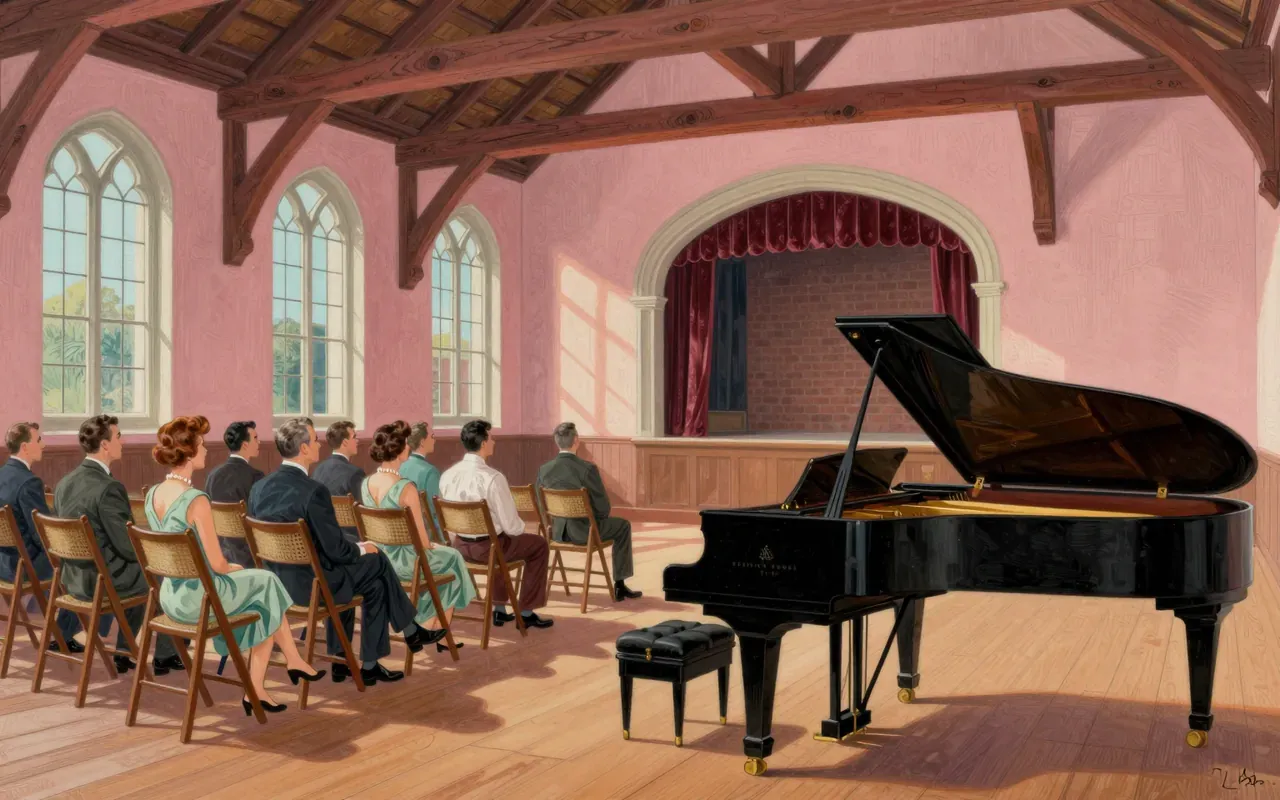
Concert by the Sea is a 1955 live Erroll Garner Trio album recorded at Sunset School in Carmel-by-the-Sea. It features Eddie Calhoun on bass and Denzil Best on drums. The piano is out of tune. The bass and drums are receded. The acoustics are poor. The recording was made with primitive sound equipment. It was captured unofficially by Armed Forces Radio Network engineer Will Thornbury. Manager Martha Glaser discovered the tape backstage, edited it, and persuaded George Avakian to release it. Servicemen from Fort Ord were bused to attend. The concert took place in a gothic-revivalist assembly hall. It was a best-selling jazz album in its day. The decision to release it was easy for Avakian.

9:42

Concerto for Orchestra

Bartók · 1956

No recording is described. Only the 1943 composition is verified — commissioned by Koussevitzky, premiered by the Boston Symphony Orchestra in 1944, scored for symphony orchestra, structured in five movements, and defined by rotating soloistic emphasis. Everything else — sound, performance, recording, interpretation — is absent from the evidence.

10:03

Confessions

Usher · 2004

Confessions is Usher’s fourth studio album, recorded 2003–2004. It is an R&B record that deliberately incorporates crunk, hip hop, and dance-pop — not as garnish, but as structural input from Lil Jon, Jimmy Jam, Terry Lewis, and Dupri.

10:08

Continuum

John Mayer · 2006

Continuum is John Mayer’s third studio album, released 12 September 2006. It was recorded between January 2005 and July 2006 across studios in Los Angeles, New York City, and Memphis. It marks a deliberate pivot toward blues and soul, co-produced by Mayer and Steve Jordan.

10:30

Cool Struttin’

Sonny Clark · 1958

Cool Struttin’ is a 1958 Blue Note album led by Sonny Clark during his time as a house musician. No source describes its sound, personnel, recording location, or creative decisions. It exists solely as a documented leadership date in his discography.

11:32

Country Life

Roxy Music · 1974

Country Life is Roxy Music’s fourth studio album, released on 15 November 1974. It entered the US Billboard 200 Top 40 at No. 37. Rolling Stone described it as 'a cabaret for psychotics'. Its sound features Eddie Jobson’s flanged violin, German oom-pah band passages, Elizabethan textures, and boogie-blues edges. The title and cover parody the British magazine Country Life. The original cover caused US retailers to wrap the album in opaque plastic. An alternative forest-only cover was later issued.

8:36

D.o.A. The Third and Final Report

Throbbing Gristle · 1978

D.o.A. The Third and Final Report is Throbbing Gristle’s 1978 studio album, released on their own Industrial Records label as the follow-up to The Second Annual Report (1977) and the single 'United / Zyklon B Zombie'. It employs pre-recorded tape samples and self-modified effects units to produce a highly distorted sound, usually accompanied by spoken-word or lyrical delivery by Tutti or P-Orridge. The album builds on their transgressive and confrontational aesthetic.

10:36

Da Capo

Love · 1966

Da Capo is a pivotal 1966 album that pivots sharply from Love’s debut—expanding instrumentation, embracing jazz and baroque textures, and anchoring studio experimentation in Arthur Lee’s acoustic demos. Its first side remains a benchmark of psychedelic eclecticism. Its second side is a bold, unresolved gesture.

10:19

Damn the Torpedoes

Tom Petty and the Heartbreakers · 1979

A 1979 rock record built by known hands in two LA studios — not a revolution, but a documented step forward in production credit.

11:07

Dare

The Human League · 1981

Dare is a methodically engineered synth-pop record, built from Linn LM-1 patterns and charted arrangements at Genetic Sound Studios in Berkshire. It uses a defined suite of early-1980s instruments and rejects avant-garde electronics in favour of emotional calibration. Its success rests on procedural discipline — not inspiration, myth, or unverified context.

9:21

Dear Science

TV on the Radio · 2008

Dear Science is TV on the Radio’s third studio album, recorded in 2008 at Stay Gold studio in Brooklyn. It is described as indie rock, art rock, funk, soul, and post-punk. Its title originated from a studio note by Dave Sitek: 'Dear Science, please start solving problems and curing diseases or shut the fuck up.' It was released on September 23, 2008.

10:36

Dirt

Alice in Chains · 1992

Dirt is Alice in Chains’ second studio album, released on September 29, 1992. It was recorded from April to July 1992 across three studios — Eldorado in Burbank, London Bridge in Seattle, and One on One in Los Angeles — during the 1992 Los Angeles riots. The band evacuated to Joshua Tree with Tom Araya for four or five days before resuming work. Producer Dave Jerden returned from Facelift and crafted the album’s signature guitar tone using three distinct amps: a Bogner Fish preamp for low end, a Bogner Ecstacy for mids, and a Rockman Headphone amp for highs. "Would?" was recorded earlier by Rick Parashar for the Singles soundtrack. Jerry Cantrell wrote most songs; Layne Staley wrote "Hate to Feel" and "Angry Chair" solo and played guitar on both. Six of the thirteen songs address addiction. Cantrell described the process as soul searching and cleansing accumulated emotional poison. The album yielded five Mainstream Rock charting singles and remained on the charts for nearly two years.

9:30

Dónde están los ladrones?

Shakira · 1998

Dónde Están los Ladrones? is Shakira’s fourth studio album, released in September 1998. Recorded over nine months at Crescent Moon Studios in Miami—the studio of Gloria and Emilio Estefan—it features rock en español blended with Latin pop and Middle Eastern musical influences. Shakira led artistic production with full control over material, arrangements, and final approval; Emilio Estefan served as executive producer. Vintage equipment—including old amplifiers and a 40-year-old German microphone—was used alongside innovative instrumental mixes. Collaborators included Luis Fernando Ochoa, Lester Mendez, Javier Garza, Pablo Flores, and Estéfano Salgado. The album topped the U.S. Latin Albums chart for 11 weeks, sold over 7 million copies globally, and earned a 1999 Grammy nomination for Best Latin Rock or Alternative Album. It represents the culmination of Shakira’s early Spanish-language career and the foundation for her subsequent global expansion.

9:45

Down and Out Blues

Sonny Boy Williamson · 1959

Down and Out Blues is Sonny Boy Williamson’s debut LP, compiling his first six Checker singles — recorded between August 1955 and September 1957 — into a single, unvarnished sequence. It is dry, direct, and documentary in intent: no overdubs, no reverb, no narrative framing. Its power lies in its refusal to soften or explain.

9:39

Duck Stab / Buster & Glen

The Residents · 1978

Duck Stab / Buster & Glen is a functional 1978 release — not a creative milestone. Its value lies entirely in its role as a commercial pivot: packaging existing and concurrent recordings to sustain momentum after Duck Stab! drew press attention. Nothing in the source confirms its sonic character, production method or internal logic. It is archival infrastructure, not art.

9:54

Dust Bowl Ballads

Woody Guthrie · 1940

Dust Bowl Ballads is Woody Guthrie’s first commercial recording, made in two sessions at Victor Studios in Camden, New Jersey — primarily on April 26, 1940, with two additional tracks recorded on May 3 — and originally issued in 1940 as eleven songs across two three-disc 78 rpm sets. Twelve sides were pressed, with 'Tom Joad' split across both sides of one disc due to its length; two other recorded songs were excluded from the original release for the same reason.

10:08

Elephant Mountain

The Youngbloods · 1969

Elephant Mountain is a focused, unembellished studio document: piano-led, locally rooted, and shaped by absence. It assumes nothing. It delivers less than it promises — and that is its strength.

9:43

Eli and the Thirteenth Confession

Laura Nyro · 1968

Laura Nyro’s 1968 album Eli and the Thirteenth Confession is a densely layered, piano-driven work built from multi-tracked vocals, strings, and a rotating ensemble of session players. It merges pop form with avant-garde jazz sensibility and centres on themes of passion, love, death, and drugs. Widely regarded as one of her best works, it was written entirely by Nyro and arranged and co-produced by Charlie Calello.

10:22

Elvis

Elvis Presley · 1956

Elvis Presley’s 1956 debut album is a pivot point made audible: five Sun recordings and seven RCA tracks, with guitar replacing piano on R&B covers, vocals prioritised over polish, and zero studio artifice. It topped Billboard for ten weeks — not as novelty, but as necessity.

11:32

Elvis Is Back!

Elvis Presley · 1960

Elvis Is Back! is a decisive, studio-crafted pivot — not a nostalgic return. Its sound is anchored by new technology (three-track, U-47 mics), deliberate personnel choices (Moore, Fontana, Randolph, Jordanaires), and Presley’s own acoustic guitar work. It avoids film material and pre-army tropes. It lands hardest where it commits to blues menace and vocal precision — not charm or spectacle. It rewards attention to process, not persona.

9:10

Eternally Yours

The Saints · 1978

Eternally Yours is The Saints’ 1978 second album, produced by Chris Bailey and Ed Kuepper, featuring an R&B-influenced sound with horn arrangements and new bassist Algy Ward. Recorded at Wessex Studios under the original title International Robots, the sessions yielded stripped-down versions later issued as bonus tracks. Bailey regarded it as the band’s first proper release—distinct from the demo character of their debut—though its horn-heavy approach reportedly alienated some listeners at the time. Retrospective assessments have elevated it as a punk classic, praised for consistency, variety, and influence, with endorsements from major musicians including Kurt Cobain and Mark Lanegan.

8:56

Faust IV

Faust · 1973

Faust IV is the sound of a band choosing collapse over compromise.

10:20

Fine Line

Harry Styles · 2019

Fine Line is a studio-recorded, emotionally direct pop record shaped by personal rupture and musical lineage. Its power lies in tactile choices — the dulcimer’s resonance, the room’s air, the decision to let a piano note decay instead of cutting it. It refuses to resolve its contradictions. That is its line — fine, deliberate, and held.

10:32

First Take

Roberta Flack · 1969

First Take is a piano-and-voice record made in ten hours. It is elegant. It is fused. It is ‘The First Time Ever I Saw Your Face’. Nothing more, nothing less.

9:57

Five Leaves Left

Nick Drake · 1969

Five Leaves Left is Nick Drake’s 1968 debut, recorded live at Sound Techniques in London between May 1968 and April 1969. Drake sang and played acoustic guitar simultaneously with a string section—no overdubbing. Producer Joe Boyd pursued an intimate vocal sound with no shiny pop reverb, inspired by John Simon’s work on Leonard Cohen’s Songs of Leonard Cohen. String arrangements were by Robert Kirby (most tracks) and Harry Robinson ('River Man'). Backing musicians included Richard Thompson and Danny Thompson. Sessions were irregular and rushed, occurring during downtime from Fairport Convention’s Unhalfbricking production. Tension emerged between Boyd’s studio-centric methodology and Drake’s preference for organic sound. Bootleg recordings reveal Drake’s anxiety and Boyd’s unsuccessful instrumentation attempts.

9:16

Fly

Dixie Chicks · 1999

Fly is the Dixie Chicks’ 1999 sophomore Monument Records album, produced by Blake Chancey and Paul Worley, with five co-written tracks, string arrangements by Dennis Burnside on 'Without You', Keith Urban’s guitar on 'Some Days You Gotta Dance', and controversy sparked by 'Goodbye Earl' and 'Sin Wagon'.

9:04

Fontessa

The Modern Jazz Quartet · 1956

Fontessa is the Modern Jazz Quartet’s 1956 Atlantic debut: their first formal guest collaboration (with Jimmy Giuffre), their first album after moving from Prestige, and their first recording following their 1956 European debut tour. The 11-minute title suite was composed by John Lewis and inspired by Commedia dell’arte, with its four characters illustrated on the cover. Lewis described it as a suite whose sketchy plot invites improvisation. The Prelude opens and closes the work. Harlequin is evoked by vibraphone improvisation in older jazz style. Pierrot appears in piano-led 'less older jazz'. Pantaloon emerges in drum-led 'still later jazz', developing the main motif. Colombine is represented by the recurring three-note 'Fontessa' motif. The mono version was issued in the USA on Atlantic’s black label, catalogue number 1231. The stereo release contained technical flaws: mains hum, tape hiss, and reduced bass level.

11:27

Fox Confessor Brings the Flood

Neko Case · 2006

Fox Confessor Brings the Flood is a tightly controlled act of withholding — in lyric, structure, and space. Its power lies in what it omits, not what it declares.

10:06

Frank Sinatra Sings for Only the Lonely

Frank Sinatra · 1958

Frank Sinatra Sings for Only the Lonely is a 1958 Capitol Records studio album defined by its torch-song repertoire, emotionally charged context—including Sinatra’s recent divorce and Riddle’s personal losses—and distinctive recording practices involving separate mono and stereo sessions with differing microphone setups. Its arrangements, crafted by Nelson Riddle, feature expressive instrumental solos by Harry Edison, Ray Sims, and Bill Miller. Though initially recorded with Riddle, the usable tracks came from a session led by Felix Slatkin, and the album marked the end of Capitol’s era of dual-format separate-recording techniques. The original stereo release omitted two tracks present on the mono version, and the album won the Grammy Award for Best Album Cover in 1959. It is widely regarded as one of Sinatra’s most introspective and artistically cohesive works, with Sinatra himself naming it his favorite album in the mid-1970s. The front cover, painted by Nicholas Volpe, depicts Sinatra as a sullen, Pagliacci-like clown, and the back cover features a lamppost—a recurring visual motif in Sinatra’s album art. The album was recorded during the transitional period when stereo was entering the marketplace, and Capitol’s engineering choices—including the use of eight microphones for mono and two or three for stereo—produced audible differences between formats, with audio engineer Steve Hoffman favoring the mono version. The album’s emotional gravity, arrangement precision, and sonic craftsmanship collectively establish it as a landmark in vocal jazz and concept-album history. The album’s legacy includes critical acclaim, chart success, and enduring cultural resonance, notably being named No. 1 on Q magazine’s list of the '15 Greatest Stoner Albums of All Time'.
9:49

Fred Neil

Fred Neil · 1967

Fred Neil (1967) is a folk record defined by geography, not genre — recorded across Greenwich Village, Coconut Grove, and Los Angeles. Its sound is undocumented. Its legacy rests on Nilsson’s cover of ‘Everybody’s Talkin’’, not its own arrangements. It is a record of transit, not technique.

9:48

Freedom Suite

Sonny Rollins · 1958

A 1958 sax-bass-drums trio record by Sonny Rollins. Recorded with Oscar Pettiford and Max Roach. Originally released briefly before being repackaged as part of Shadow Waltz.

9:44

Full House

Wes Montgomery · 1962

Full House is Wes Montgomery’s final unvarnished jazz statement — live, lean, and frontline-focused.

7:46

Further Definitions

Benny Carter and His Orchestra · 1962

Further Definitions is a tightly focused 1962 octet session that revisits Benny Carter’s 1937 Paris format with full documentation of solo order and personnel. It offers no studio experimentation — just eight standards played with clarity, balance, and purpose.

11:04

FutureSex/LoveSounds

Justin Timberlake · 2006

FutureSex/LoveSounds is a studio document—not a concept album, not a narrative arc, but a set of rapid, vivid, off-the-cuff moments captured in Virginia Beach with Prince on repeat and no safety net.

10:12

Gene Vincent and the Blue Caps

Gene Vincent and the Blue Caps · 1957

A lean, guitar-forward rock ’n’ roll record defined by who played — and who didn’t — rather than what was said.

11:14

Genius of Modern Music, Volume 2

Thelonious Monk · 1952

Monk’s Blue Note Sessions are not about expression — they’re about architecture. Every silence is placed. Every dissonance is justified. Every track is a working model of how rhythm and harmony can resist expectation without abandoning form.

9:26

Genius + Soul = Jazz

Ray Charles · 1961

Genius + Soul = Jazz is a tightly focused, instrumentally unified statement — not a genre experiment, but a logistical execution of a clear idea: jazz as architecture, not improvisation.

9:34

Germfree Adolescents

X‐Ray Spex · 1978

Germfree Adolescents is X-Ray Spex’s 1978 debut album. All twelve tracks were written by Poly Styrene. Five had previously appeared on singles’ A-sides or B-sides. The core band was Poly Styrene (vocals), Jak Airport (guitar), Paul Dean (bass), Rudi Thomson (saxophone), and B.P. Hurding (drums). Rudi Thomson played saxophone on the album.

8:54

Go

Dexter Gordon · 1962

Go! is a 1962 Blue Note album by Dexter Gordon, recorded in August 1962 with Sonny Clark, Butch Warren, and Billy Higgins. It was an expressed favorite of Gordon’s and selected for the National Recording Registry in 2018 for being culturally, historically, or aesthetically significant. It forms part of his New York renaissance.

9:18

Go Bo Diddley

Bo Diddley · 1959

Go Bo Diddley is a mono document of rhythmic insistence — not a curated album but a functional stack of takes, anchored by maracas, guitar, and a hambone pulse that refuses to yield.

9:05

Gold: Greatest Hits

ABBA · 1992

ABBA Gold: Greatest Hits is a 1992 compilation album compiled by Chris Griffin, Jackie Stansfield, George McManus, Ingemar Bergman, and John Tobler, with sequencing designed as a radio show—opening with 'Dancing Queen' and closing with 'Waterloo'—and featuring representative tracks from nearly all ABBA studio albums up to that point. It draws on performances by Agnetha Fältskog, Anni-Frid Lyngstad, Björn Ulvaeus, and Benny Andersson, and was produced by Andersson and Ulvaeus, with engineering and remastering by Michael B. Tretow (1992), Jon Astley (1999–2004), and Henrik Jonsson (2008).

10:13

Goodbye and Hello

Tim Buckley · 1967

A 20-year-old Tim Buckley, given full creative control by Elektra, recorded Goodbye and Hello in Los Angeles in June 1967. He sang in both lower register and falsetto, played bottleneck guitar, kalimba, and vibraphone, and worked with an ensemble including double bass, harpsichord, and congas. Larry Beckett’s lyrics explored the psychological nature of war; Buckley’s addressed estrangement from his wife and child. Critics noted improved lyrical and melodic qualities. The album peaked at No. 171. It distinguished itself from Buckley’s debut through thematic depth, varied time signatures, and late-1960s poetic sensibility.

10:35

Greatest Hits

Al Green · 1975

A definitive, no-frills distillation of Al Green’s Memphis soul peak — precise, warm, and deeply rhythmic.

9:56

Gris-Gris

Dr. John, the Night Tripper · 1968

Gris-Gris is Dr. John’s 1968 debut album, produced by Harold Battiste at Gold Star Studios in Los Angeles. It introduced his Dr. John persona—a voodoo-inspired frontman—and fused traditional New Orleans R&B with psychedelia. Though recorded in California, it featured numerous native New Orleans musicians. The sessions occurred under unusual circumstances: Dr. John secured studio time originally booked for Sonny & Cher due to an impending deadline and lack of a prepared lead singer. The album’s personnel included a cast of New Orleans players credited with elaborate, ritualistic titles, and its sound was described in original liner notes as steeped in bayou mysticism, voodoo chants, and studio experimentation rooted in post-Spector LA techniques. Initial commercial reception was poor—failing to chart in the US and UK—but later critical reassessment hailed it as a psychedelic landmark and one of the most enduring recordings of its era.

9:42

Groovin’

The Young Rascals · 1967

A soul record that swaps sweat for sway — and wins on rhythm alone.

10:36

Groovin' High

Dizzy Gillespie Big Band · 1990

A 1945 bebop composition by Dizzy Gillespie, first performed in February and preserved in full on December 29, 1945, by Armed Forces Radio Service. It uses the chord structure of the 1920 standard 'Whispering'. It is a pleasant medium-tempo tune demonstrating Gillespie's skill in fashioning interesting textures using only six instruments. It features a two-bar unison figure by Gillespie and Charlie Parker at the opening and a Gillespie coda at the end. Parker's 16-bar solo is praised for its lovely, logical, melodic construction. It was regarded as the first famous bebop recording. It sounds radically different, harmonically and rhythmically, from the swing popular at the time.
10:37

Hard Again

Muddy Waters · 1977

Hard Again is a 1977 studio album by Muddy Waters, produced by Johnny Winter for Blue Sky Records. It was recorded in three days with Waters’s touring band — Bob Margolin, Pinetop Perkins, Willie 'Big Eyes' Smith — plus James Cotton and Charles Calmese. It includes re-recordings of Chess-era staples and new co-writes. Critics describe it as Waters’s comeback album. It won a Grammy.

10:19

Harlem Street Singer

Blind Gary Davis · 1961

A solo gospel session. Twenty songs. Three hours. One guitar. No compromise.

9:12

Headquarters

The Monkees · 1967

Headquarters is The Monkees’ third album, released May 22, 1967, after firing Don Kirshner and winning full creative control. It is their first record made entirely with their own instruments and original writing — six songs by the band, two experimental interludes, and production by Chip Douglas.

9:17

Hello Nasty

Beastie Boys · 1998

Hello Nasty is a studio-dug experiment — reclusive, unplanned, genre-fluid. It uses 808s, disco breaks, analogue synths, and samples to build a freer, looser Beastie Boys record than before. Mix Master Mike reshapes the group’s sound. Guest vocals from Miho Hatori and Lee 'Scratch' Perry add distinct textures. Its sprawl works in moments — ‘Intergalactic’, ‘Body Movin’’, ‘Dr. Lee, PhD’, ‘Three MC’s and One DJ’ — but not across all 22 tracks.

9:57

Here, My Dear

Marvin Gaye · 1978

Here, My Dear is a 1978 double album recorded at Marvin Gaye Studios in Los Angeles between 1977 and 1978. It was inspired by the fallout from Gaye’s marriage to Anna Gordy. It was recorded with the intention of remitting a portion of its royalties to her as alimony payments. It performed poorly on the charts and was poorly received. Gaye played all keyboard parts himself. He composed lyrics spontaneously during sessions with only engineer Art Stewart present, developing embryonic melodies into finished lyrics over multiple takes. The album's music is largely midtempo funk, incorporating traditional soul, gospel, doo-wop, and a slight hint of disco. The title track opens the album, and Gaye's tone in the song is described as self-serving, self-justifying, and self-pitying. 'I Met a Little Girl' includes doo-wop-drenched harmonies with its lyrics and music producing a thick mixture of sincerity and sarcasm. 'When Did You Stop Loving Me, When Did I Stop Loving You' abandoned traditional song structure with a discursive mode, without a chorus, with its lyrics expressing different feelings—tenderness, fear, anger, regret.

8:21

Histoire de Melody Nelson

Serge Gainsbourg · 1971

Histoire de Melody Nelson is a 1971 concept album by Serge Gainsbourg, co-written and arranged by Jean-Claude Vannier and produced by Jean-Claude Desmarty. It features funk-style electric guitar and bass guitar, Gainsbourg’s spoken word and Sprechgesang vocals, and lush string and choral arrangements. Personnel include Vic Flick, Big Jim Sullivan, Dave Richmond, Dougie Wright, Jean-Luc Ponty, and Jane Birkin. At just under twenty-eight minutes, its short running time and stylistic consistency give it qualities more in line with an extended play or a single continuous suite.

10:28

Honky Tonk Masquerade

Joe Ely · 1978

A factual anchor: 1978, Murfreesboro, steel guitar, acoustic guitar, Moog, accordion, Chip Young, Lloyd Maines, Butch Hancock, Hank Williams — nothing more, nothing less.

11:24

Hot Buttered Soul

Isaac Hayes · 1969

Hot Buttered Soul is a landmark Southern soul album that redefined structure, scale, and authorial control in Black popular music. Recorded across Memphis and Detroit in 1969, it features four extended tracks—including a 12-minute 'Walk On By' and an almost 19-minute 'By the Time I Get to Phoenix'—built on live Hammond organ and vocals, conducted by Hayes while performing, and augmented by Detroit-arranged strings and horns. Its production deployed pre-delay reverb to unify geographically split sessions. It established Hayes as a visionary auteur, not just a performer, and remains foundational to soul, R&B, and film scoring.

9:53

How to Dismantle an Atomic Bomb

U2 · 2004

U2’s How to Dismantle an Atomic Bomb is a record defined by contradiction: a self-proclaimed 'first rock album' made with too many producers, recorded twice, and built around instrumental limitation yet undermined by sonic fragmentation.

11:02

How Will the Wolf Survive?

Los Lobos · 1984

How Will the Wolf Survive? is Los Lobos’s major label debut (October 1984), composed informally at Louie Pérez’s brother-in-law’s home, drawing lyrical inspiration from a National Geographic article about survival and identity; musically, it fuses Mexican traditions with R&B, country, and blues, and centres immigrant experience in songs like 'A Matter of Time' and 'Will the Wolf Survive?'.

10:26

Howlin’ Wolf

Howlin’ Wolf · 1962

Howlin’ Wolf (1962) is a compilation of twelve Chess singles from 1957–1961 — no new material, no unified production, no session details. Willie Dixon wrote all but six tracks. Howlin’ Wolf sings lead and plays guitar and harmonica. Six guitarists, five pianists, two bassists rotate across the tracks. Its nickname comes solely from Don S. Bronstein’s sleeve illustration. It lands because the songs landed elsewhere — not because the album makes them land anew.

11:30

Hub-Tones

Freddie Hubbard · 1962

Hub-Tones is Freddie Hubbard’s third Blue Note album, recorded in 1962 with Wayne Shorter, Cedar Walton, Reggie Workman, and Philly Joe Jones at Van Gelder Studio. It is a tightly arranged, dry-sounding hard bop session — declarative, disciplined, and devoid of studio artifice. It lands on structure and interplay, not innovation or expansion.

8:34

I Am a Bird Now

Antony and the Johnsons · 2005

A record built around voice and string arrangement — sparse, deliberate, unadorned. No filler. No myth. Just what was played, who played it, and what the material says it means.

9:31

If I Could Only Remember My Name

David Crosby · 1971

If I Could Only Remember My Name is David Crosby’s 1971 solo debut, recorded at Wally Heider Studios in San Francisco. It features contributions from Graham Nash, Neil Young, Joni Mitchell, Jerry Garcia, and members of Jefferson Airplane, Quicksilver Messenger Service, and Santana. The loose ensemble was informally dubbed The Planet Earth Rock and Roll Orchestra by Paul Kantner, though Crosby clarified it was not an organised collective. Five tracks contain lyrics, including 'Orleans', a 15th-century round about French cathedrals. The final two tracks feature Crosby alone. The album was panned on release by Rolling Stone but has since been reappraised and remains in print. In a 2010 list published by L'Osservatore Romano, it ranked second to the Beatles' Revolver.